
If you're searching for how to document custody violations texas kingwood, you're probably not doing it on a calm day. You're doing it after a missed pickup at a familiar Kingwood location, after a holiday schedule was ignored, or after your child asked why the other parent didn't show up again.
That kind of moment creates two problems at once. First, it disrupts your child's routine. Second, it leaves you wondering what you're supposed to do next without making the situation worse.
Texas law gives parents tools to enforce custody and visitation orders. But in Harris County family court, rights aren't protected by frustration alone. They are protected by clear, organized, court-ready documentation. If the other parent is violating the order, the most useful step you can take today is to start creating a record that shows exactly what happened, when it happened, and how often it has happened.
For parents in Kingwood, Humble, Porter, and Northeast Houston, the local details matter. Where you file matters. How you save texts matters. Whether your notes look factual or emotional matters. Small choices can make the difference between a persuasive enforcement case and a weak one.
Protecting Your Rights When Your Co-Parent Violates a Custody Order
A common Kingwood scenario looks like this. You arrive for an exchange near Kingwood Drive, your child is supposed to be produced under the order, and nobody shows up. You wait. You call. You text. Then the other parent sends a vague excuse, or says nothing at all.
Most parents feel the same mix of anger, worry, and helplessness in that moment. They want to fix the problem immediately, but they also don't want to create a bigger conflict in front of the child or trigger a new accusation against themselves.
The first thing to understand is that you do have options. Texas enforcement law allows courts to respond when a parent fails to follow an existing custody or visitation order. But courts usually want specifics, not general complaints. "My co-parent never follows the order" is far less useful than "On Friday, March 8, I arrived at the designated exchange point at 6:00 p.m., waited until 6:30 p.m., sent two texts, and the child was not produced."
Why documentation matters so much
Judges in Harris County are trying to sort through competing stories. One parent says there was a denial. The other says there was a misunderstanding. The parent who keeps a careful record usually stands in a stronger position.
That record also does more than support a court filing. It helps you stay calm and consistent. Instead of reacting from emotion, you begin responding from facts.
Practical rule: Your documentation should read like a timeline a judge can follow without guessing.
For many parents in Northeast Houston, this is also where the case starts to feel less overwhelming. You don't have to solve the entire custody dispute in one day. You need to preserve what happened today, then do the same thing the next time something goes wrong.
What you are really protecting
You're protecting your own credibility. You're protecting your parenting time. Most of all, you're protecting your child's stability.
A strong documentation habit can also reveal patterns that are hard to see when you're living through the conflict. Missed Thursday dinners may turn into denied weekends. Excuses about traffic may line up with repeated holiday interference. A judge can't respond to a pattern you never captured.
Your Kingwood Co-Parent Violated the Order Now What
When a violation happens, your next few moves matter. Not because you need to be perfect, but because the first record is often the foundation for everything that follows.

In Harris County, documentation isn't just helpful. It often drives the outcome. In Texas family courts, particularly relevant to Kingwood residents in Harris County, meticulous documentation of child custody violations under Texas Family Code Chapter 157 has proven decisive in over 80% of enforcement cases reviewed in recent judicial analyses, with courts granting remedies such as make-up visitation time in 65% of documented instances between 2020 and 2025. According to data from the Texas Office of Court Administration, Harris County family courts handled 12,347 child custody enforcement motions in 2024 alone, a 22% increase from 10,142 in 2020 according to TexasLawHelp guidance on visitation enforcement and visitation journals.
What counts as a custody violation
A violation usually means the other parent didn't do what the court order required. In plain English, that can include:
- Denied exchange time: You appeared for pickup or drop-off as ordered, and the child wasn't produced.
- Missed holiday possession: The order gave you Thanksgiving, spring break, or another holiday period, and the other parent refused to comply.
- Interference with communication: The order required calls, possession, or access, and the other parent blocked it.
- Unapproved schedule changes: The other parent repeatedly changes pickup times, school release plans, or return times without agreement.
- Failure to surrender the child after visitation: The child isn't returned at the time or place stated in the order.
Not every frustrating co-parenting problem is automatically enforceable. The question is whether the conduct violates a specific part of an existing court order.
What to do in the moment
Start with control. Don't argue in the parking lot. Don't threaten the other parent. Don't involve your child in adult conflict.
Instead, do these things:
- Show up as ordered. If the order says 6:00 p.m. at a certain location, be there on time.
- Wait a reasonable amount of time. If the other parent is late, document how long you stayed.
- Send a calm written message. A simple text works: "I'm at the exchange location for scheduled pickup under the order."
- Record what happened immediately. Write down the date, time, place, and the exact problem.
- Save every related communication. Don't delete texts, call logs, or emails.
Keep your messages short and factual. A judge would rather read one calm text than ten angry ones.
What not to do
Parents in Kingwood often hurt their own cases by trying to force compliance in the moment. Don't trespass, don't block a vehicle, and don't make a scene at school or an exchange point. If there is a safety issue, treat it like a safety issue first.
This short overview may help if you're trying to stay grounded while the situation is unfolding.
Your first written entry should include
Write it as if someone unfamiliar with your family will read it later.
- Date and exact time
- Location in Kingwood, Humble, or nearby
- What the order required
- What happened
- Who was present
- What you did to comply
- Any message or response from the other parent
That first entry doesn't need to be polished. It needs to be accurate.
Creating Your Bulletproof Documentation System
Parents often think documentation means keeping random screenshots in their phone and a few notes in the Notes app. That's better than nothing, but it usually isn't enough. A useful system creates a consistent record that can later be attached to a Motion to Enforce.
The strongest systems are simple enough to maintain and detailed enough to survive scrutiny. In practice, that usually means choosing one main method and sticking with it.
Pick your primary tool and use it every time
Some parents do best with a physical binder. Others do better with an app that timestamps entries. Either can work if the record is consistent and specific.
App-based logs have a real advantage. Kingwood attorneys report 75% higher enforcement success with app-based versus manual logs, due to unchallengable timestamps, and 40% of pro se motions are rejected for lacking "each occasion" details, according to TexasLawHelp information on enforcing a visitation order.
Here are the usual options:
- Co-parenting apps such as OurFamilyWizard or AppClose: Strong for timestamps, message exports, and preserving a sequence of events.
- A bound journal: Useful if you're disciplined and write entries immediately.
- A digital folder system: Good for storing exhibits such as screenshots, school notices, receipts, and photos.
- A binder with printed sections: Some parents like a paper trail they can review with counsel. The Law Office of Bryan Fagan's Kingwood office also helps parents organize case records into a structured file when they're preparing for enforcement review.
What every entry needs
The biggest mistake isn't failing to write enough. It's writing opinions instead of facts.
A judge needs to know what the order required and what happened instead. That means every entry should include the same core fields.
| Field | Example Entry |
|---|---|
| Date | Friday, March 8 |
| Time | Arrived 6:00 p.m., waited until 6:30 p.m. |
| Location | Starbucks on Kingwood Drive |
| Order provision | Friday pickup at 6:00 p.m. |
| What occurred | Child was not produced for exchange |
| Your compliance | Arrived on time, remained at location, sent text |
| Response from co-parent | "We're not coming" by text at 6:12 p.m. |
| Supporting evidence | Screenshot of text, photo at location, receipt |
| Witnesses | My sister was present in vehicle |
Build a system that a court can follow
A strong record has two layers. The first layer is your incident log. The second layer is your evidence folder.
Use a naming system that stays organized. For example:
- Incident log: "2025-03-08 denied Friday pickup"
- Photos: "2025-03-08 exchange location photo"
- Texts: "2025-03-08 text thread export"
- Receipts: "2025-03-08 gas receipt near exchange"
If you're trying to improve the way you organize repetitive legal records, general advice on optimizing professional documentation workflows can help you think through naming conventions, consistency, and file discipline.
Manual notes versus app records
A handwritten journal can still be useful, especially if you're diligent. But manual records have weaknesses. They can be harder to search, easier to challenge, and easier to leave incomplete.
App records are often better for:
- Timestamp integrity
- Message history
- Exporting logs for court review
- Showing a pattern across multiple incidents
Manual records may still help when:
- You need a quick same-day entry.
- You want to jot down observations after a school exchange.
- You are also tracking related issues like missed medical updates or late returns.
The best system is the one you'll actually maintain after every incident, not the fanciest one you stop using after two weeks.
If your case is becoming more formal, it also helps to understand how information is exchanged once litigation is underway. This overview of what discovery is in divorce gives useful context for how records and evidence may later be requested, reviewed, and challenged.
A practical weekly routine
Don't wait until you're meeting a lawyer to organize months of chaos. Once a week, do a short review.
- Update the main log
- Save screenshots outside your phone
- Rename files clearly
- Print or export important items
- Check whether the violated order language is attached to the incident
That routine prevents the most common problem in family enforcement cases. Parents know what happened, but they can't prove it cleanly.
Gathering Evidence Beyond Your Own Notes
Your notes matter, but your notes alone usually aren't the whole case. Judges tend to trust a record more when it is backed up by objective material. That can be a text thread, a school attendance record, a receipt showing you were at the exchange point, or a photo with visible time and location data.
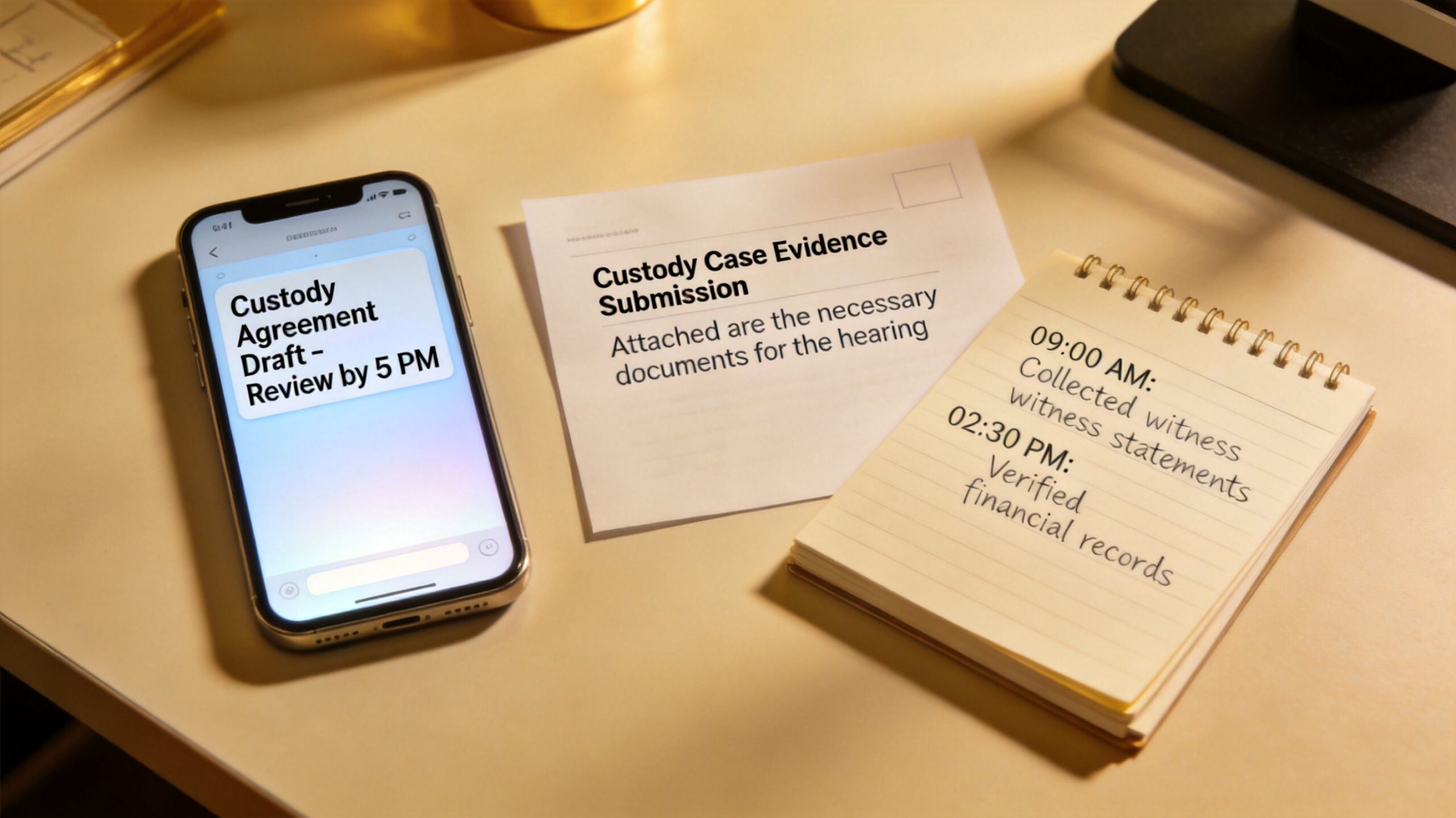
This is especially important now because digital evidence gets challenged more often than many parents expect. Texas Family Code §157.002 mandates unaltered proof. In 2025 Harris County data, 35% of enforcement hearings involved contested documents, and 18% were dismissed for authenticity issues, up from 12% in 2024 due to deepfake texts, as noted in discussion of custody-order violations in Texas.
What outside evidence helps most
Think in terms of corroboration. Your log says you were there. What else shows you were there?
Useful supporting evidence can include:
- Text messages and emails: Keep the full conversation, not just one screenshot.
- Email headers: Save full header information when possible.
- Photos at the exchange spot: Your vehicle, the location sign, or an empty pickup point can matter.
- Receipts nearby: A coffee shop, gas station, or store receipt close to the exchange time can support your timeline.
- School records: Attendance records, pickup logs, or notices from a Kingwood-area school may help.
- Witness statements: Another adult who was present can support your account.
- Voicemails and call logs: Preserve them in their original form.
How to preserve digital evidence without weakening it
Many parents accidentally create problems by editing screenshots, cropping too tightly, or forwarding evidence so many times that metadata is lost.
A better approach is:
- Save originals first
- Export from the app when possible
- Avoid editing images
- Back up files in one organized folder
- Keep complete conversation threads
If you're considering recorded conversations, start by understanding practical recording issues and preserving clean transcripts. A technical guide on recording conversations can be useful for storage and transcription workflow, but you should always get legal advice before relying on any recording in a family law case.
If a judge thinks your evidence was altered, the issue can shift from the co-parent's conduct to your credibility.
Prepare for authenticity attacks
A co-parent may claim your texts were edited, your log was rewritten later, or your screenshots are incomplete. That's why app exports, full headers, and third-party records matter so much.
For parents dealing with interference that overlaps with manipulation of the child, this can also connect to broader issues addressed in how to prove parental alienation.
The safest habit is to preserve the record in the form it was created. Original text threads, original files, original timestamps. Clean evidence is harder to attack.
Common Pitfalls When Documenting Violations
Most weak enforcement cases don't fail because nothing happened. They fail because the proof is messy, emotional, incomplete, or inconsistent.
That matters because the stakes can be serious. Texas Family Code §157.001 grants courts authority to impose penalties for custody violations. Harris County reported 3,214 contempt orders in 2024. In Kingwood's 246th District Court, enforcement hearings resolved 1,456 cases, with make-up time awarded in 62% and fines up to $500 per violation in 28%. HB 1253 expanded remedies in 2011 to include jail time up to 180 days for repeat offenders, according to the Texas State Law Library child custody guide.
Writing conclusions instead of facts
Parents often write entries like, "He was trying to manipulate me again" or "She was being impossible." Those statements may be emotionally accurate, but they aren't strong evidence.
Use observable facts instead:
- Weak entry: "She lied and played games."
- Better entry: "She texted at 5:58 p.m. that pickup would not occur, despite the order requiring pickup at 6:00 p.m."
Only documenting the other parent's conduct
You also need to document your own compliance. Show that you arrived, waited, communicated appropriately, and followed the order yourself.
If you don't, the other parent may argue there was no denial because you were late, at the wrong place, or failed to confirm the exchange.
Turning the text thread into an argument
A bad text thread can damage a good underlying case. If your messages are full of insults, threats, or sarcasm, the judge may focus on the conflict instead of the violation.
Keep communication:
- Brief
- Neutral
- Child-focused
- Limited to logistics
Waiting too long to act
Some parents hope the other parent will improve on their own. Sometimes that happens. Often it doesn't.
The risk is practical. Delay allows a pattern to continue, evidence gets harder to gather, and details get fuzzier with time.
Courts respond to specific, repeated, documented conduct. They don't respond well to months of reconstructed memory.
Using partial screenshots and scattered files
A screenshot with one message bubble and no date is weak. A collection of photos named "IMG_4482" and "Screenshot_991" isn't much better.
Better practice includes:
- Full thread screenshots
- Clear file names
- A chronological folder
- Copies stored outside your phone
- Direct connection between the exhibit and the violated order
A careful record doesn't guarantee enforcement. But poor documentation can make a strong complaint look uncertain.
From Documentation to Enforcement The Harris County Process for Kingwood Parents
Parents in Kingwood are often surprised by how local procedure works. They assume there must be a nearby place to file because the dispute happened in Kingwood or Humble. In most family enforcement matters, that isn't how it works.
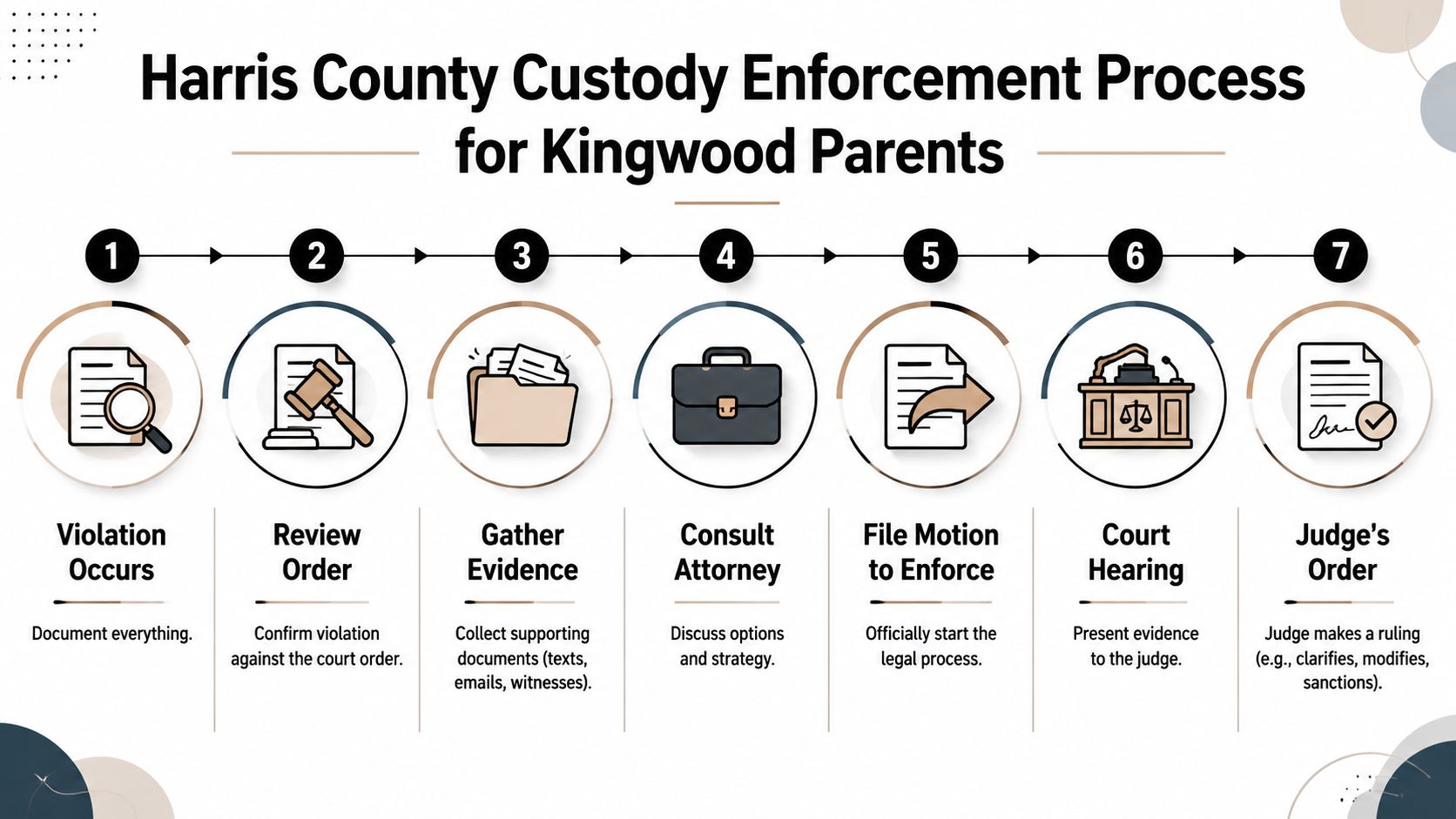
For Kingwood parents, filings are generally made through the Harris County District Clerk's office at 201 Caroline Street in downtown Houston, not at a local Kingwood facility. Residents may also use Texas eFile. Texas Courts Online data reflected 12,547 family cases in Harris County in 2025, with 22% enforcement-related, and local guidance often misses that hearings may involve the Atrium Court at 7900 Will Clayton Parkway in Humble according to this discussion of local filing confusion and venue issues.
What a Motion to Enforce actually does
A Motion to Enforce asks the court to address a failure to follow an existing order. It is not the same as asking for a brand new custody arrangement from scratch. It tells the judge:
- what the current order required,
- how the other parent failed to comply,
- when each violation happened,
- and what relief you want the court to order.
That relief may include make-up visitation, contempt findings, fines, or other remedies allowed by law.
Kingwood filing realities that statewide guides skip
For families in Kingwood, Porter, Humble, and Northeast Houston, the logistics are part of the stress. Downtown filing means planning for traffic, parking, and time off work. E-filing can ease some of that burden, but only if the documents are prepared correctly.
A filing problem isn't just an inconvenience. If the wrong court is used, the wrong case number is referenced, or the motion doesn't clearly identify the violated order provisions, you can lose time and momentum.
What your motion must be specific about
General complaints don't belong in an enforcement motion. The document needs precision.
The court will usually expect the motion to identify:
- The exact order provision violated
- The date and time of each incident
- The place where compliance should have occurred
- The specific act of noncompliance
- The relief requested from the court
This is why detailed documentation matters so much. The motion is only as strong as the records behind it.
What the process usually feels like for parents
The legal process often feels slower than the violation itself. The denial happened in one evening. The court response takes planning, drafting, filing, service, and a hearing date.
That doesn't mean it's pointless. It means the work is front-loaded. Good records make the legal process more efficient because they reduce ambiguity.
A practical sequence often looks like this:
- Review the current order carefully
- Match each incident to exact order language
- Organize your exhibits
- Prepare the motion
- File in the correct Harris County court
- Serve the other parent properly
- Prepare for hearing testimony and exhibits
A court can't enforce a vague memory. It can enforce a well-pleaded violation tied to a specific order.
Hearing preparation for Kingwood parents
If your hearing is set, don't assume your paperwork speaks for itself. You may need to explain the timeline clearly and authenticate your evidence.
Helpful preparation includes:
- Bring the signed custody order
- Prepare a chronological incident summary
- Label exhibits clearly
- Be ready to testify in short, factual answers
- Avoid exaggeration
Parents who want a better sense of local practice can review this guide on navigating Harris County family court from Kingwood.
Why local procedure changes strategy
A statewide article may tell you to "file a motion to enforce." That's legally true, but it's incomplete. Kingwood parents need to know where to file, where they may have to appear, and how to prepare records that work in Harris County courtrooms.
That local knowledge matters because enforcement is procedural. A valid complaint can still stall if the filing is sloppy, the venue is wrong, or the exhibits don't match the motion.
When to Partner with a Kingwood Family Law Attorney
Some parents can begin the documentation process on their own. In fact, they should. Waiting for perfect conditions usually means losing evidence.
But there comes a point where doing it yourself stops being efficient and starts becoming risky. That point often arrives sooner than people expect.
Signs it's time to stop handling it alone
You should strongly consider legal help if:
- Violations are becoming a pattern: Not one bad weekend, but repeated denials, late returns, or blocked communication.
- Your evidence is getting complicated: App exports, school records, emails, and witness statements need to be organized and presented correctly.
- The other parent is attacking authenticity: If they claim your screenshots are edited or your timeline is false, strategy matters.
- You are ready to file: Drafting an enforceable motion requires more than telling the court you're frustrated.
- There are safety concerns: If exchanges are volatile or your child may be at risk, a broader court response may be needed.
- The other parent has counsel: Once the case becomes formal, self-representation gets harder.
What an attorney actually helps with
A family law attorney doesn't just "take over the case." The practical value is more specific than that.
An attorney can help you:
- identify which incidents are legally enforceable,
- match violations to exact order language,
- decide what evidence helps and what distracts,
- avoid mistakes that weaken your credibility,
- and prepare for a Harris County hearing in a way that fits local practice.
Parents often feel relief from having someone review the log and say, "This entry works. This one needs more detail. Save this. Don't send that text."
Legal help is not an overreaction
Many parents hesitate because they think hiring counsel will make things more hostile. Often, the opposite is true. Clear legal guidance can reduce chaos because it replaces reactive communication with a plan.
It also protects against a common problem in custody disputes. A parent has valid concerns, but presents them poorly. Courts tend to reward the parent who looks organized, measured, and focused on the child.
If your goal is to protect parenting time and create stability for your child in Kingwood, Humble, Porter, or Northeast Houston, professional guidance isn't a sign that you've failed. It's a sign that you're taking the issue seriously.
What to do before the consultation
Before you meet with counsel, gather:
- Your current custody order
- A timeline of incidents
- Screenshots and exports
- School or third-party records
- A list of witnesses
- Any messages you plan to rely on
Bring the cleanest version of the story you can. Dates, places, facts, exhibits.
That makes the consultation more productive, and it helps your attorney evaluate next steps quickly.
The bottom line
If you're dealing with repeated violations, don't wait for the situation to fix itself. Start documenting immediately. Keep the record factual. Preserve original evidence. Learn the local Harris County process before you file anything.
And if you're unsure whether your records are strong enough, that question alone is often a good reason to get legal advice.
If you're dealing with missed exchanges, denied visitation, or repeated custody-order violations in Kingwood, Humble, Porter, or Northeast Houston, the Law Office of Bryan Fagan – Kingwood TX Lawyers can help you evaluate your documentation, explain your options, and prepare for the Harris County enforcement process. Schedule a free consultation with the Kingwood office to discuss your situation and get practical guidance specific to your family.