Skip to content
A parent in Humble gets a job offer in another state. Another parent in Porter needs to move closer to grandparents who can help with childcare. A parent in Kingwood hears the word “relocation” and immediately thinks about weekends lost, school breaks divided, and how to stay close to a child who won't be just down the road anymore.
That fear is normal. Long-distance parenting can feel like your family life is being reduced to mileage, calendars, and court language.
Texas law gives you a framework to work with, and that matters. In custody cases, two building blocks shape almost everything. Conservatorship is about decision-making rights and duties. Think of it as who has authority to make important choices about school, medical care, and daily welfare. Possession and access is the schedule. That's the part most parents think of as visitation or parenting time.
When parents in Kingwood, Humble, Porter, or Northeast Houston start looking up custody arrangements for long distance parents texas kingwood, they're usually trying to answer one urgent question: “How do I protect my relationship with my child if one of us moves?” The answer starts with understanding how Texas separates decision-making from time-sharing.
A long-distance case is still a parenting case. The court's focus stays on the child's best interests. That means the legal system isn't trying to punish a parent for moving or reward one for staying put. It's trying to create a workable plan that keeps the child stable and keeps both parents meaningfully involved.
The Building Blocks of Texas Custody Conservatorship and Possession
Texas family law uses terms that sound formal, but the ideas are straightforward once you break them down.
Conservatorship means parental authority
Conservatorship refers to a parent's legal rights and duties. In many cases, parents are named Joint Managing Conservators, which usually means both parents keep significant rights related to the child. One parent may still have the right to determine the child's primary residence, while the other has scheduled possession.
A different arrangement is Sole Managing Conservatorship. That gives one parent more exclusive decision-making authority. Courts may use that structure when the facts support it, but many parents in Kingwood custody cases begin with the idea that both parents should stay involved unless there's a serious reason not to.
If you want a fuller explanation of how Texas treats shared parenting, this guide on shared custody in Texas is a useful companion.
Possession means parenting time
Possession and access is the legal schedule for when each parent has time with the child. That's where long-distance issues become very practical.
Texas uses a Standard Possession Order, often called an SPO, as a default framework. According to this discussion of Texas custody guidelines, Texas Family Code §§ 153.3101 to 153.317 set out a schedule that changes significantly depending on how far apart the parents live.
For parents living within 100 miles, the standard schedule typically gives the non-custodial parent possession on the first, third, and fifth weekends of each month, plus 30 days in the summer and holiday periods such as Thanksgiving and Christmas. For parents living more than 100 miles apart, the schedule usually changes to one weekend per month with 7 days' prior notice and up to 42 days of summer possession.
That's the core shift in long-distance custody. The law generally moves from frequent shorter visits to fewer but longer blocks of parenting time.
Practical rule: In Texas, distance doesn't usually change whether a parent matters. It changes how the schedule is structured.
Why the schedule changes so much
This part confuses many parents. They think crossing the mileage line should only tweak the order a little. In reality, the difference can be major because the court is balancing several things at once:
- School stability: Children still need predictable school attendance and routines in Kingwood, Humble, or wherever they primarily live.
- Travel burden: Repeated long drives or flights can wear a child down and create conflict between parents.
- Meaningful time: A distant parent still needs enough uninterrupted time to do more than just shuttle the child back and forth.
A simple way to think about it
If parents live relatively close, the law favors rhythm. Weekend visits happen often enough to keep a regular pattern.
If parents live farther apart, the law favors blocks. Summer, holidays, and pre-planned weekends become more important because they reduce disruption and make travel more realistic.
Here's why that matters for your next step. Before arguing about exact dates, pickup spots, or flights, you need to know which framework applies. In many Kingwood cases, the most important early question isn't “What do I want the schedule to be?” It's “Are we under or over the Texas distance threshold?”
The 100-Mile Rule The Heart of Long-Distance Custody in Texas
For Texas parents, the 100-mile rule is often the turning point.
Texas law treats distance as more than an inconvenience. Once one parent lives far enough away, the default schedule changes because a local weekend-based routine may no longer make sense. For parents searching for custody arrangements for long distance parents texas kingwood, this is usually the rule that decides whether the case feels manageable or overwhelming.
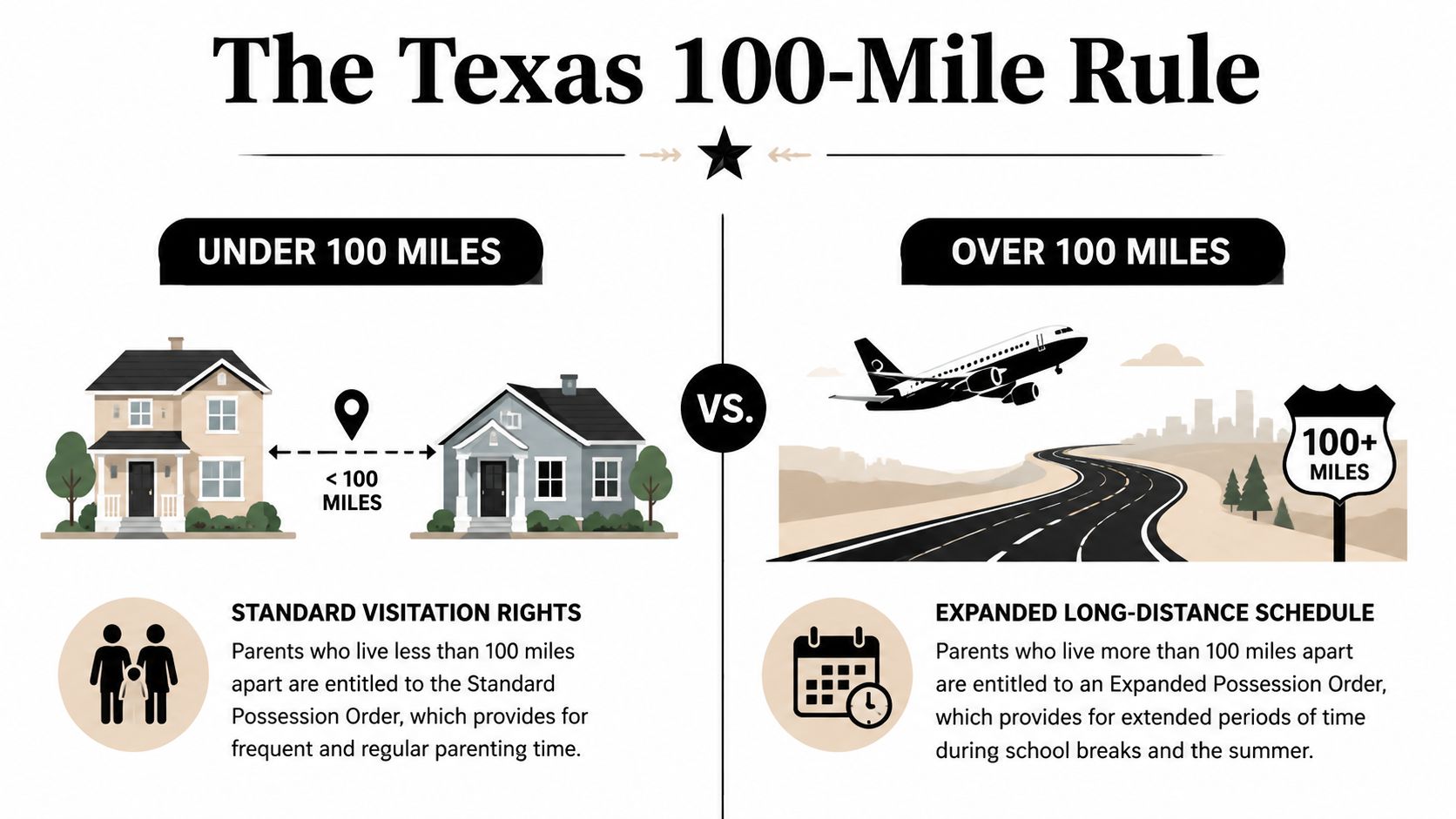
What happens when parents live under or over the line
The practical difference is easier to see side by side.
| Possession Item | Parents Live Under 100 Miles Apart | Parents Live Over 100 Miles Apart |
|---|---|---|
| Weekend possession | First, third, and fifth weekends each month | One weekend per month with advance notice |
| Summer possession | 30 days during summer vacation | Up to 42 days during summer |
| General structure | Frequent, shorter contact | Fewer trips, longer blocks |
| Goal | Ongoing local rhythm | Reduce disruption while preserving meaningful time |
That legal threshold also connects to relocation restrictions. If you're dealing with a move-away issue, this page on geographic restriction in Kingwood custody cases can help you see how courts handle where a child may live.
Why Texas uses this approach
A schedule that works between Kingwood and Humble may fall apart if one parent moves much farther away. The law tries to protect the child from constant travel while still preserving a strong parent-child relationship.
The child's best interests remain the controlling standard under Texas Family Code § 153.002, and that's why distance matters so much in real cases. The schedule isn't just about fairness between adults. It's about whether the child can realistically succeed in school, maintain routines, and still spend quality time with both parents.
Sample language parents often need to think through
A long-distance order works best when it's specific. Vague orders invite conflict. Clear language prevents unnecessary disputes.
Here are examples of the kinds of clauses parents often discuss with counsel when drafting a plan:
- Weekend election language: “The parent exercising long-distance weekend possession must provide written notice to the other parent at least seven days before the selected weekend.”
- Summer possession language: “Summer possession will begin and end on clearly stated dates, with exchange times listed in the order.”
- Holiday division language: “Thanksgiving, winter break, and spring break will alternate according to the written schedule in the final order.”
- Exchange terms: “The order should identify who picks up the child, where the exchange occurs, and what happens if travel delays occur.”
Those clauses may look simple, but they answer the arguments parents have. Which weekend? What if the flight is late? Who drives? What if school starts earlier than expected?
A parenting plan should be detailed enough that a neutral third person could read it and know exactly what each parent must do.
A Northeast Houston example
Suppose a child lives primarily in Kingwood and one parent moves farther away. Under a local schedule, that parent might have seen the child multiple weekends each month. Under a long-distance structure, the focus shifts. The parent may have one selected weekend each month, more time in summer, and a larger role during school breaks.
That doesn't automatically weaken the relationship. In some families, longer visits give the parent and child more normal time together. They can settle into a routine, attend activities, and have real downtime instead of constant transitions.
Questions to ask before proposing terms
Before you negotiate details, slow down and answer these:
- Where will the child attend school? That affects exchange timing and travel limits.
- How far apart will the households be in daily life? A map matters more than assumptions.
- Can both parents reliably manage transportation? Flights, drives, and work schedules all matter.
- How will the child communicate with the off-duty parent? A long-distance plan almost always needs virtual contact terms.
- What happens during holidays and school breaks? Those dates become central in long-distance parenting.
If you don't answer those questions in the order itself, you're leaving major decisions to future arguments.
Drafting an Enforceable Long-Distance Parenting Plan for Kingwood Families
A good parenting plan does more than describe a schedule. It gives both parents a set of instructions they can follow. In Kingwood and across Harris County, that level of detail can make the difference between a workable order and constant conflict.

Parents often start with the broad legal framework, then realize the actual problems are much smaller and more specific. Who books the ticket? What if there's a storm delay? Which app do we use for schedule changes? Who gets the child's school login?
If you want to see how the standard Texas schedule works before it changes for distance, this overview of the standard possession order in Kingwood gives helpful context.
What an enforceable plan should cover
According to this explanation of long-distance parenting plans under Texas Family Code § 153.313, the long-distance schedule is triggered when one parent lives more than 100 miles from the child's primary residence. That specialized structure typically includes 42 days of consecutive summer possession for children over 5, plus one weekend per month, and court precedents discussed there indicate this can reduce travel frequency by 70 to 80 percent. The same discussion notes that for Kingwood-area parents, courts often look at travel-cost allocation, with the noncustodial parent often covering 100 percent of flights under 500 miles, and Harris County judges often favor geographic neutrality and may require tools like OurFamilyWizard for logging communication.
That legal background helps explain why a written plan should answer everyday questions in plain terms.
Schedule details
Start with exact dates, times, and notice rules.
- Weekend selection: If one weekend per month is allowed, state how and when the parent chooses it.
- Summer blocks: If summer time can be split, spell out the split and the deadline for choosing dates.
- Holiday exchanges: Identify the holiday schedule in writing, not by memory or informal habit.
A phrase like “reasonable visitation” is almost always too vague for long-distance parenting.
Travel logistics
Travel provisions should be concrete.
- Flights: State who books, who pays, and how itineraries are shared.
- Driving exchanges: If parents meet halfway, list the exact exchange city or location.
- Delays and cancellations: Include what happens if weather, traffic, or airline issues interfere.
For families between Kingwood and another Texas city, one of the most common problems isn't disagreement over parenting time. It's disagreement over transportation details that were never written down.
Local insight: The more travel your plan requires, the more precise the order should be.
Communication terms
Long-distance parenting works better when regular contact is predictable.
Some parents do well with flexible phone calls. Others need a set routine. A practical clause might identify the days, time window, and method for virtual communication, whether by FaceTime, Zoom, or another agreed platform. If conflict is already high, parents may also use a co-parenting app such as OurFamilyWizard to create a clean record of schedule changes and child-related communication.
School and medical information
Distance should never mean exclusion from important information.
A well-drafted plan often addresses:
- School records and portal access
- Medical updates and appointment notices
- Extracurricular calendars
- Emergency contact information
That matters for a parent living outside Kingwood just as much as for one still living nearby.
Mediation and court produce different kinds of plans
The same legal issue can be resolved through mediation or through a contested hearing in court. Each path has strengths and weaknesses.
| Issue | Mediation | Court hearing |
|---|---|---|
| Control over details | Parents keep more control | Judge decides disputed terms |
| Flexibility | Easier to customize | Often more rigid and evidence-driven |
| Tone | Usually more collaborative | Often more adversarial |
| Best use | Parents can still problem-solve | High conflict or safety concerns |
Mediation often works well when both parents agree the move is happening but disagree about how to structure the new schedule. They can tailor details around school calendars, work schedules, and holiday traditions.
Court becomes more necessary when one parent won't cooperate, when there are serious concerns about compliance, or when the facts are too disputed to settle.
Sample wording ideas parents often consider
These are examples of the style of language that helps, not substitute legal advice:
- Notice provision: “Notice of the selected monthly weekend must be provided in writing through the agreed communication platform.”
- Travel exchange term: “The transporting parent must provide itinerary details promptly after booking.”
- Virtual contact term: “The child may have scheduled video contact with the non-possessing parent during agreed evening hours.”
- Information-sharing term: “Both parents must keep current contact information and promptly share school and medical updates.”
Specific terms reduce friction. They also make enforcement more realistic if problems arise later.
Resolving Disputes Mediation vs Litigation in Harris County
When parents in Kingwood or Northeast Houston can't agree on a long-distance schedule, the dispute usually moves in one of two directions. They either try to settle it in mediation, or they ask a Harris County judge to decide.

Neither path is automatically right for every family. The better question is which process fits your facts, your level of conflict, and your child's needs.
When mediation makes sense
Mediation works best when both parents are able to negotiate, even if they disagree strongly. A neutral mediator helps them identify terms they can both live with.
This process is often useful in long-distance cases because the details matter so much. Parents may be able to craft a more practical plan than a court could after a short hearing. They can address school calendars, airline preferences, exchange cities, app-based communication, and make-up time in a way that reflects real family life in Kingwood, Humble, or Porter.
Mediation can also lower the emotional temperature. Parents who will be co-parenting for years often benefit from resolving the issue through structured discussion instead of a courtroom fight.
When litigation becomes necessary
Sometimes mediation won't work, and that doesn't mean you've failed.
Court may be necessary if:
- One parent refuses to disclose plans: A move is proposed, but details keep changing.
- There are safety concerns: Family violence, threats, or serious instability may require stronger court involvement.
- The other parent ignores temporary agreements: A parent says one thing and does another.
- Basic facts are disputed: Parents don't agree on schooling, travel ability, or whether relocation is even appropriate.
A Harris County judge will want to see organized evidence and a clear explanation of why your proposed order protects the child's best interests.
A practical evidence checklist
Bring proof, not just frustration.
- Calendar records: Show the current parenting pattern, missed periods, and school-break availability.
- Written communications: Keep emails, texts, and app messages that show requests, responses, and disagreements.
- School information: Attendance concerns, schedules, and activity calendars can show what arrangement is workable.
- Travel records: Save itineraries, mileage planning, and receipts if transportation is a major issue.
- Proposed parenting plan: Judges respond better to a parent who brings a clear solution, not just complaints.
Judges usually need specifics. “We can't make this work” is far less persuasive than “Here is the schedule, exchange location, and communication plan that solves the problem.”
A short video can also help parents understand how custody disputes are approached in practice.
What a judge is really looking for
The court isn't grading which parent sounds more hurt or more reasonable. The judge is looking for a plan the child can realistically live under.
That means your proposal should answer practical questions. Can the child get to school on time? Are exchange points realistic? Does the order reduce conflict? Can both parents follow it without constant argument?
If the answer is yes, your position becomes stronger.
Building Your Case Evidence and Documentation for Long-Distance Custody
Good custody cases are built on records. That's especially true when distance is part of the dispute.
A parent in Kingwood may know the current schedule is failing. A parent in Humble may know the travel plan is unrealistic. A parent in Porter may know the other parent is withholding information. None of that carries much weight unless you can show it clearly.

Keep records that answer real court questions
Judges and mediators tend to focus on patterns, not isolated drama. Documentation helps show the pattern.
Use a simple system and keep it current.
- Communication logs: Save texts, emails, and co-parenting app messages about scheduling, travel, and the child's needs.
- Parenting calendar: Track when the child was with each parent, changes to the plan, and whether makeup time was offered.
- School and activity records: Keep calendars, notices, and participation details for the child's routines in Kingwood or Northeast Houston.
- Travel documents: Save flight confirmations, gas receipts, exchange directions, and lodging details if relevant.
- Medical and school access records: Note whether both parents are receiving information and attending important appointments or meetings.
Organize by topic, not by emotion
Don't keep one giant folder full of screenshots.
Create separate folders for:
- Schedule compliance
- Travel and transportation
- School and medical updates
- Requests for changes
- Missed communication or denied access
That makes it much easier for your attorney, mediator, or the court to understand what happened.
“He's impossible to deal with” isn't evidence. A dated message thread showing a missed exchange and your proposed solution is.
Think ahead to modification and enforcement
Documentation doesn't only help with the current dispute. It can matter later if you need to modify or enforce the order.
If a parent moves again, repeatedly ignores pickup terms, blocks virtual visits, or stops sharing school information, your records may become the backbone of a later case. That's why consistency matters more than perfection. You don't need a dramatic file. You need a reliable one.
Parents who do best in these cases usually keep records calmly and routinely. They don't document to “win.” They document so the facts stay clear if the order needs to be updated or enforced.
Modifying and Enforcing Your Long-Distance Custody Order
A custody order isn't frozen forever. Children grow, parents move, jobs change, and schedules that once worked can stop making sense.
That's why Texas allows parents to seek a modification when there has been a material and substantial change in circumstances. In long-distance parenting, that might mean a parent relocates again, a child's school or activity schedule changes, or the travel setup becomes impractical. The question isn't whether life changed a little. The question is whether the existing order still serves the child well.
When should you consider a modification
Ask yourself a few direct questions.
Is the current plan causing repeated school disruptions?
Has one parent moved far enough that the old exchange terms no longer work?
Has your child gotten older and developed needs the original order didn't anticipate?
Has communication broken down so badly that the written plan needs more structure?
If the answer to one or more of those questions is yes, it may be time to review the order instead of continuing to fight over a schedule that no longer fits your family.
What enforcement looks like
Modification changes the order. Enforcement asks the court to make a parent follow the order that already exists.
You may need enforcement if the other parent keeps denying visits, fails to appear for exchanges, refuses to return the child on time, or ignores communication terms that are written into the order. In those cases, the wording of the original order matters a lot. A vague order is harder to enforce. A specific order gives the court something concrete to act on.
The key takeaway for worried parents
Many parents feel trapped once an order is signed. They think they just have to live with it, even if the arrangement keeps breaking down.
That usually isn't true.
If the order no longer fits reality, modification may be available. If the other parent won't follow the order, enforcement may be available. The law gives you tools for both problems.
The best long-distance order is one that can survive real life. The next best option is knowing how to fix it when real life changes.
For Kingwood families, that often means acting early. Don't wait until missed visits, school problems, and travel disputes pile up into a larger crisis. A focused legal review can often tell you whether you need to negotiate, modify, or enforce.
Frequently Asked Questions About Long-Distance Parenting in Texas
What if we live just over 100 miles apart, like near College Station
Small mileage differences can still matter because the legal threshold matters. If your situation is close to the line, accuracy is important. Don't guess. Confirm the actual distance that applies to the child's primary residence and the other parent's residence.
Who chooses the monthly weekend in a long-distance schedule
That usually depends on the written order. Some orders give the non-primary parent the right to select a weekend with advance notice. If the order is vague, conflict often follows. Clear drafting helps avoid that fight.
Can the other parent stop me from moving out of state with my child
Sometimes. It depends on your current order, whether there is a geographic restriction, and whether the court believes the move serves the child's best interests. Relocation requests often require court review when they affect possession and school stability.
If we agree on our own schedule, do we still need a formal order
Yes. Informal agreements can work until they suddenly don't. A signed court order gives both parents clarity and creates something enforceable if problems arise.
If you're dealing with long-distance custody questions in Kingwood, Humble, Porter, or Northeast Houston, Law Office of Bryan Fagan – Kingwood TX Lawyers can help you understand your options and build a practical path forward. Whether you need help with a relocation issue, a parenting plan, modification, or enforcement, schedule a free consultation with the Kingwood office to get clear, local guidance suited to your family's needs.