Skip to content
A lot of parents in Kingwood make this decision in the middle of ordinary moments. You leave school pickup near Kingwood High School, drive past Town Center, and start doing the math in your head. Where will the backpacks stay? Who handles homework? How do you keep life steady for your kids when your home life has changed?
That's where a week on week off custody schedule texas kingwood arrangement often comes into the conversation. For many families in Kingwood, Humble, Porter, and Northeast Houston, it offers a practical way to share parenting time evenly without turning every few days into an exchange day. It can work well, but only if it's built carefully and matched to your child's age, school routine, and your ability to co-parent.
Texas law doesn't hand every family the same answer. Courts still focus on the child's best interest. In real life, that means judges want to see a schedule that children can live in, not just one that looks fair on paper. A weekly rotation can create predictability, reduce handoff stress, and give each parent meaningful parenting time. It can also fail quickly if the order is vague or the parents live too far apart.
Kingwood families need more than a generic custody article. Local parents deal with Humble ISD calendars, school-based exchanges, Northeast Houston commutes, youth sports, and Harris County court expectations. Those local details matter.
Navigating Custody in Kingwood A New Path for Your Family
A weekly 50/50 schedule usually appeals to parents for one simple reason. It feels clean. One parent has a full week. Then the other parent has a full week. There's less constant shuffling, and many children understand it faster than more complicated rotations.
In Kingwood, that simplicity matters. Parents are often balancing school drop-offs, after-school activities, traffic toward downtown Houston, and work schedules that changed after remote and hybrid work became more common. A possession schedule has to fit that routine, not fight it.
What I see most often is this. Parents don't just want equal time. They want stable time. They want their child to know where they'll sleep, where homework gets done, and how the next school week will look.
What makes this schedule different
A week-on/week-off arrangement tends to work best when both homes are set up for normal life. That means the child isn't “visiting” one parent. The child is living in two homes with two workable routines.
For many Kingwood and Humble parents, the appeal comes down to practical points:
- Fewer transitions: There's less chance for repeated handoff conflict.
- Better school rhythm: A child can settle into a school week without a midweek switch.
- Real parenting time: Each parent handles both the fun parts and the ordinary parts, including mornings, homework, meals, and bedtime.
- More predictable planning: Families can plan work, childcare, tutoring, and activities further in advance.
Practical rule: If your proposed schedule only works when everything goes right, it probably won't hold up in real life.
Why local context matters
A family in Kingwood doesn't face the same logistical issues as a family spread across wider parts of Texas. Geographic closeness matters in any shared arrangement, but in this area it often becomes the deciding factor. If one parent is in Kingwood and the other is nearby in Humble or Porter, a weekly schedule may be manageable. If one parent is much farther away, every school morning starts to feel heavier.
That's why the right question isn't just, “Can we do 50/50?” The better question is, “Can our child live this schedule comfortably over time?”
Why Kingwood Families Are Choosing a Weekly 50/50 Schedule
A Kingwood parent leaves work late on a Thursday, heads down Northpark, and realizes the child's backpack, baseball pants, and math folder are all at the other house. That is the kind of ordinary problem that pushes families toward a week-on/week-off schedule. They want fewer handoffs, fewer missing items, and a routine a child can follow during the school year.
In my practice, this schedule usually appeals to parents who live close enough to make shared parenting realistic, but want something more stable than frequent back-and-forth exchanges. For many Northeast Houston families, a weekly rotation matches the way life already works. School is steady. Activities are steady. Work schedules are often easier to manage in full-week blocks.

Kingwood parents are also more familiar now with joint custody options under Texas law, including true 50/50 possession schedules that go beyond the Standard Possession Order. Harris County courts will consider those arrangements when the facts support them and the parents present a clear, workable plan. That local court reality matters. A week-on/week-off schedule is no longer viewed as unusual if both homes can support school attendance, transportation, homework, medical needs, and activities without constant conflict.
Why children often respond well to a weekly rhythm
School-aged children usually do better when they can predict where they will sleep, who is handling pickup, and what the week looks like. A weekly rotation gives that pattern in a way many children can understand. One home for one full school week. Then the other home for the next.
That structure can be especially helpful in Kingwood and Humble ISD households where school projects, early practices, and long commutes across the Houston area can wear a child out fast. Fewer exchanges often means fewer chances for arguments in parking lots, fewer forgotten items, and less mental load on the child.
The schedule also forces both parents to carry the full weight of parenting. Each parent handles school mornings, homework, laundry, meals, bedtime, and the unexpected problems that come with a normal week. That tends to produce better long-term balance than a plan where one parent gets most of the weekday responsibility and the other gets most of the leisure time.
Why this schedule fits some Kingwood families better than others
The families who make this work usually have three things in place.
First, the homes are close enough that the child can stay in the same school and activities without spending too much time in the car. In Kingwood, that often means both parents remain in Kingwood, Humble, Atascocita, Porter, or another nearby area.
Second, each parent can run a full household without depending on the other parent to fill the gaps. If one parent cannot reliably get a child to school, manage medication, supervise homework, or communicate about schedule changes, the weekly model starts to break down.
Third, the parents accept that a child needs two real homes. That means duplicate basics in both places, a clear calendar, and a shared understanding that the child should not feel like a guest every other week.
Here's a helpful overview before getting into legal drafting.
The trade-offs parents should weigh honestly
A week-on/week-off plan has real benefits, but it also asks more from everyone involved. Some younger children struggle with a full week away from one parent. Some parents struggle more than they expected during the off week. High-conflict co-parents sometimes find that longer blocks reduce exchange friction, while others use the extra time to build resentment and fight over phone access, missed updates, or schedule deviations.
I also tell parents to be careful with informal agreements. Tools like AI-drafted marital separation documents can help people start organizing terms, but Harris County judges approve court orders, not rough drafts or handshake deals. A workable weekly schedule needs to fit your child's age, your geography, your work realities, and your ability to communicate without constant supervision from the court.
The best reason to choose a weekly 50/50 schedule is simple. It gives the child a stable routine in both homes and gives each parent a full, real parenting role. The wrong reason is just as simple. It should never be used to chase equal time on paper if the day-to-day logistics in Kingwood will make the child's week harder.
Crafting Your Week-On-Week-Off Parenting Plan Agreement
A weekly schedule only works if the court order is precise. Parents often think they have an agreement because they've discussed the broad outline. That's not enough. If the order doesn't clearly define exchanges, holidays, communication, and problem areas, conflict usually shows up later.
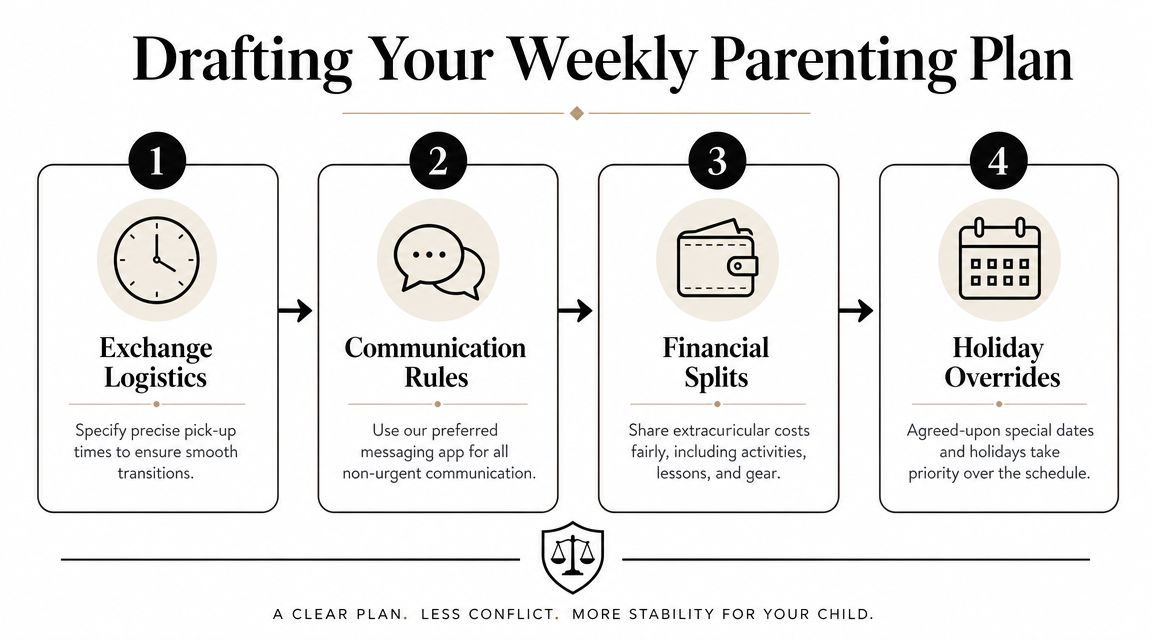
Texas enforceability depends on detail. Under Texas Family Code §153.317, the agreement should define exchange protocols, include holiday overrides from the Standard Possession Order, and be placed in a court order. Vague exchange times are a major problem and are tied to 30% of enforcement motions, while co-parenting apps such as OurFamilyWizard can improve stability, as explained in this discussion of 50/50 alternative possession schedules in Texas.
Define the week before you define anything else
Start with the basic unit of the schedule. What exactly is a “week”?
For some Kingwood families, the cleanest version is Friday after school to the following Friday after school. For others, it's Sunday at 6:00 p.m. to the next Sunday at 6:00 p.m. The right answer depends on your child's school rhythm, parent work hours, and how tense direct exchanges tend to be.
The best choice is usually the one that reduces face-to-face friction and keeps the child in a familiar routine. If school is in session, exchange at school often works better than a parking lot handoff.
Write exchange language like it will be read by a judge
A good order doesn't say “the parents will exchange the child weekly.” That sounds fine until one parent is late, school is closed, or there's a holiday.
Use terms that answer practical questions:
- When does possession begin
- When does possession end
- What happens if school is not in session
- Where does the exchange take place
- Who is responsible for transportation
A usable clause often looks like this in concept:
Parent A's possession begins on Friday at school dismissal, or at 6:00 p.m. if school is not in session. Parent B's possession begins the following Friday at school dismissal, or at 6:00 p.m. if school is not in session.
That kind of language prevents the common dispute where one parent believes “after school” means pickup, and the other believes it means after dinner.
Build in communication rules early
Most failed weekly schedules don't fail because of the calendar. They fail because of communication. Parents in Kingwood often do better when the order identifies one communication method for routine issues and one for emergencies.
Common practical terms include:
- Routine communication through one app: OurFamilyWizard is often used because it keeps a record.
- School and medical updates within a set time
- A shared calendar for activities, tutoring, and appointments
- A policy on child calls during the off week
If you're using online drafting tools to organize your thoughts before meeting counsel, AI-drafted marital separation documents can help parents think through terms and categories. They're not a substitute for legal review in a Texas custody case, but they can help you identify issues that need to be settled before an order is finalized.
Cover the rights and duties that people forget
Possession is only one part of parenting. Your order also needs to address how decisions are made. That includes education, medical care, extracurricular activities, counseling, and access to records.
Many parents accidentally leave room for future litigation when they agree on a weekly schedule without defining who can consent to tutoring, who pays registration fees, or how therapy appointments are scheduled.
A short planning table can help:
| Issue | What the order should clarify |
|---|---|
| School decisions | Which rights are independent, joint, or exclusive |
| Medical care | Who can consent to non-emergency treatment |
| Activities | How enrollment decisions are made |
| Cost sharing | How parents reimburse agreed expenses |
| Information access | How report cards, portals, and notices are shared |
For a broader look at decision-making and possession frameworks, this guide to joint custody in Texas is a useful companion.
Let holidays override the weekly rotation
This matters more than parents expect. The weekly plan is the default schedule. Holidays and summer usually override it.
If you skip this part, Thanksgiving, Christmas, spring break, and summer possession become predictable flashpoints. Your order should state plainly that the Standard Possession Order holiday provisions control over the weekly schedule. It should also make clear when the normal weekly rotation resumes after a holiday period ends.
Families in Kingwood often benefit from spelling out these restart points with exact dates and times. The more school calendars and travel plans are involved, the more important that becomes.
Choose exchange locations that lower conflict
If direct handoffs are tense, don't insist on front-door exchanges just because they sound convenient. In practice, school exchanges, daycare exchanges, or a neutral public location in Kingwood can protect the child from adult conflict.
A few options commonly used by local parents include:
- School dismissal or drop-off
- A daycare provider
- A neutral public place if school is closed
- A consistent family-friendly business parking lot
Practice note: Neutral exchange points help when one parent is highly reactive, chronically late, or likely to turn handoffs into arguments.
The goal isn't to create distance. It's to create calm.
Making It Official How to Get Your Schedule Approved in Harris County
A Kingwood parent can have a thoughtful week-on/week-off plan, color-coded calendar, and a workable exchange routine, then hit a wall the moment the other parent says, “A judge will never sign off on that.” I hear that concern often. In Harris County, the question is rarely whether a 50/50 schedule looks unusual on paper. The question is whether the order is specific, realistic, and clearly tied to the child's best interest.
Until the schedule is signed into a court order, it is only an agreement in principle. That matters more than parents expect. If the other parent stops following it, law enforcement cannot enforce a text message chain or a verbal deal. The order has to state the possession terms with enough detail that a court can enforce them later if needed.
Start with a judge-ready proposal
Parents usually get better results when they present a weekly schedule as a practical parenting plan instead of a fight over “equal time.” In Kingwood cases, that means showing how the child will get to school, how exchanges will happen during the school year, and how the routine fits life in Humble ISD or nearby private schools.
A proposal has a better chance of settling, and a better chance of being approved, when it includes the details judges and mediators expect to see:
- A clear week-on/week-off rotation
- Exchange day and time
- Holiday and summer override language
- Transportation responsibilities
- Decision-making terms for school, medical care, and activities
- A child support position that matches the financial reality
That last point gets missed all the time.
What Harris County courts usually focus on
Judges in Harris County want a schedule that can hold up on an ordinary Tuesday, not just in a mediation room. For Kingwood families, that often comes down to logistics. How far apart are the homes? Who handles school drop-off during each week? What happens if a parent works shifts, travels, or relies on grandparents for part of the routine?
Courts also pay attention to conflict level. A week-on/week-off plan can work well for parents who communicate decently and live close enough to keep the child's school routine stable. It can be a harder sell when parents are still fighting over basic exchanges, school information, or medical decisions.
If you want a clearer picture of local procedure, this guide to Harris County family court for Kingwood families explains how these cases typically move through the system.
The usual paths to approval
In practice, Harris County cases usually reach approval in one of four ways.
Attorney-led negotiation
Each side exchanges proposed terms, revises language, and tries to reach an agreement before a hearing is necessary.Mediation
Many Kingwood-area parents resolve the hard details here, especially the school-week logistics, holidays, and who carries the transportation burden.Agreed order submitted to the court
If the parents settle, the written order is signed and presented for court approval.Contested hearing or trial
If there is no agreement, the judge decides whether the proposed weekly schedule serves the child's best interest better than another possession structure.
Mediation is where many week-on/week-off cases are won or lost. The parents who do best usually arrive with a draft order, school calendar, work schedule, and a realistic answer to predictable objections.
Child support does not disappear because time is equal
A 50/50 calendar does not automatically cancel child support in Texas. Courts treat possession and support as related issues, but they are not the same issue. If one parent earns substantially more, pays for health insurance, or covers a larger share of the child's fixed expenses, support may still be part of the final order.
I often tell parents to settle the money terms with the same care they use on the calendar. A clean possession schedule paired with vague support language often leads to the next round of conflict.
The strongest Harris County orders do two things at once. They give the child a stable weekly routine, and they leave very little room for future arguments about what the parents agreed to.
Adapting the Schedule for Real Life in Northeast Houston
It is Tuesday in Kingwood. One parent is trying to get a child from Greentree to baseball near Deer Ridge Park, the other is stuck on West Lake Houston Parkway, and a therapy appointment in Humble is still on the calendar. The possession order may be clear, but the critical test is whether the schedule still works once school, traffic, and extracurriculars start colliding.
That is where many week-on/week-off plans either settle in or start producing conflict.
Parents in Kingwood, Porter, Humble, and Atascocita usually feel the strain first around activities. A child may have dance at a fixed time every Thursday, tutoring twice a week, or a school event that falls during the other parent's week. If the parents treat those commitments as optional depending on whose week it is, the child pays for it first.

When activities don't fit neatly into the calendar
A weekly rotation works best when the parents separate possession from participation. The week determines where the child sleeps. It should not decide whether the child gets to attend therapy, make practice, or show up for a school commitment that matters.
I see this problem often in Harris County cases involving children with special needs, anxiety, learning differences, or intensive activity schedules. Parents may agree on equal time and still need more detailed language about routines, transitions, and transportation. Tracy Law's article on common child custody schedules, modifications, and special needs concerns discusses the same pressure point. A standard weekly rotation sometimes needs extra structure to fit the child, rather than forcing the child to fit the calendar.
That usually means writing the routine down before conflict starts.
A better way to handle special routines
The strongest week-on/week-off plans I see in the Kingwood area are activity-neutral. Regular therapy, sports, tutoring, and school obligations continue no matter whose week it is. The order also assigns the transportation burden clearly, because vague expectations are what lead to missed exchanges and angry texts.
A practical plan may provide that:
- Both parents can attend major games, performances, and school events
- One parent always handles a fixed weekly therapy drop-off
- Transportation is divided by activity or location, not just by possession week
- Each parent must make the child available for agreed extracurriculars during his or her week
Working parents often need another layer of planning. Shift work, downtown commutes, and after-school pickup windows can make a pure alternating schedule harder to keep. This guide on a custody schedule for working parents in Kingwood Texas is useful if your weekly rotation has to match a demanding work calendar.
Protect the off-week relationship
A week-on/week-off plan also needs a rule for the parent who is off duty that week. Without one, some parents drift to the margins. They stop checking school updates, wait seven days to reconnect, and end up feeling like a visitor in the child's routine.
Children usually do better when the off-week parent stays present in small, predictable ways. The contact should be steady and calm, not constant.
Examples that tend to work well include:
- A scheduled call on the same evenings each week
- One consistent FaceTime after homework
- School portal access for both parents
- Shared notice of assignments, events, and medical information
In Northeast Houston, the best schedules are rarely the ones that look perfect on paper. They are the ones that account for Humble ISD calendars, long commutes, extracurricular traffic, and the reality that a child's life keeps moving during both parents' weeks. A good order gives the family a repeatable system, not a weekly argument.
Common Questions About the Week-On-Week-Off Schedule in Texas
Parents usually reach the same practical questions once the idea becomes real. They want to know whether the schedule fits their child's age, what happens if the other parent doesn't follow it, and whether equal time changes support. Those are the right questions to ask.
Is this schedule right for a young child
Usually, this schedule is strongest for older children. In Kingwood-area cases, the week-on/week-off schedule is considered ideal for children 8 and older, and teens show a 92% adaptation rate, according to Kingwood-area guidance on split custody in Texas.
For children under 5, courts may require a psychological evaluation. That doesn't mean a weekly schedule is impossible. It means judges are more cautious because long separations can be harder on very young children.
If your child is a toddler or preschooler, ask a more specific question than “Can we do 50/50?” Ask whether your child can tolerate a full week away from each parent. If the answer is uncertain, another schedule may fit better for now, with the option to modify later as the child matures.
What happens if the other parent starts missing exchanges
If the weekly schedule is in a signed court order, it can be enforced. Missed exchanges, late returns, or refusals to surrender the child can lead to an enforcement case. In some cases, violations can trigger enforcement motions and potential fines, as noted in the same Kingwood-area split custody discussion.
The strongest first response is documentation. Keep records of exchange times, messages, and missed periods of possession. Don't retaliate by withholding the child during your next week. That usually turns one violation into two legal problems.
A practical response often looks like this:
- Record what happened clearly
- Save app logs, messages, and calendar entries
- Follow the order yourself
- Address the pattern early through counsel if it continues
Does 50/50 mean there won't be child support
Not necessarily. Equal parenting time and child support are separate issues. A court can still order support in a 50/50 arrangement depending on the parents' incomes, health insurance obligations, and the overall structure of the case.
Parents often get into trouble when they treat weekly possession as a complete financial agreement. It isn't. If support is part of the dispute, it needs to be negotiated or presented with the same care as the schedule itself.
Does this kind of order usually last
In Kingwood-area cases, 75% of 50/50 orders endure for 3+ years, largely because fewer handoffs reduce friction, according to the same Kingwood-area split custody source.
That long-term durability makes sense. Fewer exchanges usually means fewer opportunities for conflict. But that success depends on one thing above all else. The order must match the family's actual routine.
A durable weekly plan usually has these qualities:
| Strong plan | Weak plan |
|---|---|
| Clear exchange times | Loose “we'll work it out” terms |
| School-based transitions | Frequent direct handoffs during conflict |
| Both homes prepared for school weeks | One parent functioning as a “visitor” home |
| Activity rules built in | Constant renegotiation each week |
| Consistent communication tools | Argument-heavy texting |
What if we already have another order and want to switch
That can often be done, but it has to be done correctly. Parents sometimes start following a weekly schedule informally without modifying the written order. That creates risk. If the old order is still the one on file, the old order is what the court can enforce.
If you want to move to a week on week off custody schedule texas kingwood arrangement, put the focus on specifics. Show why it works for your child now, why the geography supports it, and how school transportation, communication, and decision-making will function in daily life.
If you're trying to decide whether a weekly 50/50 schedule will work for your family in Kingwood, Humble, Porter, or Northeast Houston, local guidance matters. The Law Office of Bryan Fagan – Kingwood TX Lawyers helps parents build custody orders that are practical, clear, and enforceable under Texas law. Schedule a free consultation at the Kingwood office to talk through your options, your court process, and the parenting plan that best protects your child's stability and your future.