Skip to content
You may be sitting at your kitchen table in Kingwood right now, staring at divorce papers, a custody notice, or a message from the other parent that raised your blood pressure in seconds. The kids still need dinner. Work still starts in the morning. And somewhere in the middle of real life, you're supposed to figure out how Harris County family court works.
That’s where many people in Kingwood, Humble, Porter, and Northeast Houston get stuck. They know they have a family law problem, but they don’t know where the courthouse is, who decides their case, what happens first, or whether they’ll be forced to go downtown every time something comes up.
The hard part isn’t only the law. It’s the feeling that the system speaks a different language than the one families use at home.
A local parent might say, “I just need a schedule that works for school pickup.” The court calls that possession and access. A spouse might say, “I need help paying the bills while this divorce is pending.” The court calls that temporary support. A grandparent may worry about a child’s safety and not know whether that concern belongs in family court, another court, or nowhere at all.
This guide is written for neighbors in Kingwood and nearby communities who want a practical explanation of harris county family court kingwood issues without the legal fog. The goal is simple. Help you understand where your case may go, what the process usually looks like, and how to prepare for each step with a clearer head.
Facing a Family Law Issue in Kingwood You Are Not Alone
A lot of family law cases start discreetly.
One spouse sleeps in the guest room for a week. A child comes home saying, “Dad said we might move.” A parent from Humble realizes the current visitation routine isn’t working anymore. Someone in Northeast Houston gets served with papers and suddenly has questions they never expected to ask.
That moment can make the whole system feel bigger than it is.

The stress is real and usually very local
For Kingwood families, the worry often sounds like this:
- Travel concern: “Do I really have to go all the way downtown for this?”
- Child concern: “What happens to the kids while this is pending?”
- Money concern: “How do we handle the house, bills, and support?”
- Control concern: “Can I choose the judge or the court?”
Those are normal questions. They’re also the right questions.
Family law cases affect school routines, exchange locations, after-school activities, work schedules, and holiday plans. For many Kingwood and Humble residents, the legal problem isn’t separate from daily life. It lands right in the middle of it.
Most people don’t need more legal jargon
They need translation.
If you’re dealing with divorce, child custody, child support, modification, enforcement, or a protective-order-related issue, the court process will have formal rules. But the practical side still matters just as much:
- where to file
- where to park
- what paperwork matters first
- how hearings are scheduled
- what to say in court
- when settlement is possible
Practical rule: Don’t treat confusion as a sign that you’re behind. Most people walk into a family law case without knowing how Harris County’s system works.
Families in Kingwood often assume there must be a “Kingwood family court” building handling everything nearby. However, the process is more specific than that. Some matters are tied to downtown Houston. Some preliminary issues may be handled closer to home. And the court that gets your case may affect how quickly certain issues are heard.
That’s why understanding the local map matters. Not just Texas family law in general, but how the Harris County system touches daily life in Kingwood, Humble, and Northeast Houston.
What Is the Harris County Family Court and How Does It Work
Harris County uses specialized family district courts for family law matters. The arrangement is akin to a hospital. If you have a heart problem, you don’t get sent to any available doctor in any department. You go to the part of the system built to handle that issue.
Family courts work the same way.
These courts handle family-specific cases
The Harris County Family District Courts handle matters such as:
- Divorce cases
- Child custody disputes
- Child support issues
- Visitation and possession questions
- Adoptions
- Protective orders
- Cases involving child abuse or neglect
That specialization matters for Kingwood residents. Even though you may live near Lake Houston and spend most of your time in Kingwood or Humble, your case is still usually handled within the Harris County family court system, not by a neighborhood court chosen for convenience.
You can’t pick your judge
One of the biggest surprises for people searching for “harris county family court kingwood” is this: you don’t get to select the specific family court or judge for an original case.
Once an original petition is filed, the clerk randomly assigns the case. That random assignment is part of the system designed to keep things fair and prevent forum-shopping, and child-related matters also follow the rule of continuing jurisdiction, meaning once a court gets authority over a child-related case, it keeps exclusive authority over later matters involving that child unless a jurisdictional change occurs, as explained in this overview of Harris County family court assignment and continuing jurisdiction.
For families in Kingwood, that means two things:
- You should expect some unpredictability about which courtroom gets your case.
- Your lawyer needs to be comfortable practicing across Harris County family courts, not just in one courtroom.
Continuing jurisdiction trips people up
Here’s a common example.
A couple divorces, and the court enters child custody orders. A year later, one parent wants to modify the schedule because the child’s school situation changed in Humble. That parent usually doesn’t start over in a brand-new court just because life changed. The same court that already has authority over the child-related case often keeps it.
That helps prevent parents from bouncing between courts looking for a better outcome.
Once a court has your child-related case, the system usually expects later disputes involving that child to return there.
Why this matters in real life
Random assignment and continuing jurisdiction aren’t just technical rules. They shape strategy.
If you’re filing for divorce with children, asking for a modification, or enforcing prior orders, your paperwork, hearing requests, and scheduling decisions need to fit the court that has authority. That’s one reason people often benefit from learning the local process before filing. A useful starting point is this page on divorce court in Kingwood, Texas, which helps connect the local search for answers with the Harris County system that will likely handle the case.
For Kingwood and Northeast Houston families, the court may be physically outside your neighborhood, but its orders will shape school pickup, child exchanges, support obligations, and property decisions right where you live.
Where You Need to Go Court Locations for Kingwood Residents
If you live in Kingwood or Humble, one of the first practical questions is simple. Where am I supposed to go?
Most family law hearings and filings are tied to downtown Houston. That surprises people who expected a nearby “Kingwood family court” building to handle the full case from start to finish.
The main downtown location
Most Harris County family law matters are heard at the Harris County Civil Courthouse, 201 Caroline St., Houston, TX 77002. Some proceedings connected to the 280th court may be handled at the Juvenile Justice Center, 1200 Congress St. Those location details, along with the use of the E-Hearing Portal and court-specific schedulers, are described in this Texas Law Help guide to Harris County Family District Courts.
For many Kingwood residents, that means planning for downtown traffic, courthouse security, elevators, and finding the right floor long before the hearing itself starts.
The Kingwood Annex can still matter
The same Texas Law Help guide notes that the Kingwood Annex Court at 3915 Rustic Woods Dr., Humble, TX 77339 can provide localized access for certain preliminary matters. That’s important for families in Kingwood, Humble, and Northeast Houston because it may reduce travel for limited court-related needs.
That does not mean every divorce or custody hearing will be moved to the Annex. It means local access exists for certain matters, and it’s worth confirming with your attorney or the court coordinator whether your issue can be addressed there.
Key Harris County Court Locations for Kingwood Residents
| Location Name | Address | Primary Purpose for Family Law Cases |
|---|---|---|
| Harris County Civil Courthouse | 201 Caroline St., Houston, TX 77002 | Main location for most family court hearings, filings, and court appearances |
| Juvenile Justice Center | 1200 Congress St., Houston, TX | Temporary location for some matters connected to the 280th court |
| Kingwood Annex Court | 3915 Rustic Woods Dr., Humble, TX 77339 | Certain preliminary matters for Northeast Houston area residents |
Travel tips that help on hearing day
Downtown court days go better when you plan them like an airport trip, not a quick errand.
- Leave earlier than feels necessary: Traffic from Kingwood into downtown can change fast.
- Bring only what you need: Security screening can slow you down.
- Keep paper and digital copies: Your attorney may have documents, but you should have your own organized set.
- Dress like the hearing matters: Because it does.
- Know your courtroom before arrival: Court numbers, floors, and check-in procedures can differ.
Scheduling tools matter more than most people expect
Harris County family courts use tools like the E-Hearing Portal and court-specific scheduling systems. For someone in Kingwood, that can affect whether a matter is set in person, coordinated through a clerk or court staffer, or handled on a more specific calendar than you expected.
Local insight: In family court, getting to the right building is only part of the job. Getting on the right docket is just as important.
That’s one reason local preparation matters so much. Families in Kingwood often aren’t worried only about legal arguments. They’re also trying to manage school drop-off, missed work, and the practical cost of a downtown court appearance.
The Family Law Case Lifecycle From Filing to Final Order
Most family law cases feel chaotic at the start. The legal process itself is more structured than people think.
Harris County Family District Courts achieved a 113 percent clearance rate in 2024, meaning they resolved more cases than were filed, according to this Harris County courts update on family court efficiency. That doesn’t mean every case moves quickly or smoothly. It does mean the courts are actively managing cases and pushing them forward.
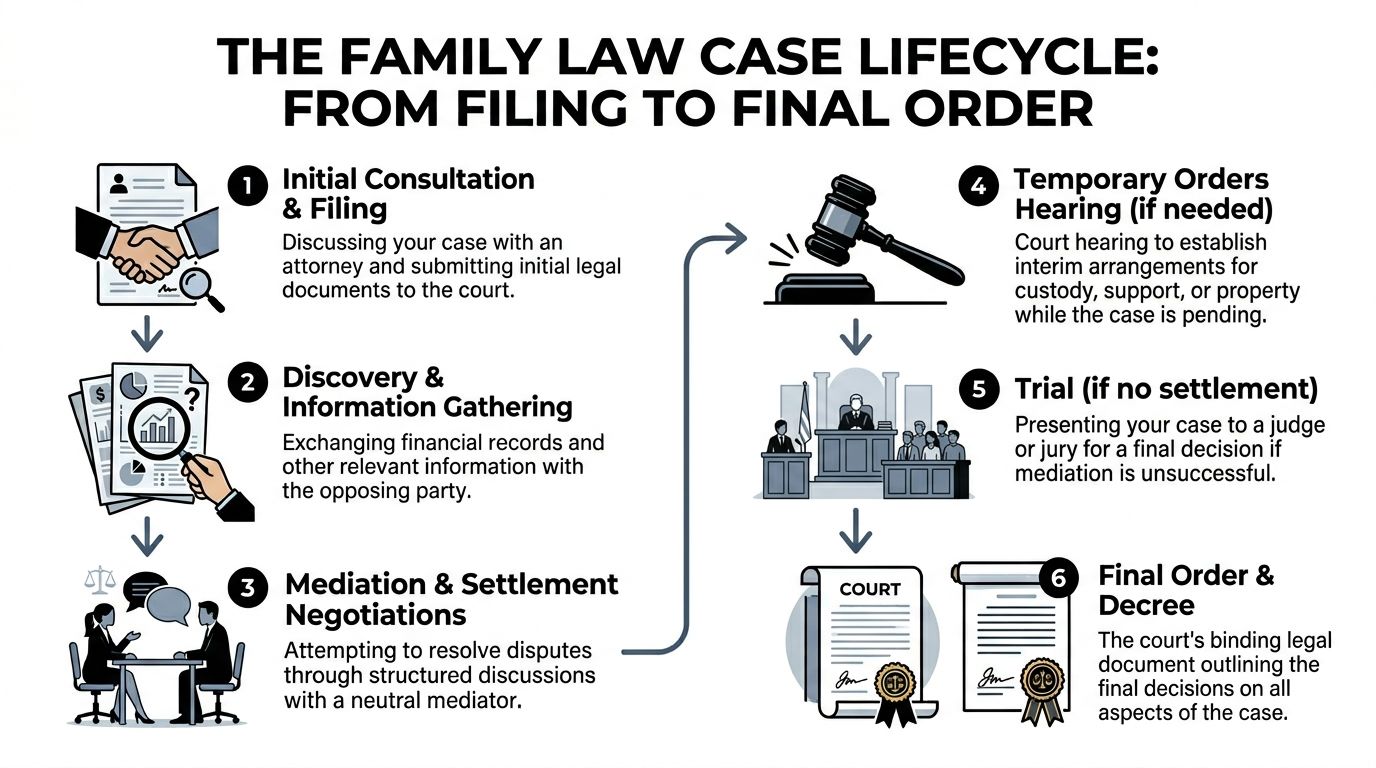
Filing starts the case
The first formal step is usually an Original Petition.
In plain language, that’s the document that opens the case and tells the court what kind of relief you’re asking for. In a divorce, it may ask for the marriage to be dissolved and for decisions on children, property, and support. In a custody case, it may ask for conservatorship, possession, and child support orders.
A lot of people assume filing means the judge immediately gets involved. Usually, it doesn’t. Filing opens the file. It starts the process.
Service puts the other side on notice
After filing, the other party must usually be formally served unless service is waived properly.
That part matters because courts want proof that everyone got legal notice. Family law doesn’t work by rumor, text thread, or “I know he saw it.” It works by service, waiver, return, and documentation.
Temporary orders handle short-term problems
When families can’t wait until the end of the case for structure, they may need temporary orders.
These can address issues such as:
- Child schedules while the case is pending
- Temporary child support
- Who stays in the house
- Who pays which bills
- Rules about communication or conduct
Temporary orders don’t usually decide everything forever. They create a workable system while the case is still active.
Discovery is the information exchange stage
At this point, people often lose patience.
Discovery means each side exchanges relevant information. In a divorce, that may include bank records, pay information, retirement account details, debt records, and other financial documents. In a custody case, it can include records that affect parenting issues.
If you’ve ever wondered why family law feels document-heavy, this is why. Judges can’t divide property or evaluate claims fairly if nobody provides records.
A helpful side note here is that final paperwork matters as much as the hearing itself. If you want a plain-English breakdown of enforceable paperwork, what makes a document legally binding gives a useful general explanation of why signatures, authority, and proper execution matter.
Mediation resolves many cases before trial
Many Harris County family cases don’t end with a full trial. They move toward settlement through mediation.
In mediation, a neutral third party helps both sides negotiate. You’re not giving up your rights by participating. You’re trying to solve the dispute in a more controlled setting than a courtroom.
Sometimes mediation settles everything. Sometimes it narrows the issues so the final hearing is shorter and more focused.
Court is where decisions can be imposed. Mediation is where families still have room to shape their own outcome.
Trial is the final decision point if settlement fails
If major disputes remain, the case may go to trial.
At trial, the judge hears testimony, reviews evidence, considers legal arguments, and then issues rulings. In some family matters, a jury may be involved on limited issues, but many family law decisions are made by the judge.
Final orders are the documents that control the future
The end of the case is not just a handshake or an oral ruling.
It’s a signed legal order, often a Final Decree of Divorce or another final order, that spells out what each person must do. This is the document schools, employers, banks, and law enforcement may rely on later if questions arise.
For a Kingwood parent, the final order is what controls pickup times, holidays, support obligations, medical decision-making, and many of the routines that follow the family home after the courthouse part ends.
What to Expect at Your Harris County Court Hearing
A hearing day usually starts earlier than you want it to.
You leave Kingwood or Humble with a folder in your lap, rehearse what you want to say in the car, and then walk into a formal building where everybody seems to know where they’re going except you. That feeling is common.
The courtroom is formal but not mysterious
When your case is called, you may see some or all of these people:
- The judge or associate judge
- Your attorney
- The other party and their attorney
- A court clerk
- A bailiff
- Other families waiting on their own cases
Some matters are brief. Others take much longer. A temporary orders hearing feels very different from a final trial.
High-volume dockets affect the pace
Historically, Harris County family judges have carried dockets as high as 4,000 pending cases each, compared with 1,500 to 2,000 for civil district judges, as discussed in this review of Harris County family court caseload pressure. For clients, the takeaway is practical. Be ready, be organized, and get to the point.
Judges and associate judges often have limited time for each matter on a busy docket. They’re listening, but they expect focused testimony and useful documents.
Bring your strongest facts first. Court is not the place to tell every painful detail in your relationship history.
What you should do before speaking
A good hearing usually depends on preparation done before anyone enters the courtroom.
- Review your documents carefully: Don’t assume you’ll remember dates or amounts under stress.
- Follow your lawyer’s outline: The order of proof matters.
- Dress conservatively: You want the judge focused on your case, not your clothing.
- Turn off your phone: Even a vibration at the wrong time creates a bad impression.
- Answer only the question asked: Extra talking can hurt more than help.
If you’re trying to organize conversations, recordings, and documents before a hearing, some families also look at tools that explain legal transcription services to better understand how spoken information can be turned into usable text. That kind of resource can help people think more clearly about records and review, even though your court strategy should always be specific to your actual case.
Temporary hearing versus trial
A temporary hearing is often narrower.
The court may focus on immediate needs such as living arrangements, bill payment, child schedules, or short-term support. Testimony is usually tighter, and the court is trying to stabilize the situation.
A trial is broader and more final. That’s where the judge may hear much more evidence and issue the final rulings that govern life after the case ends.
If your dispute involves parenting issues, this guide on how to prepare for custody hearing can help you think through documents, behavior, and the type of preparation that matters most.
The tone you use matters
Judges notice more than paperwork.
They notice whether you interrupt, whether you follow instructions, and whether you can stay composed when the other side says something upsetting. In a Kingwood family case, your credibility often matters as much as your frustration.
Exploring Alternatives to Court Mediation and Required Classes
Not every family problem needs a courtroom fight.
For many Kingwood and Humble families, the better outcome comes from reducing conflict early, especially when children will still connect both parents long after the case ends.

Mediation gives families more control
Mediation is often one of the most useful parts of a family case.
Instead of waiting for a judge to impose a schedule or property decision, both sides work with a neutral mediator to try to reach an agreement. In many cases, that produces solutions that fit real life in Kingwood better than a one-size-fits-all ruling from the bench.
A mediated agreement can address details families care about, including exchange logistics, extracurricular activity decisions, holiday timing, and practical property issues. If you want a closer look at that process, this page on divorce mediation in Texas is a helpful next read.
Required classes can feel annoying but they serve a purpose
Parents sometimes see court-required classes as one more box to check.
Sometimes they are exactly that. But they can also do something useful. They force both parents to pause and think about communication, conflict, and how children experience separation. In a high-stress case, even a basic structure can lower tension.
That matters because family court isn’t only about winning points. It’s about building orders people can live under afterward.
Local support can strengthen a legal strategy
Harris County also offers support programs that may help families outside the courtroom, including counseling through TRIAD and Community Youth Services (CYS), along with financial aid support for low-income families, as described in this report on Harris County support programs for families.
For a parent in Northeast Houston dealing with a struggling teen, a family violence concern, or a child already under stress from litigation, those resources may support stability while the case moves forward.
One local option families may consider when evaluating representation is the Law Office of Bryan Fagan – Kingwood TX Lawyers, which handles family law matters from its Kingwood office and works on issues such as divorce, custody, support, modification, and enforcement.
Here’s a short overview that helps many parents understand why negotiated resolution is often worth serious effort before trial:
Why alternatives often work better
- Children benefit: Less conflict usually means fewer loyalty battles and fewer ugly exchanges.
- Parents keep flexibility: Agreements can be more specific than broad court orders.
- Communication improves: Even partial settlement can narrow the issues and make future co-parenting easier.
- Court time is used better: If only one or two issues remain disputed, the hearing is usually more focused.
Some of the best family law outcomes don’t look dramatic. They look stable.
When to Hire a Kingwood Family Law Attorney for Your Case
Some people can read forms, gather records, and understand the broad outline of the process. That doesn’t mean they should handle a family court case alone.
Harris County family cases involve local procedures, formal deadlines, court-specific scheduling, and rules that affect where the case stays and how it moves. If you live in Kingwood, Humble, or Northeast Houston, you’re often managing all of that while also dealing with work, children, housing decisions, and emotional strain.
You should strongly consider hiring a family law attorney when:
- Children are involved
- Property or debt is disputed
- The other side already has counsel
- You need temporary orders quickly
- There are safety concerns or protective-order issues
- You’re seeking modification or enforcement of existing orders
A local attorney adds practical value, not just legal theory. They can help you prepare for downtown hearings, organize documents in a way the court can use, communicate with court staff, and frame the issues clearly when time is short.
For Kingwood residents, local knowledge matters because your case may be heard in downtown Houston, but the facts of your life are still rooted here. School zones, exchange routes, work commutes, and neighborhood realities all shape what a workable order looks like.
If you’re feeling stuck between “I know this matters” and “I don’t know what to do next,” that’s usually the point where legal guidance becomes useful.
Frequently Asked Questions About Harris County Family Court
What’s the difference between a district judge and an associate judge
A district judge is the elected judge assigned to the court. An associate judge often handles many hearings and recommendations within that court. In day-to-day practice, you may appear before either depending on the issue and the court’s schedule.
Can I represent myself in family court
You can, but that doesn’t mean it’s wise in every case. Simple matters with full agreement are different from contested custody, support, or property disputes. If the other side disagrees with you on important issues, self-representation becomes much harder.
What forms usually start a case
That depends on the type of case. A divorce usually begins with an Original Petition for Divorce. A suit involving children may require different initiating documents. The right starting paperwork depends on whether you’re filing for divorce, custody, modification, enforcement, or another family law matter.
How is child support decided
Texas uses legal rules and calculations for child support, but the facts of your case still matter. Income, existing orders, and the specific relief requested can affect what gets presented to the court. If support is disputed, it’s smart to review the numbers carefully before any hearing.
Do I always have to go downtown if I live in Kingwood
Not always for every limited matter, but many family court proceedings are handled downtown. Local access may exist for certain preliminary issues, so it’s important to confirm the exact location for your setting rather than assume it will be close to home.
What if I already have an old custody order and need changes
That usually becomes a modification case rather than a brand-new custody case. The court with authority over the child-related matter may continue to handle later disputes, which is one reason reviewing prior orders early is so important.
If you’re dealing with divorce, child custody, child support, enforcement, or another family law issue in Kingwood, Humble, or Northeast Houston, the Law Office of Bryan Fagan – Kingwood TX Lawyers offers free consultations at its Kingwood office. A conversation can help you understand your options, your likely next steps, and how the Harris County court process may apply to your family’s situation.