A lot of people start searching for a probate attorney near kingwood texas at one of the hardest moments of their lives.
A parent has passed away. The house keys are on the kitchen counter. Bank accounts are frozen. A sibling is asking what happens next. Someone found a will, but no one is sure whether it needs to go to court, how long probate takes, or what it might cost in Kingwood, Humble, Porter, or Northeast Houston.
That uncertainty is what makes probate feel heavier than it needs to be.
The good news is that probate in Texas is a legal process with a clear purpose. It exists to honor a person’s final wishes, protect heirs, pay valid debts, and transfer property the right way. When families understand the process, things usually feel more manageable.
Navigating a Loved One's Estate in Kingwood
A family in Kingwood might go through something like this.
Their father passes away after living in the same home for years. He had a will tucked away in a desk drawer. One daughter is named executor. A son lives in Humble. Another family member is in Porter and wants to know whether the house can be sold right away. The bank says it needs legal paperwork before anyone can access accounts. Everyone is grieving, and now they’re suddenly dealing with deadlines, signatures, and questions they never expected to answer.
That’s where probate becomes less about legal jargon and more about simple, practical steps.

In plain terms, probate is the court process for wrapping up a person’s affairs after death. It can involve proving a will, appointing the right person to act for the estate, identifying assets, handling creditor issues, and transferring what remains to the proper heirs or beneficiaries.
For many families in Northeast Houston, the first confusion is about which assets go through probate. Some do. Some don’t. If you’re trying to sort that out, this guide on what assets go through probate can help you start with the right list.
Another common concern is real estate. Families often ask whether inherited property can be transferred, sold, or maintained while probate is pending. If that’s part of your situation, resources on probate and inherited property services can give useful context about how inherited homes are handled.
What usually worries families first
- The paperwork: Court forms and legal notices can feel intimidating when you're already overwhelmed.
- The timeline: People want to know how soon bills can be paid and property can be transferred.
- The family dynamic: Even loving families can become tense when roles and expectations aren’t clear.
- The fear of making a mistake: Executors often worry they’ll do something wrong and create bigger problems.
Probate isn't meant to punish families. It's meant to create an orderly way to protect the estate and carry out the law.
If you’re sitting at a kitchen table in Kingwood with a death certificate, a will, and more questions than answers, you’re not behind. You’re at the place where most families begin.
Understanding Probate A Simple Guide for Kingwood Families
A common Kingwood scene goes like this. A family gathers after the funeral, someone sets the will on the table, and the questions start right away. Can we access the bank account? Who deals with the house? Do we have to go to court in Harris County or Montgomery County? Probate is the court process that answers those questions and gives one person the legal authority to act for the estate.
Probate functions as an organized handoff. The court confirms who is in charge, identifies what belongs to the estate, makes sure valid debts and taxes are addressed, and then clears the way for property to pass to the right people. That structure can feel frustrating when you want everything settled quickly, but it exists to prevent confusion, missed creditors, and disputes later.
With a will and without a will
If your loved one left a valid will, the estate is called testate. The probate court reviews the will and, if it meets Texas requirements, appoints the executor named in it.
If there is no valid will, the estate is intestate. Texas law then decides who inherits and who has priority to serve as administrator.
That distinction affects real families here in practical ways. In a testate estate, the will usually answers the big questions up front. In an intestate estate, the family often needs more paperwork, more court involvement, and more patience because the law must fill in the missing instructions.
Who does what in probate
The titles can sound formal, but the jobs are easier to understand once you strip away the legal wording.
- Executor: The person named in the will to carry out the estate administration.
- Administrator: The person appointed by the court when there is no will, or no executor who can serve.
- Beneficiaries or heirs: The people entitled to receive estate property.
- Creditors: The people, lenders, or businesses that may have valid claims against the estate.
The executor or administrator is the point person. That person may open an estate account, gather records, notify interested parties, protect property, and keep careful track of what comes in and what goes out. If you have ever been the family member everyone turns to during a crisis, that role feels familiar, except the court now expects records and deadlines to be handled properly.
Why county procedure matters around Kingwood
Kingwood families often have one extra layer of confusion. Some estates are filed in Harris County, while others belong in Montgomery County, depending on where the deceased lived. That local detail affects filing logistics, hearing schedules, and how quickly you may get in front of the court.
In general, families filing in Harris County should expect a busier probate docket because of the county's size. Montgomery County probate settings can sometimes feel more predictable, but timing still depends on the type of case, the court's calendar, and whether the paperwork is complete the first time. A clean filing usually moves faster in either county than a case with missing documents or family disagreement.
Independent administration and dependent administration
This is one of the most important probate concepts for Kingwood-area families because it affects both cost and delay.
In many Texas estates, the court allows independent administration. That means the executor can handle much of the estate work without asking the judge for permission at every step. As noted by McNamara Law Office’s Kingwood probate guidance, independent administration often finishes in 6 to 12 months, while dependent administration can take 18 to 36 months because more court approval is required for major actions.
Independent administration is usually the smoother path when the will is clear, the family is cooperating, and the assets are straightforward. Dependent administration is more common when there is conflict, uncertainty, or concern that tighter court supervision is needed.
Here’s a short video that gives a helpful overview of probate concepts many Texas families ask about:
What probate does and does not cover
Another point that trips people up is that probate does not control every asset a person owned. Some property passes outside probate, such as accounts with a named beneficiary or jointly owned assets with survivorship terms. Other property, including a home titled only in the deceased person's name, often does require probate or a related court process before it can be sold or transferred.
That is why two neighbors in Kingwood can both say, "We handled an estate," and mean very different things. One family may only need a simple transfer process. Another may need a full probate administration because there is a house, several accounts, unpaid bills, and no clear beneficiary designations.
Practical rule: Probate is a series of steps, not a single form. The right path depends on whether there is a will, what property exists, which county has jurisdiction, and whether the family agrees on the basics.
For families in Kingwood, Humble, and Porter, probate gets easier to understand once you stop treating it like one mystery process and start seeing it as a checklist with local rules, local courts, and a clear order.
Do I Need a Probate Attorney in Kingwood?
Some families can handle a very simple estate with limited legal help. Many others shouldn't try to do it alone.
That’s not because probate is always hostile or dramatic. It’s because even ordinary estates can become complicated once real property, debts, deadlines, or family disagreements enter the picture. In this area, local experience also matters. Avvo’s Kingwood probate listings note that Harris County processed over 15,000 probate cases in 2022, reflecting the scale of probate activity around Kingwood and greater Houston.
When legal help is more than a convenience
You should strongly consider hiring a probate attorney if any of these apply:
- There’s a will contest or family dispute: If one relative questions the will or accuses the executor of acting unfairly, legal guidance becomes hard to avoid.
- The estate includes a house or land: Real estate often raises title, transfer, and sale issues.
- The deceased owned property outside Texas: Another state may require additional steps.
- There are debts you don't understand: Executors need to sort valid claims from invalid ones.
- You were named executor but feel overwhelmed: That’s common. Being organized and trustworthy doesn't automatically mean you know probate procedure.
- There’s no will: Intestate estates are often less predictable and can create confusion over who inherits.
- The family dynamic is tense: A neutral legal process can lower conflict and keep communication focused.
What a local probate attorney actually does
A probate attorney doesn’t just “go to court.” The practical value is often in the quieter work behind the scenes.
A lawyer can prepare the filing correctly, help determine the right county, review whether independent administration is available, organize notices, and make sure the executor understands what authority they do and don’t have. That prevents avoidable mistakes.
For Kingwood families, that local piece matters. A lawyer who regularly works with Harris County or Montgomery County probate procedures will usually know the filing flow, common documentation issues, and what tends to slow cases down.
Going without help can cost more later
People often avoid calling a lawyer because they want to save money. That instinct is understandable.
But probate mistakes can create delays, family friction, title problems, or personal exposure for the executor. When that happens, the estate can spend more time and more money fixing preventable issues than it would have spent getting early guidance.
If you're asking whether you need a lawyer, the better question is often this: how much risk is attached to this estate if I misunderstand one step?
That answer changes from family to family. A modest estate with one beneficiary is different from a Kingwood estate that includes a house, multiple accounts, blended family relationships, and unanswered creditor questions.
For many people in Humble, Porter, and Northeast Houston, legal help brings something simple but valuable. Relief. Someone can explain what has to happen, what can wait, and what needs attention right now.
The Texas Probate Process A Step-by-Step Timeline
Most executors feel better once they can see the process in order.
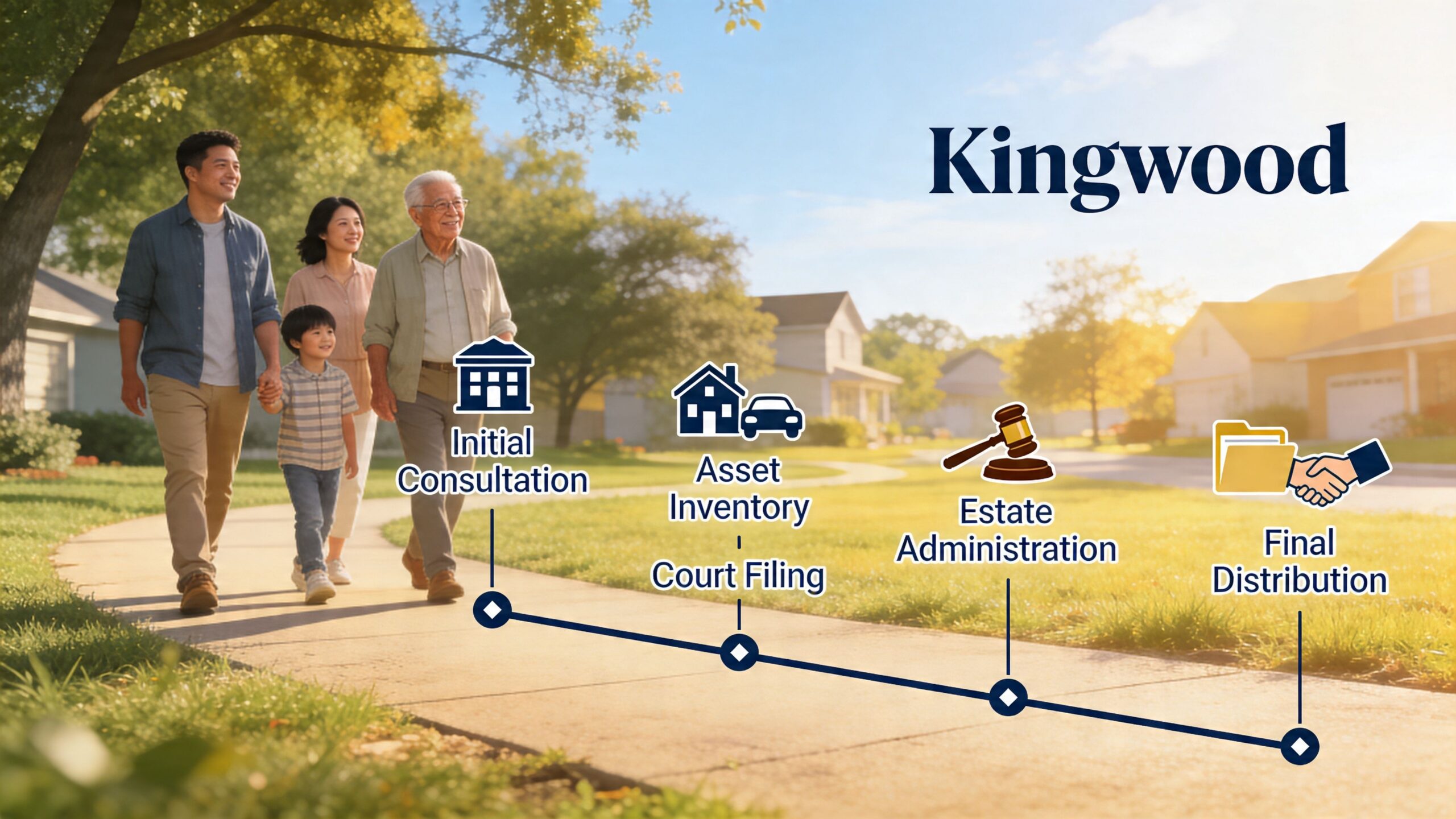
Probate is not a single court date. It’s a chain of tasks, each with its own purpose. Missing a deadline can create serious trouble. Texas probate guidance from CiCi Cunningham notes two of the most important deadlines: the application to probate a will generally must be filed within four years of death, and creditors must be notified within four months of the executor’s appointment. Missing deadlines can lead to lost rights and personal liability for the executor.
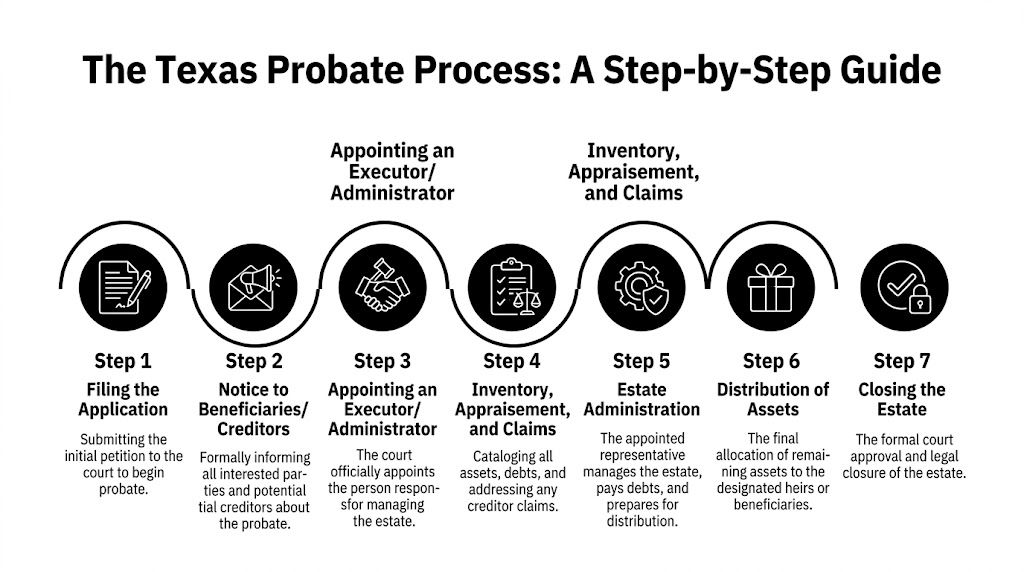
Step one Filing in the right county
The probate case usually begins in the county where the deceased lived. For families in this area, that often means Harris County or Montgomery County.
The court filing asks the probate court to admit the will, if there is one, and appoint the executor or administrator. If there’s no will, the filing asks the court to determine who has authority to manage the estate.
Step two The hearing
After filing, the court sets a hearing.
At that hearing, the judge reviews the application and any will presented. If everything is in order, the court signs the order admitting the will to probate and authorizes the executor to act. That authority is what banks, title companies, and other institutions usually need before they’ll deal with estate property.
Step three Notice and early duties
Once appointed, the executor has immediate tasks.
Some beneficiaries may need formal notice. Creditors also become part of the picture. Texas law requires timely notice to certain creditors, and this is one area where executors can get into trouble if they assume they can “handle it later.”
Step four Identifying the estate
This stage is less dramatic than court, but it takes real effort.
The executor gathers information about:
- Real property: homes, land, or mineral interests
- Bank and investment accounts: accounts titled in the decedent’s name
- Vehicles and personal property: cars, collections, tools, jewelry, furniture
- Debts and liabilities: mortgages, credit cards, medical bills, taxes
The goal is to understand what the estate owns and owes. Executors often spend a lot of time tracking account statements, deeds, titles, and beneficiary information during this stage.
Step five Inventory debts and administration
Executors then move into administration. That means protecting estate property, evaluating claims, and paying valid debts from estate funds where appropriate.
Some estates are straightforward. Others involve questions like whether a debt is legitimate, whether a property should be sold, or whether an account passes outside probate. In these situations, legal guidance often saves time.
If you want a fuller timeline for Texas estates, this page on how long probate takes in Texas gives a useful overview.
Local reality: Even when a probate is uncontested, gathering records from banks, insurance companies, and title records often takes longer than families expect.
Step six Distributing property
Only after debts, claims, and administration issues are handled should the executor distribute estate assets.
That distribution depends on the will, if there is one, or on Texas intestacy rules if there is not. This is the step many heirs focus on first, but it usually comes later than people think.
Step seven Closing the estate
The final step is wrapping up the administration according to the type of probate involved.
Some estates close with relatively little fanfare. Others require more documentation. Either way, the executor’s job is not finished until the estate has been administered properly and the required obligations have been met.
A simple timeline view
| Stage | What happens |
|---|---|
| Filing | Application is submitted to the probate court |
| Court hearing | Judge reviews the case and appoints the executor or administrator |
| Notice period | Required parties and creditors receive notice |
| Asset review | Property, accounts, and debts are identified |
| Administration | Valid obligations are handled and estate matters are managed |
| Distribution | Remaining assets go to beneficiaries or heirs |
| Closing | The estate is wrapped up under the applicable procedure |
For families in Kingwood, Humble, and Porter, the biggest mistake is usually not bad intent. It’s delay. People wait because they’re grieving, unsure, or hoping things will sort themselves out. Probate rarely works that way. Timely action matters.
Probate Costs and Attorney Fees in the Kingwood Area
A Kingwood family will often ask the cost question before anything else. That is the right instinct.
Probate expenses can feel confusing because there usually is not one single price tag. A better way to look at it is the same way you would look at a home repair estimate. One part is the professional's fee. Another part is the filing and paperwork costs. A third part depends on whether hidden problems show up after the work begins.
How probate fees are usually charged in this area
Around Kingwood, Humble, and Porter, probate lawyers commonly charge in three ways:
- Flat fee: Often used for a straightforward estate with a valid will, cooperative heirs, and no fight over property.
- Hourly billing: More common when the work could expand because of title issues, creditor problems, or family conflict.
- Percentage-based fee: Less common in Texas probate than many families expect, but it still comes up in some situations.
For many families, the essential question is not just, "What do you charge?" It is, "What kind of case do we have?" A simple independent administration in Harris or Montgomery County is a very different project from an estate with missing documents, a blended family dispute, or a house that cannot be sold without extra court work.
What usually affects the total cost
Two estates can look similar at first and still end up with very different bills.
The difference often comes down to friction. If the will is clear, the executor has good records, and the beneficiaries are on the same page, the work is usually more predictable. If no one can find the original will, an heir objects, or real estate has title questions, the lawyer may need to spend far more time solving problems than filling out forms.
Here is a practical comparison:
| Expense Type | Simpler Estate | More Complicated Estate |
|---|---|---|
| Attorney fee structure | Often flat fee | Often hourly |
| Court activity | Usually limited | Often includes added hearings or motions |
| Paperwork load | Moderate | Heavy |
| Family coordination | Usually manageable | Often time-consuming |
| Total cost pattern | More predictable | Less predictable and often higher |
The local costs families should ask about
Attorney fees are only part of the picture. In Kingwood-area probate cases, families should also ask about:
- Court filing fees
- Fees for certified copies and issued letters
- Bond premiums if a bond is required
- Appraisal or valuation costs for a home, land, or business interest
- Recording fees tied to real estate
- Extra legal time if the matter becomes contested
Those smaller items matter because they affect cash flow early in the case. A family may feel prepared for the lawyer's fee but still be caught off guard by court costs, document fees, and property-related expenses that arrive in the first few weeks.
A Harris County and Montgomery County reality check
Court location can affect both timing and cost pressure.
For example, if the decedent lived on the Harris County side of Kingwood, families often want to know how local procedure may shape filing steps and hearing timing. Our guide to Harris County probate for Kingwood families gives county-specific context that can help you ask better questions during an initial consultation.
Montgomery County cases can feel a little different in pacing and paperwork expectations. The legal rules are still Texas probate rules, but local practice matters. That is one reason a "one-size-fits-all" fee quote can be misleading for families in Kingwood, Humble, and Porter.
Questions to ask before you hire anyone
A good fee conversation should leave you calmer, not more confused.
Ask these questions early:
- Is this likely to stay a flat-fee matter, or do you expect hourly work?
- What services are included in the quoted fee?
- What filing costs or court costs should I expect on top of that fee?
- What facts in this estate could increase the price later?
- Do you see any warning signs involving the will, debts, real estate, or family disagreement?
A clear answer does not require perfect certainty on day one. It should give you a realistic range, explain what drives cost, and tell you where the budget could change.
That kind of transparency helps families make decisions without feeling pressured while they are still grieving.
Your Local Kingwood Partner for Probate Matters
When probate lands on your shoulders, you don’t just need legal information. You need someone to help carry the process.
That usually means practical support with documents, deadlines, court procedure, and communication among family members. For many Kingwood families, the hardest part isn’t understanding one legal term. It’s managing a dozen moving parts while also grieving.

What local probate support looks like
A probate lawyer working with families in Kingwood, Humble, Porter, and Northeast Houston often helps with work such as:
- preparing the probate application and related filings
- reviewing the will and identifying possible issues before court
- helping the executor understand their authority and duties
- organizing notices, inventories, and supporting records
- answering beneficiary questions before misunderstandings turn into disputes
- appearing in probate court when hearings are required
Some families want full representation from start to finish. Others want targeted guidance so they can feel confident making decisions. Both approaches can be useful, depending on the estate.
Why proximity matters
Local service has real value in probate.
Meeting with someone nearby is easier when you’re trying to gather original documents, sign papers, or talk through a family problem that doesn’t fit neatly into an email. A nearby office also means you’re working with a team that understands the concerns common in this part of Northeast Houston, including family homes, blended families, retirement assets, and inherited property questions.
The Law Office of Bryan Fagan – Kingwood TX Lawyers serves clients from its Kingwood office at 900 Rockmead Dr #225, giving local families a place to sit down, ask questions, and get a clearer sense of what comes next.
A steady approach matters
Probate often improves when one person helps keep the process calm and organized.
That means speaking plainly. Returning calls. Explaining what can wait and what can’t. Telling an executor when a concern is minor, and when it needs immediate legal attention.
Families don't need pressure during probate. They need clarity, timing, and a plan they can actually follow.
If you’re handling an estate in Kingwood, Humble, Porter, or nearby Northeast Houston, a local attorney can help turn a confusing situation into a manageable one.
Frequently Asked Questions About Probate in Northeast Houston
A common scene in Kingwood goes like this. A family has the will on the kitchen table, the death certificates are still being ordered, and someone asks, "Do we need probate at all?" That question often turns into five more. Here are the ones families in Kingwood, Humble, Porter, and nearby communities ask most often.
What if my loved one owned property outside Texas?
Texas probate may only solve part of the problem.
If your loved one owned land or a house in another state, that property often needs a separate court process there before it can be sold or transferred. The Texas case still matters because it helps establish who has authority to act here. Then the other state may require its own paperwork to recognize that authority. Families are often surprised by this because one estate can involve two court systems, two timelines, and extra title work.
Can a small estate avoid full probate?
Sometimes.
Texas offers shorter paths in some cases, but the answer depends on what the person owned, whether there is a will, and how the assets were titled. A Small Estate Affidavit can work a bit like a shortcut road, but only if the estate fits the legal requirements. A home, creditor issue, or unclear ownership record can take that shortcut off the table.
What is a muniment of title?
A muniment of title is a limited probate option used in certain cases where there is a valid will and no need for a full administration.
In plain terms, it is often used to transfer title without appointing an executor for a full estate administration. Around Kingwood, this question comes up often when the main asset is a family home in Harris County or Montgomery County. It can save time and reduce paperwork in the right situation, but it is not available in every estate.
What happens if there is no will?
The estate can still go through probate. Texas law then decides who inherits.
Families often encounter significant surprises. Property does not always pass the way relatives expect, especially with blended families, second marriages, or children from different relationships. What feels simple at the kitchen table can look very different once the court applies intestacy rules.
Can the executor distribute property right away?
Usually, no.
The executor first needs legal authority from the court and enough time to identify debts, claims, and title issues. Handing out money or property too early is a little like paying out the contents of a bank account before checking all the withdrawals that are still pending. If a problem shows up later, the executor may be the person asked to fix it.
Is independent administration common in Texas?
Yes.
As noted earlier, many Texas estates use independent administration because it usually involves less court supervision than dependent administration. That can make the process more practical for families, especially when everyone is cooperating and the will supports that approach. In Harris County and Montgomery County, the exact pace still depends on the court's calendar and whether the paperwork is complete the first time.
What should I gather before meeting a probate attorney?
Bring what you can find. It does not need to be perfectly organized.
Helpful documents often include:
- The original will, if there is one
- A certified death certificate, if available
- Deeds, tax statements, or mortgage records
- Bank, retirement, and investment statements
- Credit card bills, medical bills, and loan records
- Names and contact information for heirs and beneficiaries
Even an incomplete stack of papers is useful. A probate attorney can often tell, within a short conversation, what is missing and what matters first.
How do I know if I need help right now?
Ask for help sooner if there is a house, a will, family disagreement, confusion about who has authority, or concern about a deadline.
That timing matters locally. Families in Kingwood may end up in Harris County or Montgomery County probate court depending on where the person lived, and each court has its own docket and filing pace. Waiting rarely makes probate simpler. It usually means more unanswered questions, more stress, and more risk that an avoidable mistake gets baked into the process.
If you need practical guidance on a probate matter in Kingwood, Humble, Porter, or Northeast Houston, Law Office of Bryan Fagan – Kingwood TX Lawyers offers free consultations to help you understand your options. A conversation with a local attorney can clarify what kind of probate may apply, which local court may handle the case, and what first steps make sense for your family.