
When a parent in Kingwood opens a notice for a custody hearing, the first reaction is usually the same. Your stomach drops, your mind races, and suddenly every small disagreement with the other parent feels like it might be judged in a downtown Houston courtroom.
That fear is normal.
A child custody hearing harris county case can feel bigger than life when you're balancing work, school pickups, bills, and the stress of getting from Kingwood or Humble into the city for court. Most parents aren't worried about legal theory. They're worried about practical things. Where do I go? What does the judge want to hear? What if I say the wrong thing? What happens to my child while this case is pending?
The good news is that custody cases are not random. Harris County follows a process. Once you understand that process, the situation becomes less mysterious and more manageable. You still may not like every step, but you'll know what the court is asking of you and why.
Parents from Kingwood, Porter, Humble, and Northeast Houston often do better when they stop treating the hearing notice like a threat and start treating it like a checklist. Court is serious, but it is also structured. Preparation matters. Conduct matters. Paperwork matters. Showing up ready matters.
If you're facing a custody dispute, think of this guide like directions from a local lawyer who knows the road from Northeast Houston to the Harris County courthouse and knows where parents usually get tripped up. The goal isn't to scare you. It's to help you walk in steadier, better prepared, and more confident about what comes next.
Your Guide to Navigating a Harris County Custody Case
A lot of parents in Kingwood call after the same kind of evening. They get home from work, sort through the mail, and find a court notice with a hearing date. Then the questions start. Is this the final hearing? Do I need witnesses? Will the judge talk to my child? Do I have enough time to get ready?
That uncertainty is one of the hardest parts.
For families in Humble and Northeast Houston, a custody case often feels especially overwhelming because the court process happens far from home, in a system that uses unfamiliar words and strict deadlines. You may still be handling school schedules, medical appointments, and handoffs with the other parent while trying to understand pleadings, notices, and court settings.
Practical rule: Don't let panic make your next move for you. Read the notice carefully, save every document, and start organizing your information right away.
Custody cases usually turn on ordinary facts, not dramatic speeches. Who gets the child to school. Who follows medical advice. Who communicates respectfully. Who can keep life stable. Harris County judges look closely at patterns, and those patterns are built from day-to-day parenting.
That means small steps taken early can help a lot:
- Create one case folder: Keep court papers, emails, school notes, and calendars together.
- Write down important dates: Hearing dates, exchanges, missed visits, and appointments matter.
- Stay child-focused: Judges respond better to facts about the child than anger about the other parent.
- Get local guidance: A parent in Kingwood has different practical concerns than someone living near downtown Houston.
If you're worried, that doesn't mean you're unprepared. It means this matters to you. With a clear plan, you can move from fear to action.
Understanding the Harris County Family Court System
Most custody disputes for families in Kingwood, Humble, and Northeast Houston are handled through the Harris County family court system in downtown Houston. For local parents, that means your case is not just a legal issue. It's also a logistics issue. You may need to plan travel time, parking, security screening, time away from work, and child care before you ever step into a courtroom.

Why the courts can feel slow
A lot of parents assume delay means their case has been ignored. Usually, that's not what's happening. Harris County family courts carry a very heavy workload.
Family law matters make up about 40% of all civil cases, and family court judges can have more than 4,000 pending cases on their dockets, compared with 1,500 to 2,000 cases for civil district judges, according to reporting summarized in this discussion of overwhelmed Harris County courts. That volume affects scheduling, wait times, and how quickly contested issues get heard.
For parents, the lesson is simple. If the court is crowded, preparation becomes even more important. You don't want your case delayed because your paperwork wasn't ready or your evidence wasn't organized.
What this means for a Kingwood parent
When you're coming from Kingwood or Porter, the downtown setting can make the whole process feel distant and impersonal. It helps to remember that your judge handles many family disputes, and the court expects parties to arrive prepared, focused, and respectful.
A local overview like this guide to navigating Harris County family court from Kingwood can help you understand how these courts operate from the perspective of someone who doesn't live near the courthouse.
Here are the practical takeaways:
- Plan your route early: Driving from Northeast Houston into downtown can add stress if you leave too late.
- Expect formal procedures: Security, check-in, and docket calls can take time.
- Bring organized papers: In a busy court, clear presentation helps.
- Don't read delay as defeat: A slow timeline often reflects the court's workload, not the merits of your case.
The Harris County system is structured, but it moves under pressure. Parents who prepare early usually handle that pressure better.
Why court familiarity matters
Not every custody hearing looks the same. Some are short and focused. Others involve testimony, exhibits, or court-ordered investigations. A lawyer who regularly works in Harris County family courts usually understands how local procedure, scheduling habits, and judicial expectations shape the experience of a hearing.
That's especially valuable when you're trying to translate court language into everyday decisions at home. For a parent in Humble, the question often isn't "What does the rule say?" It's "What do I need to do this week so I don't walk into court unready?" That's the right question.
The Different Types of Child Custody Hearings Explained
Parents often use the phrase "custody hearing" as if it's one event. In Harris County, it can mean very different things depending on where your case stands. If you don't know what kind of hearing you have, it's like packing for the wrong trip. You may bring the wrong documents, prepare for the wrong issues, or misunderstand what the judge can decide that day.
Temporary orders hearings
A temporary orders hearing is the court's way of putting basic rules in place while the larger case is still pending. It's similar to setting household rules during a long remodel. The house is still under construction, but people still need a workable plan for bedtime, school mornings, pick-ups, and decision-making.
At this stage, the judge may address matters such as where the child stays, how parenting time works for now, and how parents should handle immediate concerns. These orders aren't necessarily the final answer, but they can strongly shape the direction of the case.
If you're dealing with an early-stage dispute, temporary custody orders in Texas are often the first court framework you need to understand.
Final trial
A final trial is different in both purpose and depth. During this proceeding, the court decides long-term orders if the parents haven't reached a full agreement. The judge looks at the broader picture and may consider testimony, documents, witness statements, and professional evaluations.
A final trial is less about emergency management and more about building the long-term parenting structure. It answers questions such as conservatorship, possession, and related child-focused arrangements in a lasting way.
For many Kingwood and Northeast Houston parents, the process feels most intimidating because more is at stake. But the same principle applies. Courts focus on facts, consistency, and the child's best interests.
Modification hearings
A modification hearing happens after orders are already in place. Life changes. Parents move. Work schedules shift. A child's needs can change. When an existing order no longer fits current circumstances, one parent may ask the court to modify it.
This type of hearing isn't about relitigating every past disagreement. It's about whether the current order still works and whether the requested change is justified. Parents often get confused here because they think dissatisfaction alone is enough. Usually, the court wants a grounded reason tied to the child's situation or the family's current reality.
Issue-Based Investigations
Some temporary disputes need more than argument from each side but less than a full custody evaluation. In those situations, Harris County courts may order an Issue-Based Investigation, often called an IBI.
According to the Harris County Domestic Relations Office, IBIs are used for faster resolutions on 1 to 2 issues during temporary hearings and do not provide a full recommendation on conservatorship or possession, as explained on the Domestic Relations Office page about Issue-Based Investigations. That makes them useful, but limited.
An IBI can help with a narrow conflict, such as a specific disputed concern the court needs clarified quickly. But it does not replace a full-picture evaluation of the family.
Here's where parents often get tripped up:
- They expect a full custody opinion: An IBI is narrower than that.
- They ignore the limited scope: The investigator is not deciding every parenting issue.
- They treat it casually: Even a limited investigation can affect temporary outcomes.
- They assume speed means simplicity: Faster process doesn't mean lower stakes.
An IBI can answer a focused question for the court. It usually won't tell the judge everything about your family.
A simple way to tell them apart
| Hearing type | Main purpose | What parents should expect |
|---|---|---|
| Temporary orders hearing | Set short-term rules while the case is pending | A practical, immediate plan |
| Final trial | Decide long-term unresolved custody issues | A fuller review of evidence and testimony |
| Modification hearing | Change an existing order | Focus on why the current order should be updated |
| Issue-Based Investigation | Examine a narrow disputed issue | A limited inquiry, not a full custody recommendation |
If you're not sure which hearing applies to you, look at your filed papers and court notice carefully. The label matters. So does the goal of the hearing.
A Step-by-Step Walkthrough of Your Hearing Day
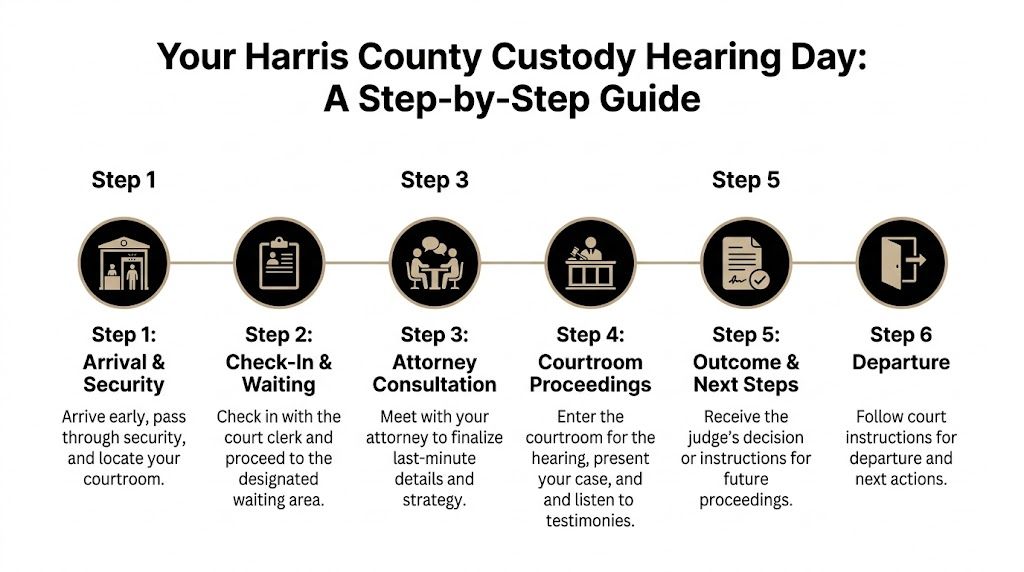
For a parent driving in from Kingwood, hearing day usually starts long before the judge takes the bench. It starts with traffic, parking, security, and that uneasy feeling that everyone else somehow knows what they're doing. Often, individuals in court lack this clarity, despite outward appearances.
The more familiar the day feels in advance, the less room anxiety has to take over.
Before you enter the courtroom
Leave earlier than you think you need to. Downtown Houston traffic doesn't care that you have a custody hearing. Neither do parking garages. Build in extra time so one delay doesn't start your morning in a panic.
Once you arrive, you'll go through security. Keep bags simple. Bring your documents in an organized folder or binder. Silence your phone before you enter the courtroom area.
A good hearing-day checklist includes:
- Court notice and filed papers: Don't rely on memory.
- Photo identification: Bring it with you.
- Organized exhibits: Keep them easy to find.
- A notepad and pen: You'll want to write down instructions.
- Child care plan: Don't assume children should come unless your lawyer or the court has told you otherwise.
What happens outside the courtroom
A lot of waiting happens in custody cases. You may check in, sit in a hallway, speak privately with your lawyer, and wait for your case to be called. That waiting doesn't mean your case is off track. It's a normal part of the day.
If you have an attorney, this is often when you'll review last-minute details. If you don't, stay alert, listen carefully, and keep your paperwork close.
Arrive early enough that you can think clearly. Rushing into family court usually hurts judgment.
What happens inside
When your case is called, you'll go into the courtroom. The judge may already have a full docket. That means time matters, and clear communication matters even more.
Most hearings follow a basic rhythm:
- The court calls the case
- The parties or lawyers announce their presence
- The judge identifies the issue to be heard
- Each side presents evidence or testimony
- The judge asks questions or gives a ruling
- The court states any next steps
You may hear legal language that sounds unfamiliar. Don't let that throw you. Focus on the practical purpose. Who is speaking. What issue is before the judge. What facts are being discussed. What orders are being requested.
Courtroom behavior that helps
Judges notice behavior quickly. In a custody case, your conduct in the courtroom can reinforce or undermine the story you're trying to tell about yourself as a parent.
Keep these habits in mind:
- Dress neatly: You don't need expensive clothes. You do need to look respectful and serious.
- Speak only when it's your turn: Interrupting damages credibility.
- Answer what was asked: Long speeches usually backfire.
- Stay calm when you hear something unfair: Your reaction matters.
- Face the judge when speaking: This sounds small, but it matters.
After the hearing
Some parents expect a full answer the same day. Sometimes that happens. Sometimes the judge gives temporary instructions, asks for additional paperwork, or sets another date. Listen closely and write everything down.
If orders are issued, follow them exactly. Don't treat a hearing result like a rough draft. Even temporary rulings need to be obeyed unless the court changes them later.
For Kingwood and Humble parents, the trip back home after court often feels emotionally heavy. That's normal too. The important part is to leave with a clear understanding of what the judge ordered and what you need to do next.
How to Prepare Your Case for a Harris County Judge
Preparation in a custody case is less like writing a dramatic argument and more like packing for a long trip. If you wait until the night before, you'll forget something important. If you prepare in stages, the hearing becomes much easier to handle.
For parents in Kingwood, Humble, and Northeast Houston, good preparation starts at home. The court only sees a slice of your life. Your job is to bring the slice that helps the judge understand your parenting clearly and accurately.
Start with documents that tell a story
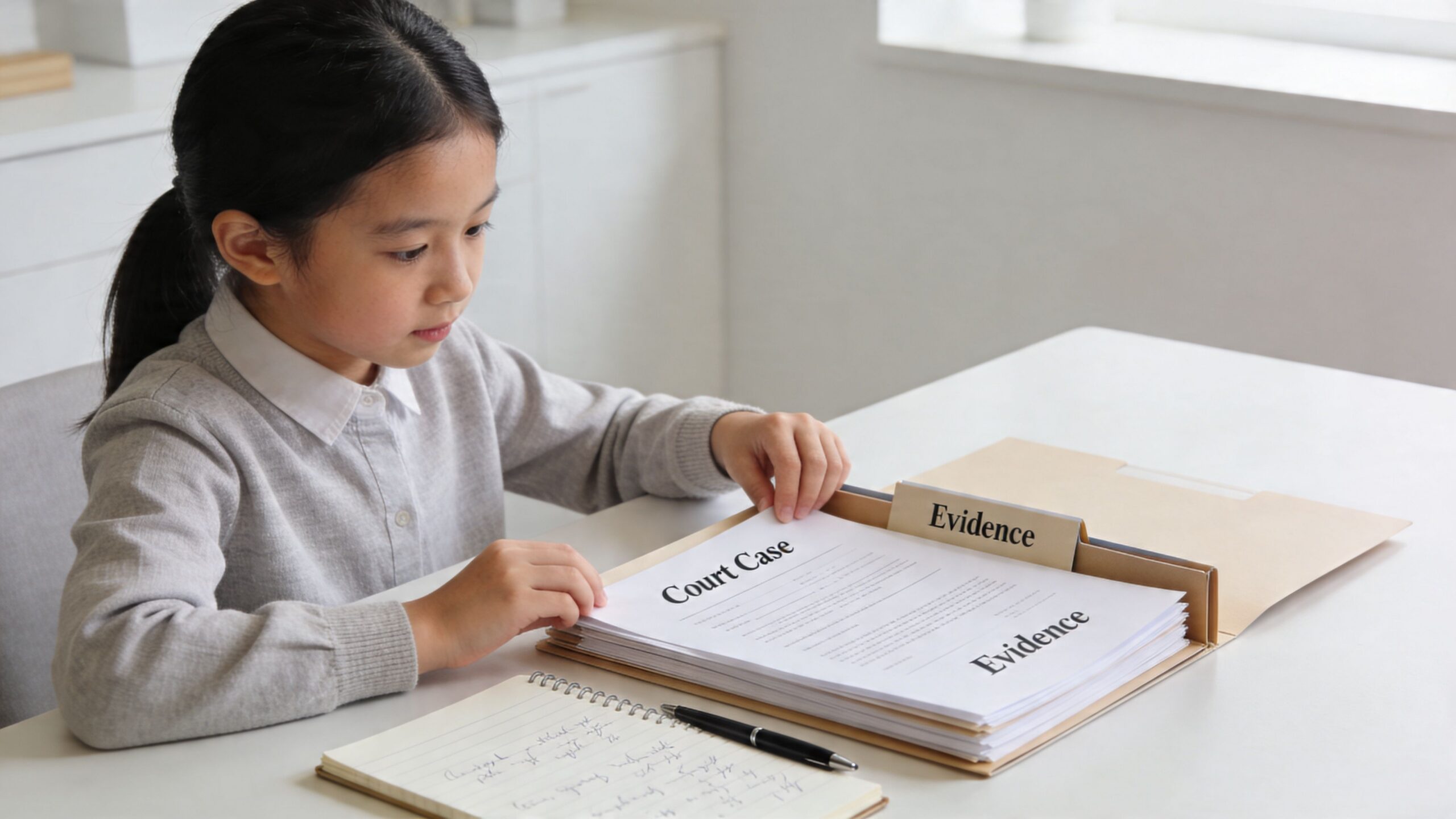
The strongest evidence is usually simple and specific. Judges often respond better to organized, everyday records than to emotional accusations.
Useful materials may include:
- School records: Attendance notes, report cards, teacher communications
- Medical records: Appointment summaries, medication information, therapy records when relevant
- Parenting calendar: Pickups, drop-offs, overnight periods, missed exchanges
- Written communication: Texts, emails, or messages that show scheduling, cooperation, or conflict
- Photos or records of living conditions: Only if they are relevant and respectful
- Court orders already in place: Bring current copies
If you need clean, readable copies for court, exhibits, or organized binders, a practical local-style support option is using legal printing services so your documents are easy to handle on hearing day.
Mandatory steps many parents overlook
Harris County has several requirements that can affect whether your case moves forward smoothly. According to this Harris County custody and divorce overview, parents must complete a co-parenting course before final orders are issued, mediation is required before temporary orders hearings and before final trial, and required documents must be produced no later than 10 days before trial. Courts may refuse to schedule hearings if mediation hasn't been completed, and failure to comply with document deadlines can lead to sanctions.
That tells you something important. In Harris County, readiness isn't optional. It is part of the case.
A strong preparation routine usually looks like this:
- Read every order carefully so you know what's required.
- Calendar every deadline the day you learn it.
- Complete the co-parenting course early instead of waiting.
- Take mediation seriously and show up prepared to discuss practical solutions.
- Organize documents before the deadline so nothing is rushed.
If the court orders an evaluation
Some custody cases involve a more detailed professional review. Harris County child custody evaluations are thorough forensic assessments, and the Domestic Relations Office notes in its child custody evaluation FAQ that they typically take 90 days from evaluator assignment to completion. During that time, evaluators may interview parents, children, and others, review records, and conduct home observations.
For a parent, that means the evaluation period is not downtime. It's part of the case.
Keep this in mind: The way you communicate, follow orders, and handle daily parenting during an evaluation may matter as much as what you say in court.
This short video gives a helpful general overview of preparing for custody issues and hearing expectations:
What judges usually find persuasive
Judges in family court are trying to make workable decisions for real children. They tend to value evidence that shows stability, follow-through, and judgment.
That often means:
- Specific examples beat broad complaints
- Respectful communication beats hostile exchanges
- Records beat memory
- Consistency beats last-minute performance
If you're using legal help, one option local parents look to is the Law Office of Bryan Fagan – Kingwood TX Lawyers for custody representation and hearing preparation based on Harris County family court practice. Whether you work with counsel or prepare on your own, the goal is the same. Present a calm, organized, child-focused case.
Common Mistakes to Avoid in Your Custody Case
Some custody cases don't weaken because the parent lacks love or involvement. They weaken because the parent makes avoidable mistakes under stress. Harris County judges see that all the time. The challenge is not just proving your position. It's avoiding conduct that makes the court question your judgment.

Mistake one, treating court like a place to vent
Parents often believe the judge needs to hear every frustration in full emotional detail. Usually, that hurts more than it helps. Judges need relevant facts tied to the child's welfare, not a running history of every insult and argument.
A better approach is to translate emotion into evidence. Instead of "She never cooperates," show the message trail about scheduling. Instead of "He doesn't care," point to missed appointments or inconsistent contact if those facts are real and relevant.
Mistake two, fighting the other parent instead of helping the child
Many parents think looking tough makes them look serious. In custody court, constant hostility can make a parent look hard to co-parent with. Even when the other parent is difficult, your own behavior stays under the microscope.
Useful alternatives include:
- Keep messages brief and polite
- Stay on topics involving the child
- Avoid insults, sarcasm, and threats
- Document problems without escalating them
Judges often learn as much from how a parent handles conflict as from the conflict itself.
Mistake three, ignoring the Domestic Relations Office process
Harris County courts frequently order forensic assessments through the Domestic Relations Office under Texas Family Code Chapter 107, and evaluators gather information through interviews, home visits, and reviews of school, medical, and criminal records, as outlined by the Harris County Domestic Relations Office child custody evaluation page. In plain terms, this is not a box-checking exercise. It is a close look at how your family operates.
Parents hurt themselves when they:
- Miss appointments or respond late
- Refuse to provide requested records
- Coach the child on what to say
- Act one way for the evaluator and another way everywhere else
The safest mindset is to treat every part of the evaluation as important.
Mistake four, posting about the case or spiraling emotionally
Social media and custody litigation do not mix well. A post made in anger can be misunderstood, screenshotted, and brought into a larger conflict. Even vague posts can create unnecessary problems.
It's also common for parents to underestimate the emotional strain of a contested case. If the process is affecting your sleep, focus, or ability to communicate calmly, getting support can help you make better decisions. Some parents benefit from seeking support for your emotional well-being during a stressful family transition so they can stay steady for both themselves and their children.
Mistake five, assuming fairness will explain itself
Many good parents think, "If I just tell the truth, the judge will see everything." Truth matters. But courts work through evidence, procedure, and presentation. If the facts aren't organized and properly presented, the court may not see the whole picture.
That is why calm preparation often beats emotional certainty. In a Harris County custody case, the parent who stays focused, follows instructions, and presents clear information usually puts the court in a better position to understand the child's needs.
Local Resources and Your Next Steps in Kingwood
When you're dealing with a child custody hearing harris county issue, reliable information matters. Random online advice can make things worse, especially when your case is local and the practical details of Harris County procedure matter.
If you're in Kingwood, Humble, or Northeast Houston, start with official and case-specific resources. Look for the Harris County District Clerk for filed case information and court records, the Harris County Family Law Center for courthouse logistics, and the Harris County Domestic Relations Office for information about evaluations and related family court services. Those resources can help you verify dates, understand forms, and confirm what stage your case is in.
You should also use local legal guidance that speaks directly to parents in this area. A parent commuting from Porter or Atascocita has different concerns than someone reading a generic article written for another state. Local context matters because travel, court practices, and county-specific requirements shape how the case feels in real life.
If you need legal help focused on custody issues, child custody representation in Kingwood is the kind of service many local parents look for when they want help preparing for hearings, responding to filings, or seeking modifications.
The main takeaway is simple. Preparation gives you options. Waiting usually takes them away.
If you've received a hearing notice, don't guess your way through it. Gather your papers, protect your communications, and get clear guidance before deadlines start passing. For families in Kingwood and nearby communities, that can make the entire process feel more manageable.
Frequently Asked Questions About Custody Hearings
Parents often ask the same practical questions after they get a court date. Here are short answers to the ones that come up most often in Kingwood, Humble, and Northeast Houston custody cases.
Quick answers to common custody hearing questions
| Question | Answer |
|---|---|
| What should I wear to a custody hearing? | Dress neatly and conservatively. Think job interview, not casual errand day. Clean, simple, and respectful is the goal. |
| Can I bring my child to court? | Usually, don't bring your child unless the court or your lawyer has told you to. Make a child care plan in advance. |
| Will the judge talk to my child? | In some cases, yes. Harris County judges may conduct a private in-camera interview with a child age 12 or older if appropriate, and it must be scheduled in advance. |
| What if I don't have every document yet? | Start organizing immediately and don't wait. Missing documents can create problems, especially if a deadline is close. |
| Do I have to go to mediation? | Often, yes. In Harris County, mediation is a required step before certain hearings and before final trial. |
| How early should I get there? | Early enough to handle traffic, parking, security, and check-in without rushing. For parents coming from Kingwood, extra travel time is wise. |
| What if the other parent lies in court? | Stay calm and respond with facts, records, and relevant evidence. Anger usually helps less than documentation. |
| Can a custody case be resolved without a final trial? | Yes. Many cases resolve through negotiation, mediation, agreed orders, or partial agreements before a final trial is needed. |
A few final practical answers
Parents also ask whether they should speak directly to the judge if they feel strongly about something. The answer is yes, but only when it's your turn and only in a respectful, focused way. Court is not a conversation at the kitchen table. Short, direct answers usually work better.
Another common question is whether a temporary hearing decides everything forever. Usually, no. Temporary orders matter, sometimes a great deal, but they are not always the final outcome. They are meant to create structure while the case moves forward.
One more concern comes up often in Kingwood consultations. "What if I'm scared I'll freeze up?" That fear is very common. Preparation helps. So does having your documents organized and your main points written down in simple terms ahead of time.
If you can explain your concerns clearly at home, you can learn to present them clearly in court.
The goal is not to sound like a lawyer. The goal is to be credible, organized, and focused on your child.
If you're facing a custody dispute in Kingwood, Humble, Porter, or Northeast Houston, the next step is to get clear, local guidance. Law Office of Bryan Fagan – Kingwood TX Lawyers offers free consultations for parents who need help understanding hearings, preparing documents, and building a practical plan for their custody case.