
You may be sitting in your car outside a grocery store in Kingwood, staring at your phone, wondering whether today is the day you finally start the divorce. Or maybe you’ve already had the hard conversation at home in Humble or Porter, and now the practical questions are piling up. Where do you file? What forms matter? What if your spouse won’t cooperate? What if you can’t afford mistakes?
That’s the part that overwhelms people. Not just the end of the marriage, but the feeling that one wrong step in Harris County could slow everything down.
Filing for divorce in harris county kingwood is manageable when you treat it like a legal process, not an emotional guessing game. You need to know whether you can file, where Harris County expects the case to start, what happens after the petition is submitted, and which mistakes cause trouble for people trying to do it all alone.
If you live in Kingwood, Humble, Porter, or Northeast Houston, you don’t need a generic internet guide written for “Texas residents” in the abstract. You need the local version. The courthouse matters. The county rules matter. The timing matters. And the paperwork matters more than is commonly understood.
Your Guide to Navigating Divorce in the Kingwood Community
A lot of people think the divorce process starts with a big dramatic decision. Usually, it doesn’t. It starts subtly. One spouse moves into the guest room. A couple keeps things civil for the kids. Someone in Kingwood starts checking bank statements more carefully. Someone in Northeast Houston looks up apartments and wonders whether moving out will hurt their case.
That’s normal.
Many who come in for a consultation aren’t looking for courtroom drama. They want a clear path. They want to know whether they can file now, whether they have to accuse the other spouse of something, whether they’ll have to go downtown to Houston, and how to keep the process from blowing up their finances or their relationship with their children.
Divorce feels personal because it is. But the filing process is procedural. The more organized you are, the less chaos you create for yourself.
For Kingwood families, that distinction matters. You may still be working, managing school pickups, dealing with shared bills, and trying to keep life steady while you sort out what comes next. If you approach divorce in Harris County with a plan, the process becomes much less intimidating.
Here’s the practical reality for local families:
- You need to qualify before you file. Residency rules are strict.
- You need the right starting documents. Sloppy petitions create problems later.
- You need to understand service and timing. Filing is only the beginning.
- You need a strategy early. That’s especially true if children, property, or a difficult spouse are involved.
Some divorces move on a fairly smooth track. Others need temporary orders, financial disclosures, and hard negotiations. The key is figuring out which kind of case you have, not the kind you hope it is.
That’s the lens I’d want any Kingwood resident to use. Be realistic. Be organized. Don’t file just to “get it over with” if your paperwork and timing aren’t ready. Filing too early, filing in the wrong county, or filing with incomplete information causes delays that are avoidable.
Confirming Your Eligibility and Preparing to File
A lot of Kingwood residents hit this point after a long week, sit down at the kitchen table, open a divorce form online, and assume they can file the next morning. Sometimes they can. Sometimes they are 20 days early on residency, missing half the financial records they will need, and about to create a mess that costs them time and money.
Start with eligibility. Harris County has to be the right place to file.
Texas requires that at least one spouse has lived in Texas for the last 6 months and in Harris County for the last 90 days before the case is filed, as outlined by the Texas State Law Library divorce filing guide.
The residency mistake that causes avoidable delays
This is a common problem in Kingwood. A spouse relocates to a rental near Northpark Drive, or moves in with family while things are falling apart at home, then assumes living somewhere in the Houston area is enough. It is not. Harris County is its own filing venue requirement, and getting that date wrong can force you to start over.
Check your timeline carefully before you file. Use the date you began living in Harris County, not the date you changed your mailing address or updated your driver’s license. If there is any chance the other side will dispute where you lived, pull documents now. A lease, utility bill, voter registration card, pay stub, or school record can save an argument later.
Do not file based on emotion. File based on dates and documents.
You probably do not need to prove anyone was "at fault"
Texas allows no-fault divorce. In plain terms, you usually do not need to walk into court with evidence of adultery, cruelty, or some dramatic event just to get divorced. For many Kingwood families, that lowers the temperature right away and keeps the opening paperwork cleaner.
If you want a plain-English explanation, read this guide on whether Texas is a no-fault divorce state.
Fault can still matter in a hard-fought property case or a case with ugly facts. But at the filing stage, the smarter move is usually to get the petition right, protect yourself financially, and avoid turning the first document into a rant.
Get your paperwork together before you ever hit submit
Generic divorce guides tell you to "gather documents." That advice is too vague to help anybody standing in Kingwood trying to file a real case in Harris County.
Here is what I tell people to collect first:
- Identity details. Full legal names, dates of birth, current addresses, date of marriage, and any prior court case information involving the family.
- Income records. Recent pay stubs, tax returns, bonus information, self-employment records, and anything showing irregular income.
- Banking and debt records. Checking, savings, credit cards, personal loans, vehicle notes, and mortgage statements.
- Retirement and investment records. 401(k)s, pensions, IRAs, brokerage accounts, stock awards, and crypto if either spouse has it.
- Children’s information. Health insurance, school names, daycare details, and the schedule you have been following, not the one you wish you had.
- Property details. House information, vehicle titles, business interests, valuable personal property, and a basic list of what each spouse believes is separate property.
- Key communications. Texts or emails about parenting, money, threats, lockouts, proposed agreements, or planned moves.
This part matters more than people think. The Harris County filing system will let you open a case with very little information, but that does not mean filing with very little information is smart. If your petition is sloppy, your inventory is incomplete, or your facts change a week later, you create problems that were easy to avoid at the start.
Preparation gives you better options
If your spouse handles the finances, get copies of records while you still have lawful access to them. If you own a home in Kingwood, write down the mortgage balance, who is living there, and whether either spouse plans to stay. If there are children, write out the current day-to-day routine now. School drop-offs, doctor visits, after-school care, weekends, all of it.
Memory gets worse once conflict starts. People rewrite history fast during divorce.
Filing first does not automatically put you ahead. Filing with accurate residency dates, organized records, and a clear picture of the marriage puts you in a stronger position. That is how you avoid early mistakes that follow you all the way to the courthouse.
The Harris County Divorce Filing Process Explained
A Kingwood spouse decides on Monday morning that it is time to file. By lunch, they learn the case does not start in some neighborhood courthouse. It starts in the Harris County system tied to the civil courthouse downtown, and the paperwork has to be right the first time.
That is the first practical reality generic divorce guides miss. If you live in Kingwood, Humble, or Porter, your case still runs on Harris County rules, Harris County clerks, and Harris County filing procedures.
Start with the Original Petition for Divorce
Your case begins with the Original Petition for Divorce. This document sets the frame for everything that follows. It identifies the parties, tells the court whether children are involved, flags property and debt issues, and states what you want the court to do.
People filing on their own often make the same mistake. They treat the petition like a simple form instead of the foundation of the case. Then the trouble starts. The children’s section is incomplete, the request for relief is too vague, or the property language is so broad that it creates cleanup work later.
Get these basics right:
| Issue | Why it matters |
|---|---|
| Identity and residency | The court needs proper jurisdiction and the dates must be accurate |
| Children | Conservatorship, possession, and support issues change the entire case |
| Property and debts | Division terms in the final decree depend on what is identified early |
| Requested relief | Judges need clear requests, not guesswork |
If there are children, use accurate facts. If there is a house in Kingwood, a retirement account, or a small business, say so with enough detail to keep your options open. Sloppy petitions cause expensive amendments.
Harris County filing is mostly electronic
Since 2025, Harris County family cases have generally been filed electronically. For self-represented filers, that usually means using the state e-filing portal. The county system is unforgiving about small errors. Wrong filing code, wrong case type, missing attachment, mismatched names, unreadable PDF. Any one of those can get your filing kicked back.
That matters because a rejected filing does not just waste an afternoon. It can disrupt your service plan, delay the start of the Texas divorce waiting period after filing, and create confusion if you told your spouse papers were already on file.
There is a practical lesson here. Do not start uploading documents while you are still editing them. Finalize the petition first, save clean PDFs, label everything clearly, and check every field before you hit submit.
Filing fees and fee waivers
Expect a filing fee unless you qualify for a waiver. In Harris County, divorce filing costs are different depending on whether children are involved, and fee schedules can change. Check the current amount before filing, not after you have filled out the portal.
If paying the fee is a real problem, you may be able to file a Statement of Inability to Afford Court Costs. Do not treat that form casually. If the information is incomplete or inconsistent, you create another delay at the front end of the case.
In a lot of self-filed divorces, the first problem is not the marriage. It is the filing system.
This short video gives a useful overview of the filing process before you start clicking through forms:
Practical filing advice for Kingwood residents
If you are filing from Kingwood, plan around distance and timing. Downtown is not next door, parking takes time, and last-minute courthouse fixes are a poor strategy. Even in an e-filed case, you should act like a rejected submission will cost you a full day, because it often does.
Use this checklist:
- Read the petition out loud once. You will catch errors faster that way.
- Match names across every document. One version of a name in the petition and another in an attachment creates problems.
- Choose your filing category carefully. Wrong selections trigger rejections.
- Save your receipts and file-stamped copies immediately. Do not trust yourself to find them later in email.
- Decide on service before you file. If your spouse is likely to cooperate, prepare for that. If not, build a plan that does not depend on goodwill.
- File early in the day. If something gets rejected, you still have time to fix it.
For people who want local help instead of guessing their way through the process, the Law Office of Bryan Fagan – Kingwood TX Lawyers handles divorce, child custody, child support, and property division matters for families in Harris County.
The smart play is simple. File clean paperwork, use accurate facts, and treat the filing itself like a legal step that deserves attention, because it does.
What Happens After You File The Next 60 Days
Once the petition is filed, many people think they’re just waiting on a court date. That’s not how it works.
The first issue is service. Your spouse has to be legally notified of the case unless they sign a proper waiver. The second issue is timing. Texas requires a mandatory 60-day waiting period between filing the Original Petition and finalizing the divorce, and that waiting period cannot be waived, even in uncontested cases, according to this explanation of the Texas divorce waiting period and the underlying timeline guidance from Texas practitioners.
Service of process matters more than people think
“Serving” your spouse means giving them formal legal notice of the divorce. In Harris County, that often happens through a constable, sheriff, or private process server. In more cooperative cases, the other spouse may sign a Waiver of Service after the petition is filed.
The method you choose affects tone and timing.
- Formal service works when cooperation is low or reliability is uncertain.
- Waiver of Service can keep things calmer, but only if both sides are on the same page.
- Bad service causes delay. If service isn’t handled correctly, the case can stall fast.
If your spouse is angry, evasive, or already making things difficult, don’t build your case around wishful thinking. Use a method that creates proof and keeps the file moving.
The waiting period is not dead time
Texas imposes that 60-day waiting period, and practitioners use it to finalize financial disclosures and parenting plans before the final prove-up hearing, which may last only a few minutes under the Texas uncontested divorce timeline guidance.
That’s exactly how you should view it in Kingwood. The clock is running, but the work is not over.
Use that period to handle the tasks that determine whether your final decree is workable:
- Exchange financial information so nobody is “surprised” at the end.
- Work through parenting details such as schedules, holiday plans, pickup logistics, and health insurance issues.
- Check debt responsibility carefully so credit cards, loans, and household bills don’t get ignored.
- Review decree language before the hearing, not on the morning of it.
The final hearing is often short. The preparation behind it should not be.
What a smooth 60 days looks like
In a healthy uncontested case, both sides use this time to get aligned. They confirm the asset list, settle parenting language, and make sure the final decree says exactly what they mean. Then the prove-up is brief because the hard work is already done.
In a tougher case, this same period helps identify the core disputes. Is the fight about the kids? The house? Support? Hidden accounts? Once you know that, you can stop arguing about everything and start focusing on what needs legal attention.
That’s the right mindset for Harris County. Don’t count days. Use them.
Uncontested vs Contested Divorce and Temporary Orders
Not every divorce follows the same road. Some cases are mostly paperwork and careful drafting. Others need immediate court intervention because one spouse moved money, cut off access, refused to return the children, or made the home situation unlivable.
That’s where temporary orders come in.
Temporary orders set rules while the divorce is pending. They can address possession of the house, parenting schedules, temporary support, bill payment, and other practical issues that can’t wait for the final decree.

The uncontested path
An uncontested divorce means both spouses agree on all major issues. That usually includes property division, debt division, conservatorship and possession if children are involved, child support terms where required, and the wording of the final decree.
This path is leaner. It still requires care, but it doesn’t require a courtroom fight at every step.
A typical uncontested case in Harris County often looks like this:
- One spouse files.
- The other spouse is served or signs a waiver.
- The parties negotiate details and review documents.
- The final decree is signed.
- One spouse attends a short prove-up hearing.
That’s the clean version. It works when the agreement is real, not superficial.
The contested path
A contested divorce means there is a dispute that matters. It might be a child custody disagreement, a support issue, a fight over the family home in Kingwood, or deep mistrust about money.
Contested cases usually involve more moving parts:
| Path | Typical features |
|---|---|
| Uncontested | Agreement-driven, shorter hearings, less procedural conflict |
| Contested | Temporary orders, discovery, mediation, and possibly trial |
If your case is contested, expect document requests, negotiations, possible mediation, and a more formal legal process. If you’re trying to understand what that information exchange looks like, this overview of what discovery means in divorce is worth reading.
Blended family cases deserve extra attention
Remarriage cases can be harder than people expect. According to remarriage divorce statistics compiled here, about 41% of first marriages end in divorce, while second marriages are around 60% to 67%, and third marriages reach about 74%. Those numbers matter because later marriages often involve blended families, prior support obligations, and more complicated financial histories.
In plain English, there’s usually more to untangle.
A second or third marriage may involve:
- Separate versus community property disputes
- Children from prior relationships
- Existing support obligations
- Conflicts over step-parent roles and household routines
Those cases can still settle. But they need more careful drafting and more realism.
When safety is part of the case
If there has been abuse, intimidation, threats, stalking, or coercive control, the strategy changes. In those situations, your first concern should be safety, not courtesy. A useful outside resource for recognizing patterns and getting grounded is this article on understanding domestic violence.
If there’s family violence, tell your lawyer early. Don’t minimize it. It can affect service, temporary orders, parenting arrangements, and how direct communication should happen.
A divorce case can be emotionally difficult without being dangerous. But if it is dangerous, the legal plan has to reflect that immediately.
How to tell which track you’re on
Ask yourself a few honest questions.
Do you both agree on the kids? Do you both know what assets exist? Can either of you discuss the house, debt, or support without threats or stonewalling? If the answer is no, the case may not be uncontested, even if one spouse says they “want to keep it simple.”
That’s why temporary orders matter. They create structure while the final outcome is still being negotiated. For many families in Kingwood, Humble, and Northeast Houston, that structure is what prevents the case from getting worse.
Avoiding Pitfalls and Finding Local Kingwood Resources
You drive in from Kingwood, pay to park downtown, get through security at the Harris County Civil Courthouse, and then learn your paperwork is missing something basic. That happens more often than it should. The problem usually is not the law itself. It is bad preparation, rushed drafting, or reliance on generic online advice that does not match how Harris County divorce cases proceed.
From what family lawyers regularly see in Harris County, a handful of mistakes keep showing up. They are preventable. They also get expensive fast.
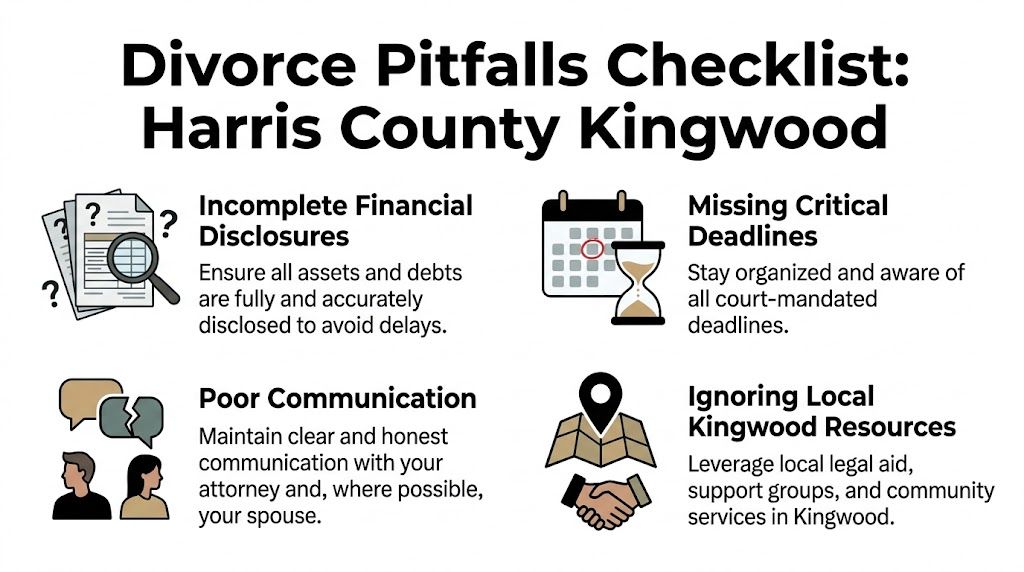
The mistakes that create expensive problems
Some problems delay your case for a few weeks. Others follow you for years because the final decree does not say clearly who gets what, who pays what, or how transfers are supposed to happen.
Watch for these trouble spots:
- Leaving out accounts, debts, or property. That includes old retirement plans, credit cards, reimbursements, restricted stock, side business income, and personal property people forget until the very end.
- Using forms that are too generic. A form may get you started, but it usually does not cover the details that matter when you own a home, have children, or need precise turnover language.
- Handling service casually. If your spouse is cooperative, fine. If not, choose your service method carefully and do it right the first time.
- Signing a decree you do not really understand. If a paragraph is vague, it will cause a fight later.
- Assuming courthouse staff can give legal guidance. They can explain process. They cannot tell you what strategy protects you.
The final decree is the rulebook. If the rulebook is sloppy, the conflict does not end. It just gets postponed.
Practical checks before you file or finalize anything
If you are filing for divorce in harris county kingwood, do these five things before you put your name on anything:
- Confirm residency and venue. File in the right county and at the right time.
- Pull your documents yourself. Tax returns, pay stubs, bank statements, mortgage information, retirement balances, insurance, and debt records should be in one folder before filing.
- Read every requested order line by line. Do not skim the petition, waiver, or decree.
- Plan for the courthouse reality. Downtown filing takes time, parking is inconvenient, security lines move slowly, and missing one document can waste half a day.
- Draft for enforcement, not optimism. If the order depends on both spouses “working it out later,” it is not finished.
That fourth point matters for Kingwood residents. The drive to the Harris County Civil Courthouse is long enough that small filing mistakes become real costs in missed work, child care problems, and repeat trips downtown.
Local and practical resources
Start with official or reputable help. Skip message boards and social media legal advice.
Useful options include:
- Harris County District Clerk information for filing logistics, court records, and basic case status information
- Texas Law Help and legal aid directories for approved self-help materials and low-cost assistance options
- Houston-area legal aid programs for qualifying residents who need civil legal support
- Community support in Kingwood and Northeast Houston for counseling, co-parenting support, and practical transition help
Legal help is only part of this. If the emotional side is hitting you hard, get support there too. This guide on healing after divorce is a useful place to start.
My advice is simple. Get organized early, draft carefully, and do not confuse an agreeable conversation with a safe legal plan. For many Kingwood clients, the cheapest move is getting good advice before the filing trip downtown, not after a bad decree has to be fixed.
Your Next Steps and Frequently Asked Questions
If you’ve made it this far, you already know more than individuals typically do when they first begin. That alone helps. Divorce in Harris County doesn’t become easier because you ignore it. It becomes easier when you break it into steps, get your facts together, and stop guessing.
If the emotional side feels heavier than the legal side right now, that’s normal too. For many people, practical legal action and personal recovery happen at the same time. This resource on healing after divorce may help you think about the next chapter while you handle the court process.
Frequently asked questions
What happens if my spouse lives out of state?
You may still be able to file in Harris County if the residency requirements are otherwise met. The issue then becomes proper service and whether the Texas court has authority over the specific issues in your case.
How long after the final decree can I get remarried?
That depends on the terms of the decree and applicable Texas rules. It’s a question worth asking directly before making plans.
How do I legally change my name back after the divorce?
In many cases, the divorce decree can restore a prior name if that request is included properly. It’s much easier to handle this during the divorce than to fix it afterward.
If you live in Kingwood, Humble, Porter, or Northeast Houston and you’re ready for clear answers about your divorce, schedule a free consultation with Law Office of Bryan Fagan – Kingwood TX Lawyers. We’ll help you understand where to file, what to do next, and how to avoid the mistakes that slow Harris County cases down.