Skip to content
When parents in Kingwood call about custody, the first thing they usually talk about isn’t paperwork. It’s the knot in their stomach.
They’re worried about bedtime routines, school pickup, missed soccer practice, and whether their child will feel caught in the middle. A parent in Humble may be wondering if moving out of the house will hurt their case. A parent in Porter may be lying awake trying to figure out what “custody” even means in Texas. Many people looking for a child custody attorney near Lake Houston aren’t trying to start a fight. They’re trying to protect their child and make careful decisions in a hard season.
That fear is understandable. Family cases feel personal because they are personal. The legal system can seem cold and technical at the exact moment your family feels most fragile. What helps is breaking the process into plain language and focusing on what matters most: your child’s stability, safety, and future.
Navigating a Difficult Path Your Family's Future in Kingwood
Many parents reach this point.
One evening, the kids are finishing homework at the kitchen table in Kingwood. The next, you’re searching online for answers because your relationship is changing and you don’t know what comes next. You may be asking yourself whether you’ll still see your child every day, who will make school decisions, or what happens if the other parent won’t cooperate.

That uncertainty is heavy. It touches everything. Work. Sleep. Finances. The way you talk to your children. Even simple decisions can feel loaded when you don’t know what a judge might think later.
What worried parents usually need first
Most parents don’t need a dramatic legal lecture on day one. They need calm, reliable direction.
They need to know:
- What Texas courts care about: Not who’s louder or more angry, but what arrangement supports the child’s well-being.
- What to do next: Whether to file, wait, gather records, or avoid saying something that could complicate the case.
- What local courts are like: A custody matter for a family in Northeast Houston doesn’t move in a vacuum. Local procedure matters.
- How to protect the child from conflict: That often starts with the parent staying steady and informed.
Practical rule: If you’re making a custody decision while angry, pause and get advice before you act.
Parents in Kingwood, Humble, and nearby neighborhoods often feel pressure to solve everything immediately. You don’t have to figure out the whole case tonight. You do need to avoid avoidable mistakes, especially around text messages, informal schedule changes, and moving children without a clear agreement.
A local guide matters
A custody case isn’t only about legal theory. It’s about your actual week. School drop-off. Therapy appointments. Transportation across Northeast Houston. Family support nearby. The child’s comfort with each home.
That’s why many families want a lawyer close to Lake Houston who understands how these issues look on paper and in real life. Good guidance should make the process feel less mysterious. It should turn a blur of anxiety into a set of clear choices.
If you’re in Kingwood and searching for answers, start with this: the situation may feel overwhelming, but it isn’t unmanageable. Once you understand how Texas custody law works and how Harris County courts handle these cases, the path becomes much clearer.
Understanding Texas Custody What 'Best Interest' Really Means
In Texas, people often say “custody,” but the legal terms are a little different.
Conservatorship means decision-making rights and duties.
Possession and access means the parenting schedule, or when each parent has time with the child.
The core rule comes from Texas Family Code § 153.002, which says courts must decide custody based on the best interest of the child. Texas courts often favor joint managing conservatorship, and one cited source states that it occurs in over 85% of cases, while also noting that children in joint custody have 20-30% lower rates of behavioral issues (Texas child custody overview).
Think of best interest as a checklist
Parents sometimes assume the court is looking for a “better parent.” That isn’t usually the right lens.
A Harris County judge is looking at a wider picture. Consider it a checklist with several boxes:
- Safety: Is the child physically safe with each parent?
- Stability: Who can provide a reliable home routine?
- Emotional needs: Who understands the child’s daily needs and follows through?
- Parental judgment: Who makes sound decisions about school, medical care, and discipline?
- Cooperation: Which parent is more likely to support the child’s relationship with the other parent?
If one parent has concerns about instability, substance abuse, or poor judgment, those concerns need evidence behind them. Judges don’t decide these cases based on suspicion alone.
Conservatorship is not the same as a visitation schedule
This confuses many good parents.
You can share decision-making and still have a detailed possession schedule. Or one parent can have stronger decision-making authority while the other still has meaningful parenting time. These are related issues, but they are not identical.
Here’s a simple side-by-side view.
Texas Conservatorship at a Glance Joint vs. Sole
| Feature | Joint Managing Conservatorship (JMC) | Sole Managing Conservatorship (SMC) |
|---|---|---|
| Basic idea | Parents share important rights and duties | One parent receives primary decision-making authority |
| Decision-making | Shared, or split by topic depending on the order | Usually centralized with one parent |
| When courts use it | Often when both parents can safely stay involved | Often when conflict, abuse, neglect, or serious instability is present |
| Parenting time | Can still vary based on the child’s needs | The other parent may still have possession and access, sometimes with limits |
| Court focus | Ongoing parental involvement where appropriate | Protection and stability when shared authority isn’t workable |
For many families near Lake Houston, the primary issue isn’t “joint or sole” in the abstract. It’s how school choices, medical decisions, and daily logistics will work once the order is signed. Parents who understand that difference are usually better prepared to negotiate sensible terms.
For example, a child in Kingwood who plays team sports may need a schedule that protects consistency across both homes. If your child is active in school or athletics, resources on the lasting benefits of youth sports for your child can help frame why routine, participation, and parental support matter so much during family transitions.
The strongest custody presentations usually sound practical, not theatrical. Judges want workable plans for real children.
Parents often ask whether “shared custody” means a perfectly equal split. Not necessarily. Texas families use different schedules, and the right one depends on distance, school demands, work hours, and the child’s age. If you want a plain-language overview of how these arrangements are structured, this guide on shared custody in Texas is a helpful starting point.
The Local Advantage Navigating Harris County Family Courts
For families in Kingwood, custody is local in a very practical way.
Your case will likely run through Harris County, and that matters because Harris County is busy. One cited source states that the county handles over 15,000 divorces annually, and for many Kingwood residents the drive to the Harris County Civil Courthouse is about 35-40 minutes, with trial delays that can average 6-12 months (Harris County family law overview).
Volume changes strategy
When a court system handles that many family cases, timing becomes part of the legal strategy.
A parent may think, “I’ll just explain everything to the judge soon.” In reality, your first important decisions often happen long before a final trial. Temporary orders, document exchanges, school records, calendars, and communication history can shape the case early.
That’s one reason local court knowledge helps. A lawyer familiar with Harris County family courts knows that procedure, pacing, and preparation matter as much as the headline dispute.
What local experience looks like in practice
For a Kingwood or Humble parent, local familiarity can help with issues like:
- Filing decisions: Knowing how to frame the initial requests in a way that fits the facts and the court’s expectations.
- Temporary hearings: Preparing for the first appearance where living arrangements, support, and communication rules may be addressed.
- Scheduling realities: Understanding that court congestion can affect bargaining position, settlement timing, and the need for interim solutions.
- Practical presentation: Organizing school records, messages, and parenting history in a way judges can follow easily.
A custody case isn’t won by saying the same point ten different ways. It’s built by presenting a steady, credible picture of your parenting.
Why geography matters for Lake Houston families
Distance affects real parenting issues. A family in Porter may be juggling a commute, after-school care, and exchange logistics. A family in Northeast Houston may be dealing with one parent who works irregular shifts. A family in Kingwood may need to keep the child anchored in the same school and activities while the case moves forward.
Those details aren’t side notes. They often sit at the center of a workable order.
A good custody plan should fit the child’s real life in Kingwood, not an idealized schedule that collapses after two weeks.
That’s why people searching for a child custody attorney near Lake Houston are often right to focus on local court experience. Convenience matters. But strategy matters more. Knowing how Harris County operates can reduce surprises and help parents make decisions that support both the case and the child.
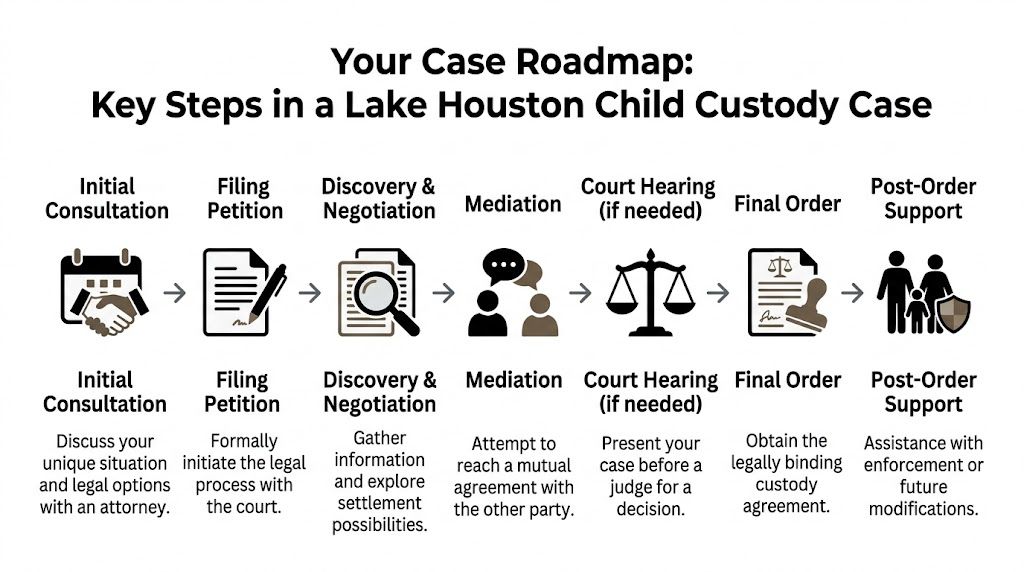
Your Case Roadmap Key Steps in a Lake Houston Custody Case
Most custody cases feel less intimidating once you can see the path.
The exact details vary, but many cases in Kingwood and Northeast Houston move through the same general stages. Texas strongly encourages alternative dispute resolution, and one cited source states that mediation success has reached 75% statewide, with 60-70% of custody cases resolving without a full trial (Texas mediation and family law process).
Step one starts with information
At the beginning, your lawyer needs a clear picture of your family’s current reality.
That includes where the child has been living, who handles school and medical care, whether there are safety concerns, and what kind of schedule has been working or failing. If you’re preparing for that first major meeting or hearing, this resource on how to prepare for a custody hearing can help you gather the right records and avoid last-minute stress.
The usual path through a custody case
Initial consultation
You explain what’s happening. The lawyer identifies immediate risks, urgent deadlines, and realistic next steps.Filing the case
One parent files the petition that formally opens the matter in court. This tells the court what orders are being requested.Service and response
The other parent must receive legal notice and has the chance to respond. This stage often sets the tone for whether the case will be cooperative or contested.Temporary orders
If parents need rules in place quickly, the court may enter temporary orders. These can address where the child lives, temporary support, and how exchanges happen while the case is pending.Discovery
Both sides gather information. That may include messages, school records, calendars, photos, medical records, or witness statements, depending on the issues in dispute.Negotiation and mediation
Many cases settle here. Parents work through a structured process to try to reach an agreement the court can approve.Final orders or trial
If the parents agree, the court can sign off on the settlement. If not, the judge decides the disputed issues after hearing evidence.
What each phase feels like for a parent
The emotional experience changes as the case moves.
Early on, most parents feel urgency. During discovery, they often feel frustrated because the process seems slower than expected. Mediation can bring relief because it creates room for practical problem-solving instead of public conflict in a courtroom.
Trial is usually the last resort. It’s sometimes necessary, especially when one parent won’t compromise or there are serious welfare concerns. But many families benefit from resolving the case before that point.
A few mistakes to avoid
- Don’t use your child as a messenger: It puts pressure on the child and often creates evidence that hurts both parents.
- Don’t rely on verbal side deals: If something matters, it should be documented properly.
- Don’t dump raw screenshots on your lawyer: Organize your evidence by issue, date, and relevance.
- Don’t confuse emotion with proof: Strong feelings are real, but court decisions turn on facts.
Keep a simple parenting journal. Dates, exchanges, school issues, missed calls, and medical concerns are easier to use when they’re recorded consistently.
One practical option many Lake Houston families consider is working with a focused local family practice. The Law Office of Bryan Fagan – Kingwood TX Lawyers handles child custody matters from its Kingwood office and can assist with filing, temporary orders, settlement efforts, and post-order issues.
The roadmap matters because uncertainty is exhausting
Parents do better when they know what stage they’re in and what the next job is.
You may not control the other parent’s behavior. You can control your preparation, your communication, and the quality of the evidence you bring forward. In a custody case, that steady approach often does more good than a dramatic one.
Beyond the Basics Custody for Special Needs and Modifications
Some custody cases don’t fit a standard pattern.
A child with developmental, medical, behavioral, or educational needs may require a parenting plan that looks very different from the usual schedule. One cited source notes that this is an underserved area in family law and states that about 15% of Texas families are dealing with special needs concerns, while Texas Family Code §153.254 allows customized possession orders for a child’s unique needs (special needs child custody guidance).

Standard orders don’t always fit special needs families
A child may need therapies several times a week. A medication routine may need exact timing. School support may depend on a detailed IEP, sensory accommodations, or consistent transportation.
In those situations, a generic order can create conflict instead of stability.
Parents in Kingwood sometimes come in assuming the court will only choose from a narrow menu of standard options. That’s not always true. When the facts support it, the order can be designed around the child’s actual needs.
For families learning more about developmental conditions, educational material on Autism Spectrum Disorder can be useful as general background alongside advice from local medical and school professionals.
What customized custody terms may address
A well-drafted order might speak directly to issues such as:
- Therapy continuity: Which parent takes the child to speech, occupational, behavioral, or physical therapy.
- Medical decision-making: How parents communicate about appointments, prescriptions, and specialist recommendations.
- School coordination: Responsibility for ARD meetings, IEP communication, tutoring, or accommodations.
- Transition planning: How exchanges happen if abrupt transitions are hard on the child.
- Respite and support services: How each parent handles outside care and support programs.
These details can reduce future conflict because the order answers the questions before a disagreement starts.
Modifications matter when life changes
Custody orders aren’t always permanent in their original form.
A child’s needs may change. One parent may move. A work schedule may shift. A once-manageable arrangement may stop working as the child grows older. When that happens, a modification may be the right step if there has been a material and substantial change in circumstances.
That can be especially important in special needs cases. A plan that worked when a child was six may fail by age ten if school supports, therapies, or medical demands become more involved.
Here’s a helpful overview for families dealing with those harder realities.
Parents of children with special needs often need orders that are more specific, not less. Precision can protect peace.
What to bring to a consultation in these cases
Bring the records that tell the child’s daily story.
That may include school plans, therapy schedules, medication instructions, communication from providers, and notes showing what routines help the child function well. In modification cases, it also helps to bring the current court order and a clear explanation of what has changed since it was signed.
These cases call for patience and careful drafting. For many families in Humble, Porter, and Kingwood, that attention to detail makes the difference between an order that exists on paper and one that works in daily life.
Choosing Your Advocate Questions to Ask a Custody Attorney
Hiring a custody lawyer is a big decision. You’re not just buying paperwork. You’re choosing the person who will help present your parenting, your concerns, and your future to the court.
That means the consultation should be a two-way conversation. You’re not only telling your story. You’re also evaluating whether the attorney is a good fit for your family.
Questions worth asking in a consultation
Some questions lead to much better answers than “Have you handled custody cases before?”
Try asking:
How often do you handle custody matters in Harris County?
Local court familiarity matters because procedure and expectations can differ from one county to another.What issues in my case stand out to you right away?
A thoughtful attorney should identify concerns, opportunities, and likely pressure points.Would you expect negotiation, mediation, or litigation in a case like mine?
You want to hear how the lawyer thinks, not just whether they promise to “fight.”What records should I start gathering now?
Good answers are usually practical. School records, calendars, medical notes, communications, and financial information often matter.How do you handle communication with clients?
Ask who returns calls, how updates are given, and how quickly you can expect responses.What does a realistic first phase of this case look like?
This helps you understand likely early steps instead of focusing only on the final hearing.
If you’re comparing attorneys in the Kingwood area, this page about working with a child custody lawyer in Kingwood, TX may help you think through what local representation can involve.
Ask about style, not just credentials
Two lawyers can both know family law and still practice very differently.
One may be highly settlement-focused. Another may prepare every file as if trial is likely. Neither approach is automatically right or wrong. What matters is whether the strategy fits your case.
A parent dealing with a cooperative co-parent may want efficient drafting and strong mediation skills. A parent dealing with dangerous behavior, manipulation, or repeated violations may need a more aggressive enforcement posture.
The right attorney should be able to explain strategy in plain English, without hiding behind jargon.
Understanding common fee structures
Parents often feel awkward asking about fees. They shouldn’t. Cost clarity is part of good representation.
Family lawyers commonly use one of these billing approaches:
| Fee structure | How it usually works | Why it matters |
|---|---|---|
| Retainer with hourly billing | You deposit funds up front, and work is billed against that amount | Common in contested custody matters because the workload can change |
| Flat fee for limited tasks | A set amount covers a defined service | More common for narrow, predictable work |
| Hybrid arrangements | Part of the work may be fixed, while the rest is hourly | Useful when some issues are clear but conflict may grow |
Ask what is included, what triggers additional billing, and how expenses are handled. A clear fee conversation early can prevent frustration later.
Green flags during the meeting
Look for a lawyer who listens closely and asks detailed follow-up questions.
Strong signs include:
- Clear explanations: You leave understanding more than when you arrived.
- Balanced judgment: The attorney doesn’t promise unrealistic outcomes.
- Child-centered thinking: The focus stays on workable parenting and legal protection.
- Practical next steps: You’re told what to gather, what to avoid, and what decision comes first.
If the conversation feels rushed, vague, or overly dramatic, keep looking. In family law, steady judgment is often more valuable than flashy language.
Your Next Step with Kingwood's Trusted Family Law Team
A custody case can make everyday life feel unstable. That doesn’t mean you have to face it alone.
Parents in Kingwood, Humble, Porter, and Northeast Houston usually feel better once they understand three things: what Texas courts care about, how Harris County procedure affects the case, and what practical steps can protect their child right now. Clarity lowers stress. Preparation lowers risk.
If you’re searching for a child custody attorney near Lake Houston, focus on someone who can explain the law plainly, stay grounded under pressure, and build a parenting plan around your child’s real needs. That’s especially important if your case involves school concerns, schedule conflicts, special needs planning, or a request to modify existing orders.
A confidential conversation can help you sort out what matters immediately and what can wait. If you’re ready to talk through your situation, schedule a free consultation at the Kingwood office and get guidance specific to your family.
Frequently Asked Questions About Child Custody in Texas
Some questions come up in almost every consultation. Here are short answers to a few of the most common ones we hear from parents around Lake Houston.
FAQs
| [object Object] | [object Object] | [object Object] |
|---|---|---|
| Can I move out of the house before custody is decided? | Sometimes, but it depends on the facts. Moving out without a plan can affect the day-to-day schedule and create new arguments. Get legal advice before making that decision. | Do judges listen to what my child wants? |
| A child’s preferences may matter in some situations, but the court still decides based on the child’s best interest. A child’s wishes are only one part of the larger picture. | What if the other parent keeps violating our agreement? | Keep records. Save messages, note missed exchanges, and document patterns. A court order can be enforced, but you’ll need proof and a clear timeline. |
| Do I need a lawyer if we already agree? | Even in an agreed case, the paperwork needs to be done correctly so the order is enforceable and complete. Informal deals often create problems later. | How should I communicate with the other parent during the case? |
| Keep it brief, polite, and focused on the child. Avoid sarcasm, threats, and long emotional texts. Assume a judge could read every message one day. | Can a custody order be changed later? | Yes, if the legal standard for modification is met. The key question is whether circumstances have changed enough to justify a new order. |
If your question isn’t listed here, that’s normal. Every family in Kingwood has its own facts, routines, and concerns. A short consultation can often answer questions that internet research can’t.
If you're dealing with a custody dispute, schedule a free consultation with Law Office of Bryan Fagan – Kingwood TX Lawyers. Our Kingwood team helps families in Kingwood, Humble, Porter, and Northeast Houston understand their options and move forward with clear, practical guidance.