Skip to content
Your phone rings while you're at work in Kingwood. A school staff member says your child looked scared at pickup. Or a neighbor tells you the other parent drove off smelling like alcohol. Or you get a text that sounds like a threat to leave Humble or Porter with your child before you can do anything about it.
In that moment, legal jargon is useless. You need to know what action fits the danger, what proof matters, and what a judge in Harris or Montgomery County is likely to do next.
Parents searching for Emergency Custody vs Temporary Custody in Texas Kingwood usually aren't comparing academic definitions. They're trying to answer a harder question: Do I need to act today, or do I need to build a temporary plan for the months ahead?
That distinction matters. If your child faces immediate danger, you may need emergency relief right away. If the situation is unstable but not a same-day safety crisis, temporary orders are usually the better path. Picking the wrong tool can waste time you don't have.
When Your Child's Safety Is at Risk A Kingwood Parent's Dilemma
A parent in Northeast Houston might wake up to a normal Tuesday and end the day in a courthouse hallway. That's how these cases often start. Not with a neat legal timeline, but with panic, incomplete facts, and the sick feeling that your child may not be safe.

I've seen the same pattern over and over with families in Kingwood, Humble, and Porter. A parent gets a call from a teacher. A relative sends photos of unsafe living conditions. A child says something alarming after a weekend exchange. Then the parent asks the question that really drives everything: What can I do right now?
The answer depends on whether you're dealing with a true emergency or a serious custody dispute that needs structure. Those are not the same thing, and Texas courts don't treat them the same way.
The crisis question most parents ask
Some parents need the court to act fast because the risk is immediate. Others need the court to create rules because the other parent is chaotic, manipulative, or unreliable. Both are serious. Only one usually qualifies for emergency relief.
Practical rule: If your concern is immediate harm, focus on urgent protection. If your concern is instability, focus on getting enforceable temporary rules in place.
That sounds simple. It isn't when you're in the middle of it.
A parent in Kingwood may know the other parent has been reckless for months. That history matters. But if there's no immediate threat at the moment of filing, the court may steer the case toward temporary orders instead of emergency custody. On the other hand, if the child is exposed to abuse, severe neglect, active substance abuse, or a real abduction risk, waiting for the ordinary process can be a mistake.
What you should do before emotions take over
When fear hits, people often lead with outrage. Courts want proof.
Start here:
- Write down the timeline: Who called, what happened, when it happened, and where the child is now.
- Save the evidence: Text messages, voicemails, photos, school messages, medical papers, police paperwork, and names of witnesses.
- Stay controlled in communication: Don't send threats, insults, or long emotional messages to the other parent.
- Call a lawyer fast if the risk is immediate: Delay helps the other side shape the story first.
If you're in Kingwood, Humble, or Northeast Houston and your child may be in danger tonight, stop debating terminology. Figure out which filing gives the judge a lawful reason to step in now.
Understanding the Two Legal Paths for Child Custody
Texas gives parents two different legal routes, and the choice you make at the courthouse matters. Pick the wrong one, and you can lose time, lose credibility, and leave your child exposed while the case slows down.
Under Texas guidance on temporary orders in custody cases, emergency custody is aimed at immediate danger and can move fast, while temporary orders are used to set rules for custody, visitation, support, and decision-making while the case is pending. That same guidance separates ordinary temporary orders from restraining or protective relief tied to safety threats. In Kingwood cases, that distinction often controls what you file first in Harris County or Montgomery County.
Emergency custody is the fast protection tool
Emergency custody works like a fire alarm. You use it when the child faces immediate risk and the judge needs sworn facts showing why waiting even a few days is unsafe.
That means specifics.
If you are asking for emergency relief, walk into court ready to show dates, texts, photos, police reports, medical records, school notices, witness names, and a clear statement of where the child is right now. Judges in this area do not grant emergency relief because a parent is irresponsible in general. They grant it when the evidence shows a current threat such as abuse, severe neglect, active drug use around the child, or a serious risk that the child will be hidden or taken.
Temporary custody is the structure order
Temporary custody usually comes through temporary orders in a pending SAPCR or divorce. This is the court's short-term operating plan for your family while the case moves toward final orders.
These orders can decide who has the right to determine the child's residence, what the possession schedule looks like, how exchanges happen, who pays support, who makes school and medical decisions, and what communication rules apply. If you need a practical explanation of that process, read our guide on temporary custody orders in Texas.
Temporary orders can also limit a parent's access when the facts support it. Texas materials describe a significant threshold for restrictions tied to family violence and safety concerns. That matters because many parents assume temporary orders are casual or easy to change. They are not. In practice, temporary orders often shape the rest of the case.
Emergency relief asks what the court must do today to protect the child. Temporary orders ask what rules the family must follow until the case is finished.
What Kingwood parents should understand before filing
The legal definition is only part of the problem. The harder question is what to do first.
If your child is in immediate danger tonight, you may need a TRO, an emergency request for temporary relief, or both, depending on the facts and the county where you file. If the danger is serious but not immediate this hour, you may be better served by pushing for temporary orders with strong evidence and a fast hearing date instead of overreaching with an emergency claim the court may reject.
That decision is strategic. It should be made with the courthouse process in mind, not just with emotion.
Parents with children who have medical, educational, or behavioral needs need even more precision. Temporary orders may need to address therapy attendance, medication decisions, school contact rules, transportation, and communication protocols between parents. If your family is dealing with those issues, this resource on how to collaborate on autism care can help you think through the practical side of co-parenting structure.
Do not blur these two paths together. In Kingwood custody cases, the parent who files the right request with the right proof usually stands in a much stronger position from the start.
Emergency Custody vs Temporary Custody A Detailed Comparison
Parents in Kingwood often want a clean answer. Here it is. Emergency custody is about urgent protection. Temporary custody is about interim stability. The court treats them differently because the job of each order is different.
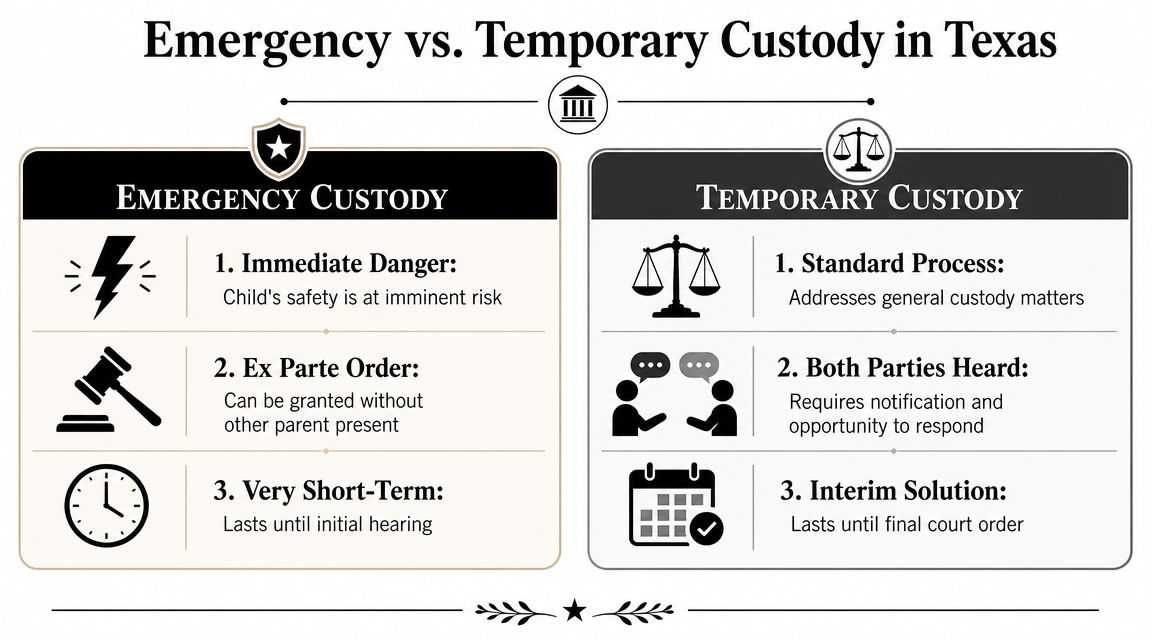
Emergency Orders vs Temporary Orders at a Glance
| Feature | Emergency Custody Order | Temporary Custody Order |
|---|---|---|
| Primary purpose | Immediate protection from imminent danger | Day-to-day structure while the case is pending |
| Main legal focus | Current risk to the child | Best-interest planning and interim management |
| Speed | Can move very quickly | Usually follows the standard court process |
| How it starts | Sworn emergency request based on urgent facts | Motion for temporary orders in a pending case |
| Type of proof | Verified pleading, affidavit, urgent supporting documents | Broader evidence about parenting, routine, and child needs |
| Other parent's role at first | Relief may be sought before a full hearing | Notice and a chance to respond are central |
| How long it lasts | Short-lived emergency relief | Continues until final orders replace it |
| Common issues covered | Immediate possession, safety restrictions, access limits | Conservatorship, possession, support, and household rules |
Speed and duration are not minor details
The timeline is one of the biggest differences. According to Texas emergency custody guidance discussing follow-up hearings, after an emergency order is granted, the follow-up hearing is typically scheduled within 14 days to decide whether to extend, modify, or dismiss it. That same guidance notes that emergency protective orders commonly last 20 days, which shows how short-term emergency relief is compared with temporary custody arrangements that remain in place until final orders are entered.
That matters in Harris and Montgomery County practice because many parents assume an emergency order solves the whole case. It doesn't. It buys time and protection. Then you still have to prove what should happen next.
The evidence burden is much higher in emergency cases
Emergency filings live or die on specifics. A judge doesn't want general complaints like "he's unstable" or "she's impossible to deal with." A judge wants concrete facts tied to immediate harm.
Use emergency relief when you can show things like:
- Immediate safety threats: Abuse, severe neglect, or dangerous conditions happening now.
- Substance-driven danger: Drug or alcohol use connected to the child's present safety.
- Abduction concerns: Threats or conduct showing the child may be taken and withheld.
- Corroboration: Documents or witness statements that support your sworn account.
Temporary orders require proof too, but the lens is wider. The court can look at schooling, routines, communication problems, caregiving history, transportation, work schedules, and the practical needs of a family in Kingwood or Humble.
Critical distinction: If your proof shows "this parent is difficult," you're likely in temporary-orders territory. If your proof shows "this child is in immediate danger," you're in emergency territory.
The hearing posture changes your strategy
Emergency custody often starts with speed and sworn papers. Temporary custody usually unfolds through notice, preparation, negotiation, mediation when required, and a scheduled hearing where both sides present evidence.
That means your strategy should change too.
If you're pursuing emergency relief, your first move is building a narrow, urgent record. If you're seeking temporary orders, your first move is building a fuller picture of the child's life and what structure will work. For local help focused on urgent filings, our page on emergency custody orders in Kingwood explains how these requests fit into a Texas custody case.
What this means for Kingwood parents
Parents in Northeast Houston often come in asking for "full custody" when what they need is one of three things:
- Immediate safety restrictions
- A short-term possession change
- A stable temporary framework until trial
Those are different requests. Asking for all of them without a strategy usually weakens the case.
The right filing should match the facts. If the house is on fire, use emergency relief. If the family needs rules, use temporary orders. If the immediate goal is stopping a dangerous act without changing custody right away, a TRO may be the smarter first step.
When to Seek an Emergency Order Real Scenarios for Kingwood Families
Parents usually know when something feels wrong. The harder question is whether the facts rise to the level a Texas court will treat as an emergency. The standard is high, and it should be. Courts don't strip access from a parent on hunches.

Under Texas guidance on emergency custody grounds and proof, courts look for immediate danger from abuse, neglect, substance abuse, or abduction risk, supported by a verified pleading or affidavit. That same guidance notes the follow-up hearing is typically set within about 14 days after the emergency order issues. It also points to the kinds of proof that make filings stronger, including police reports, medical records, CPS material, and witness affidavits.
Scenario one involves a real abduction risk
A parent tells you they're taking the child and you'll never see them again. Then they pull the child from school, stop answering calls, or make travel plans that don't fit the existing arrangement.
That can justify emergency relief when the threat is credible and immediate. Judges care less about dramatic language than conduct that shows the risk is real.
Helpful proof includes:
- Texts or emails showing the threat
- School messages confirming unusual pickup or withdrawal
- Travel records or itinerary evidence if available
- Witness statements from relatives, teachers, or neighbors
Scenario two involves substance abuse tied to current danger
A lot of custody cases involve accusations of drinking or drug use. Not all of them justify emergency action. If the concern is historical or vague, the court may leave that for temporary orders or trial.
But if the other parent is actively impaired while caring for the child, driving with the child, or exposing the child to dangerous people or conditions, that is different.
Judges respond to present-tense danger. They don't respond well to broad character attacks.
Photos, police contact, medical records, and sworn witness accounts matter here. So does your own affidavit if it is detailed, chronological, and factual.
Scenario three involves abuse or severe neglect
This is the clearest emergency category. If a child reports physical abuse, if there are injuries, or if the living conditions are dangerous enough to threaten the child's safety, emergency relief may be necessary.
The biggest mistake parents make is waiting too long while trying to gather perfect evidence. You need proof, but you also need speed.
What to preserve right away:
- Photos of injuries or dangerous conditions
- Medical paperwork from urgent care, ER, or pediatric visits
- CPS communications if CPS has been contacted
- Statements from adults who observed the child or the scene
Scenario four is abandonment or disappearance
Sometimes the issue isn't aggression. It's absence. A parent disappears, leaves the child with inappropriate caregivers, or stops functioning in a way that leaves the child exposed.
That can support emergency action if the child lacks safe supervision or if the parent's conduct creates immediate instability. The key is showing the judge that the danger is current, not theoretical.
For Kingwood families, the practical takeaway is straightforward. If your facts show imminent risk plus sworn proof, emergency custody may fit. If the danger is serious but not immediate, temporary orders may be the more realistic and more effective path.
Navigating the Temporary Orders Process in Harris and Montgomery Counties
Most custody cases in Kingwood don't start with flashing lights. They start with a parent realizing the current arrangement is unsustainable. One parent keeps the child late. School decisions are chaotic. Support isn't being paid. Exchanges turn ugly. The child needs routine, and nobody agrees on the rules.
That is where temporary orders do the heavy lifting.
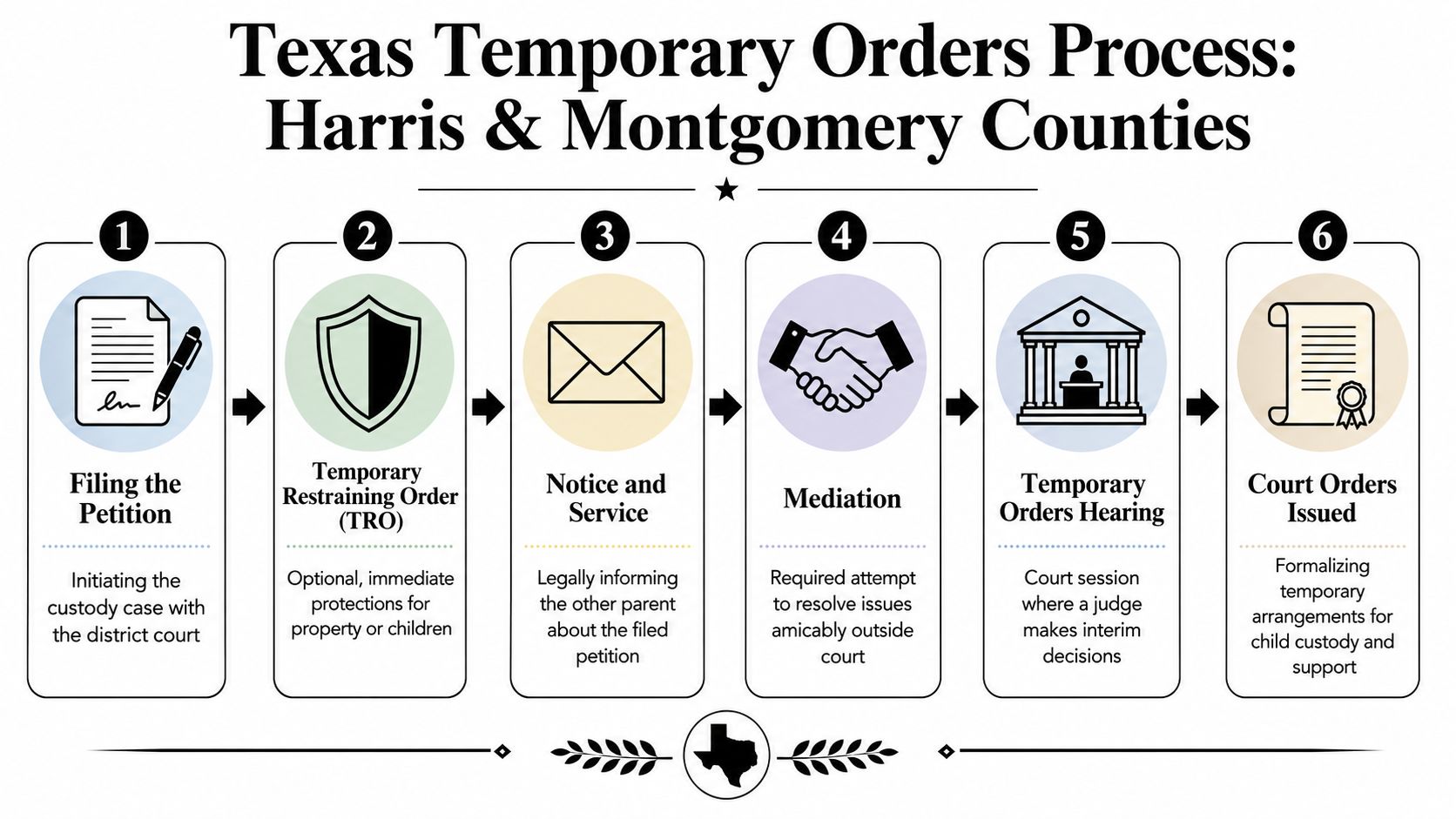
For a local overview of forum, filing, and practical court expectations, review our guide to navigating Harris County family court from Kingwood.
Step one is filing the right case and motion
Temporary orders don't float on their own. They typically sit inside a pending family case, often a SAPCR, divorce, or modification. If you need the court to set temporary conservatorship, possession, child support, or household rules, the pleadings have to ask for it clearly.
A sloppy filing causes delays. A narrow filing can leave out protections your child needs.
Step two is service and notice
The other parent must be properly served unless you're in a true emergency situation handled differently by the court. This is one place where do-it-yourself filings often fall apart. If service is defective, your hearing may go nowhere.
In Harris and Montgomery Counties, judges expect parties to respect procedure. Good facts can still get buried under bad process.
Step three often includes negotiation or mediation
Many local courts expect serious effort to resolve temporary issues before the hearing. That doesn't mean giving in. It means being prepared with a reasonable parenting proposal, school plan, exchange terms, and financial positions.
This video gives a useful overview of how temporary orders fit into a Texas family case:
Step four is building a best-interest case
Temporary orders are not won by sounding more upset than the other side. They're won by showing the judge a workable plan tied to the child's needs.
Bring practical evidence such as:
- School information: Attendance issues, schedules, teacher concerns, special programs
- Medical details: Appointments, prescriptions, therapy routines, provider contacts
- Parenting history: Who handles bedtime, homework, meals, transport, and discipline
- Communication records: Clear examples of cooperation or interference
The parent who looks organized, child-focused, and realistic usually starts ahead.
Step five is preparing for what the judge actually cares about
Judges in Harris and Montgomery County family courts usually want to know which arrangement will reduce conflict and protect the child's routine while the case is pending. They aren't impressed by score-settling. They want specifics.
That means you should be ready to answer questions like these:
- Where will the child sleep on school nights?
- Who gets the child to school and activities on time?
- How will medical decisions be made?
- What exchange plan reduces conflict?
- What temporary support terms are realistic?
Parents in Kingwood, Humble, and Northeast Houston do better when they treat temporary orders like a working blueprint, not an emotional referendum on the relationship. The judge is looking for structure that can function immediately.
Choosing Your First Step A TRO vs Full Emergency Custody
A lot of parents use the phrase "emergency custody" when what they really want is a court order that stops dangerous conduct immediately. Those are not always the same request.
The practical question is this. Do you need to change who has the child right now, or do you need to stop the other parent from doing something dangerous while you prepare for a hearing?
A TRO can create breathing room
According to TexasLawHelp's explanation of temporary orders and TROs, a Texas TRO can be issued quickly and can last up to 14 days, but it cannot include custody or child support orders. Temporary orders, by contrast, can include temporary conservatorship after a hearing. Texas guidance also separates TROs from temporary orders and notes that temporary orders require a pending SAPCR.
That means a TRO can be useful when your immediate objective is to stop conduct such as harassment, interference, concealment, or unsafe behavior while the case moves toward a hearing. It is a shield. It is not a same-day custody rewrite.
Full emergency custody is the stronger and riskier ask
A request for emergency custody seeks immediate court intervention over possession or access based on urgent danger to the child. That is a bigger ask, and the evidence has to be stronger.
If you overreach, you can lose credibility. Parents in Kingwood sometimes file for emergency custody when the facts really support a TRO plus a fast temporary-orders hearing. That mistake can make the whole case harder.
Use this rough decision guide:
- Choose a TRO first when you need immediate restrictions but don't yet have the proof for an emergency conservatorship change.
- Choose emergency custody when the child's current placement itself is the danger.
- Choose temporary orders when the issue is instability, not imminent harm.
Strategy matters more than labels
The smartest move isn't always the most aggressive move. Sometimes the right first filing is the one that creates safety without asking the judge to decide too much too fast.
If family violence is part of the picture, it can also help to review broader legal context from outside your area, such as this guidance on protective orders in Austin. The local court where you file matters, but the core strategic lesson is the same. Match the order to the danger.
Ask for the relief you can prove today, not the relief you wish the judge would grant eventually.
That approach is more disciplined, more credible, and usually more effective.
Why You Need a Local Kingwood Custody Lawyer on Your Side
It is 4:15 p.m. on a Friday. Your child is supposed to be returned in Kingwood, but the other parent is missing, intoxicated, or threatening to leave with the child. At that point, you do not need general legal information. You need a filing plan, the right evidence in hand, and someone who knows which courthouse can act fast.
That is why local counsel matters in custody emergencies. These cases turn on proof, timing, and judgment under pressure. A lawyer who regularly handles Kingwood-area cases knows the difference between a request that gets heard and a request that gets rejected as overblown.
Local knowledge affects practical decisions from the first hour. Harris County and Montgomery County do not always move the same way, clerks do not all handle urgent filings the same way, and judges want specific facts, not panic. If you walk into court with screenshots but no affidavit, allegations but no dates, or fear but no clear request for relief, you waste time your child may not have.
A good local custody lawyer helps you do four things quickly:
- choose the right first filing based on the danger
- organize proof that a judge can rely on today
- prepare your testimony so it sounds accurate and controlled
- avoid asking for relief you cannot support yet
That last point matters more than parents expect.
In a crisis, people often ask for the biggest order possible. That is a mistake. If the facts support a TRO, file for a TRO. If the child's current placement is the immediate danger, ask for emergency custody and bring hard proof. If the problem is instability, missed exchanges, school issues, or a parent making reckless decisions over time, a temporary-orders hearing may be the stronger path. A local lawyer makes that call based on how judges in this area usually respond to the facts you have.
Local counsel also helps with courthouse reality. Where do you file if the child lives in one county and the prior order came from another? What can you get signed ex parte, and what will the court set for a full hearing? What records should you bring to the courthouse the same day, and what can wait for the temporary-orders hearing? Those are not academic questions. They affect whether you get immediate restrictions, supervised access, a pickup order, or no relief at all.
You also need someone who can tell you when your case is weak. That advice protects you. Filing an exaggerated emergency motion can damage your credibility for the rest of the case, especially if the judge decides the situation called for a narrower order. Strong advocacy is disciplined advocacy.
The goal is simple. Protect your child now, and put a stable court order in place that can hold up at the next hearing. If you are in Kingwood and trying to decide between emergency custody, a TRO, or temporary orders, get legal advice from someone who works in these courts and knows how to turn urgent facts into admissible proof.