Skip to content
A sheriff's deputy knocks at the door in Kingwood. Maybe you're holding your child on your hip. Maybe you've barely slept. Maybe you're scared because someone in your home crossed a line, or maybe you're stunned because you've just been handed court papers that could affect where you live and when you see your kids.
That moment feels isolating. It also moves fast.
Across the country, restraining and protective order cases are common enough that the legal system handles them on a massive scale. In the United States during 2008, courts issued an estimated 1.7 million domestic-violence restraining orders, with about 1.2 million active on any given day, according to Across Walls' summary of national restraining order statistics. For families in Kingwood, Humble, Porter, and Northeast Houston, those numbers point to one thing. These cases are serious, frequent, and personal.
People often search for a Restraining Order Lawyer Kingwood TX when they're already in crisis. They need answers now, not a lecture. They need someone to explain what Texas law says, what Harris County courts expect, and what steps come next. They also need someone who understands that these cases often overlap with divorce, child custody, criminal defense, and even later enforcement issues.
Facing a Family Crisis? You Are Not Alone
A mother in Humble may be wondering how to get court protection before the next school pickup. A father in Kingwood may be reading an order he doesn't fully understand, afraid one wrong move will lead to an arrest. A grandparent in Northeast Houston may be trying to help an adult child make sense of court dates, paperwork, and fear.
All of those situations are real. All of them are overwhelming.

What people usually need first isn't courtroom strategy. It's calm, clear direction. They need to know whether they're dealing with a protective order, a restraining order in a divorce case, or a criminal emergency order. They need to know what to do tonight, what to bring tomorrow, and what could happen if they ignore the paperwork.
Practical rule: If a court order involves safety, contact, children, or your home, treat it as urgent even if the language feels confusing.
In a busy law office, quick communication matters too. For people trying to reach legal help during a stressful week, tools like SkipCalls for attorneys show how legal intake systems can help law firms respond to urgent client calls when timing matters.
Why local guidance matters
Kingwood residents don't just need generic Texas advice. They need someone who understands how these issues play out in Harris County and nearby communities like Porter and Humble. A protective order can affect child exchanges, possession schedules, access to a shared home, and parallel criminal allegations.
That's why this guide speaks to both sides. If you're asking for protection, you need to know how to present your case clearly. If you've been served, you need to know how to comply immediately while protecting your rights. Both people need real information, not assumptions.
Understanding Texas Protective Orders and Restraining Orders
Texas uses several different court orders that people often lump together as “restraining orders.” That creates confusion fast. In Kingwood family law matters, using the right label matters because each order serves a different purpose.
The terms people mix up most often
A protective order is usually the main tool used in family violence and certain related safety cases. A temporary restraining order, often called a TRO, usually shows up in civil cases such as divorce and can address conduct, property, or parenting issues. A Magistrate's Order of Emergency Protection usually comes from the criminal side after an arrest.
For family violence cases in Texas, WomensLaw's Texas protective order overview explains that a temporary protective order typically lasts up to 20 days before a full hearing is required. That short window is one reason people in Kingwood and Humble often need legal help quickly. The same resource explains that filing may occur in the county where the applicant lives, where the other person lives, or where the violence occurred, but if a divorce is already pending, filing must happen in that specific court.
Texas protective and restraining orders at a glance
| Order Type | Primary Purpose | Typical Duration | Issued By |
|---|---|---|---|
| Final Protective Order | Protect a person from family violence or certain related threats | Up to two years in many cases | A judge after a hearing |
| Temporary Protective Order | Provide short-term protection before the full hearing | Up to 20 days | A judge |
| Temporary Restraining Order in a civil case | Preserve safety, property, or status quo during a case like divorce | Short-term, pending further court action | A civil court judge |
| Magistrate's Order of Emergency Protection | Set emergency conditions after an arrest in a criminal matter | Varies by the criminal court process | A magistrate or criminal court judge |
Which order fits which problem
If someone in Kingwood fears ongoing family violence, the issue is usually a protective order, not just a divorce TRO. If a spouse in Northeast Houston is worried about property being moved, accounts being disrupted, or parenting routines being changed during a divorce, a temporary restraining order may be part of the civil case. If police make an arrest, a criminal court may issue an emergency order without waiting for a family court filing.
A lot of confusion disappears once you ask one simple question: Is this about physical safety, a pending family case, or a criminal arrest?
For readers looking for a focused local service page, Protective Orders in Kingwood addresses protective orders in domestic violence and family safety matters.
One point that surprises many clients
Some people think they must bring a stack of police reports before a judge will listen. Texas law can be more flexible than that. In some family violence protective order settings, an applicant's testimony can be enough for a court to issue relief, which means the way a person tells the story matters. Dates, details, and context matter. So does preparation.
That's one reason a restraining order lawyer in Kingwood, TX often helps with much more than forms. The lawyer helps identify which type of order is involved and what legal standard applies.
The Filing and Hearing Process in Harris County
If you live in Kingwood, your case will usually move through Harris County procedures. That can feel intimidating at first, but the process becomes easier to follow when you break it into steps.
A practical visual can help:
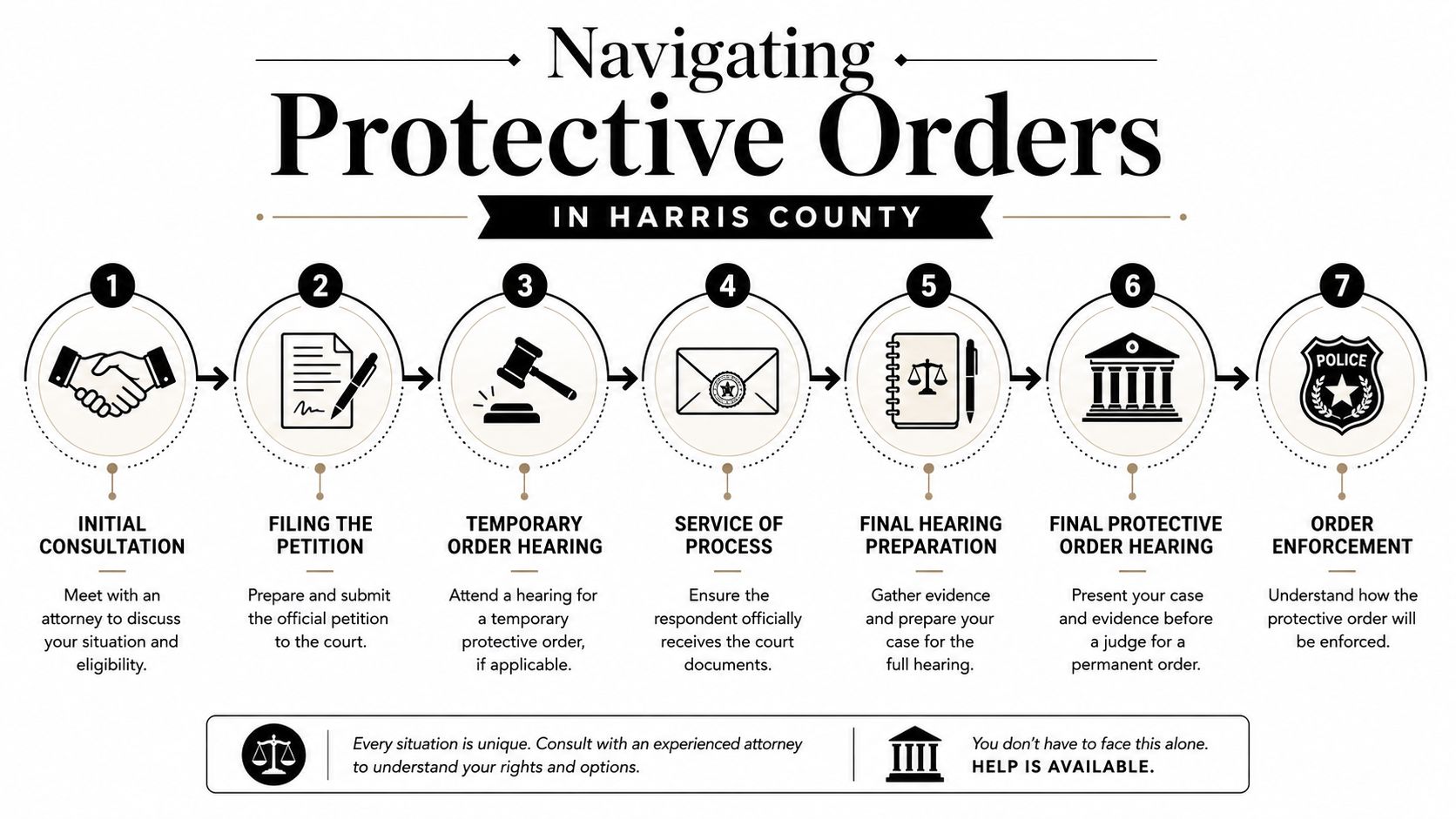
Step one through step three
Start with the facts. Write down what happened, when it happened, who saw it, and whether there are texts, photos, medical records, or other documents. People under stress forget details later.
File the application. The court paperwork needs to match the actual procedural posture of your case. If there's already a divorce or SAPCR pending, the filing location can change.
Ask for immediate relief if needed. Texas cases often move quickly here. According to Land Legal Group's Texas restraining order timeline discussion, the typical timeline from filing a protective order petition to the hearing is 14 to 20 days, and a judge may issue a temporary order during that short period. For families in Kingwood, Humble, and Porter, that means there isn't much time to delay.
Service matters more than most people realize
The respondent must be served properly. That means formally receiving the court papers through the legal process. Until service is completed, enforcement questions can become messy and hearing preparation can suffer.
People often assume filing is the whole job. It isn't. Filing starts the case. Service makes sure the other side receives notice. Then the hearing becomes the key event.
Local insight: In Harris County, small procedural mistakes can create major delays. Missing paperwork, weak dates, or incomplete service can hurt a case before the judge even hears the facts.
For families trying to understand venue, scheduling, and case flow, this Harris County family court overview for Kingwood residents can help put the court system in context. Readers may also find Harris County Family Courts: A Kingwood Resident's Guide useful for understanding how family law cases proceed in the Harris County courts serving Kingwood.
Preparing for the final hearing
The final hearing is where both sides can present testimony and evidence. That preparation usually includes:
- Organizing your timeline so the judge can follow the events.
- Collecting documents such as messages, photos, or records.
- Identifying witnesses who have firsthand knowledge.
- Reviewing the requested relief so you know what the order would require.
- Planning for related issues like child exchanges, home access, or criminal allegations.
Later in the process, many clients benefit from seeing the hearing format in action:
The strongest preparation is usually practical, not dramatic. Judges want clear facts, relevant evidence, and focused testimony. In a Harris County case, that discipline matters.
What to Do If You Are Served with an Order
Being served with a protective order or related court order can feel like the floor dropped out from under you. Many people in Kingwood make the same mistake in the first hour. They call or text the other person to “clear things up.” That can make the situation much worse.
Read the order. Then obey it.

What to do in the first day
If the order says no contact, stop contact. If it says stay away from a home, school, or workplace, stay away. If it restricts firearms, possession of children, or communications, treat every word seriously.
This isn't the time to argue with the paper. It's the time to prevent a second problem.
Avvo's discussion touching on restraining order representation in Texas notes that an estimated 70% of domestic violence restraining orders in Texas are contested. That matters because many respondents in Kingwood need immediate, local guidance about how Harris County courts and magistrates handle these cases. Generic advice from elsewhere in Texas often misses practical local differences.
What not to do
- Don't contact the petitioner. Even a calm message can be treated as a violation.
- Don't delete texts or posts. Preservation matters.
- Don't coach witnesses. That can damage your credibility.
- Don't skip the hearing. If you don't appear, the court may hear only one side.
- Don't assume the accusation will disappear on its own. These cases can affect custody, housing, and criminal exposure.
If you've been served, your first legal goal is compliance. Your second is preparation.
How to start building your response
A respondent still has rights. You can gather records, identify witnesses, create a timeline, and present your side at the hearing. In many Kingwood and Northeast Houston cases, context matters. Maybe the messages are incomplete. Maybe the timeline doesn't fit. Maybe there are prior communications that change how the court sees the allegation.
That doesn't mean you should treat the case casually. It means you should prepare carefully.
For a better sense of what happens when your court date arrives, this guide on what happens at a family court hearing in Kingwood TX can help you understand the courtroom setting and what judges typically expect.
The Crucial Role of Evidence and Your Attorney
Protective order hearings often turn on one issue more than any other. Evidence. Not assumptions, not outrage, not who speaks louder.
Texas law requires proof. As explained in Matt Horak's discussion of Texas protective orders, a petitioner must show that abuse occurred, including conduct such as offensive physical contact or a threatening act, and must support the request with evidence such as photos, medical records, police reports, or witness statements to show both the act and a continuing threat.
What evidence can look like
For a petitioner, useful evidence may include:
- Photos and medical records that document injury or treatment.
- Text messages or emails that show threats, admissions, or escalating conduct.
- Police reports if law enforcement responded.
- Witness accounts from someone who saw events or heard statements firsthand.
For a respondent, useful evidence may look different:
- A complete message thread instead of a selective screenshot.
- Timeline records that challenge where someone claims you were.
- Witness testimony that provides missing context.
- Contradictory documents that undercut a key allegation.
Why organization changes outcomes
A stack of papers isn't automatically persuasive. Judges need a clean story supported by credible exhibits. That means dates should line up. Screenshots should be readable. Witnesses should know why they are appearing and what they observed.
Strong evidence is specific. “He was angry a lot” is vague. “At 8:14 p.m. he sent this message, and I took this photo ten minutes later” is much more useful.
This is one place where a lawyer's role becomes practical and concrete. An attorney can help sort what matters from what doesn't, prepare exhibits, frame testimony, and question witnesses in a way that keeps the hearing focused. In family cases that overlap with custody disputes, readers may also find this resource on preparing evidence for a Texas custody hearing in Kingwood helpful because many of the same proof and organization issues carry over.
What legal counsel actually does here
One option for local representation is the Law Office of Bryan Fagan – Kingwood TX Lawyers, which handles family law, criminal defense, estate planning, probate, and civil matters for Kingwood-area clients. In a protective order case, a lawyer may help by:
- reviewing allegations and deadlines,
- preparing filings and responses,
- organizing evidence,
- preparing witnesses,
- appearing at the hearing,
- and addressing related divorce, custody, or criminal issues.
That kind of coordination matters because a protective order case rarely lives in isolation.
Life After the Hearing Duration and Modifications
The hearing isn't always the end of the stress. It's often the start of a longer set of rules.
Under the Texas State Law Library's protective order guidance, a Texas protective order is typically effective for up to two years. If the case is connected to a divorce or child custody matter, the order can remain effective for two years after the final order in that underlying case. The same guidance notes that a protective order overrides conflicting custody terms.
Why duration matters in real life
That rule can affect parents in Kingwood more than they expect. A possession schedule from a divorce or SAPCR might not control if it conflicts with the protective order. School pickup, exchange locations, communication methods, and visitation logistics can all change.
For petitioners, that can provide meaningful long-term stability. For respondents, it means a short hearing can produce consequences that continue well beyond the hearing date.
Can an order be changed
Sometimes circumstances change. A person moves. A divorce finishes. Child exchange logistics need revision. In those situations, the proper path is to return to court and request a lawful modification or seek advice on enforcement, not to make private side agreements that conflict with the written order.
That's especially important in Harris County. Informal understandings can break down quickly, and they don't erase the signed court order.
Court orders remain in effect until a court changes them. Personal agreements don't automatically replace written terms.
When post-order problems arise, enforcement can become its own legal issue. For local readers dealing with compliance problems after court, Enforcement of Court Orders in Kingwood covers enforcing divorce decree and custody order provisions in Harris County.
FAQ Your Restraining Order Questions Answered
How fast do I need to act
Immediately. If you're seeking protection, delay can affect safety and evidence. If you've been served, delay can increase the risk of violating the order or missing the hearing.
Do I need a lawyer if I already have the forms
Forms start a case. They don't replace legal judgment. Many people in Kingwood need help deciding what kind of order applies, how it intersects with divorce or custody, and how to present evidence clearly.
Will this affect my children
It can. Protective orders often intersect with possession, communication, school pickup, and exchange arrangements. If your case also involves a pending SAPCR or divorce, those issues should be evaluated together.
What if there are criminal charges too
Then the implications are more serious. Statements made in one case can affect another. A respondent should be careful about speaking without legal advice when family court and criminal court issues overlap.
How much does it cost
The answer depends on the facts, the urgency, whether the case is contested, and whether related divorce, custody, or criminal issues are involved. A consultation is usually the best place to get a realistic picture of likely work and next steps.
Can I just agree with the other person privately and move on
Not safely. If a court order exists, follow the written order until a judge changes it. Private agreements can create confusion and, in some situations, expose a person to enforcement or criminal problems.
What if I'm not in family law trouble but need help with estate, civil, or criminal issues too
That happens often. A family crisis can spill into criminal defense, probate concerns, civil disputes, or urgent planning needs. A local law office that handles multiple practice areas can sometimes help clients coordinate those overlapping issues more efficiently.
If you're dealing with a protective order, a TRO, or a confusing family crisis in Kingwood, Humble, Porter, or Northeast Houston, don't try to sort it out alone. The Law Office of Bryan Fagan – Kingwood TX Lawyers offers a free consultation and can help you understand your options, your deadlines, and the next practical step for your situation.