Skip to content
Getting a notice for family court can make your stomach drop. Many residents in Kingwood, Humble, and Northeast Houston don't start by wondering about procedure. They wonder where to park, what to bring, whether the judge will let them speak, and whether one bad moment in court could affect their children or finances.
That reaction is normal. A family hearing feels personal because it is personal. But the hearing itself is usually more structured than people expect. Your case may involve divorce, custody, child support, enforcement, or another family issue, yet the court process still follows a sequence with deadlines, document rules, and a specific purpose for that day.
One reason people search for what happens at family court hearing in Kingwood TX is that local information often skips the practical part. Kingwood cases are heard in Harris County family courts at 201 Caroline St. in Houston, but many explanations never tell you what the first hearing looks like or how the day unfolds for someone coming from Northeast Houston.
Your Guide to Navigating a Kingwood Family Court Hearing
A Kingwood parent might receive a hearing notice and immediately think the judge is about to decide everything in one morning. That's rarely how it feels once you're inside the process. Family court usually moves in stages. One hearing may deal with temporary possession, another may address support, and another may be set later for final resolution.
For families in Humble and Porter, the biggest surprise is often location and pace. Your matter is local to your life, your children, and your home, but the hearing itself usually takes place downtown in the Harris County courthouse system. That means preparation starts before you ever enter the courtroom. You need the right date, the right court, the right paperwork, and a clear understanding of why your case is on that docket.
What most people are really asking
When clients ask what happens at family court hearing in Kingwood TX, they usually mean a few practical questions:
- What kind of hearing is this really: Is it a temporary orders hearing, a final hearing, or a shorter status setting?
- Will I have to testify: Some hearings involve testimony and exhibits. Others are much shorter and focus on scheduling or limited issues.
- What does the judge care about: Judges need organized facts and proper documents, not just frustration with the other side.
- Am I expected to appear in person: In some situations, appearance rules matter a great deal, especially if the hearing is evidentiary.
Court usually feels less chaotic once you know the purpose of the setting. The confusion comes when people prepare for the wrong kind of hearing.
A hearing is better understood as a structured problem-solving event than a dramatic showdown. The judge is there to decide the issue that is set for that date. If you know that issue, your preparation becomes much clearer.
What helps before the hearing date
For Kingwood and Northeast Houston residents, the most useful early step is simple. Read the notice closely and match it to your case goal. If you're seeking temporary support, parenting time, or use of property while the case is pending, you prepare differently than you would for a final trial.
It also helps to stop thinking only about what you want to say. In family court, what you can prove and what you've properly filed or exchanged often matters more than the strength of your feelings. That isn't cold. It's how the court creates enforceable orders.
Understanding the Purpose of Your Hearing in Harris County
Not every family hearing does the same job. That's why two people can both say, "I have court next week," and be facing completely different experiences. Harris County family courts use separate settings for different matters, and one posted weekly example from the 507th Family Court shows uncontested matters from 8:00 a.m. to 8:45 a.m., a 9:00 a.m. docket call, and separate settings for trials, temporary orders, and enforcement actions on the schedule at this Harris County family court docket example.
The hearing type changes everything
If you know the hearing type, you know what the judge is being asked to do. That affects how much evidence you need, how much time the court may allow, and what result is even possible that day.
| Hearing Type | Primary Purpose | Typical Duration | Key Focus |
|---|---|---|---|
| Temporary orders hearing | Set interim rules while the case is pending | Varies by court and dispute level | Children, finances, property use, immediate stability |
| Final trial or final hearing | Resolve the case and enter final orders | Usually longer than brief settings | Final custody, support, divorce terms, property division |
| Enforcement hearing | Address alleged violations of an existing order | Depends on the issues raised | Compliance, missed obligations, remedies |
| Status conference or scheduling setting | Move the case forward procedurally | Usually brief | Deadlines, next steps, readiness |
Temporary orders often shape daily life first
A temporary orders hearing is often the first meaningful court event in a family case. It sets ground rules while the case is still open. In practical terms, a judge may address who has the children on what schedule, who pays what bills, who stays in the home, or whether temporary support should be paid.
For many Kingwood families, this hearing matters because it affects the next several months of daily life. School drop-offs in Humble, extracurricular schedules, and household budgets often depend on what happens here.
Practical rule: Prepare for temporary orders as if they matter immediately, because they do. They often control the routine until the case is finished or later modified.
Final hearings are narrower than people think
A final hearing is not just a longer version of the first court date. It is the setting where the court is asked to resolve the case and sign final orders. That means the issues should be clearly defined, the notice should be proper, and the evidence should match the relief requested.
In real life, people often get tripped up. They assume being emotionally ready is the same as being procedurally ready. It isn't. A final hearing works best when the paperwork and notice have already been handled correctly.
Enforcement hearings focus on compliance
If someone isn't following a court order, an enforcement hearing asks the judge to address that failure. The issue is not just whether the situation feels unfair. The issue is whether the order was clear, whether it was violated, and what remedy the court can give.
That distinction matters in Kingwood custody and support disputes. Strong enforcement cases usually rely on specific records, dates, messages, payment histories, and clean documentation.
Brief settings still matter
Status conferences and scheduling settings may seem minor, but they often determine the next phase of the case. If you miss one, arrive in the wrong court, or don't understand what the judge expects, the case can lose momentum quickly.
Those shorter hearings don't always involve a full presentation of evidence, but they still require attention and preparation.
A Step-by-Step Walkthrough of Courtroom Procedures
The first part of hearing day usually doesn't feel legal. It feels logistical. You leave Kingwood early, account for Houston traffic, find parking, go through courthouse security, and locate the right courtroom. By the time you sit down, you've already spent energy just getting there.

Once the case is called, the courtroom process becomes more predictable. In a contested Texas family-court hearing, the court calls the case, each side states the issues, both sides present documents and witness testimony, and then make a closing argument. The judge's decision is heavily shaped by what is already organized and admissible before the hearing begins, as described in this overview of Texas family court hearing procedure.
What the room usually feels like
Most family courtrooms are quieter and faster-moving than television suggests. The judge may have many cases on the docket. Lawyers, parties, and court staff are all trying to move efficiently, which means clarity matters.
Small things help:
- Dress neatly: You don't need anything flashy. You do need to look respectful and serious.
- Speak to the judge properly: "Your Honor" is the safe form of address.
- Don't interrupt: Even when the other side says something frustrating, wait your turn.
- Keep papers accessible: If you have to dig through a loose stack of documents, you lose momentum.
The sequence once your case is called
A typical contested hearing often follows this rhythm:
Announcement of the case
The judge or clerk calls the matter. The parties or attorneys announce their presence.Statement of the issues
Each side identifies what it wants the court to decide that day.Presentation of evidence
Documents may be offered. Witnesses may testify. The other side may question those witnesses.Closing argument
Each side explains why the evidence supports its request.Ruling or later decision
The judge may rule from the bench or decide later in writing.
If your issue involves custody, it helps to review a practical breakdown of a child custody hearing in Harris County before your court date so the sequence feels familiar instead of intimidating.
The best courtroom testimony is usually clear, specific, and calm. Long speeches almost never help as much as organized facts.
What doesn't work in court
People often think the hearing will turn on who appears more upset. Usually, it doesn't. What tends to hurt a case is rambling, arguing with the judge, guessing at dates, or bringing documents no one can identify quickly.
For Kingwood and Humble clients, I usually stress one practical point. The hearing starts before anyone speaks. If your records are disorganized, your witnesses are unprepared, or your exhibits are incomplete, the courtroom part becomes much harder than it needed to be.
Preparing the Documents Your Judge Needs to See
Judges decide family cases using proof. In everyday terms, that means records, not just recollections. If you're asking for support, custody terms, reimbursement, or enforcement, the judge needs something concrete to review.
For certain temporary support requests in Harris County, the rules are specific. Parties seeking temporary child-support or spousal-support orders must exchange a Financial Information Statement, the past 2 years of income tax returns, and the 2 most recent payroll stubs before the hearing begins under the county's family court rules on temporary support exchanges. If those documents aren't ready, your request can become harder to prove.
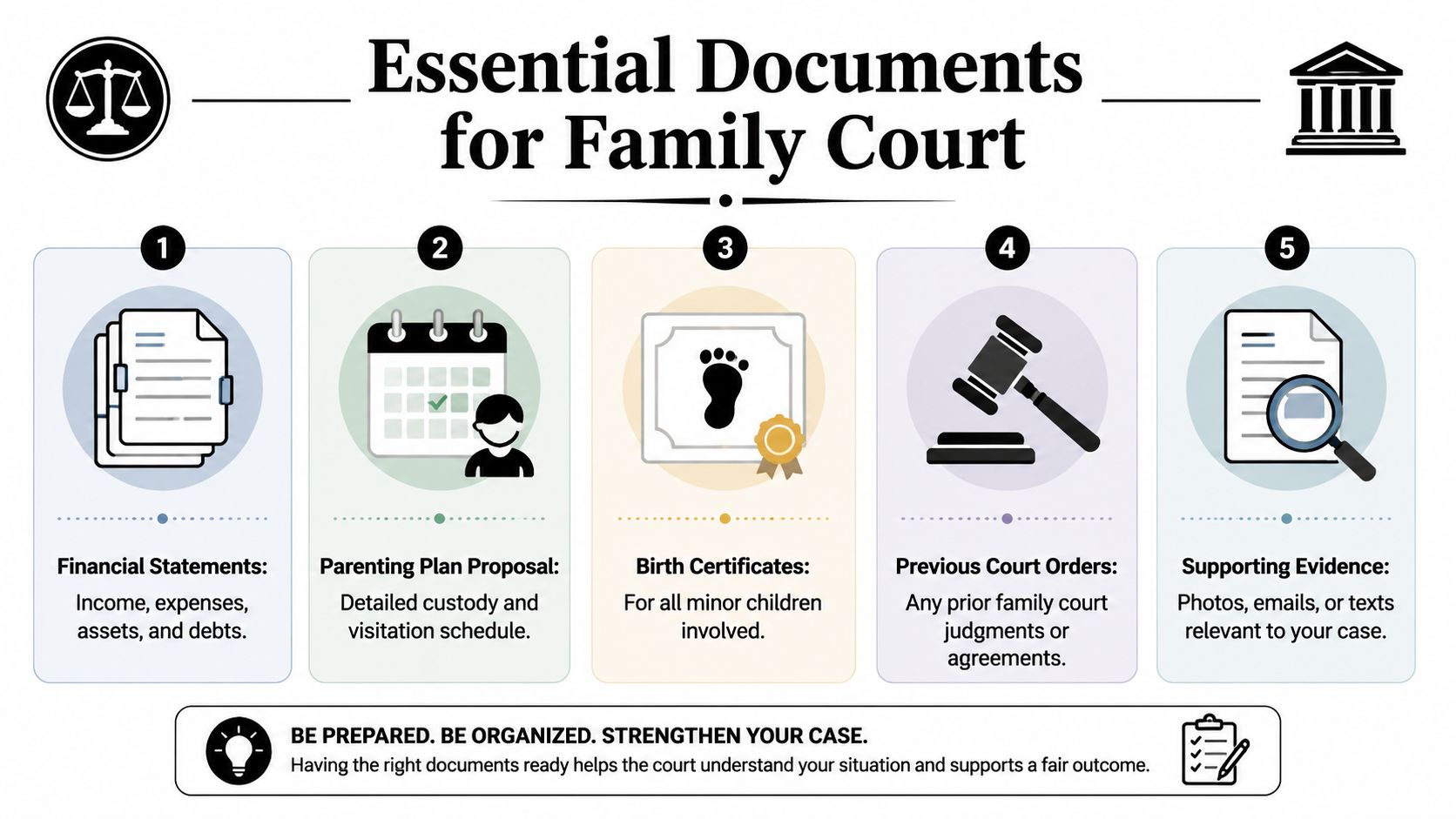
What to gather before your hearing
Your evidence should match the issue the judge must decide. A strong packet often includes:
- Financial records: Pay stubs, tax returns, account statements, and a financial information statement help the court evaluate income, expenses, and support issues.
- Parenting proposal: A written schedule shows the judge you've thought through school, exchanges, holidays, and transportation.
- School and child records: Report cards, attendance records, counseling records when appropriate, and childcare receipts can help explain the child's routine.
- Prior orders and filed papers: Bring any existing court orders, mediated agreements, or notices relevant to the current dispute.
- Communication records: Texts, emails, and app messages can matter if they directly prove a disputed fact.
Why organization matters as much as content
A stack of papers isn't the same thing as evidence. The judge needs to understand what each document is and why it matters. That means labeling, sorting, and separating materials by topic.
This is one reason some families use professional legal printing solutions when they have a large set of exhibits, timelines, school records, and financial documents to prepare. The point isn't presentation for its own sake. The point is making the record usable under pressure on hearing day.
If you're preparing for a custody setting, this guide on how to prepare for a custody hearing can help you build your documents around the actual issues the court will decide.
Bring documents that answer the judge's question. Leave home the papers that only show how angry the case has made you.
Common mistakes with evidence
The most common problems aren't dramatic. They're practical.
- Too much irrelevant material: Hundreds of messages rarely help if only a few matter.
- No timeline: Events blur together when dates aren't organized.
- Missing context: A screenshot without surrounding messages may create more confusion than clarity.
- Last-minute assembly: If you wait until the night before, key items get overlooked.
For families in Porter, Kingwood, and Northeast Houston, the strongest preparation is usually simple and disciplined. Gather the right records early, sort them by issue, and make sure each document supports a specific request.
How Long Hearings Take and What Happens Next
One of the hardest parts of family court is uncertainty about timing. A court notice gives you a date, but it doesn't always tell you how much of the day you'll spend waiting, whether your case will be reached right away, or whether the judge will decide everything on the spot.
Some settings are brief. Others take much longer. The court's schedule, the number of cases ahead of yours, whether testimony is needed, and whether the parties reach any agreement in the hallway all affect how long you're there.
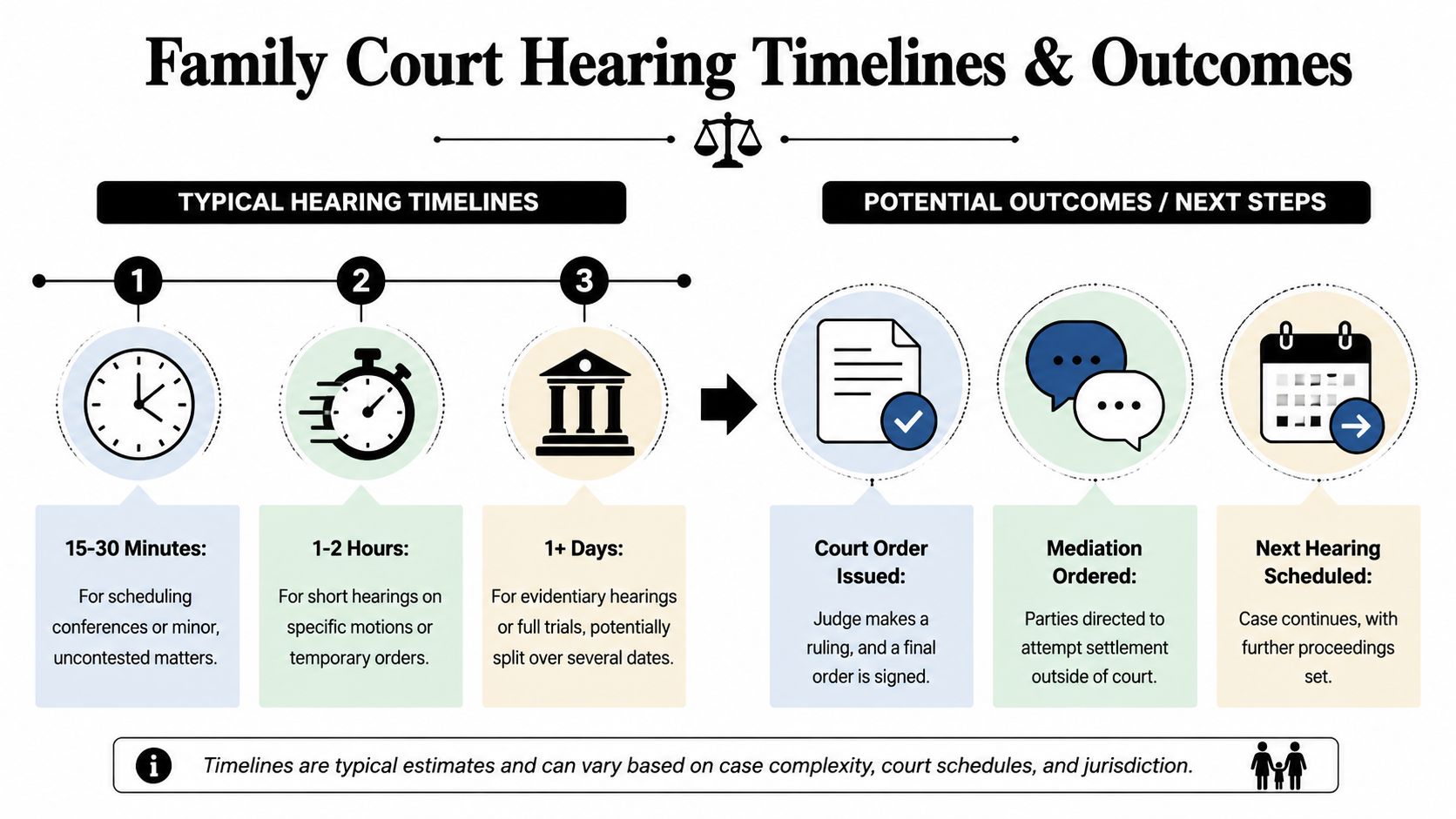
What can happen after the hearing ends
The judge usually does one of a few things after hearing the evidence:
- Makes an immediate ruling: The court announces a decision from the bench.
- Takes the matter under advisement: The judge considers the issue and signs an order later.
- Sets another date: The case continues because more procedure, evidence, or negotiation is needed.
- Directs the parties toward settlement work: In some cases, the court may push the parties to resolve remaining issues outside a full trial.
The practical point is this. Walking out of the courtroom doesn't always mean the legal work is finished. The ruling must still be turned into a written order that matches what the judge decided.
Deadlines still control the process
Family court outcomes are often shaped by scheduling rules as much as testimony. For a contested final hearing in Texas, the other side must receive at least 45 days' notice, according to Texas Law Help's explanation of contested final hearing notice. If notice is defective or late, the court may not be able to proceed as planned.
That matters to Kingwood residents because hearing readiness is not just about facts. It's also about whether the case is procedurally positioned for the judge to act.
What clients should watch for next
After court, pay attention to these practical items:
- The written order: Make sure it reflects the judge's ruling accurately.
- Deadlines created in court: New exchange dates, mediation dates, or hearing settings often follow.
- Compliance steps: If the order requires payment, pickup times, or document production, those obligations begin quickly.
- Questions about enforcement: If the final paperwork doesn't match what happened in court, address it promptly.
A hearing is one event. The enforceable order is what carries the legal force afterward.
Why You Should Not Face a Harris County Judge Alone
A Harris County family hearing can go sideways before you ever speak. A parent from Kingwood may take time off work, drive downtown, clear security, find the right courtroom, and still lose ground because the judge cannot act on what was filed, how notice was handled, or what proof is ready that day.
That is the part self-represented parties often underestimate. Family court requires more than a clear story. It requires the correct request, proper notice, usable evidence, and a hearing setting that matches the issue in front of the court.
Harris County procedure also changes based on the type of hearing. Self-represented parties often have to work directly with the clerk to get a setting, and some hearings require in-person evidence unless both sides agree otherwise, as outlined in this guide to Harris County family district court procedures.

Procedure mistakes can block the judge from helping
One common problem is not the facts. It is the setup. A parent may bring texts on a phone instead of printed exhibits, expect to testify about documents that were never filed or exchanged, or arrive ready for a full evidentiary hearing when the court only set a short temporary hearing.
Judges notice preparation fast. They also have limited time. If the paperwork is incomplete or the request is not framed in a way the court can rule on, the hearing may end with a reset, a narrow ruling, or no immediate relief at all.
Law offices put systems in place for this because clients under stress miss details. Some firms also use tools like a legal client intake solution so hearing dates, urgent questions, and new facts are captured quickly instead of getting lost between phone calls.
What a lawyer changes on hearing day
A family lawyer does not change the facts, but good counsel can change how clearly and efficiently those facts reach the judge. That includes identifying what relief is available at that setting, organizing exhibits, preparing witnesses, handling objections, and making sure the written order matches the ruling.
That support usually includes:
- Case framing: Tying your request to the exact order the judge has authority to sign that day.
- Evidence preparation: Making sure documents, photos, messages, and school or medical records are organized and usable.
- Witness control: Keeping testimony focused on the points that matter instead of drifting into background that wastes hearing time.
- Courtroom response: Addressing objections, questions from the bench, and last-minute issues raised by the other side.
- Order follow-through: Reducing the ruling to written language the court can enforce.
For some families, limited help may be enough. For others, especially in custody disputes or enforcement cases, full representation is the safer choice. If you are weighing that decision, this guide on when to hire a custody lawyer in Kingwood gives a practical starting point.
Law Office of Bryan Fagan – Kingwood TX Lawyers handles family-law matters for Kingwood-area residents dealing with divorce, custody, support, and related hearings in Harris County.
Going alone means learning court procedure while your family issue is already in front of the judge. That is a hard position to be in, especially when the ruling can affect parenting time, support, possession, or the next steps in the case.