Skip to content
Many people in Kingwood start a divorce thinking the hard part is making the decision itself. Then the actual friction begins. One spouse wants to keep the house near the schools. The other wants it sold. One person believes the retirement accounts should be split a certain way. The other says a family business in Northeast Houston changes everything. If you have children, even a basic weekly schedule can turn into a painful disagreement.
That's usually the moment people realize they're no longer dealing with a simple divorce. They're dealing with a contested divorce.
If that's where you are, you're not alone. Families across Kingwood, Humble, Porter, and Northeast Houston face this same crossroads every day. A contested divorce doesn't mean you've failed. It means there are important issues the two of you can't resolve without legal structure, court deadlines, and sometimes a judge's decision. It can feel overwhelming, but it becomes far more manageable when you understand the process and know what steps come next.
Navigating Divorce When You and Your Spouse Disagree
A Kingwood parent might come in believing the divorce is mostly settled. Then one conversation changes everything. Maybe both spouses agreed they should separate, but they can't agree on whether the children should stay in the marital home during the school year. Maybe one spouse says the savings account is separate property, while the other says it was built during the marriage and should be divided. That shift is often sudden.
In plain terms, a contested divorce happens when spouses cannot agree on one or more important issues such as custody arrangements, property division, or spousal maintenance. Texas law treats those disagreements seriously because they affect your children, your finances, and your future.
Practical rule: A divorce can be “contested” even if you agree that the marriage should end. The conflict is often about the terms, not the decision to divorce.
For families in Kingwood and Humble, the emotional strain is often tied to ordinary life. You still have work, school pickups, mortgage payments, and family routines while legal questions are unfolding in the background. That's why clarity matters. When people understand what the court is looking at, they usually make steadier decisions.
What local families often struggle with
- Parenting questions: Who will handle school nights, holidays, and transportation across Kingwood or Humble?
- Money concerns: How will debts, accounts, and monthly bills be handled while the case is pending?
- Property disputes: What happens to the house, retirement funds, or a business interest in Northeast Houston?
Family law is only one part of many people's legal lives. Some families dealing with divorce are also updating wills, reviewing estate plans, or trying to protect a business from broader civil disputes. Others are balancing family court stress while facing unrelated criminal accusations or civil claims. Texas law touches all of these areas differently, and a local lawyer can help separate those issues so one problem doesn't make another worse.
Contested Versus Uncontested Divorce in Texas
The simplest way to understand the difference is this. In an uncontested divorce, both spouses agree on all major terms. In a contested divorce, they don't. Even one unresolved issue can move the case into contested territory.
That matters because the process changes. A contested case usually involves formal exchanges of information, court hearings, and more attorney work. It also tends to place more pressure on both sides to gather records and define their goals early.
Contested vs. Uncontested Divorce at a Glance
| Factor | Uncontested Divorce | Contested Divorce |
|---|---|---|
| Agreement between spouses | Full agreement on major terms | Disagreement on one or more major terms |
| Court involvement | Usually limited | Often includes hearings and possible trial |
| Information exchange | Usually simpler | Often requires formal evidence gathering |
| Decision maker | Spouses largely control outcome | Judge may decide unresolved issues |
| Timeline | Can be relatively short | Often longer and more demanding |
| Attorney role | Often focused on drafting and review | Often focused on strategy, evidence, and advocacy |
For Kingwood couples who are in full agreement, an Uncontested Divorce Lawyer in Kingwood handles efficient uncontested divorce handling for agreeing Kingwood couples. That option usually isn't the right fit once there's a serious dispute over custody, support, or property.
Grounds for divorce in Texas
Texas also requires a legal ground for divorce. Texas recognizes seven permissible grounds for divorce: three no-fault grounds, insupportability, living apart for three years, and confinement to a mental hospital, and four at-fault grounds, conviction of a felony, abandonment, infidelity, and cruelty, as summarized by Texas divorce statistics and grounds.
Disagreement over those grounds can make a case more contentious. One spouse may want to proceed on a no-fault basis. The other may want fault allegations considered because they believe those facts matter to the judge.
Some of the most emotionally difficult divorces in Kingwood aren't driven by whether the marriage ends. They're driven by whether one spouse believes the court should hear why it ended.
Why that distinction matters
When spouses disagree about grounds or terms, the judge may need evidence. That changes how lawyers prepare the case. It can affect records requests, witness preparation, and settlement discussions. For Porter and Northeast Houston families, the practical takeaway is simple. If there's meaningful disagreement, treat the case seriously from the beginning.
The Contested Divorce Process in Harris County Courts
Kingwood residents generally file divorce cases in Harris County, and local procedure shapes how the case moves. Many people feel less anxious once they understand the sequence. Contested divorce in this area usually follows a recognizable path: filing, temporary orders, discovery, negotiation, trial if needed, and final judgment.
To help make that clearer, here's the process visually.
Filing and the first deadlines
Before filing, the person starting the case must meet Texas residency rules. A petitioner must have lived in Texas for at least six continuous months and in the county for at least 90 days before filing, and after service the other spouse has a strict 20-day window to file an Answer, according to this Kingwood divorce attorney overview.
That first stage is more than paperwork. Filing sets the legal process in motion, and service of process gives the other spouse formal notice. If you've been served in Kingwood or Humble, don't ignore the papers and hope things calm down on their own. Missing the response window can create serious problems.
Temporary orders and daily life during the case
Many contested divorces need temporary rules while the case is pending. These orders can address who stays in the home, who pays certain bills, temporary parenting schedules, and other immediate concerns. They don't end the case, but they can shape daily life for months.
For many families in Northeast Houston, this is the first court hearing that feels real. The court isn't just listening to broad complaints. It's trying to stabilize the situation so the family can function while larger disputes are sorted out.
Temporary orders are often where people first see how a judge views the facts. That early impression can influence how settlement talks develop.
Discovery, mediation, and possible trial
The discovery phase is where contested divorces often become more demanding. Spouses exchange financial records, written questions, and other evidence. In cases involving hidden income concerns, disputed debts, or a closely held business, discovery may be the key to understanding what exists and what it's worth. If you want a closer look at that stage, this guide on discovery in divorce explains how evidence gathering works in Texas family cases.
Mediation often follows. Many people assume that if they attempted mediation, their case is no longer contested. That isn't how it works. A case can remain contested if major issues are still unresolved after mediation. In practical terms, mediation is an effort to settle. It isn't a guarantee of settlement.
If no agreement is reached, the case may go to trial. At that point, the judge decides the unresolved issues under Texas law. For a broader overview of local procedure, Harris County Family Courts: A Kingwood Resident's Guide describes how family law cases proceed in the Harris County courts serving Kingwood.
Common Disputes in Kingwood Contested Divorces
Most contested divorces in Kingwood don't revolve around abstract legal theories. They revolve around three practical questions. What happens with the children, what happens with the property, and does one spouse need post-divorce support?
Child custody and support
Parents often use the word “custody,” but the court is usually looking at a bigger picture. Who will make important decisions for the child? Where will the child primarily live? How will weekends, holidays, summers, and school transportation work?
For Kingwood and Humble parents, details matter. A parenting plan has to fit real life. It has to account for school schedules, work hours, extracurricular activities, and the distance between households. A plan that sounds reasonable in a conference room can break down quickly if nobody has thought through pickup times, homework routines, or how to handle schedule changes.
Common points of conflict include:
- School stability: Parents may disagree about keeping children in the same school zone or changing schools after separation.
- Weekly routines: One parent may want more midweek time, while the other is focused on consistency.
- Decision making: Medical care, counseling, extracurriculars, and education choices can all create conflict.
Property and debt division
Texas follows a community property system, but that does not mean every case ends in an automatic equal split. In contested divorces, disputes often center on what belongs in the marital estate, what counts as separate property, and how debts should be assigned.
For some Kingwood families, the disagreement is straightforward. One spouse wants to keep the house and refinance. The other wants to sell. For others, the issues are more layered. There may be retirement accounts, stock compensation, inherited funds, or a family-owned business in Northeast Houston.
Business ownership changes the conversation. The question is rarely just “Who keeps the business?” It's also “What is it worth, what records are reliable, and was marital effort used to grow it?”
That's why business-related divorces tend to feel more technical. A spouse may believe the company is their separate achievement. The court may need a fuller record of when the business started, how income flowed during the marriage, and whether business and personal finances were mixed together.
Spousal maintenance and support disputes
Spousal maintenance is another area that can trigger a contested case. People often come in with strong assumptions. One spouse may believe support is automatic after a long marriage. The other may believe support is never available.
Neither assumption is safe. Texas courts look at specific legal factors, and the answer depends on the facts. In practice, disputes arise over financial need, earning ability, health issues, and how long support should last. For many families in Porter and Northeast Houston, these arguments are tied to a bigger question about how each spouse will transition into separate households after the divorce.
Why these cases need careful preparation
When contested issues overlap, they affect each other. A custody schedule may affect work hours. Work hours may affect income. Income may affect support and housing decisions. That's why family law often connects with other legal planning. Some spouses need to revise estate planning documents, update wills, or protect business records during the divorce. Others may need separate advice on civil disputes connected to a company or property. Looking at the whole picture helps avoid rushed decisions.
The Financial Realities of a Contested Divorce
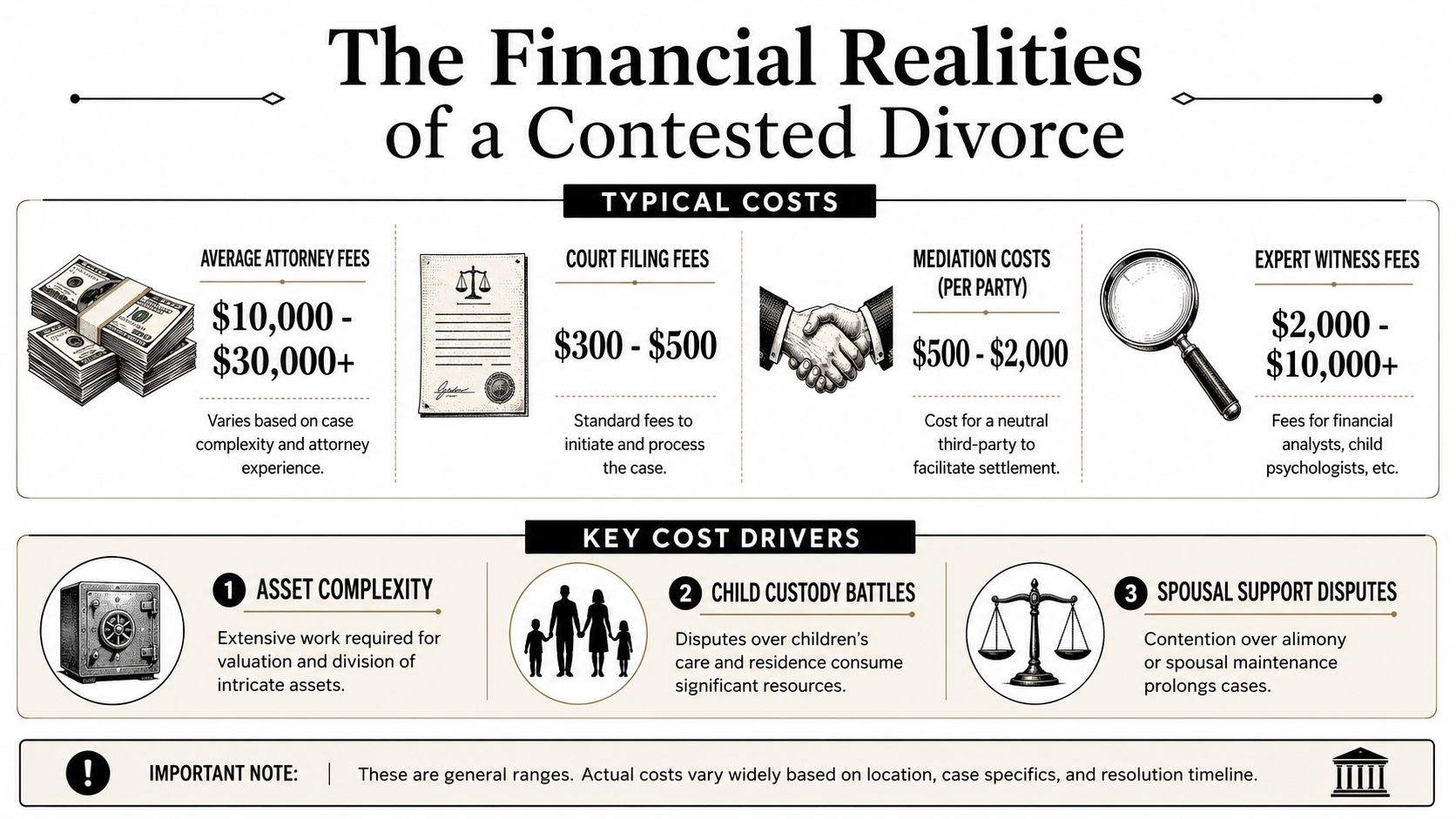
The cost of a contested divorce is one of the hardest parts to discuss, but avoiding the topic doesn't help families plan. In Texas, the average cost of a contested divorce with attorneys ranges from $15,000 to over $40,000, and in Harris County these cases typically last 6 to 12 months, according to Texas divorce cost and timeline data. Those numbers reflect work that often includes hearings, document review, negotiations, and trial preparation.
Here is the required visual summary.
Why costs rise
The legal fees in a contested case usually come from time and complexity, not from conflict for its own sake. If one spouse owns a business, disputes account balances, or challenges a parenting proposal, the lawyer has to investigate facts, review records, and prepare arguments. That work takes time.
The biggest cost drivers often include:
- Complex assets: Businesses, retirement accounts, and disputed real estate usually require more analysis.
- Children's issues: Parenting disagreements often lead to more negotiation and court involvement.
- Evidence gathering: Financial records, written discovery, and witness preparation expand the workload.
For many people in Kingwood, one practical concern is housing. If the house may be sold as part of the divorce, it helps to understand the mortgage implications early. This overview of selling your house fast after divorce is a useful starting point for thinking through what can happen to the home loan and sale process after separation.
Spending carefully still means protecting yourself
Trying to save money by staying passive can backfire. If a spouse signs an unfair temporary arrangement or fails to gather records, fixing the problem later may cost more than addressing it early. The wiser goal is usually not “spend nothing.” It's “spend deliberately.”
If property division is one of your major concerns, this guide on property division in Kingwood divorce can help you understand how Texas courts look at marital assets and debts.
How to Prepare for Your Consultation with a Kingwood Attorney
Your first consultation feels easier when you walk in with a clear picture of your life on paper. You don't need a perfect folder or every answer. You just need enough information to help the attorney spot the main issues quickly.

What to bring
Start with the basics. Think of your meeting as a working session, not a test.
- Income records: Recent pay stubs, tax returns, or other proof of earnings help show the financial picture.
- Asset information: Bring what you have for bank accounts, retirement accounts, deeds, vehicle information, and business records.
- Debt details: Mortgage statements, credit card balances, personal loans, and other obligations matter too.
- Children's information: School schedules, childcare arrangements, health concerns, and current parenting routines are useful if custody is disputed.
If you want a more detailed checklist before your meeting, this page on what to bring to a consultation with a family lawyer in Texas gives a practical overview.
What to write down before you go
Documents are only part of the preparation. Your story matters.
Write down a short timeline of the marriage and separation. Note major assets, major disagreements, and anything urgent that needs immediate attention. If there's a business, make a note of who owns it, who works in it, and whether family funds were used to support it.
Bring your goals, not just your frustration. A useful consultation answers questions like “What do I need to protect right now?” and “What outcome matters most six months from now?”
Questions worth asking
You'll get more from the meeting if you ask direct questions. For example:
- What issues make my case contested?
- What needs attention first?
- What records should I gather next?
- What temporary arrangements may be necessary?
- How should I communicate with my spouse while the case is pending?
This kind of preparation helps people feel less helpless. It gives structure to a situation that often feels emotionally scattered.
Finding the Right Legal Partner in Kingwood
Not every divorce lawyer is the right fit for a contested case. If you're looking for a contested divorce attorney in Kingwood, TX, ask questions that tell you how the representation will work in real life.

Questions to ask any attorney
A good consultation should leave you with practical clarity. Ask things like:
- Who will be my main point of contact: Will I hear from the attorney, support staff, or both?
- How do you approach contested cases: Are you focused on settlement, trial preparation, or both?
- What do you need from me early: Which documents or decisions will help the case most?
- How familiar are you with local court practice: Harris County procedure matters for Kingwood residents.
Those questions also help you compare options fairly. Some people need a narrow service for one issue. Others need broader help because divorce overlaps with estate planning, business concerns, civil disputes, or even a criminal matter that affects family court strategy.
A local option for Kingwood families
One local option is Contested Divorce Attorney in Kingwood, which provides advocacy for high-conflict divorces in Harris County courts. Families may also want to review the firm's broader Divorce Lawyer in Kingwood, TX resources to understand how divorce, custody, support, and property issues are handled locally.
The right legal partner should help you feel informed, not rushed. You should leave the first conversation with a clearer sense of your risks, your options, and your next step. For families in Kingwood, Humble, and Northeast Houston, local experience matters because the process is not just about Texas law in the abstract. It's about how that law plays out in the courts and communities where you live.
If you're facing a contested divorce in Kingwood, Humble, Porter, or Northeast Houston, you don't have to sort it out alone. Law Office of Bryan Fagan – Kingwood TX Lawyers offers free consultations at the Kingwood office so you can talk through your situation, understand your options, and take the next step with local support.