Skip to content
Going through a divorce in Kingwood can feel like you're trying to put together a thousand-piece puzzle, but you suspect half the pieces are still in the box. Discovery is the formal legal process for finding every single one of those missing pieces. It's the fact-finding stage where both you and your spouse exchange all the necessary information about your finances, property, and even parenting issues, all to ensure the final outcome is fair and equitable under Texas law.
Uncovering the Full Picture in a Texas Divorce

Forget the high-stakes drama you see on TV. A real divorce is about building a complete, honest financial picture so that everything can be divided fairly. For families all over Northeast Houston, from Kingwood to Humble, a thorough discovery in divorce process is the bedrock of a just settlement. It's what stops one spouse from getting an unfair advantage by hiding assets or downplaying their income.
Think of it this way: you can’t split a pie if you don’t know how big it is or what ingredients went into it. Discovery is how we find and take inventory of everything—from bank accounts and 401(k)s to hidden credit card debt and family business interests.
Why Discovery Matters for Your Case
The entire process is governed by the Texas Rules of Civil Procedure, which lays out the ground rules for how information is requested and shared. This structured approach is absolutely critical because it forces everyone to play with the same deck of cards, creating a level playing field for negotiations or, if it comes to it, a court decision right here in the Kingwood area.
So, what are we trying to accomplish? Here’s a simple explanation of the main goals of discovery, which are essential for anyone facing divorce in Kingwood.
The Goals of Divorce Discovery in Texas
| Objective of Discovery | Why It's Important for Your Kingwood Case | Examples of Information Gathered |
|---|---|---|
| Identify All Assets and Debts | You can't divide what you don't know exists. This ensures a complete inventory of the marital estate. | Bank statements, retirement account information, property deeds, mortgage statements, car titles, credit card bills. |
| Verify Income and Expenses | This is crucial for calculating child support and determining if spousal maintenance is appropriate under Texas law. | Pay stubs, W-2s, tax returns, business profit-and-loss statements, monthly budget records. |
| Gather Custody-Related Evidence | The court's primary focus is the child's best interest. This helps show who can provide a stable, nurturing home. | School records, communication logs (texts/emails), evidence of a parent's work schedule or living situation. |
| Prevent Surprises and Ambush | Full disclosure means no last-minute bombshells in court. It makes the entire process more predictable and fair. | Revealing a secret bank account, disclosing a recent large purchase, or admitting to a new job offer. |
By gathering this information upfront, the discovery process builds a foundation of facts that allows for more productive settlement talks and informed court rulings.
A common misconception is that discovery is only for high-conflict, "gotcha" style cases. In reality, it's a fundamental step in nearly every Texas divorce, providing the clarity needed to move forward, whether through friendly mediation or a contested trial.
Understanding your rights and responsibilities during this phase is one of the most important things you can do to protect your financial future. For many Kingwood residents, the process starts with the basics, and you can learn more about those initial steps in our guide on how to file for divorce in Texas.
Navigating discovery can feel overwhelming, but you don't have to face it alone. The Law Office of Bryan Fagan is right here in Kingwood to guide you through every step. Schedule a free, no-obligation consultation with our team to discuss your case and learn how we can help protect your future.
The Five Essential Tools of Divorce Discovery
Think of divorce discovery like a mechanic's toolbox. You wouldn't use a wrench to hammer a nail, and in a divorce, you don't use the same tool for every situation. A seasoned Kingwood attorney knows exactly which tool to grab to get the right information and build a strong case for local clients.
For our clients in Kingwood, Humble, and across Northeast Houston, understanding these five core tools helps demystify the process. It's not about stirring up conflict; it's about methodically piecing together the full financial picture to ensure a fair outcome, all guided by the Texas Rules of Civil Procedure.
Let's break them down with simple explanations.
1. Requests for Production
This is the workhorse of the discovery toolbox. A Request for Production is a formal, written demand for your spouse to hand over copies of specific documents or other tangible items. It's the legal way of saying, "Show me the proof."
These requests can be incredibly broad, covering almost any document relevant to the case.
- Financial Records: We're talking bank statements, credit card bills, mortgage paperwork, and retirement account statements.
- Income Verification: This means pay stubs, W-2s, and several years of tax returns to get an accurate picture of income for support calculations.
- Property Documents: We'll ask for deeds to real estate, vehicle titles, and any appraisals for valuable assets like art or jewelry.
- Electronic Data: This is a big one. It can include emails, text messages, or spreadsheets related to finances or parenting matters.
For families in the Porter area, this is often the first and most critical step. It helps us build a complete and accurate inventory of the marital estate, leaving no stone unturned.
2. Interrogatories
If Requests for Production are about documents, Interrogatories are all about getting specific answers. These are written questions that your spouse must answer in writing, under oath. You can think of it as a formal, written interview about the key facts of your case.
Because the answers are provided under oath, they are legally binding—lying is perjury. Interrogatories are designed to uncover information that might not be obvious from a document alone.
For example, we might ask: "Please list every financial institution where you have held an account, either individually or jointly, within the past five years." This forces a direct answer, which we can then double-check using Requests for Production.
3. Requests for Admission
This is the "yes or no" tool. A Request for Admission is a list of simple, direct statements that your spouse must either admit or deny. The point isn't really to find new information but to officially confirm facts and narrow down the issues that are actually in dispute.
For instance, we could send a request that states: "Admit that the home located at 123 Main Street, Kingwood, TX was purchased during the marriage with community funds." If your spouse admits it, we no longer have to spend time and money proving the house is community property. It’s an incredibly efficient way to streamline the case.
4. Depositions
A deposition is the closest you'll get to courtroom testimony during the discovery phase. It’s a formal, in-person interview where one attorney questions the other spouse (or another key witness) under oath. A court reporter is present, transcribing every single word.
Depositions are priceless for a few key reasons:
- Gauging Credibility: Seeing how someone answers questions on the spot—their hesitations, their confidence—can be incredibly revealing.
- Locking in Testimony: Once someone says something in a deposition, it's very hard for them to change their story later in court.
- Digging Deeper: Unlike written questions, a deposition allows for immediate follow-up. If an answer is vague or seems off, we can probe further right then and there.
Depositions can sound intimidating, but with good preparation from an experienced Kingwood attorney, they are a powerful tool for getting straight to the truth. You can learn more in our guide on how to prepare for a deposition. When it comes to sorting through the mountains of documents discovery can generate, exploring legal use cases for document parsing can be a game-changer for efficiency.
5. Subpoenas
So, what happens when a third party—like a bank, an employer, or a business partner—holds the key information? That's where the subpoena comes in. A subpoena is a formal order from the court compelling a person or business that isn't part of the divorce to produce documents or show up to testify.
If you suspect your spouse has a secret bank account, we don't have to take their word for it. We can issue a subpoena directly to the bank for all the records. This ensures we get complete, unaltered information straight from the source, giving us a vital way to verify what your spouse has—or hasn't—told us.
Your Step-by-Step Guide to Navigating Discovery
Knowing the different tools of discovery is one thing, but actually going through the process is something else entirely. For families here in Kingwood and the surrounding communities, understanding what to expect can turn a nerve-wracking experience into a manageable one. Think of this as your practical roadmap, guiding you from the moment a request lands on our desk to the day your answers are sent out.
The whole thing kicks off when your spouse’s attorney sends formal discovery requests to our office. These aren't just casual questions; they're legally binding demands for information with firm deadlines set by Texas law—typically 30 days from the day you receive them. The first and most important step? Don't panic. This is a standard part of nearly every divorce case in Northeast Houston.
Staying Organized and On Track
During discovery, your job is to be the expert on your own life and finances. Our job is to be your guide, your shield, and your legal strategist. For that partnership to work smoothly, organization is everything. One of the first things we advise our Kingwood clients to do is create a secure digital folder. This becomes the central hub where you can gather all the requested documents, from bank statements and pay stubs to property deeds.
At the same time, we’ll map out a clear calendar with every single deadline. This simple step helps break a huge task into smaller, more achievable pieces, ensuring we stay well ahead of the court's schedule. A proactive approach like this prevents the last-minute scramble and keeps you feeling in control.
The process flow diagram below shows how the key discovery tools fit together to gather the necessary information.
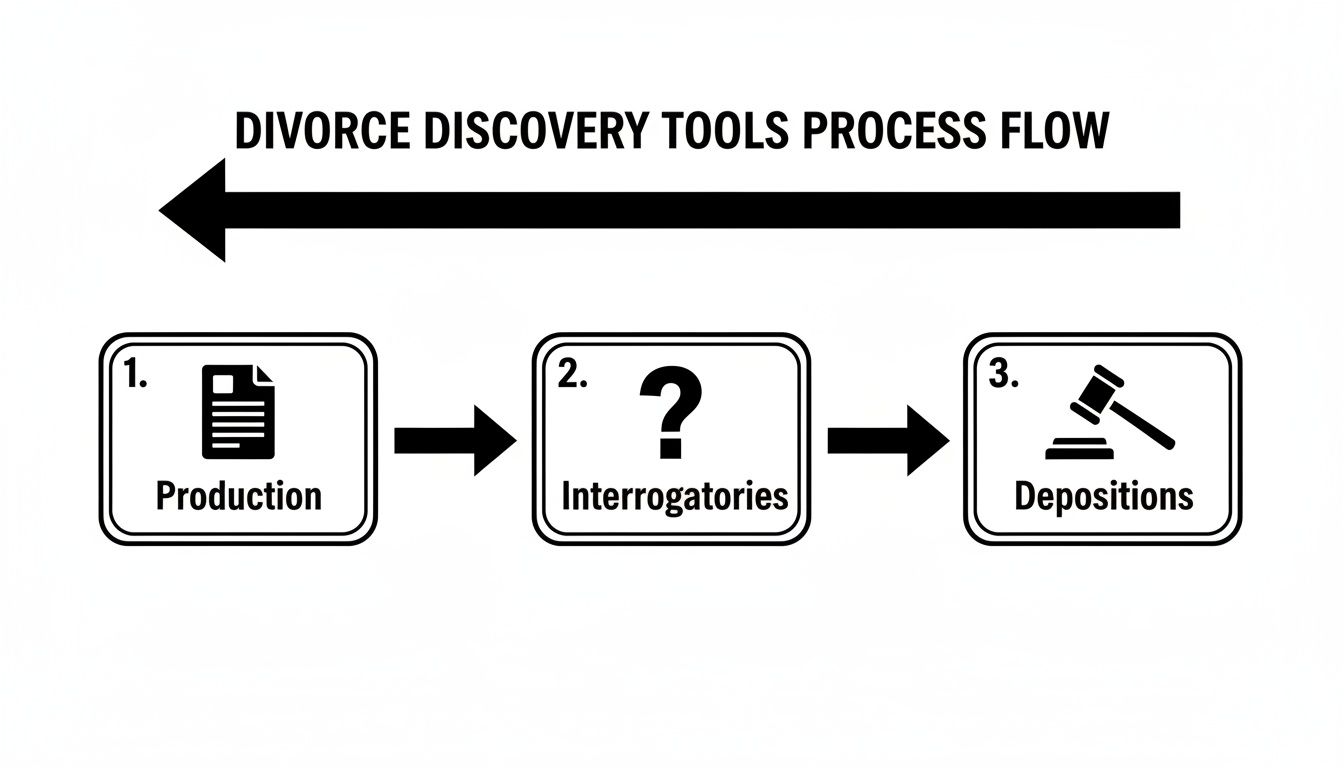
This visual helps you see how different tools like requests for production, interrogatories, and depositions are used methodically to build a complete picture of the marital estate.
The Critical Duty to Preserve Evidence
During a divorce, you have an incredibly serious obligation: the duty to preserve evidence. This legal rule means you absolutely cannot delete, destroy, or change any information that might be relevant to your case. This includes everything from:
- Emails and text messages
- Social media posts and direct messages
- Financial records or spreadsheets
- Voicemails and photos
Intentionally deleting a heated text exchange or trying to hide a financial statement can bring about severe penalties from a Texas judge. We're talking about fines or even being ordered to pay your spouse's attorney fees. The court could even make a "spoliation inference," which basically means they assume the evidence you destroyed was bad for your case. Honesty and transparency are simply non-negotiable.
This duty is especially crucial in more complex situations, like a second marriage, which often comes with a more complicated financial history. It’s a stark reality that second marriages have a significantly higher rate of ending in divorce—around 67% compared to roughly 45% for first marriages. This is often because of pre-existing financial entanglements and separate property claims that need to be carefully untangled. For Kingwood families, this just underscores how important full and honest financial disclosure really is.
Your attorney at The Law Office of Bryan Fagan is your first line of defense. We meticulously review every single request sent by the other side to ensure it is fair, relevant, and not designed to harass or overwhelm you. We will object to improper or invasive questions, protecting both your privacy and your legal rights.
You are never alone in this. We will sit down with you to carefully formulate answers that are honest, accurate, and strategic. Whether you need help jogging your memory about old financial details or want to understand what really happens in an in-person interview, you can find practical guidance in our article about how to prepare for a deposition.
Feeling overwhelmed by the demands of discovery is completely normal, but you don’t have to go through it by yourself. The Law Office of Bryan Fagan is right here in Kingwood, ready to provide the support and legal expertise you need. Contact us today for a free consultation to talk about your case.
How to Protect Your Privacy During Discovery

While the discovery in divorce process is built on transparency, it isn't a free-for-all. Your spouse doesn’t get an unlimited pass to dig through every corner of your life. For our clients here in Northeast Houston, protecting sensitive personal information is often one of their biggest concerns. Thankfully, Texas law recognizes this and provides several powerful ways to guard your privacy while still meeting your legal obligations.
You are not expected to blindly hand over every document or answer every single question. Texas law draws clear boundaries, and a seasoned attorney knows exactly how to enforce them. It’s all about striking that critical balance between providing what’s legally required and protecting what is rightfully private.
Understanding Legal Privileges
Certain relationships are so important that the law shields the communications within them. This protection is called a “privilege.” You can think of it as a cone of silence the law places over specific conversations, encouraging total honesty without the fear of those words being used against you later.
The most critical shield you have in a divorce is the attorney-client privilege.
This is a fundamental protection, meaning that what you say to your lawyer at The Law Office of Bryan Fagan stays 100% confidential. You can, and should, speak freely about your concerns, your fears, and every detail of your case, knowing that your spouse's attorney can never demand to know what was said.
This privilege is the bedrock of the trust we build with our clients right here in Kingwood. But it’s not the only one. Other privileges might come into play, such as:
- Doctor-Patient Privilege: Your private medical history and conversations with your doctors are generally off-limits.
- Therapist-Patient Privilege: Your mental health records and discussions with a counselor are confidential.
- Clergy-Penitent Privilege: Communications with your pastor, rabbi, or other spiritual advisor are also shielded.
When we get discovery requests, one of the first things we do is scan them for any questions that cross these lines. If a request asks for privileged information, we will immediately file a formal objection to protect you.
Using a Protective Order as a Shield
So, what happens when information is relevant to the case but also incredibly sensitive? This is a common situation for business owners in Humble or professionals in Porter who need to protect trade secrets, client lists, or sensitive financial data. In these cases, your attorney can go to the court and request a Protective Order.
A Protective Order is a legal tool that acts like a custom-built set of privacy rules just for your case. It’s a formal order from the judge that puts strict limits on how sensitive information can be shared, who can see it, and what they can do with it.
For instance, a Kingwood resident who owns a local business might be asked for detailed financial reports. A Protective Order could set out specific rules, such as:
- Only your spouse and their attorney are allowed to view the documents.
- The information cannot be shared with anyone else, period.
- All copies of the documents must be returned or destroyed once the divorce is final.
This solution allows the necessary information to be shared for the purposes of the divorce while protecting your business's confidential data from becoming public knowledge. Protective Orders are also incredibly useful for safeguarding sensitive medical records or other personal details that, while relevant, deserve an extra layer of security.
Facing invasive questions during discovery is undoubtedly stressful, but remember, you have rights. If you're worried about your privacy in a divorce, schedule a free consultation at our Kingwood office. We can walk you through your options and build a strategy to protect what matters most.
Handling Common Discovery Challenges and Roadblocks
In a perfect world, discovery would be a simple, cooperative exchange of information. But let's be realistic—divorce is rarely perfect. For many families in Kingwood and Humble, the process can hit some serious bumps in the road.
It’s incredibly frustrating when a spouse drags their feet, gives vague answers, or just flat-out ignores requests for documents. This isn’t just annoying; it’s a direct violation of the rules. When this happens, we don’t just sit back and wait. We take action on your behalf.
When Your Spouse Won’t Cooperate
The go-to legal tool for dealing with a stonewalling spouse is a Motion to Compel. This is a formal request we file with the court, laying out exactly how your spouse has failed to follow the rules of Texas law. We're essentially asking the judge to intervene and order them to produce the information they’re withholding.
Filing this motion puts the other side on notice. A judge in Harris or Montgomery County will take it very seriously. If the motion is granted, your spouse gets a new, non-negotiable deadline. Ignoring a direct court order can lead to stiff penalties, like fines or even being forced to pay your attorney’s fees for having to chase them down.
Navigating E-Discovery and Digital Evidence
These days, the most telling evidence isn't always in a filing cabinet. It’s on our phones, laptops, and social media accounts. This is the world of e-discovery, and it's a game-changer in modern divorce cases. Text messages, emails, Venmo transactions, and social media posts can tell the real story about finances, parenting, or infidelity.
But e-discovery comes with its own set of challenges. What if you’re worried your spouse is deleting incriminating texts or hiding money in a cryptocurrency account? Here are a few things our clients in Northeast Houston need to remember:
- Preserve Everything. You can't shred paper documents, and you can't delete digital ones. Once a divorce is initiated, you have a duty to preserve all relevant electronic information.
- Think Before You Post. Assume anything you put on social media will be seen by your spouse's attorney. It’s best to limit your online activity and avoid posting about your divorce, new relationships, or big purchases.
- Call in the Experts. If we suspect digital evidence is being hidden or has been destroyed, we can bring in a forensic expert to recover the data. It's amazing what they can find on a "wiped" hard drive.
The whole point of discovery is to make sure the final outcome is fair and based on facts. Hiding assets or refusing to cooperate is a high-risk gamble that almost never pays off. A Texas judge has the power—and the willingness—to make sure everyone plays by the rules.
Things can get even more complicated when you’re trying to manage a high-conflict situation while raising kids. For tips on navigating these challenging dynamics, you may find it helpful to learn more about co-parenting with a narcissistic ex-spouse.
While divorce feels incredibly personal, it's also a global phenomenon. Interestingly, the Maldives holds the record for the world's highest divorce rate at 5.5 divorces per 1,000 people—nearly three times the global average. Knowing this doesn't make your situation easier, but it does show that divorce is a common life transition that millions of people navigate, and with the right local support, so can you.
Handling Common Discovery Roadblocks in a Texas Divorce
When discovery gets tough, it’s easy to feel stuck. This table offers a quick guide to some frequent challenges we see in Kingwood divorce cases and how our experienced, client-focused firm addresses them.
| Common Problem | Practical Solution | How a Kingwood Attorney Helps |
|---|---|---|
| Spouse is ignoring deadlines or providing incomplete answers. | File a Motion to Compel with the court to get a judge's order forcing compliance. | Drafts and argues the motion, highlighting the non-compliance and asking the judge for specific relief, including attorney's fees. |
| You suspect your spouse is hiding or deleting digital evidence (texts, emails). | Send a spoliation letter demanding preservation and potentially hire a forensic expert to recover data. | Immediately puts the other side on notice to preserve evidence and has a network of trusted experts to investigate and testify if needed. |
| The other side is demanding overly broad or irrelevant personal information. | File a Motion for Protective Order to limit the scope of discovery and protect your privacy. | Assesses if the requests are improper, files the correct legal objections, and argues in court why certain information should be off-limits. |
| Your spouse is making false claims or providing misleading documents. | Use a deposition to question them under oath and issue subpoenas to third parties (like banks) for the real records. | Skillfully cross-examines the other party to expose inconsistencies and uses legal tools to get objective, third-party proof to counter the lies. |
Ultimately, these roadblocks are designed to frustrate you and wear you down. Having an experienced local attorney means you have a professional who has seen these tactics before and knows exactly how to shut them down.
Whether you're facing an uncooperative spouse, drowning in digital data, or just feeling overwhelmed, you don’t have to go through this alone. The Law Office of Bryan Fagan is here in Kingwood, ready to enforce your rights and guide you forward. Schedule a free consultation with our team today to see how we can clear any roadblock that stands in your way.
Why an Experienced Kingwood Attorney Is Crucial for Discovery
Trying to navigate the divorce discovery process on your own is like walking through a minefield blindfolded. This isn't just paperwork; it's the phase where the entire foundation of your case is built, piece by piece. The Texas rules are strict, the deadlines are unforgiving, and every single document or answer you provide can dramatically influence the final outcome—from who gets the house to how custody is decided.
When you go it alone, you're not just managing a complex process; you're going up against a trained legal professional on the other side. That's a serious imbalance. It can easily lead to missed evidence, critical mistakes, and ultimately, a settlement that leaves you financially vulnerable. A seasoned local attorney from a client-focused firm is your guide, your strategist, and your shield all in one.
Your Advocate in a Complex Process
At The Law Office of Bryan Fagan, our Kingwood attorneys provide hands-on, practical support for clients throughout Kingwood, Humble, and Northeast Houston. We don't just shuffle papers; we strategically build your case from the ground up, starting with discovery.
Here’s our step-by-step guidance in action:
- Crafting Targeted Requests: We don't just send out generic forms. We draft sharp, specific questions and document requests aimed at uncovering the complete financial picture—including any assets or income streams your spouse might prefer to keep hidden.
- Protecting Your Rights: We scrutinize every single request that comes from the other side. If a request is overly broad, irrelevant, or simply designed to overwhelm and harass you, we object. We protect your privacy and your peace of mind.
- Managing All Communications: We become the point of contact for your spouse’s attorney. This shields you from the stress and potential pitfalls of direct communication, letting you focus on your life while we handle the legal battle.
When we gather the right evidence during discovery, we're not just collecting facts—we're building leverage. A well-run discovery phase puts us in a position of strength, often paving the way for a favorable settlement before a courtroom battle is ever necessary.
Choosing the right legal partner is one of the most consequential decisions you'll make. If you need more help with this, our guide on how to choose a divorce attorney walks through the key qualities to look for.
The discovery phase is far too important to leave to chance. Our team is dedicated to serving the Kingwood community with legal representation that is both empathetic and assertive. We're here to make sure your rights are defended and your case is built on a rock-solid foundation of facts.
Don't face this critical stage alone. Contact The Law Office of Bryan Fagan at our Kingwood office today for a free, no-obligation consultation. Let us show you how we can protect what matters most and help you move forward with confidence.
Your Top Questions About Divorce Discovery Answered
When you're facing a divorce, the discovery process can feel overwhelming and bring up a lot of questions. For our clients here in Kingwood and across Northeast Houston, getting clear, straightforward answers is the first step toward feeling more in control. Here are a few of the most common questions we hear in our Kingwood office.
How Long Does Discovery Take in a Texas Divorce?
This is probably the most common question we get, and the honest answer is: it really depends. There’s no magic number. In a fairly straightforward case where both spouses are cooperative and willing to share information, we might get everything wrapped up in a few months.
But when things get complicated—say, there’s a family business in Humble, suspected hidden accounts, or just a lot of conflict—the process can stretch out much longer. The court sets initial deadlines, usually giving you 30 days to respond to requests, but the overall timeline is unique to each case. An experienced Kingwood attorney can look at the specifics of your situation and give you a much more realistic estimate.
What Happens If I Hide Assets During Discovery?
Trying to hide assets is a huge gamble, and it almost never works out. You're providing all this information under oath, so deliberately concealing property or income isn't just dishonest—it's considered fraud on the court under Texas law.
If you get caught, the judge can come down hard. The consequences can include:
- Awarding your spouse a disproportionate share of the community property.
- Ordering you to pay for your spouse's attorney's fees.
- Imposing other financial penalties, known as sanctions.
Perhaps most importantly, it completely shatters your credibility. Once a judge believes you’ve lied about one thing, they’re far less likely to believe you on anything else. Our firm always advises Kingwood clients to be honest and transparent.
Can My Spouse Look at My Social Media?
Absolutely, and you should assume they will. During discovery, anything you post on Facebook, Instagram, X (formerly Twitter), or any other platform is fair game. That photo from a lavish vacation, a post bragging about a new job, or angry comments about your spouse can all be pulled and used as evidence.
It's just smart to be incredibly careful with what you do online during a divorce. We often advise our Kingwood clients to either take a break from social media altogether or lock down their profiles to the highest privacy settings until the case is finalized.
Is the Discovery Process Expensive?
The cost of discovery really hinges on two things: the complexity of your finances and how well you and your spouse can cooperate. If both sides are transparent and exchange information without a fight, the costs can be kept very reasonable.
On the other hand, expenses can add up quickly if we have to file motions to force the other side to comply, take depositions of multiple people, or bring in experts like a forensic accountant to trace money. Here at our Kingwood office, we are always upfront about potential costs and work with you to build a smart strategy—one that’s thorough enough to protect your interests without spending money unnecessarily.
Navigating the maze of divorce discovery is much easier with a skilled and steady legal partner by your side. At The Law Office of Bryan Fagan – Kingwood TX Lawyers, we're committed to guiding our neighbors through this challenging time with clarity, empathy, and strength. If you have more questions or need to talk about your case, we invite you to schedule a free, no-obligation consultation with our local Kingwood team. We are here to help you feel understood and supported. Visit us at https://kingwoodattorneys.com to see how we can help protect your future.