
Getting a notice for a deposition can feel overwhelming, but a little preparation goes a long way. For our clients here in Kingwood and Northeast Houston, we always start by explaining that a deposition is just a formal, out-of-court interview where you answer questions under oath. It’s a key piece of the "discovery" phase of any Texas lawsuit, and it heavily influences everything from settlement talks to trial strategy.
What a Deposition in Texas Actually Looks Like
Let's demystify the process. A lot of the anxiety people feel comes from imagining a dramatic courtroom scene from a movie. The reality is much less theatrical.
A deposition is just a question-and-answer session, usually held in a lawyer's conference room. It’s the other side's chance to gather information before we ever see a judge. For many folks in our community, from Kingwood to Humble, this is their first real interaction with the legal system. The most important thing to remember is that while there’s no judge, your testimony is given under oath. That means it has the same legal weight as if you were testifying in a Harris County courtroom.
Who You'll See in the Room
When you sit down for your deposition, you’ll be joined by a few key people. Knowing who’s who and what they do can help you feel much more in control.
- You, the Deponent: You’re the one answering the questions.
- Your Attorney: One of our experienced Kingwood lawyers will be right there next to you to protect your interests, object to improper questions, and give you guidance when you need it.
- Opposing Counsel: This is the attorney for the other party. They’ll be the one asking the questions.
- The Court Reporter: This is a certified professional who will create an official, word-for-word transcript of everything said.
The Three Phases of a Deposition
The process isn't just a free-for-all interrogation. It follows a predictable flow with three distinct parts, each with a clear purpose.
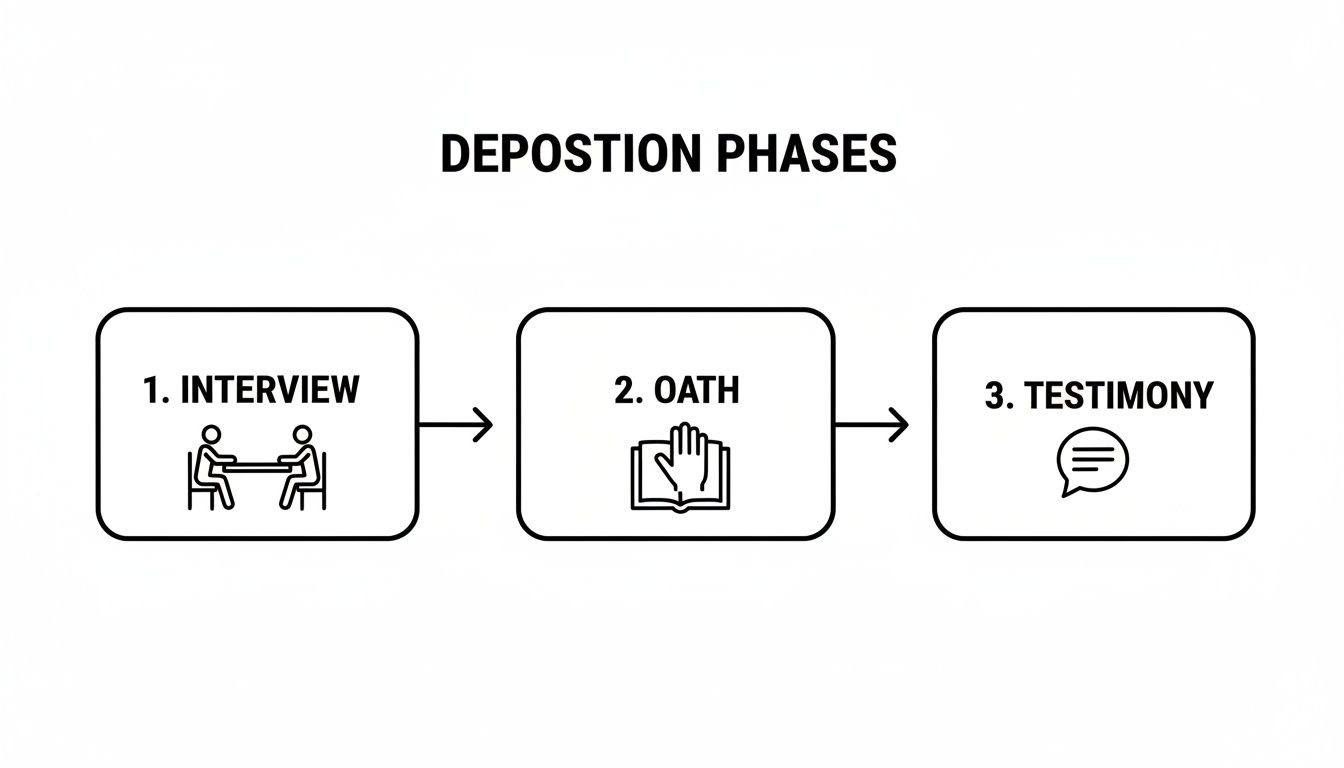
As the flowchart shows, things start with some brief introductions. Then, the court reporter will place you under oath—it’s a quick, formal process. From there, we move into the main event: the testimony, where the opposing attorney asks you questions about the case. They’ll usually begin by explaining the ground rules before diving into the facts of your family law or civil case.
Here's the bottom line: The other side's main goal is "discovery." They want to find out what you know, see how you come across as a witness, and lock in your testimony so there are no surprises if we go to trial.
Your job is not to win the case in the deposition. It's simply to give truthful, direct, and concise answers. Our job is to make sure you are fully prepared long before you ever set foot in that conference room. If you’re facing a deposition, contact The Law Office of Bryan Fagan in Kingwood for a free consultation. We’ll walk you through exactly what to expect.
Working With Your Kingwood Attorney
When you're facing a deposition, your lawyer is your single most important resource. Think of us as your coach, strategist, and guide all rolled into one. Here at The Law Office of Bryan Fagan, we don't just hand you a pamphlet; we dive in and prepare with you, side-by-side. The goal is simple: for you to walk into that room feeling confident and ready for anything.

This isn't just our job; it's a partnership. You bring the firsthand knowledge of your situation, and we bring the legal expertise. Together, we build the strongest possible case, starting with your testimony.
Gathering Your Key Documents
The first real step is to get all the paperwork together. The other side will have documents, so we need to be masters of our own. Your records are the bedrock of your story, and what we need depends entirely on your case.
- Family Law Cases: If you're a client in Humble dealing with a divorce or custody battle, we’ll be digging through financial statements, texts, emails, and school or medical records for the kids.
- Civil Litigation: For a business dispute in Porter, we’re hunting for contracts, invoices, internal memos, and any correspondence that lays out the timeline of what happened.
- Criminal Defense: For a Northeast Houston resident facing charges, this could mean carefully reviewing police reports, witness statements, and every piece of evidence turned over by the prosecution.
Going through these documents together is non-negotiable. It jogs your memory on key dates and conversations, locks in the consistency of your story, and, frankly, helps us predict exactly where the opposing lawyer is going to poke and prod.
The Power of the Mock Deposition
One of the most valuable things we do is run a mock deposition. It's basically a dress rehearsal. We'll set it up right here in our Kingwood office, and one of our attorneys will take on the role of the other lawyer, asking you the kinds of tough, tricky questions you're likely to hear.
It might sound a little intense, but every client who does it says it was a game-changer. Here’s why it works:
- It Kills the Nerves: The real deposition won't feel so alien and intimidating because you've already been through a version of it.
- It Sharpens Your Answers: We can fine-tune your responses, keeping them truthful and direct without accidentally giving the other side extra ammunition.
- It Builds Composure: You’ll get practice staying cool and collected, even when faced with confusing or hostile questions.
A mock deposition isn't about memorizing a script. It's about building the muscle memory for clear, honest communication under pressure. It's where we turn theory into practice.
This kind of preparation is vital, and the skills you build are useful in other legal settings, too. It's the same core training we use when helping clients understand how to prepare for a custody hearing.
Mastering Your Testimony
Your testimony is simply your truth. Our job is to help you tell it clearly and effectively. A huge part of this is learning to embrace three simple but powerful words: "I don't know."
If you genuinely don't know the answer to a question, say so. That’s the only correct answer. Guessing or making assumptions is a trap; it creates tiny cracks in your testimony that a good lawyer can break wide open. The same goes for "I don't recall." It's a perfectly complete and honest answer.
Another fundamental rule is to answer only the question that was asked. So many people feel a natural urge to explain themselves or add extra context. Resist that urge. It’s almost always a mistake. Volunteering information just opens up new doors for the other lawyer to walk through. Keep your answers short, sweet, and to the point.
Finally, we also bring a data-driven approach to our preparation. Modern litigation increasingly relies on hard numbers to build a compelling case. In fact, leveraging statistical analysis has become a game-changer, with data-driven insights helping to counter complex arguments. A 2023 survey found that 65% of litigators credited statistical preparation for deposition successes. This level of thorough preparation ensures we are ready for whatever comes our way.
If you have a deposition on the horizon, don't try to navigate it alone. Schedule a free consultation with our Kingwood office today. We're here to help our neighbors in Northeast Houston prepare with confidence.
How To Conduct Yourself During The Deposition
When you step into that deposition room, remember that everything you say and do matters. This isn't a casual conversation; it's a formal, on-the-record event where your composure and credibility are just as important as the facts themselves. For our clients in Kingwood, this is the moment where all our preparation work comes to life.
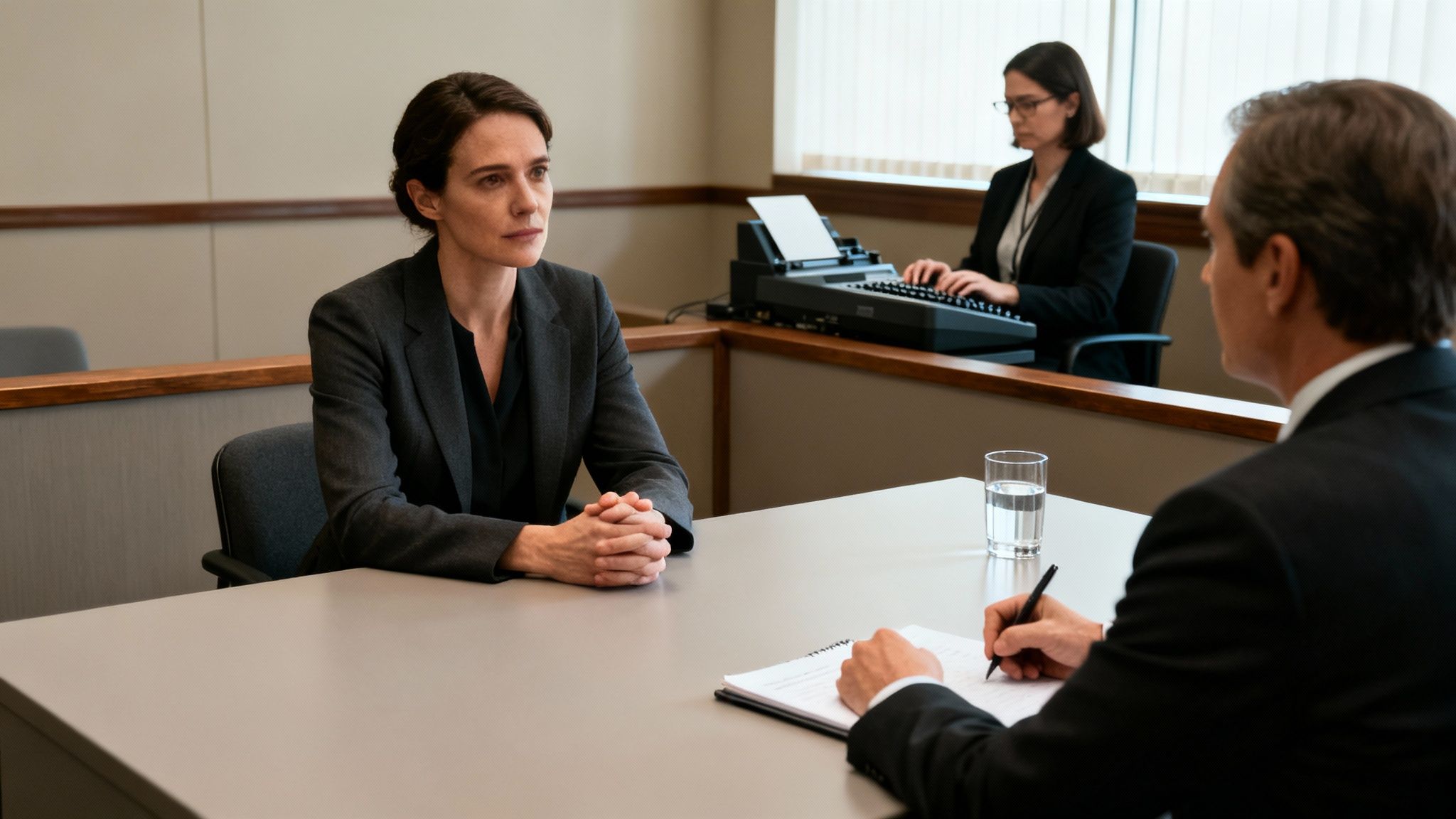
The goal isn't to put on a performance. It's about presenting your truth in a clear, calm, and controlled way. By sticking to a few key principles, you can navigate even the toughest questions with confidence and ensure the official transcript is an accurate reflection of the facts.
The Art of Answering Questions
The opposing lawyer is there to gather information, and they are masters at phrasing questions to get certain responses. Your strategy is simple: be truthful, be direct, and stay disciplined.
The most fundamental rule is to always listen to the entire question before you even think about answering. It’s a natural human tendency to anticipate what someone is going to ask and jump in. Resist that urge. Answering too quickly can lead you to respond to a question that was never actually asked.
After the question is complete, take a deliberate pause. This isn't a race. That pause gives you a moment to process the question and gives your attorney a window to object if the question is improper under Texas law. A slow, thoughtful pace is your greatest asset.
Key Things You Should Do
Your approach during testimony can make or break your case. These are the core "Do's" we drill with our clients from Humble to Northeast Houston:
- Always Tell the Truth. This is non-negotiable. You are under oath, and honesty is the only policy.
- Answer Only the Question Asked. If a question can be answered with a simple "yes" or "no," that's your answer. Don't feel obligated to explain or provide extra context.
- Keep Your Answers Brief. Short, concise answers are always best. Volunteering extra information just opens the door for the other attorney to go down unplanned and often unhelpful rabbit holes.
- Say When You Don't Understand. If a question is confusing, long-winded, or uses a word you don't know, it's perfectly fine to say, "Can you rephrase that?" or "I don't understand the question."
Remember, a deposition is not your chance to argue your case or win over the other side. Your only job is to provide truthful, factual answers. Let your attorney handle the legal strategy and arguments later in court.
Critical Mistakes You Must Avoid
Knowing what not to do is just as important. Avoiding these common traps is crucial to protecting your case. For example, in a personal injury case, guessing what the other driver was thinking can seriously undermine your credibility. These same principles are vital if you are learning how to file a personal injury claim in Texas.
Keep these "Don'ts" front and center:
- Don't Guess or Speculate. If you don't know the answer, the correct response is, "I don't know." If you can't remember, say, "I don't recall." Never invent an answer.
- Don't Volunteer Information. Stick to the question asked. Every extra word you offer can be used to harm your case.
- Don't Argue or Get Emotional. The opposing lawyer might try to rattle you or get a rise out of you. Stay calm and collected. A level-headed demeanor communicates control and credibility.
- Don't Bring Notes or Documents. Anything you bring with you to the deposition table, including personal notes, can be requested, examined, and marked as an exhibit by the opposing counsel.
Deposition Do's vs. Don'ts Checklist
To make it even clearer, here’s a quick-reference table summarizing how to act versus what to avoid. Think of this as your cheat sheet for deposition day.
| Do This | Don't Do This |
|---|---|
| Listen to the full question. | Interrupt or anticipate the question. |
| Pause before answering. | Rush to give an answer. |
| Tell the truth, always. | Guess, speculate, or lie. |
| Answer only what is asked. | Volunteer extra information. |
| Keep answers short and to the point. | Tell long stories or give explanations. |
| Say "I don't know" if you don't know. | Make up an answer to seem helpful. |
| Ask for clarification if confused. | Answer a question you don't understand. |
| Stay calm and composed. | Argue or get visibly angry or upset. |
| Trust your attorney to protect you. | Bring notes or other unapproved documents. |
Keeping these simple do's and don'ts in mind will help you stay focused and in control.
Navigating a deposition requires discipline, but you’re not in it alone. At The Law Office of Bryan Fagan, we prepare you for every step and stand by your side throughout the entire process. If you’re a Kingwood-area resident facing a deposition, schedule a consultation with us today. We'll make sure you're ready.
Preparing for a Remote Deposition
More and more, legal proceedings are happening online, and depositions are no exception. For many of our clients here in Northeast Houston, the idea of testifying through a screen can be intimidating. It brings a whole new set of challenges to the table.
Successfully navigating a remote deposition means blending solid legal preparation with being ready for the technology. It’s not just about what you say, but how you say it in a virtual setting.
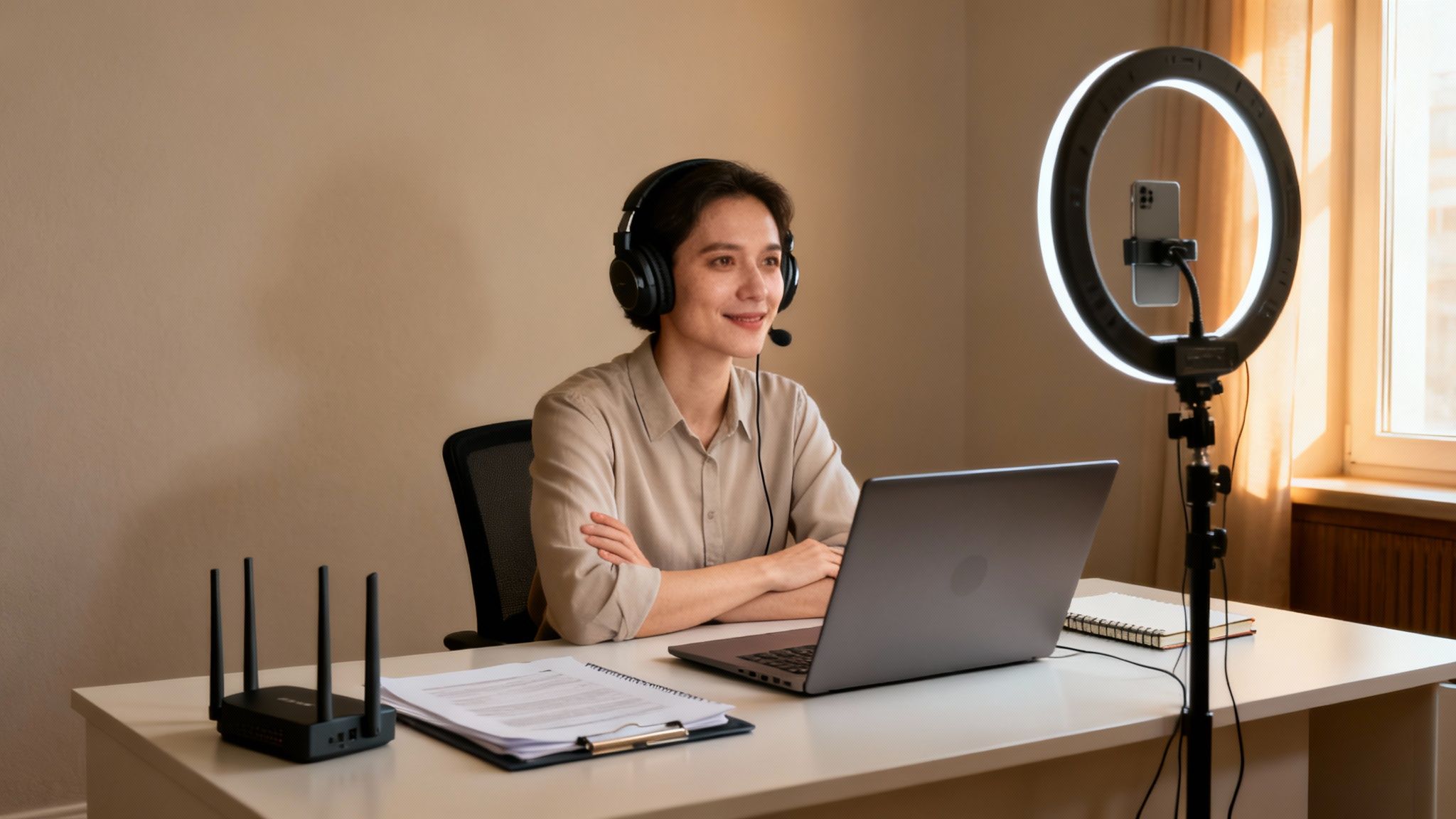
This shift isn't just a passing trend—it's fundamentally changing how the legal system works. A 2023 survey showed that over 70% of law firms now handle at least some depositions remotely. That number is expected to jump to 85% by 2025.
What does that mean for you? It means tech proficiency is no longer optional. The same study found that 90% of people who felt their remote deposition went well had practiced with the platform, like Zoom, beforehand. They got comfortable with features like screen sharing and virtual exhibits before the pressure was on. You can read more about the rise of remote depositions and see the data for yourself.
Setting the Stage for Success
Your physical environment plays a massive role in your virtual presence. Before your deposition, you need to create a space that is professional, private, and totally free from distractions. This isn’t just about looking good on camera; it’s about creating a setting where you can focus completely on giving clear, accurate testimony.
We always give our Kingwood clients a simple checklist to run through:
- Find a Private Room: Choose a room where you can close the door. Make it clear to family or roommates that you cannot be disturbed for any reason while the deposition is happening.
- Choose a Neutral Backdrop: A simple, blank wall or a tidy bookshelf works best. We strongly advise against using virtual backgrounds—they can be distracting and sometimes come across as unprofessional. The focus needs to be on you.
- Eliminate All Distractions: Silence your phone and put it out of sight. Close your email and any other notifications on your computer. Your full attention has to be on the questions being asked.
Mastering Your Tech Setup
Nothing derails focus and undermines your credibility faster than a technical glitch. A smooth, seamless tech experience allows your testimony to be the main event, not your spotty internet connection. A full tech rehearsal with your attorney isn't just a good idea; it's a non-negotiable step in our preparation process.
Here’s a technical checklist to work through:
- Test Your Internet Connection: A stable, high-speed connection is crucial. If your Wi-Fi is known to be unreliable, connecting directly to your router with an ethernet cable is the safest bet.
- Check Your Audio and Video: Use a quality webcam and microphone—the ones built into your laptop might not be enough. Test them out on the exact platform being used for the deposition, whether it's Zoom, Webex, or something else.
- Optimize Your Lighting: This is a simple but important one. Make sure your main light source is in front of you, not behind you. A window in front of your desk is perfect. This keeps your face clearly visible, which is essential for non-verbal communication.
A remote deposition requires you to be your own IT manager. A few minutes of technical prep can prevent hours of frustration and ensure your testimony is delivered clearly and without interruption.
Navigating the Virtual Dynamic
Testifying remotely just feels different. You can't pick up on all the subtle body language cues you would in person, and the natural rhythm of a conversation can get a little clunky. You have to adapt your communication style for the screen.
For example, make a conscious effort to look directly into your webcam when you speak. It feels unnatural at first, but to everyone else, it will look like you're making eye contact.
Because of potential audio lags, it's more important than ever to wait for the other attorney to completely finish their question before you start to answer. That deliberate pause does two things: it prevents you from accidentally talking over them, and it gives your Kingwood attorney a clear window to make an objection if needed.
Finally, you and your attorney will set up a private, back-channel way to communicate during the deposition. This might be through text or a secure messaging app. It ensures we can give you guidance in real-time without interrupting the official record.
Whether your deposition is remote or in-person, you don't have to prepare alone. The team at The Law Office of Bryan Fagan is here to guide our neighbors in Kingwood, Humble, and the surrounding communities. Contact us for a free consultation to make sure you walk in fully prepared and confident.
Handling Depositions Across State Lines
For our clients here in Kingwood and Northeast Houston, it’s not uncommon for a legal case to spill across state lines or even international borders. When a key witness, an expert, or a crucial piece of evidence is located outside of Texas, the simple act of gathering testimony suddenly becomes a lot more complicated.
This isn't just about juggling time zones for a phone call. We're talking about a maze of different state laws, federal rules, and sometimes even international treaties that dictate how testimony can be legally obtained. A misstep here can be disastrous, potentially getting crucial testimony thrown out of a Texas court and torpedoing your case.
Understanding the Jurisdictional Hurdles
When everyone involved in a case is right here in Harris County, scheduling a deposition is straightforward—we just follow the Texas rules. But what happens if a critical witness in your Humble family law case now lives in California? Or the expert witness for your civil suit is based in New York?
Suddenly, we have to play by their rules. We must follow that state's specific legal procedures to compel their testimony. This often means hiring local counsel in that state or going through a multi-step process to issue a valid subpoena. It adds extra layers of time, cost, and complexity, which is why you need an attorney who has been down this road before. We handle these logistical headaches so you can concentrate on the facts of your case.
International Depositions and The Hague Convention
When a witness is in another country, the rulebook gets tossed out completely. Modern life means many cases, from business disputes to complicated family law matters, involve people living abroad. To get their sworn testimony, we have to operate within the framework of international law, most often The Hague Evidence Convention.
This is a treaty between many countries that creates a formal, official channel for requesting evidence from a foreign nation. But it's far from a simple process. It can be incredibly slow, bogged down in bureaucracy, and the requirements can vary wildly from one country to another.
Some countries are extremely protective of their legal sovereignty. They can place strict limits on any foreign legal proceedings—including depositions—taking place on their soil. Ignoring their rules isn't just a procedural mistake; it can be seen as a violation of that country's laws.
Navigating Foreign Restrictions
The key to a successful international deposition is understanding these global legal quirks long before the deposition date. In fact, more than 20 countries impose serious prohibitions or restrictions on depositions. The risks of getting it wrong are real; from 2018-2024, an estimated 25% of international depositions in U.S. federal courts were invalidated because of procedural failures.
To get around this, attorneys often advise witnesses to travel to a more permissive nearby location. For instance, Hong Kong is a common neutral ground for witnesses based in China, while Finland is often used for residents of Russia. It is absolutely crucial to review the host country's rules at least 90 days in advance to make sure everything is done by the book. You can learn more about how to prepare for a deposition around the world to see just how vital this advance planning is.
Because the stakes are so high, an out-of-state or international deposition is not a DIY project. The rules are intricate, and a single mistake can be incredibly costly.
If your case involves people or evidence located outside of Texas, don't leave the outcome to chance. The Law Office of Bryan Fagan in Kingwood has the experience to manage these complex logistical and legal challenges. Schedule a free consultation with us today, and let us handle the complexities while you focus on what matters most.
Answering Your Top Deposition Questions
After we've gone over the process and run through a prep session, we find clients still have a few practical questions. That’s completely normal. The unknown can be nerve-wracking, and our goal is to have you walk into that deposition room feeling confident and prepared, not anxious.
Let's tackle some of the most common questions we hear from our clients right here in Kingwood. Getting these details sorted out helps you focus on what matters: giving clear, honest testimony.
What Should I Wear to My Deposition?
Think of it this way: you want your appearance to signal that you’re taking this 100% seriously. Dress like you're heading to the courthouse in downtown Houston. For our clients, we always suggest aiming for business casual.
You don’t need to buy a whole new outfit, but you do need to look professional and put-together.
- A simple collared shirt with slacks works great.
- A conservative blouse or a nice sweater is a solid choice.
- A professional dress or a skirt and top are also perfect.
- Always opt for closed-toe shoes.
What you don't wear is just as important. Stay away from t-shirts with logos, shorts, or sandals. Avoid flashy or distracting jewelry. Your clothes shouldn't be the focus—your credible testimony should be.
How Long Is This Going to Take?
This is usually the first question everyone asks, and the most honest answer is, "it depends." The Texas Rules of Civil Procedure generally cap a deposition at six hours per witness, but that's the maximum, not the standard.
For a relatively straightforward case in Porter, we might be done in just two or three hours. But for a complex divorce involving years of financial records or contentious custody issues, you can bet the other side will use as much of that six-hour block as they can. We might even have to schedule a second day.
Your attorney will always give you a realistic estimate based on your specific situation.
Our Advice: Block off your entire day for the deposition. Don't schedule anything important right after. If you're not constantly checking the clock, you'll be less stressed and better able to provide the thoughtful, accurate answers your case needs.
Can I Bring My Notes with Me?
In a word: no. Please don't bring any notes, timelines, or documents into the deposition unless your attorney has specifically told you to. We know it seems like a good way to keep your facts straight, but it almost always backfires.
Here's why: Anything you bring with you is fair game for the opposing attorney. They have the right to see your notes, question you on every single word you wrote, ask when and why you wrote it, and then mark those notes as an exhibit. Suddenly, your private cheat sheet is official evidence.
The best preparation is the work we do together beforehand. Trust that process. If you need to refresh your memory, do it in the waiting area before we start, not at the deposition table.
What Happens After My Deposition Is Over?
Once the last question is asked, your part is done for the day, but the process isn't quite finished. Your testimony now becomes a powerful tool in your case.
First, the court reporter will type up a full, word-for-word transcript of everything that was said. You’ll get a chance to read through it and check for any errors—maybe they misspelled a name or got a number wrong. This is called the "read and sign" review.
Once you approve it, that transcript is locked in as official evidence. We can then use it in several key ways:
- To support motions we file with the court.
- To gain leverage in settlement talks.
- To use at trial if you’re unavailable, or to lock in the other party's story.
Your deposition is a major milestone in the discovery phase—the formal part of a lawsuit where both sides exchange information. Afterward, you and your attorney will have a quick debrief to discuss how it went and map out the next steps for your case.