Skip to content
Parents in Texas can agree informally to any parenting arrangement they want, but without a court order, that agreement isn't enforceable and can leave both the parents and the child vulnerable to instability and legal chaos. In practical terms, parents may cooperate well for months or even years, but if something changes, no judge can step in to enforce visitation or support until a formal order is signed.
A lot of parents in Kingwood, Humble, and Porter start from a good place. They want to keep things peaceful. They don't want to turn their child into the center of a court fight. They may already have a working routine where one parent handles school pickups, the other takes weekends, and both split expenses in a way that feels fair.
That instinct deserves respect.
When parents ask about can parents agree to no custody order in Texas in Kingwood, they usually aren't trying to avoid responsibility. They're trying to avoid conflict. They want flexibility, privacy, and less stress. The problem is that an informal agreement may feel stable right now, while still being legally fragile underneath.
A custody order isn't just for parents who are fighting. For many families in Northeast Houston, it's the opposite. It's the written backup plan that protects a cooperative relationship before misunderstandings, new partners, job changes, school decisions, or a move across town put that cooperation under pressure.
A Common Question for Kingwood Co-Parents
A father in Kingwood moves into an apartment near Woodland Hills Drive after a separation. A mother stays in the family home so their child can keep the same school and friends. They still talk politely. They work out pickup times by text. Holidays are flexible. Nobody wants a courtroom battle.
That arrangement can feel mature and healthy.
For a while, it often is. Many parents in Humble and Northeast Houston tell themselves they don't need paperwork because "we agree on everything." If that's where you are, you're not being unreasonable. You're trying to protect your child from conflict and keep your family life as normal as possible.
Why parents want to skip court
Most cooperative parents worry about three things:
- Stress: They assume filing anything in court will turn a manageable situation into a fight.
- Cost: They don't want legal fees attached to a relationship that's still civil.
- Flexibility: They think a formal order will make everyday parenting too rigid.
Those concerns are real. But they often rest on a misunderstanding. A court order doesn't have to be a weapon. It can function more like a family roadmap. It tells both parents what happens on school nights, holidays, transportation, medical decisions, and support. It gives everyone a shared reference point when life gets busy or emotions change.
Practical rule: If an arrangement matters enough to depend on, it matters enough to put in a form a judge can enforce.
The real issue isn't trust today
The issue is what happens later.
Today, both parents may agree that the child spends weekdays in Kingwood and weekends with the other parent in Porter. But what if one parent starts a new job with changing hours? What if someone begins a new relationship and household tensions rise? What if one parent suddenly decides the old routine "isn't working anymore"?
Without a signed order, the family has no legal safety net.
That is why experienced family lawyers in Kingwood often reframe the question. The issue isn't whether you and the other parent can cooperate without an order. Many parents can. The issue is whether your child should have to rely on goodwill alone when schedules, finances, and emotions do change.
A formal order takes a handshake agreement and turns it into lasting protection. For a child, that means more predictability. For a parent, that means more peace of mind.
What No Custody Order Legally Means in Texas
When Texas parents don't have a custody order, the law doesn't assume one parent is automatically in charge. In general, both parents retain equal rights and duties toward the child. That sounds balanced, and in some ways it is. But it also creates uncertainty in real life.
Texas guidance explains that when there is no custody order, there are no visitation rules, and no court can enforce visitation or support until a SAPCR order or divorce decree is entered through the court process. That means an informal arrangement may exist in practice, but it doesn't carry the force of a signed order in the way many parents assume it does. You can read that in Texas Law Help's explanation of parents' rights when no custody orders exist.

What equal rights look like in daily life
Equal rights can create conflict fast when parents don't define responsibilities in writing. Questions that seem small can become major disputes:
- School choice: Which parent decides where the child enrolls?
- Medical care: Who has final say if the parents disagree?
- Residence: Can one parent move the child away from Kingwood?
- Schedules: Who decides weekends, summers, or holidays?
The phrase can parents agree to no custody order Texas Kingwood often leads to questions about whether peace can replace paperwork. The legal answer is that peace helps, but paperwork still matters because equal rights without clear boundaries often lead to confusion.
What a SAPCR is
A Suit Affecting the Parent-Child Relationship, usually called a SAPCR, is the Texas court process used to establish legal rights involving a child. It can address custody, visitation, support, and related decision-making.
That name sounds intimidating, but the process doesn't automatically mean a trial or hostile litigation. In many agreed cases, parents use the SAPCR process to turn a workable parenting plan into an enforceable court order. That's especially important for unmarried parents in this area, and our guide to Texas custody laws for unmarried parents gives more local context.
A SAPCR can be a conflict-management tool, not a conflict-creation tool.
Why the legal default creates practical risk
The legal default works poorly when life becomes less cooperative.
A parent may assume, "We've always done alternating weekends, so that's our deal." But Texas doesn't treat that informal routine the same way it treats a signed order. If the routine breaks down, the court doesn't have an order to enforce. If support was paid informally, that arrangement may also lack immediate enforceability.
For families in Humble, Porter, and Northeast Houston, that uncertainty matters most when a child needs consistency. A formal order doesn't eliminate every disagreement, but it gives the child a stable structure and gives the parents a legal way to resolve problems.
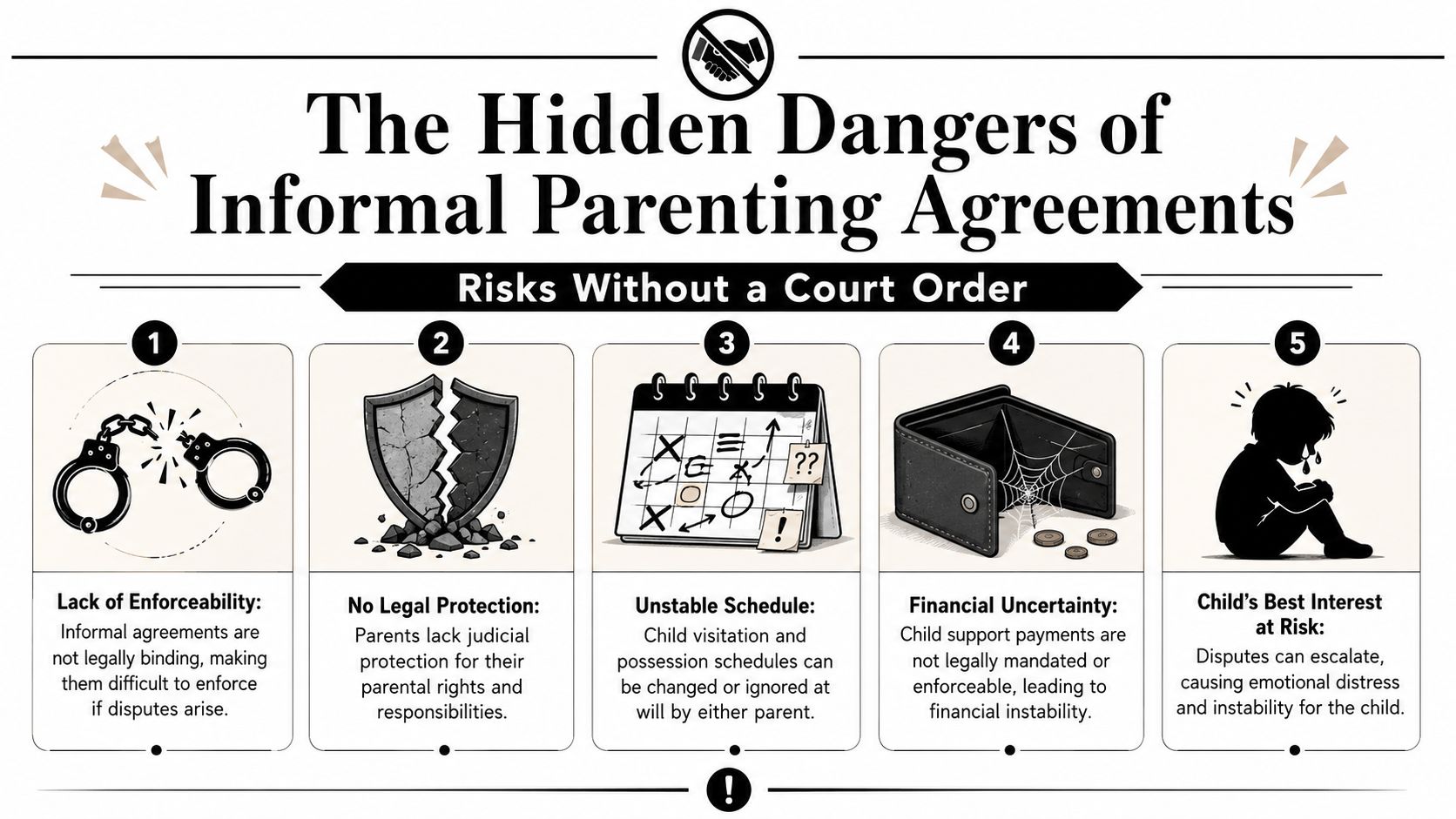
The Hidden Dangers of Informal Parenting Agreements
A handshake agreement works only as long as both parents keep choosing it.
That sounds obvious, but it's where many Kingwood families get blindsided. The arrangement may feel solid because it has worked before. Then one disagreement changes everything. One parent stops responding. One holiday gets disputed. One missed payment turns into a pattern. Suddenly, the family realizes that "our agreement" and "an enforceable order" aren't the same thing.
Where informal deals break down
The biggest problem isn't that parents make informal agreements. The problem is that those agreements depend entirely on ongoing cooperation.
Here are common pressure points:
- Holiday conflicts: One parent says the child will stay through Christmas morning because that's what you've "always done." The other parent denies it and keeps the child longer.
- Withholding possession: A parent decides the child shouldn't go for the weekend and refuses the exchange.
- Money disputes: One parent stops contributing to school costs, activities, or regular support.
- Schedule drift: Pickups become inconsistent, then stop following any pattern at all.
- Relocation fears: A parent talks about moving out of Northeast Houston, and the other parent has no written restrictions to point to.
These aren't rare because people are bad. They're common because life changes and stress exposes the weak spots in informal arrangements.
Agreement versus enforceable order
One useful way to think about this is the same way people think about business and property issues. A verbal understanding can reflect good intentions, but it doesn't offer the same protection as a signed, enforceable document. That's one reason some families find it helpful to read about protecting your business with agreements. The family-law setting is different, but the practical lesson is similar. Clarity and enforceability matter when people later disagree about what was promised.
| Situation | Informal agreement | Court order |
|---|---|---|
| Weekend possession dispute | Depends on cooperation | Can be enforced through court process |
| Holiday confusion | Often resolved by argument or compromise | Written terms guide the schedule |
| Child support disagreement | Hard to compel informally | Order creates enforceable obligation |
| Major change in routine | One parent may act unilaterally | Modification goes through court review |
The child's routine takes the hit
Adults often tell themselves they can "work it out later." Children usually absorb the cost of that delay.
A child may not know legal terms like SAPCR or agreed order, but the child does know when pickup times keep changing, when parents argue over school breaks, or when the answer to "Where am I sleeping this weekend?" depends on who is angry. Informal parenting plans create uncertainty in the place children need certainty most.
Children usually don't need perfect co-parents. They need predictable co-parents.
Why legal fragility becomes emotional fragility
Without an enforceable order, every disagreement becomes a fresh negotiation. That can produce repeated texting, pressure from relatives, last-minute schedule shifts, and tense exchanges in parking lots. In some situations, one parent starts documenting everything because trust has broken down, but still has no signed order to enforce.
That creates a dangerous gap. The family has conflict, but not yet legal structure.
For Kingwood and Humble parents, this is often the turning point. They realize a custody order isn't about mistrust. It's about protecting the child from instability if cooperation weakens. The paper itself doesn't create peace. It protects peace when peace gets tested.
Better Alternatives for Cooperative Co-Parenting
A better path exists when both parents are trying to keep life calm for their child. The goal is not to "win" custody. The goal is to build a clear plan that keeps the peace you have now from falling apart later.
For cooperative parents in Kingwood, Humble, or Porter, the strongest alternative to a handshake arrangement is a plan with layers. First, get the terms out of your heads and onto paper. Then make sure those terms can be enforced if schedules change, communication breaks down, or a new partner, job, or school issue puts pressure on the routine.

Start with a written parenting plan
A written parenting plan is often the first practical upgrade from a verbal agreement. It gives both parents the same reference point, which cuts down on "I thought we said…" disputes.
A good plan usually addresses daily life, not just broad ideas. That can include:
- School-week schedules
- Exchange times and locations
- Holiday and summer schedules
- Transportation responsibilities
- Phone or video contact
- How parents will handle medical, school, and activity decisions
Writing these details down often reveals missing pieces. Parents may agree on weekends, for example, but realize they never talked about teacher conferences, spring break, or what happens if a child gets sick during one parent's time.
A written plan helps. By itself, though, it is still more of a promise than a rule unless it becomes part of a signed court order.
Use mediation to work out the hard details
Mediation gives cooperative parents a structured setting to solve problems before they turn into arguments. Instead of debating by text message at 10:30 p.m., parents sit down with a neutral third party and work through the points that usually cause friction.
That process is especially useful when parents agree in principle but need help pinning down specifics, such as who picks up from daycare, how holiday exchanges will work, or how much notice is required before changing a weekend. Parents considering equal or near-equal time often benefit from reviewing how shared custody in Texas is commonly structured before finalizing those details.
Mediation also tends to produce clearer language. That matters because vague agreements feel friendly at first, but vague terms often create the very conflict parents were trying to avoid.
The strongest option is an agreed order
An agreed order is usually the safest choice for parents who are getting along. It keeps the cooperative spirit of a private agreement, but adds the legal force of a court order.
That distinction matters in Texas. Parents can agree to many custody and support terms, but the court still has to approve them if they affect the child. Judges are looking at the child's best interest, not just whether both adults signed off. The same issue comes up with child support. Texas courts may approve a no-support or reduced-support agreement in some agreed cases, but only after reviewing whether the arrangement still meets the child's needs, as explained in this discussion of whether parents can agree to no child support in Texas.
An agreed order turns cooperation into structure. It gives parents a working rulebook for ordinary life and a legal fallback if life stops being ordinary.
Which option gives your child the most protection?
These choices do not all offer the same level of security.
- Verbal agreement: Easy to start, easy to dispute
- Written parenting plan: Better clarity, but limited protection if never filed
- Mediated agreement: Often more thoughtful and detailed, but still needs court approval
- Agreed court order: Clear terms, court approval, and a way to enforce the plan if needed
Many parents worry that formalizing an agreement will make the relationship feel hostile. In practice, it often does the opposite. A clear order removes guesswork, lowers the number of repeat arguments, and gives children a more predictable routine.
That is why cooperative co-parenting works best with structure. A custody order is not a sign that parents expect the worst. It is a way to protect the good working relationship they have already built.
How to Formalize Your Custody Agreement in Kingwood
If you and the other parent already agree on the basics, formalizing that agreement is often more administrative than adversarial. The process still matters, though, because the wording in the final documents affects what happens later if school schedules change, one parent moves, or support becomes an issue.
A local family lawyer can help prepare the paperwork for Harris County and make sure the agreement says what you think it says. That's especially useful when parents are trying to avoid future conflict, not create it.
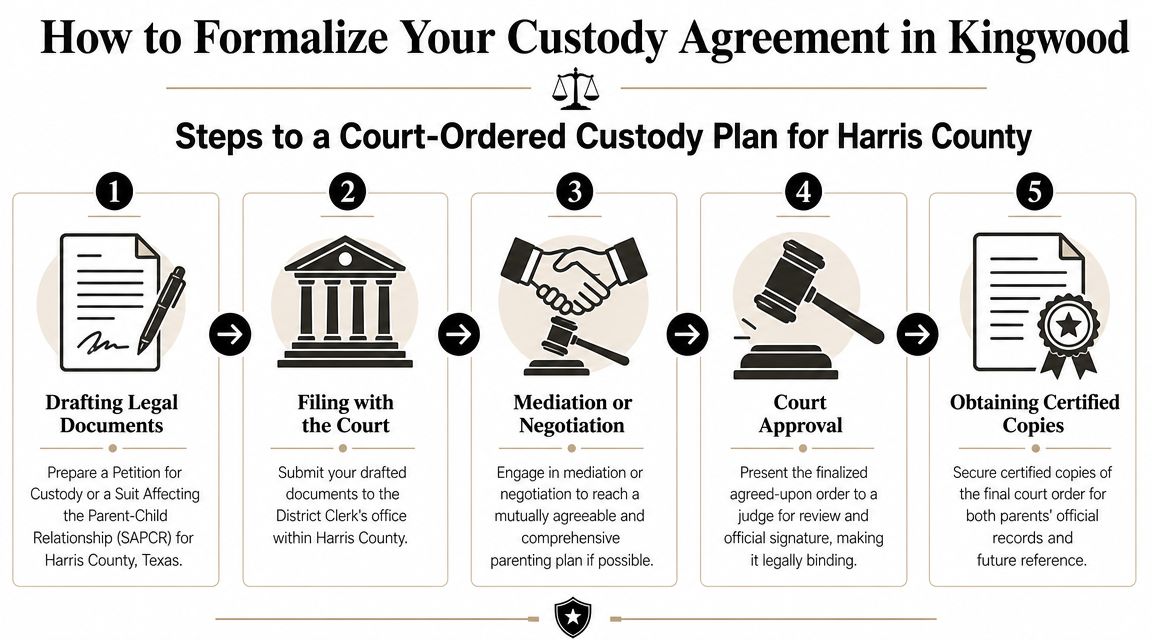
Start with a visual overview of the process many parents in Kingwood follow.
Step one is drafting the right documents
The process usually begins with legal pleadings and a proposed final order. In many cases, that includes a SAPCR filing and an agreed order that sets out conservatorship, possession, support, and rights related to the child.
The drafting stage is where many problems get planted. Vague wording like "reasonable visitation" may sound cooperative, but it can become a source of dispute later. Precise language gives both parents a practical rulebook.
Some agreements need extra detail about:
- School-year schedules
- Holiday exchanges
- Summer possession
- Medical decision-making
- Travel and notice requirements
Step two is filing in Harris County
Once the paperwork is ready, it must be filed with the proper court. For Kingwood families, that often means working through the Harris County filing process.
The act of filing doesn't mean your cooperative case has turned hostile. It places the agreement where a judge can review and sign it. That review is part of what gives the order legal effect.
This video offers a helpful general overview of Texas custody issues and can give parents a better sense of how the process works in practice.
Step three is getting the judge's signature
Texas family-law guidance explains that for a legally enforceable no-order or modified arrangement, parents must reduce their agreement to an Agreed Order and obtain a judge's signature. Even when both parents fully agree, the proposed order still must be submitted to the court, and the judge signs only if the changes are in the child's best interest, as described in this explanation of changing a custody agreement in Texas through an agreed order.
That final approval is the moment when your family's plan moves from private understanding to enforceable law.
A signed order gives the court something concrete to enforce. Before that, you're relying on cooperation alone.
Step four is keeping certified copies
After the judge signs the order, both parents should keep copies in an accessible place. Schools, doctors, and caregivers may need to know who has authority to make certain decisions or who is authorized for pickup.
This is also where many parents feel the biggest sense of relief. The goal wasn't to "win." The goal was to replace uncertainty with a clear plan that protects the child and gives both homes a dependable framework.
When You Should Consult a Kingwood Family Law Attorney
Some parents can move from an informal arrangement to an agreed order with relatively little friction. Others shouldn't try to handle it alone.
The difference usually isn't whether the parents "get along." It's whether there are risk factors that make mistakes more costly. If your situation includes one of the warning signs below, getting legal advice in Kingwood is often a practical step, not an aggressive one.
Red flags that change the analysis
You should strongly consider speaking with a lawyer if any of these apply:
- Family violence concerns: Safety planning and careful drafting matter more than convenience.
- Substance abuse issues: A parenting plan may need tighter structure and clearer protections.
- Unreliable follow-through: If one parent already ignores schedules or promises, informal terms are especially risky.
- Special needs planning: A child with medical, developmental, or educational needs may require detailed provisions that generic forms won't address.
- Income imbalance: Support questions may be more sensitive when one home has much greater financial pressure.
- Possible relocation: If one parent may leave Kingwood, Humble, or Northeast Houston, the stakes rise quickly.
When online conflict becomes part of the case
Modern co-parenting disputes don't stay offline. Parents sometimes post frustrations on social media, argue by text in ways that can later be screenshot, or involve friends and family online. If the relationship is becoming more contentious, it can help to think carefully about privacy and public image. For broader context, this article on safeguarding online reputation amidst divorce offers practical ideas about reducing unnecessary digital damage.
A custody matter can shift from calm to complicated faster than one might expect.
Why local guidance matters
A local attorney can help you spot issues before they become emergencies. That may include reviewing a draft order, identifying missing protections, or helping you decide whether an agreed case is still realistic.
If you're in this position, a child custody lawyer in Kingwood, TX can help assess whether your current plan protects your child or only works as long as nobody changes course.
Creating a Secure Future for Your Child in Northeast Houston
Parents often ask whether formalizing custody will make things more tense. In many families, the opposite is true. Clear written expectations lower the number of avoidable arguments because nobody has to guess what was agreed.
That matters in everyday life. Children do better when routines are stable, exchanges are predictable, and both homes know the plan. Parents also sleep better when they know school decisions, holiday schedules, and support expectations aren't hanging on a text thread that can be ignored.
What a formal order really provides
A court order doesn't guarantee perfect co-parenting. It does provide a stronger foundation than a handshake arrangement ever can.
It gives your family:
- Predictability: The child knows where they'll be and when.
- Clarity: Parents know who handles what.
- Protection: Disputes can be addressed through a legal process instead of improvisation.
- Peace of mind: The family isn't relying only on memory, mood, or goodwill.
For many Kingwood and Humble parents, that's the essential answer to the question behind can parents agree to no custody order Texas Kingwood. Yes, parents can agree informally. But if the goal is long-term stability, an enforceable order is usually the safer and kinder choice for the child.
A responsible step, not a hostile one
Some of the most thoughtful parents are the ones who formalize a good agreement before anything falls apart. They aren't expecting the worst. They're planning carefully because children need security even when adults remain on decent terms.
Getting an order in place is often an act of prevention. It can preserve cooperation by removing uncertainty.
If you're in Kingwood, Porter, Humble, or nearby Northeast Houston communities, it helps to treat a custody order as part of responsible family planning. The same way parents plan for school, health care, and transportation, they should also plan for legal stability.
A clear order can protect the relationship you have with your child, reduce avoidable conflict with the other parent, and give your family a calmer path forward.
If you have questions about a parenting agreement, child support, or how to turn a cooperative arrangement into a signed order, Law Office of Bryan Fagan – Kingwood TX Lawyers invites you to schedule a free consultation at the Kingwood office. Families in Kingwood, Humble, Porter, and across Northeast Houston can get clear, practical guidance specific to their situation, with a focus on protecting children and building lasting peace of mind.