Skip to content
A lot of parents in Kingwood, Humble, and Northeast Houston end up asking the same question after life shifts: can child support be changed without going to court in Texas?
Usually, the question starts with a real change. One parent got laid off. The other got a better job. The child now needs different medical care. Parenting time changed, and the old monthly amount no longer feels fair. Both parents may even agree that the current order doesn't fit anymore.
That instinct makes sense. Most families don't want a drawn-out court fight. They want a practical solution, some updated paperwork, and a payment amount that reflects real life now.
The good news is that a courtroom battle often can be avoided.
The hard truth is that a legal process usually cannot.
Regarding changes to child support without going to court in Texas Kingwood, the short answer is this: you may be able to avoid a contested hearing, but you still need a formal, legally recognized change. In the Kingwood area, that often means working through an agreed order, mediation, or the Child Support Review Process instead of relying on a private side deal.
That distinction matters more than many parents realize. A private agreement may feel cooperative and reasonable. But if it never becomes an official new order, the old one can still control. That creates risk for both sides.
Families in Porter, Humble, and Kingwood often feel relieved once they understand that they do have options. There are structured ways to update support that are calmer, more efficient, and more predictable than people expect. If you need a starting point, this overview of how to modify child support in Texas helps explain the larger process.
Your Life Changed So Can Your Child Support Order
Take a common Kingwood example. A parent who has been paying support for years loses overtime or changes jobs. The amount that once seemed manageable now puts pressure on rent, groceries, and transportation. Or the receiving parent sees the child's needs grow and wonders how to cover school costs, medical expenses, or insurance changes.
In many families, the first conversation goes pretty well. One parent says, “Let's just lower it for now.” The other says, “That's fine, we don't need to make this a big thing.” Everybody wants to stay civil. Everybody wants to protect the child from conflict.
That cooperative mindset is valuable. It can make the process smoother.
But in Texas, cooperation alone usually isn't enough to change the order in a way the law will enforce.
What most parents are really asking
When people in Humble or Northeast Houston ask whether they can change child support without going to court, they usually mean one of these questions:
- Can we avoid a fight and still get the amount changed?
- Can we handle this by agreement instead of arguing in front of a judge?
- Can we keep costs down and still protect ourselves?
- Can we act quickly if income or custody has already changed?
The answer to those questions is often yes. Families can often work together. They can negotiate. They can mediate. They can submit an agreed order. In some situations, they can use an administrative process instead of a traditional courtroom setting.
Practical rule: In Texas, you can often avoid a courtroom battle, but you usually can't skip the need for a formal order.
Why this feels confusing
Parents often assume child support works like any other shared household decision. If both adults agree, the agreement should control. That sounds fair, but child support isn't treated like an informal family arrangement. It's part of a court order tied to a child's well-being.
That's why a parent in Kingwood who starts paying less based on a verbal agreement can still end up accused of being behind. And a parent who accepts less for months may later learn the old amount never legally changed.
The better approach is to treat the change seriously from the beginning. Not aggressively. Just carefully.
Why a Handshake Agreement Is Not Legally Binding in Texas
A Texas child support order is a formal court order. It isn't a suggestion, and it isn't a flexible side arrangement that parents can rewrite over text message. Until a new order replaces it, the old order remains the one that counts.
Consider the deed to a house. Two people can't stand in a driveway and verbally agree that ownership changed. They need proper documents, filing, and legal recognition. Child support works in a similar way. Parents can discuss changes, but the legal obligation changes only when the system recognizes it.
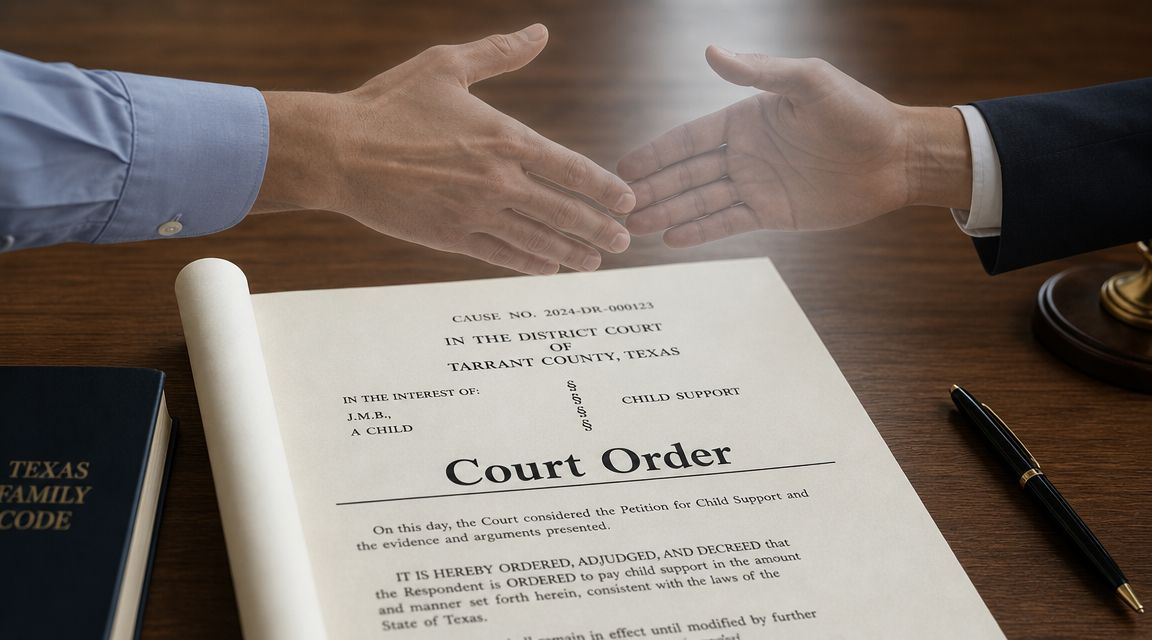
Texas law takes a narrow view of when support can be modified. In Texas, child support generally cannot be changed informally just because both parents agree; the existing order remains enforceable until a court approves a modification. A court can modify support only in limited situations, mainly a material and substantial change in circumstances or under the three-year review rule. For the latter, the order must be at least 3 years old, and the new guideline amount must differ by at least 20% or $100 from the existing order, as explained in this discussion of when child support can be modified in Texas.
What stays in effect until a new order is signed
Many parents in Kingwood assume that if both of them agreed to a lower or higher amount, that agreement replaces the old number. It doesn't.
Until the order is formally changed, the prior order still controls issues such as:
- The payment amount the paying parent is expected to send
- The payment schedule for when support is due
- Any wage withholding setup already tied to the case
- Enforcement rights if someone claims the order wasn't followed
That's the point where things become expensive and stressful. A parent may believe they complied with the family's agreement, even though the law still sees unpaid support under the old order.
Why informal agreements create risk for both parents
The paying parent takes the most obvious risk. If they reduce payments without a formal modification, the difference may be treated as unpaid child support under the old order.
The receiving parent also takes risk. If they informally accept less because they want to help the other parent through a rough time, they may later face confusion about what was paid, what was owed, and what should have been documented.
Even when the parents trust each other, situations change. New partners enter the picture. Memories differ. A once-friendly arrangement becomes a dispute.
The old order doesn't disappear because the parents were trying to be reasonable.
What counts as a legal basis to ask for change
Texas generally allows modification in limited situations. One common path involves showing a material and substantial change in circumstances. Another involves the review rule discussed above. The phrase material and substantial matters, but it can also frustrate parents because it isn't a simple checklist.
That uncertainty is one reason people in Humble and Porter often benefit from getting guidance early. A change may feel obvious to you, but you still need to present it clearly and through the right process.
A simple example from daily life
Say a Kingwood father loses income and the mother agrees by text that he can pay less for a while. He follows that message and sends the lower amount month after month. They stay friendly. No one files anything.
Months later, a disagreement happens. The mother asks for enforcement based on the original order. The court won't focus first on the text exchange. It will focus on the signed order already in place and whether it was formally changed.
That surprise is what catches families off guard.
The child is the reason formality matters
Texas courts don't treat child support as just a private bargain between adults. The system is designed to protect the child through a clear, enforceable order. That's why private consent by itself usually won't replace the formal order.
If you're trying to handle this calmly in Northeast Houston, that's still possible. It just needs to be done in a way the law recognizes.
Your Four Main Paths to Change Child Support in the Kingwood Area
Most families in Kingwood don't need a dramatic courtroom showdown. They need the right path. In practice, there are four common ways parents try to change child support, and each comes with different trade-offs in control, risk, and effort.
One path is mostly a trap. The other three are the ones worth serious attention.
A side-by-side view of the options
| Method | Best For | Typical Cost | Typical Timeline | Level of Control |
|---|---|---|---|---|
| Informal Agreement | Parents who are trying to cooperate but haven't formalized anything | Varies | Often feels immediate | High personal control, low legal protection |
| Mediation | Parents who can negotiate but need structure | Varies | Often depends on scheduling and document prep | High control because parents shape terms |
| Agreed Modification Order | Parents who already largely agree on the new terms | Varies | Often more direct than contested litigation | High control with formal enforceability |
| Child Support Review Process | Parents open to an administrative review process through the state | Usually more structured than private negotiation | Depends on state scheduling and case complexity | Moderate control because the process is guided by the state |
Because costs and timelines can vary by county, conflict level, and paperwork issues, it's better to think in relative terms rather than expecting one standard result for every family in Humble or Porter.
Path one is the informal agreement
This is the “we already worked it out ourselves” option.
It sounds easiest. One parent agrees to pay less, or the receiving parent asks for more, and both decide to follow the new arrangement. The problem is enforceability. This route may reduce conflict in the short term, but it creates the most legal risk if no formal order follows.
This option is best viewed as a temporary conversation, not a completed solution.
Path two is mediation
Mediation gives parents a structured place to work out new terms with help from a neutral third party. It can be especially useful when both parents want to stay out of a contested hearing but need help discussing income, expenses, insurance, or parenting-time changes without arguments taking over.
For many Northeast Houston families, mediation works well because it keeps decision-making with the parents rather than handing every issue to a judge. If you want a fuller picture of that process, this page on divorce mediation in Texas gives a helpful overview of how guided negotiation can work.
A key point matters here. Mediation itself doesn't replace the court order. It helps create an agreement that still needs to be turned into formal paperwork.
Path three is the agreed modification order
This is often the cleanest route when both parents already agree in principle. Instead of fighting over whether the amount should change, they work together to prepare the legal documents, file them properly, and submit the revised order for approval.
For many Kingwood families, this is the closest thing to “changing child support without going to court” in the way they mean it. There may be little or no adversarial courtroom experience at all. But the court still plays a role by making the agreement official.
This path tends to work best when:
- Communication is workable and both parents can discuss terms without constant conflict
- The reason for change is clear such as job loss, income change, or a shift in child-related costs
- Both parents want closure and don't want the old order hanging over them
- The paperwork can be prepared correctly so the judge has a clean record to review
Path four is the Child Support Review Process
The Child Support Review Process, often called CSRP, is an administrative route available through the state. This can be useful when parents want a lower-conflict option that is more formal than private negotiation and more guided than trying to draft everything alone.
A parent in Porter might choose this route if communication is decent but not strong enough for direct drafting without assistance. Another parent in Humble might use it when they want the state process involved from the start.
CSRP can be practical, but it isn't a magic bypass. If the parents can't reach agreement, the matter may still end up in court.
If your goal is peace, the question isn't “How do I avoid every legal step?” It's “Which legal path creates the least conflict and the most protection?”
Which path usually makes the most sense
A simple way to view it:
- If you only have a verbal deal, you're not finished.
- If you need help reaching terms, mediation may be the bridge.
- If you already agree, an agreed modification order is often efficient.
- If you want an administrative route, CSRP may fit.
The right option depends less on emotion and more on cooperation, documentation, and whether both parents are ready to formalize what they already know needs to change.
A Step-by-Step Guide to the Agreed Modification Order
For many parents in Kingwood, an agreed modification order is the most practical answer to the question can child support be changed without going to court Texas Kingwood. It usually doesn't mean skipping the legal system. It means using the legal system in a cooperative way.
That difference matters. You still end up with a real order. You just avoid much of the conflict that people associate with family court.
A simple process map helps:
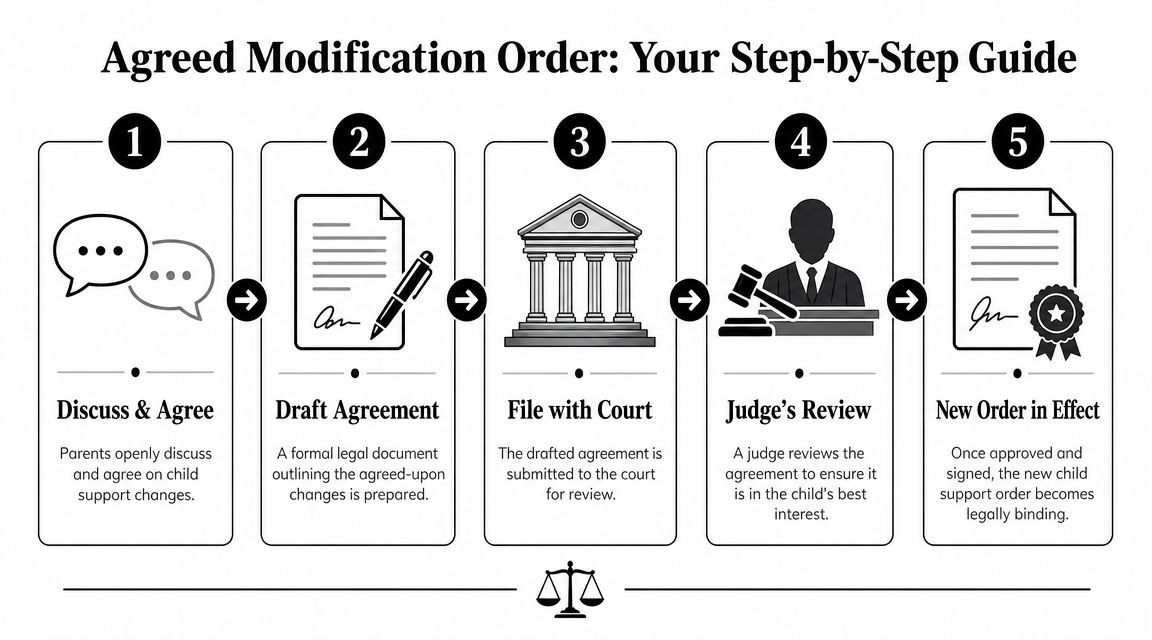
Step one starts with the reason for change
Before any documents are drafted, parents need a legally supportable reason to ask for modification. In real life, that often means one parent's income changed, the child's needs changed, health coverage changed, or the living arrangement changed enough to justify updating support.
This step is where people often get stuck. They know life is different, but they haven't gathered the details that show why the current order no longer fits.
Useful documents may include:
- Recent pay information that shows income changed
- Insurance records if coverage or cost shifted
- Parenting schedule details if day-to-day care has changed
- Child expense records if needs are different now
Step two is reaching clear agreement
This part sounds simple, but it needs specificity. Parents shouldn't stop at “we agree to change support.” They need to agree on the actual amount, the payment start point, any healthcare responsibilities, and whether other parts of the order need to be updated too.
A vague agreement causes trouble later. A clear agreement gives the paperwork a solid foundation.
Local perspective: The calmer the conversation is at this stage, the easier the formal filing usually becomes for families in Kingwood, Humble, and Porter.
Step three is preparing the legal paperwork
At this point, informal understanding becomes formal legal language. Depending on the case, that can involve a petition to modify, service-related documents or waivers, and the final agreed order that states the new terms.
Parents who try to do this without care often make one of two mistakes. They either leave out needed language, or they sign documents that don't match what they intended.
The Law Office of Bryan Fagan – Kingwood TX Lawyers can assist with child support modification paperwork and filing for parents who want a formal update without turning the matter into a contested fight.
A short video can make the process feel less abstract before you start gathering documents:
Step four is filing with the proper clerk
For families in this area, filing often happens through the district clerk in the county where the order belongs, such as Harris County or Montgomery County. Filing is the point where the request officially enters the system.
That doesn't always mean anyone is gearing up for a courtroom showdown. In many agreed cases, it means the file is being updated so a judge can review the submitted documents.
Step five is the judge's review and signature
Once the paperwork is complete and properly submitted, the judge reviews the agreement. If everything is in order and the modification is acceptable, the judge signs it. That signature is the moment the change becomes enforceable as a new order.
Until then, parents should be careful about assuming they are already operating under the new terms.
Why this route feels more manageable than people expect
Parents often imagine all legal action as a contested hearing with testimony, accusations, and long waits. An agreed modification order is different. It is structured, document-driven, and often far less dramatic.
For a cooperative family in Northeast Houston, the primary work is usually in getting the terms right and the documents clean. Once that happens, the process tends to feel much more administrative than combative.
Common Misconceptions and Pitfalls to Avoid
Most child support modification problems don't start with bad intentions. They start with false confidence. A parent assumes a text exchange is enough. Another assumes they can wait a few months to file. Someone else thinks the state agency is their personal lawyer.
Those assumptions can create lasting trouble.
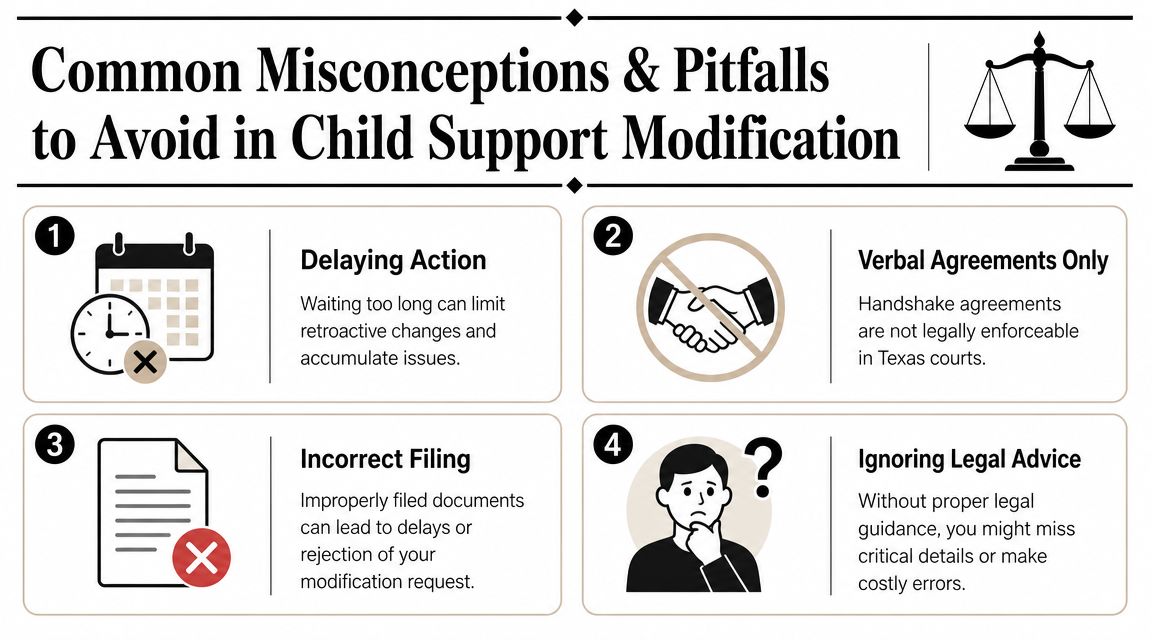
Texas Law Help points to a major practical issue many parents miss. A major risk is relying on shortcuts when circumstances change. While Texas law requires a "material and substantial change," the statute does not define this term, leaving it to judicial discretion. Assuming a verbal deal is sufficient can lead to massive arrears or enforcement actions because the old order remains fully active until a new formal order is entered, as noted by Texas Law Help's explanation of changing a child support order.
Misconception one is that texts prove the order changed
Texts, emails, and friendly messages can help show what the parents discussed. They do not automatically create a new enforceable court order. That's the gap many parents in Humble discover too late.
If the signed order says one thing and the text messages say another, the signed order usually remains the legal anchor until formally changed.
Misconception two is that waiting won't hurt
Waiting often makes everything harder. If your income dropped and the old amount no longer fits, delay can increase pressure fast. If support should rise because circumstances changed on the other side, delay can also leave money issues unresolved for too long.
Parents often wait because they hope things will “work themselves out.” Family law usually rewards action, not wishful thinking.
Misconception three is that any life change is automatically enough
A change may feel major inside your home, but that doesn't mean it will automatically persuade the court or fit neatly into the review process. Because the standard involves discretion, two parents with similar stories may still need very different documentation.
That's why evidence matters so much.
Helpful proof often includes:
- Income records that show what changed and when
- Health insurance information if coverage costs shifted
- Parenting-time details if the child is spending time differently than before
- Written financial records that are organized and current
Misconception four is that the Attorney General represents you personally
Some parents assume that once the Child Support Review Process begins, the government lawyer is acting as their individual advocate. That's not a safe assumption. The process may help move the case forward, but parents still need to understand their own interests, documents, and goals.
For a Kingwood parent, that can be the difference between passively reacting and actively shaping a fair result.
Don't confuse participation in a process with personal legal representation.
Pitfalls that show up in real cases
A few mistakes come up again and again:
- Underreporting or misreading income so the proposed amount starts from bad numbers
- Ignoring medical coverage details even though insurance is often part of the support picture
- Filing incomplete paperwork which can slow review or create avoidable corrections
- Changing payment behavior too early before a new signed order exists
Each of those errors usually comes from trying to simplify the situation too much.
The safer mindset
A child support change doesn't have to become hostile. But it does have to become official. If you approach modification like a paperwork problem that deserves care, you're much less likely to create bigger legal problems later.
That mindset helps families across Kingwood, Porter, and Northeast Houston protect both the child and themselves.
Get Trusted Guidance for Your Family's Future in Kingwood
If your life changed, your child support order may need to change too. That isn't unusual. It happens after job loss, income increases, insurance changes, and shifts in parenting time all across Kingwood and nearby communities.
The key point is simple. You may be able to avoid a courtroom fight, but you shouldn't rely on an off-the-record agreement. A formal process protects everyone involved. It gives the child a stable, enforceable framework. It gives both parents clarity about what is required.
For many families in Humble, Porter, and Northeast Houston, the most practical route is a cooperative one. If both parents can communicate, an agreed modification order may provide the cleanest path. If discussion is harder, mediation or the Child Support Review Process may offer a more workable structure.
What matters most is choosing a path that matches your situation and finishing it properly.
When local guidance makes a difference
Child support cases often look simple from the outside. Then the questions start. Has the change been documented well enough? Are all the terms covered? Is the paperwork complete? Is this really an agreed case, or is conflict likely to surface at the last minute?
Those are the moments when local legal guidance can help families avoid preventable mistakes. A Kingwood-based family law office understands the concerns local parents bring in every day. They want a fair result, less stress, and a process that doesn't turn their co-parenting relationship into a war.
If you're dealing with this issue now, a conversation with a child support lawyer in Kingwood can help you sort out whether your best next step is agreement, mediation, CSRP, or a formal modification filing.
You don't have to guess your way through it. And you don't have to choose between doing nothing and starting a fight.
If you're ready to update a child support order the right way, schedule a free consultation with Law Office of Bryan Fagan – Kingwood TX Lawyers. Our Kingwood office works with families throughout Kingwood, Humble, Porter, and Northeast Houston to explain options clearly, reduce confusion, and help parents pursue a legally sound path forward.