Skip to content
A living trust is a legal tool that holds your assets for you while you're alive and transfers them to your beneficiaries after you pass, often without involving the probate court. Among people who create an estate plan, about 75% have wills while only about 18% have trusts, which is one reason so many families in Kingwood, Humble, and Northeast Houston still ask what a living trust does.
If you're a homeowner in Kingwood, there's a good chance this question feels personal, not academic. You may have a house, a few bank accounts, retirement savings, maybe a small business interest or property that you want to pass on without leaving your family stuck sorting things out in court.
That's where a living trust often comes into the conversation. In Texas, it can be a practical planning tool for families who want more control, more privacy, and a smoother handoff if illness or death happens at the wrong time. But it also takes work up front, especially if you want it to function the way people think it will.
What Is a Living Trust Explained Simply
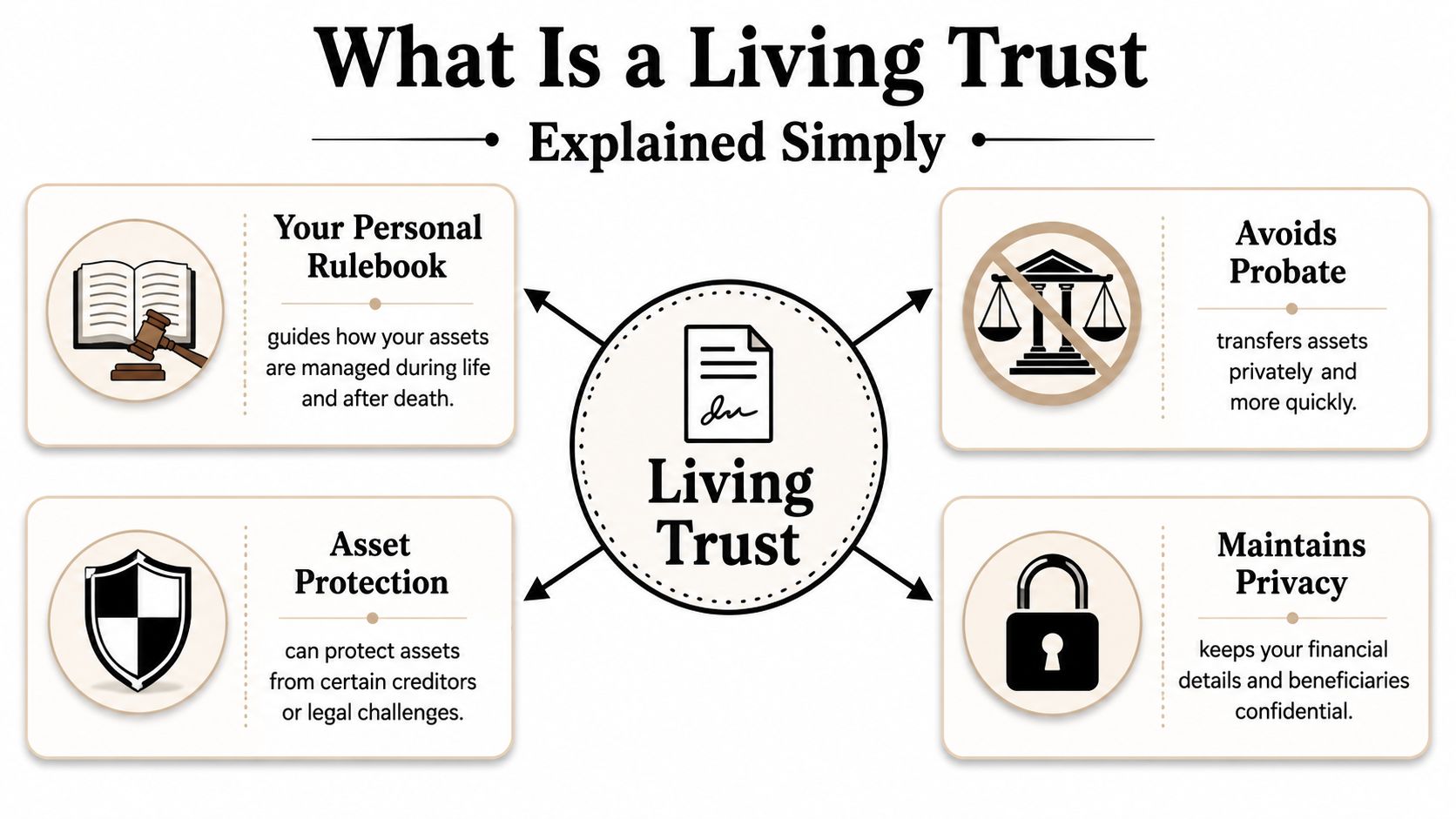
A living trust is most commonly a revocable trust created during your lifetime. You usually stay in control of it while you're alive, and you can name a backup person, called a successor trustee, to step in if you become incapacitated or after your death. The CFPB explains that this setup lets trust assets pass outside the public probate process when the trust is properly used and funded through its guidance on revocable living trusts.
For many Kingwood families, the easiest way to understand a living trust is to think of it as a personal rulebook for your property. The trust says who manages your assets, when they can step in, and who receives what later.
The four people or roles that matter
Here's the part that often confuses people in Humble and Porter. One person can wear more than one hat.
- Grantor means the person who creates the trust. That's usually you.
- Trustee means the person managing the trust property. While you're alive and well, that's often also you.
- Successor trustee means the backup manager who steps in if you can't act anymore or after you die.
- Beneficiaries are the people or groups who receive the benefit of the property.
A simple example helps. Say you own a home in Kingwood, a checking account, and a brokerage account. You create a living trust and transfer those assets into it. You still manage them day to day if you're serving as trustee. If you later become unable to handle finances, your successor trustee can take over according to the rules you wrote.
Practical rule: A living trust doesn't mean you give up use of your own property during your lifetime. In a typical revocable living trust, you still control the assets while you're able to act.
Why families use one
A living trust isn't just about what happens after death. It also helps with lifetime management.
That matters in Texas because families often need a clear plan for what happens if a parent develops dementia, has a stroke, or can no longer keep up with bills and property management anymore. A will doesn't handle that kind of day-to-day asset management during life. A trust can.
People in Northeast Houston also like trusts because they can keep administration more private than a will-based transfer. A will usually has to go through probate court. A trust, when it's set up and funded correctly, lets the successor trustee act under the trust document itself.
What a living trust is not
A living trust is not a magic document.
It doesn't automatically pull every asset under its control just because you signed it. It doesn't replace every other estate planning document. And it doesn't work well if no one follows through on the transfer steps.
That's why local families should think of a trust less like a single form and more like a system. The trust document creates the rules. The funding process puts property under those rules. Both parts matter if you want your estate plan to protect your family in Kingwood the way you intended.
Revocable vs Irrevocable Trusts The Texas Rules
An inquiry into what a living trust is typically refers to a revocable living trust. That's the flexible version. You can usually change it, update it, or cancel it during your lifetime.
An irrevocable trust is different. It's designed to be far harder to change, which usually means less personal control but potentially stronger separation between you and the assets. In Texas planning, that flexibility-versus-protection tradeoff matters a lot.

A lot of confusion comes from the word “trust.” People assume all trusts work the same way. They don't. Even though trusts are a key part of estate planning, they're still less common than wills. One estate-planning source reports that among people with an estate plan, approximately 75% have a will while only about 18% have a trust, which helps explain why many Texas families are still learning the basics through this discussion of trust usage compared with wills.
Revocable trust in plain language
A revocable trust is usually the better fit for someone who wants to stay in charge.
That might be a retired couple in Porter who want a smooth transition for their home and accounts if one spouse becomes ill. It might also be a Kingwood parent who wants the successor trustee to step in without waiting on court involvement.
Revocable trusts are commonly used for:
- Control during life because you usually remain the trustee.
- Easy updates when family circumstances change.
- Incapacity planning so a chosen person can manage trust assets if needed.
- Probate avoidance for trust assets when property has been transferred into the trust.
If you want a deeper side-by-side explanation, this page on revocable trust vs irrevocable trust is a useful next read.
Irrevocable trust in plain language
An irrevocable trust is more like placing assets in a separate legal container with tighter rules. You don't approach it casually.
A Texas business owner might consider one when the planning goal is stronger asset separation, not just probate avoidance. A family using life insurance as part of a larger plan may also explore this structure. If that's your situation, this overview of Protecting family assets with ILITs gives a helpful introduction to one specific irrevocable trust strategy.
A good way to think about it is this. Revocable means flexibility first. Irrevocable means commitment first.
The practical Texas choice
For many households in Kingwood and Humble, a revocable living trust is the first trust worth discussing because it solves ordinary family problems. Who can manage things if I can't? How do my loved ones handle the house? Can we keep more of this process outside court?
Irrevocable trusts can be important, but they're usually tied to more specialized goals. If your main concern is your home, your accounts, and a smooth transition for your spouse or children, a revocable trust is often the conversation to have first.
Living Trust vs Will Which Is Right for You
A will and a living trust can both direct where your property goes. They don't work the same way.
A will is a set of instructions that usually has to be carried out through probate court after death. A living trust is a private legal arrangement that can manage assets during life and pass trust assets after death without that same court process, if it has been funded properly. The Illinois State Bar Association explains that a revocable living trust is created and funded while the grantor is alive, the grantor can typically serve as trustee, and a successor trustee can step in at incapacity or death through its public guide to living trusts.
For many Kingwood homeowners, this is the central question. Is the added setup work of a trust worth it compared with a simpler will?
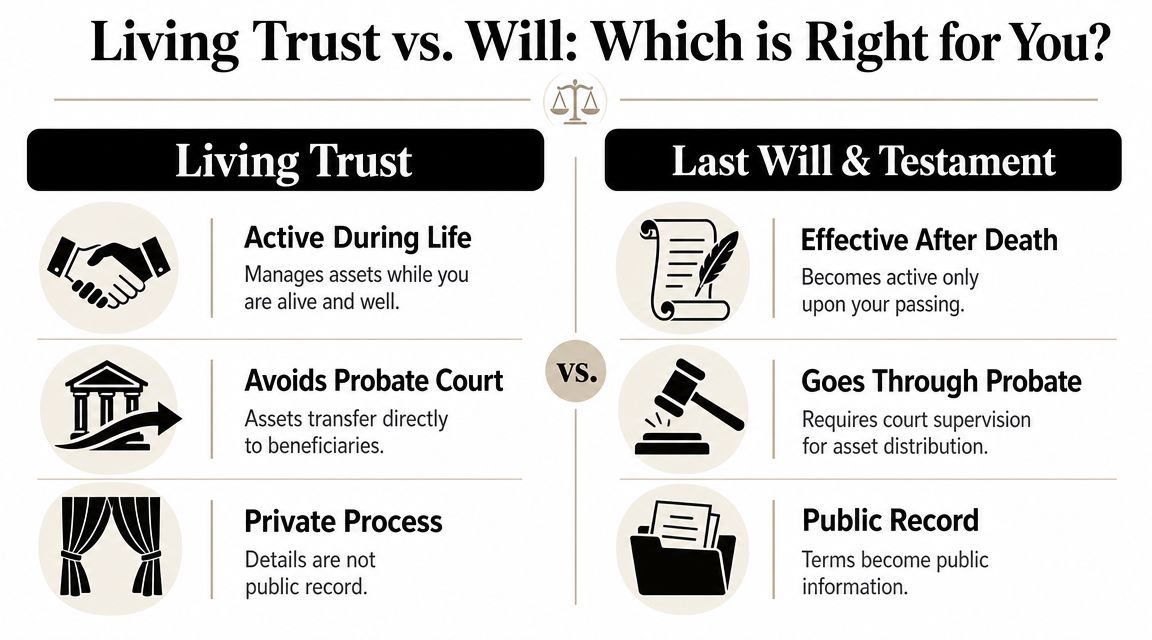
Living Trust vs. Will in Texas at a Glance
| Feature | Living Trust | Last Will and Testament |
|---|---|---|
| When it works | During life and after death for trust assets | After death |
| Probate in Texas | Can help trust assets avoid probate if funded | Usually works through probate court |
| Privacy | More private administration | Probate filings are generally part of a court process |
| Incapacity planning | Successor trustee can manage trust assets | Doesn't give active management during life |
| Setup effort | More paperwork and follow-through | Usually simpler to create |
| Funding needed | Yes, assets must be transferred into trust | No trust funding step |
A simple will may be enough for some people. If you're younger, have modest assets, and most of what you own already passes by beneficiary designation or joint ownership, a will-based plan may be the more sensible starting point.
A trust often makes more sense when your estate has more moving parts. That could mean a house in Kingwood, a rental property, non-retirement investment accounts, a blended family, or strong concerns about what happens if you become incapacitated.
The tradeoff most families need to hear
The biggest selling point of a living trust is probate avoidance. The biggest drawback is upfront work.
Nationwide notes that while a living trust can avoid probate, its setup is more involved and costly than a will, and assets must be carefully retitled into the trust for it to work as intended in its comparison of a living trust vs a will. That's the practical decision point for Northeast Houston families. You do more now so your family may have less to sort out later.
Here's a useful way to consider it:
- A will is simpler today. You sign it, store it safely, and it tells the court what should happen later.
- A trust asks more of you now. You sign it, then transfer assets into it, and keep it updated as your property changes.
- The payoff depends on your life. Homeowners, families with multiple accounts, and people concerned about incapacity often see more value in the trust structure.
This video gives a helpful overview before you make that choice.
A local example from Kingwood
Suppose a couple owns their primary residence, has savings, a brokerage account, and wants adult children to receive assets smoothly. If they rely only on a will, their executor may need to walk through probate to transfer assets that don't pass automatically.
If the same couple uses a funded trust, the successor trustee may be able to handle those trust assets under the trust terms instead of opening the same type of court-supervised transfer for those items. That difference is often what drives the decision.
For a more detailed breakdown specific to this question, you can review the difference between a will and trust.
Bottom line: If your main goal is simple instructions after death, a will may be enough. If your goals include privacy, smoother management during incapacity, and keeping key assets out of probate, a living trust is often worth a closer look.
Key Benefits of a Living Trust for Kingwood Families
The strongest reasons to create a living trust usually show up in real life, not in legal definitions.
For a family in Kingwood, the trust benefit may start with the house. For a retiree in Humble, it may be the fear of losing the ability to manage bills or investments. For an adult child helping aging parents in Northeast Houston, it may be the need for a clear legal pathway when a parent can't act independently anymore.

The benefit people feel first
A living trust is a critical tool for incapacity planning. U.S. Bank notes that a trust allows a named successor trustee to manage trust assets if you become unable to do so yourself, which is especially important in situations involving aging, dementia, or unexpected illness through its overview of wills, living trusts, and living wills.
That's not a small benefit. It can be the difference between a family having a ready-made manager and a family scrambling to figure out what authority anyone has.
Why that matters in everyday Texas life
Consider a common local scenario. A husband and wife in Porter own a home, have checking and savings accounts, and one spouse handles all the finances. Then a medical crisis hits. The healthy spouse may still need clear authority over assets titled in the trust if the other spouse can't act.
A will doesn't solve that problem during life. It speaks after death. A trust can create continuity before death, which is why it's so useful for practical planning.
Here are the benefits many local families care about most:
- Smoother management during illness because a successor trustee can step in under the trust terms.
- Less public exposure since trust administration is generally more private than a probate file.
- Better handling of out-of-state property because one trust plan can hold more than one type of asset.
- More specific distribution instructions if you want to stagger inheritances or protect a vulnerable beneficiary.
Families often focus on death planning first. In practice, incapacity planning is where many living trusts prove their value.
Why homeowners often ask first
Homeowners in Kingwood and surrounding communities ask about living trusts more than almost anyone else because real estate tends to be the asset families worry about most. They don't want delays, confusion over authority, or unnecessary public court involvement if something happens.
That concern grows when a family also owns a vacation property outside Texas or inherited land elsewhere. A trust can help centralize those instructions under one plan instead of leaving loved ones to chase procedures in multiple places.
A trust won't solve every estate-planning issue by itself. But for local families who want continuity, privacy, and a clearer handoff, it often provides the structure a will alone can't provide.
How to Fund Your Texas Living Trust Step by Step
A signed trust that holds no assets is like an empty safe. The document exists, but it can't do much.
MetLife explains that the critical step of funding a trust is retitling assets into the trust's name, and an estate plan can fall short if property like real estate or bank accounts is never transferred under its explanation of how living trusts work. This is the part many families in Kingwood skip, usually because no one showed them how practical the process really is.
Step 1 Put together a clean asset list
Start with a written inventory of what you own. Include your house, bank accounts, brokerage accounts, business interests, and valuable personal property.
If organizing everything feels overwhelming, tools that simplify estate planning with inventory can help you build a practical starting list before you meet with an attorney.
Step 2 Transfer real estate correctly
If you own a home in Kingwood, Humble, or elsewhere in Northeast Houston, the property usually needs a new deed moving title into the trust. That deed then needs to be properly prepared and filed in the right county records.
For local families, this often means checking whether the property sits in Harris County, Montgomery County, or another Texas county. Filing details matter. An error in the deed can create problems later, so this isn't the step to rush through casually.
A trust avoids probate only for assets that are actually in the trust. If the house never gets transferred, the trust can't control that transfer the way you intended.
Step 3 Update bank and brokerage accounts
Financial accounts often require their own forms. Your bank or brokerage firm may ask for a certificate of trust, excerpts from the trust, or institution-specific paperwork before changing ownership.
Many people in Porter get frustrated. They assume signing the trust document changed everything automatically. It didn't. Each institution has its own process, and the details need to match the trust exactly.
Step 4 Assign personal property
Some personal property can be transferred through an assignment document. This may include household items, collections, or other non-titled property.
Not every asset belongs in a trust the same way, though. Retirement accounts, insurance, and assets with beneficiary designations often need a separate review because title and beneficiary planning don't work the same way.
Step 5 Check your work and keep it current
Funding isn't a one-time event if your life keeps changing.
Review your trust when you:
- Buy or sell a home in Kingwood or elsewhere in Texas.
- Open a new account that should be titled in the trust.
- Start or restructure a business that affects ownership records.
- Go through a family change such as marriage, divorce, or the birth of a child.
For people who want help implementing these steps, how to set up a trust gives a practical overview of the creation process and what usually follows after signing.
Common Questions About Living Trusts in Texas
Texas families usually reach the same set of follow-up questions after they understand the basics. Here are direct answers in plain language.
Do I still need a will if I have a living trust
Usually, yes.
A trust handles assets that are transferred into it. A pour-over will is often used to catch assets left outside the trust and direct them back into the trust structure after death. It also handles issues a trust doesn't replace by itself. In Texas estate planning, a trust and a will often work together, not against each other.
Can a revocable living trust protect my assets from a lawsuit
Usually, not in the way people hope.
A revocable trust is mainly about management, control, and distribution of assets. Because you generally keep control of the assets during your lifetime, it's not the same as placing property beyond your own reach. If your planning goal is lawsuit protection or stronger creditor shielding, that usually requires a different conversation and often a different kind of trust.
Does a living trust affect my Texas homestead rights
This is a detail that should be reviewed carefully for your specific property.
Many Texas homeowners in Kingwood worry that moving a residence into a trust will somehow damage homestead-related protections or tax treatment. The answer depends on how the trust is drafted, how title is transferred, and whether the arrangement preserves the homeowner's rights under Texas law. This is one of those areas where local legal review matters because the house is often the family's biggest asset.
If your home is part of the plan, don't assume a generic online form will handle Texas title and homestead issues correctly.
Is a living trust only for wealthy families
No.
A trust can be useful for ordinary families with a home, savings, and a desire to make things easier for loved ones. The better question isn't whether you're wealthy enough. It's whether the benefits match your goals. If your main concern is simple, low-cost planning, a will may be enough. If you want continuity during incapacity and a smoother transfer process for key assets, a trust may be worth the effort.
How much does it cost to create one
The cost varies, and it's better to discuss that directly with a lawyer rather than rely on generic pricing online.
What matters more at the first meeting is understanding what's included. Are you paying only for the document? Does the lawyer also help with funding? Will deeds, transfer documents, and follow-up guidance be part of the work? For many families in Northeast Houston, the true value of a trust plan is in the implementation, not just the signature page.
What's the biggest mistake people make
They sign the trust and stop there.
A living trust works only when the assets, titles, and supporting documents match the plan. The biggest failure point isn't usually the legal idea. It's incomplete follow-through.
Create Your Plan with a Kingwood Estate Planning Lawyer
A living trust can be a strong tool for Texas families, but it's only helpful when it matches your life and your property. For a homeowner in Kingwood, that may mean planning for the house and keeping a smooth line of authority if illness strikes. For a family in Humble or Porter, it may mean deciding whether the extra setup work makes sense compared with a will.
The practical question is rarely “Is a trust good?” The key question is whether a trust fits your assets, your family dynamics, and your goals under Texas law.
Some people compare several educational resources before meeting with counsel. For example, this overview of Vollmer Law Firm estate planning is another general resource on the broader planning field. But once your questions turn to Texas deeds, trust funding, probate avoidance, and incapacity planning for a Kingwood-area family, personalized legal advice becomes much more important than general reading.
The Law Office of Bryan Fagan – Kingwood TX Lawyers handles estate-planning matters including wills, trusts, and probate-related concerns for local clients. That kind of help is especially useful when the hard part isn't understanding the concept of a living trust, but making sure the plan is carried out correctly.
If you live in Kingwood, Humble, Porter, or Northeast Houston, you don't have to figure this out alone. A careful conversation now can save your family confusion later.
If you're ready to talk through whether a living trust makes sense for your family, schedule a free consultation with Law Office of Bryan Fagan – Kingwood TX Lawyers. We help Kingwood-area residents understand Texas estate planning in plain English, weigh trust versus will options, and build plans that fit their homes, assets, and long-term goals.