Skip to content
When a parent in Kingwood calls about custody, the fear usually sounds the same. They're worried the other parent will say something dramatic in court, they're worried a judge won't see what daily life really looks like, and they're worried one bad hearing will change everything.
That fear is understandable. But in Harris County, custody cases usually aren't won by the parent with the angriest story. They're won by the parent who shows the court a steady, child-focused pattern and follows the local process carefully. If you're trying to understand how to win a custody case in Harris County Texas, start there.
Understanding the Harris County Custody Landscape
Texas courts decide custody issues based on the best interest of the child. That sounds broad because it is broad. Judges look at things like parental involvement, emotional support, and stability. In real life, that means the court wants to know who handles school needs, who keeps routines in place, who shows up for medical care, and who helps a child feel secure.
Parents in Kingwood, Humble, Porter, and Northeast Houston often read generic custody articles that stop at that legal standard. The problem is that Harris County practice adds another layer. Local process matters. A lot.
Why local procedure matters so much
One Harris County practice source notes that local custody practice includes procedural steps many general guides leave out, including a possible co-parenting course, required pretrial submissions, and in some settings specific hearing procedures through local court channels, all of which can affect credibility and delay risk in a crowded court system (how local court process affects custody outcomes in Harris County).
That's the part many parents miss. A judge can only work with what gets presented correctly and on time. If your file is organized, your evidence is child-centered, and your lawyer understands how Harris County family courts operate, you start from a stronger position.
For local families, that's especially important when your case runs through downtown Houston while your life is happening in Kingwood. School pickups, work schedules, commutes, and hearing logistics all become part of the strategy. If you need a local overview of the forum where these cases move, this guide to Harris County family court for Kingwood parents is a useful starting point.
The court is looking past broad accusations
A parent who says, “I'm the better parent,” usually doesn't get far unless the record backs it up. A parent who can show routines, calendars, communication, and reliable judgment usually has the more persuasive case.
Practical rule: In Harris County, “winning” often means making it easy for the judge to see your consistency.
That also applies outside the courtroom. If your child is struggling with the family transition, emotional support matters. Parents looking for practical ways to help at home often benefit from understanding child well-being during divorce, especially while the legal case is still unfolding.
Building Your Foundation Before You File
The strongest custody cases usually begin before the petition is filed. If you're in Humble or Kingwood and litigation may be coming, the goal isn't to create drama. The goal is to create a clean record of daily parenting.
A Harris County custody practice guide emphasizes that a parent improves their position by building documentation that matches the best-interest framework, including daily caregiving logs, school and medical participation records, communication screenshots, and proof of stable housing and work schedules (Harris County custody documentation guidance).
Here is the core mindset. Don't prepare like you're writing a story. Prepare like you're assembling a file.

What to start gathering right now
If you think a custody suit is likely, build a folder system that covers parenting, communication, and finances. Keep it simple enough that you'll maintain it.
| Document Category | Specific Examples |
|---|---|
| Parenting records | Daily caregiving log, pickup and drop-off notes, bedtime routine notes, calendar entries showing parenting time |
| School involvement | Attendance at school meetings, report cards, school emails, notices from local Kingwood or Humble-area schools |
| Medical records | Appointment confirmations, after-visit summaries, prescription pickup records, therapy scheduling records |
| Communication | Text screenshots, email chains, co-parenting app messages, messages showing schedule coordination |
| Stability documents | Lease or mortgage records, work schedule, childcare arrangements, proof of transportation routine |
| Financial records | Pay stubs, tax returns, insurance information, monthly child-related expenses |
Build evidence that matches real parenting
A daily log doesn't need to be fancy. It needs to be credible. If your child stayed with you on school nights, note homework help, meals, school transportation, and extracurricular coordination. If you attended a pediatric visit in Northeast Houston, save the appointment confirmation and after-visit paperwork.
Use ordinary records. Judges trust ordinary records more than last-minute summaries created for court.
Keep your notes factual. “Picked up from school at 3:20, attended parent conference, emailed teacher about reading support” carries more weight than “I always do everything.”
What works and what doesn't
What works
- Consistent records: A calendar maintained over time is more persuasive than a reconstructed timeline.
- Neutral communication: Messages that stay focused on the child help show maturity.
- Routine evidence: School, medical, and extracurricular involvement shows responsibility in a way photos alone usually don't.
What doesn't
- Long emotional text messages: They may reveal conflict more than parenting value.
- Secret stockpiling without organization: A phone full of screenshots is not the same as a usable exhibit file.
- Retaliatory conduct: If your behavior looks like punishment of the other parent, the court may view it poorly.
For many parents, this is also the stage where legal help becomes worthwhile. A custody attorney can help decide what to preserve, what to ignore, and how to avoid creating harmful evidence. If you're weighing timing, review when to hire a custody lawyer in Kingwood.
Think ahead to court requirements
Before filing, act as if every document may need to be produced later. That habit prevents panic. It also keeps you from scrambling when the case moves faster than expected.
Parents who prepare early usually feel more in control, and that matters. Custody litigation is stressful enough without trying to recreate months of parenting history from memory.
The First Court Battle Temporary Orders and Mediation
Most parents think trial will decide everything. In many cases, the first major turning point is much earlier. It happens at temporary orders and then again in mediation.
Temporary orders create structure while the case is pending. They can address where the child stays, how exchanges happen, who makes certain decisions, and how day-to-day life will function until final orders are entered. That's why the first hearing often carries more weight than people expect.

What judges tend to notice early
In Texas custody disputes, the controlling standard is the child's best interest, but practical advantage often comes from proving day-to-day involvement. Harris County also requires parents in custody-related cases to complete a co-parenting course, and key trial materials, including financial statements and tax returns from the last 2 years, are due no later than 10 days before trial (Texas custody guidance with Harris County requirements).
At the temporary stage, judges are often looking for the parent who appears stable, organized, and focused on the child instead of revenge. That doesn't mean you ignore serious problems. It means you present them clearly and tie them to the child's needs.
A strong temporary-orders presentation often includes:
- A workable routine: School transportation, homework supervision, meal planning, and bedtime structure.
- A calm communication record: Messages that show coordination instead of escalation.
- Specific requests: A proposed schedule is better than a complaint with no solution.
Mediation is not a side event
A lot of Harris County custody cases move through mediation before trial. Parents sometimes treat it like an annoying checkpoint. That's a mistake.
Mediation gives you a chance to control details a judge may handle more bluntly. Holiday schedules, exchange locations, travel rules, extracurricular decisions, and communication methods can often be shaped more carefully there than in a courtroom. If you want a plain-language overview of how the process usually unfolds, WeUnite's mediation process guide gives a useful general walkthrough.
A parent who enters mediation with calendars, school information, and a realistic parenting proposal usually negotiates from a stronger place than a parent who only brings grievances.
A realistic mediation example
A parent from Porter may walk into mediation convinced the only issue is “primary custody.” By midday, the key sticking points may be school pickup times, holiday exchanges, and how to handle late notice for work conflicts. Those details matter because they shape the child's life.
The best mediation posture is firm but practical. Know what you must protect. Know where you can compromise. Don't trade long-term stability for the emotional relief of winning one argument in one room.
Some families also choose to get strategic guidance before the session from counsel who regularly handles custody matters in this area. That can include reviewing a proposed parenting plan, preparing a settlement range, and identifying terms that look harmless but cause conflict later.
Gathering Evidence That Wins in Harris County
The most persuasive custody evidence usually isn't dramatic. It's cumulative. A Harris County judge often decides credibility by looking at repeated patterns of care, reliability, and judgment.
One family-law source warns that a common mistake is treating custody like a narrative dispute instead of a document-driven case. That same guidance stresses documenting parenting involvement, avoiding conflict, and showing court-friendly behavior because judges are alert to conduct such as alienation, intoxication, and unsafe supervision, while Harris County expects a full evidentiary package at least 10 days before trial (document-driven custody preparation in Harris County).
Strong evidence versus weak evidence
Here's the distinction many parents need to hear. Strong evidence helps a judge verify a pattern. Weak evidence mostly proves that the parents dislike each other.
| Evidence Type | Why it helps or hurts |
|---|---|
| School emails and attendance records | Strong because they show ongoing involvement and responsiveness |
| Medical appointment records | Strong because they connect you to decision-making and care |
| Organized communication logs | Strong when they show cooperation, notice, and child-focused planning |
| Random photos | Sometimes useful, but usually weak if they don't prove a relevant pattern |
| Angry text chains | Often harmful if they show escalation or poor judgment |
| Unsupported accusations | Weak unless tied to documents, witnesses, or other reliable proof |
How to document concerns without looking vindictive
Sometimes the other parent is creating real risk. The mistake is overreaching. If there's a safety issue, document the event, the date, the impact on the child, and any objective follow-up. Save messages. Preserve school notices. Keep your language factual.
Don't label every disagreement as abuse or every missed exchange as abandonment. Judges hear exaggeration all the time. Credibility rises when your concerns are measured and supported.
Evidence test: Ask whether a neutral person could understand the problem from the document alone, without needing your anger to fill in the gaps.
Handle recordings carefully
Parents often ask whether they should record calls or conversations. That can create legal issues if handled carelessly. Before you rely on call recordings or plan to create them, review a general guide for compliant business calls and then get Texas-specific legal advice for your case.
Turn everyday life into trial-ready proof
A good evidence file doesn't look theatrical. It looks usable. That means dated folders, clear labels, concise summaries, and supporting attachments. If your child attends school in Kingwood or Humble, group school records together. If exchanges happen around work shifts in Northeast Houston, preserve the schedule records that explain your availability.
Parents preparing for hearing often need help turning raw material into exhibits the court can follow. For a practical local resource, see how to prepare evidence for a custody hearing in Texas from Kingwood.
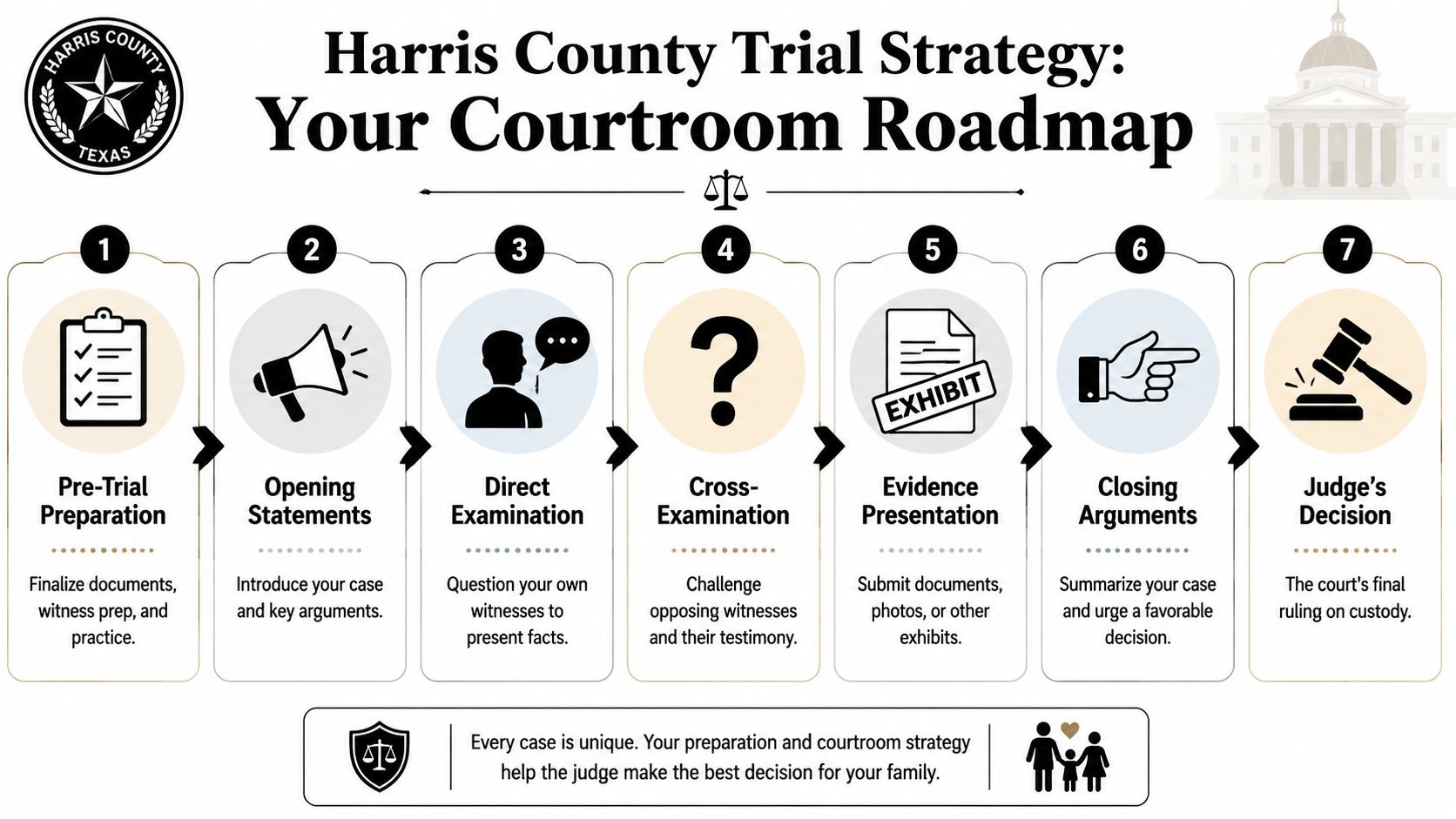
Mastering the Courtroom Your Harris County Trial Strategy
The trial date is finally here. You leave Kingwood before sunrise, fight traffic into downtown Houston, clear security, find your courtroom, and sit down knowing the judge may have a crowded docket that morning. In Harris County, that setting matters. Custody trials are not won by the parent who sounds the angriest. They are often won by the parent who is organized, credible, and ready to present a clean record without wasting the court's time.

A Harris County courtroom has its own pace. Judges move quickly. Court staff expect parties to be ready. Small procedural mistakes can hurt more than parents expect, especially if exhibits are disorganized, witnesses are missing, or testimony drifts into old relationship grievances instead of facts tied to the child.
Courtroom credibility decides close cases
By the time a custody case reaches trial, both parents usually claim they care about the child and want stability. The court is looking for something more specific. Which parent presents reliable facts? Which parent follows court orders, meets deadlines, and answers questions directly? Which parent is asking for a parenting plan that can work on school days, exchange days, and holidays?
That is why courtroom behavior matters. A parent who interrupts, argues with the judge, or gives speeches instead of answers can damage a good case. A parent who stays calm, admits what is true, and keeps bringing the focus back to the child usually gives the judge a safer option.
Parents who help themselves at trial usually do four things well:
- They answer only the question asked.
- They tie each answer to the child's routine, needs, schooling, health, or stability.
- They correct mistakes without becoming defensive.
- They avoid exaggeration, especially on points the other side can easily disprove.
Harris County trial preparation is practical, not theatrical
Many online custody guides stop at "show the court you are acting in the child's best interest." That is too general to help on trial week. In Harris County, procedural readiness often separates a strong case from a weak one.
That means confirming the courtroom, arrival time, parking plan, and security delays ahead of time. It means knowing whether your exhibits have been marked, whether your witness is coming, and whether your proposed parenting terms are specific enough for the judge to sign. It also means bringing a paper copy of what matters, even if you have everything on your phone or in email.
I often tell parents to prepare for trial like a professional meeting with very high stakes. If your school records, calendars, medical notes, and communication logs are easy to find, your lawyer can use them. If they are scattered across screenshots and half-labeled files, good evidence becomes hard to present.
What judges tend to hear well
Judges hear patterns better than piles. Ten minutes of clear testimony about school attendance, homework supervision, medical follow-up, and exchange reliability usually carries more weight than a long retelling of every argument in the relationship.
Useful trial testimony sounds like this:
- "I take our child to school on these days, and the attendance records match that schedule."
- "Here is the medication schedule, who fills prescriptions, and who attends appointments."
- "This is the work schedule, and this is how child care is handled during that time."
- "These are the exchanges that were missed, with dates and messages."
Weak trial testimony usually sounds broad, emotional, or absolute. Words like "always," "never," and "everyone knows" create openings on cross-examination.
Practical habits for parents coming from Kingwood
The trip into downtown Houston adds pressure before you even enter the courtroom. Plan for that. Leave early. Bring your documents in a binder or folder you can use quickly. Dress conservatively. Silence your phone before you step into the courtroom.
One more point matters. Do not coach your child, talk in the hallway about what the judge "needs to hear," or react visibly when the other parent testifies. Judges notice those things. So do court staff. In close custody cases, those moments affect credibility.
If the child's preference may come up, treat that issue carefully. The court may consider a mature child's wishes in some circumstances, but a child's preference is only one part of the decision. Judges still want a workable order backed by evidence, not pressure placed on the child.
Trial usually goes better for the parent who looks dependable on an ordinary Tuesday, not the parent who looks dramatic for one morning in court.
What your lawyer is trying to accomplish at trial
A good trial presentation gives the court a short, believable story and then proves it with witnesses, documents, and consistent testimony. The goal is not to raise every complaint. The goal is to prove the few points that matter enough to shape the final order.
Sometimes that means calling fewer witnesses. A school counselor with first-hand knowledge may help more than two relatives offering general support for your side. Sometimes a clean calendar, attendance record, or medical file does more work than a long explanation from either parent. Those are judgment calls, and they involve trade-offs between detail and clarity.
For parents in Kingwood and nearby communities, Law Office of Bryan Fagan – Kingwood TX Lawyers is one local option for custody representation and hearing preparation in family law cases.
Life After the Final Order Enforcement and Modification
A final custody order brings structure, but it doesn't guarantee smooth co-parenting. Problems can still happen. The key is responding in a way that protects your rights without creating new problems.
When the other parent won't follow the order
If the other parent is refusing exchanges, ignoring decision-making rules, or violating the possession schedule, start with documentation. Keep a dated record of what was supposed to happen, what happened, and any written communication about it.
Then bring the order and your records to a lawyer for review. Enforcement cases often turn on precision. The court needs to see exactly what provision was violated and when. Vague complaints make enforcement harder.
When life has changed and the order no longer fits
Custody orders can also be modified when circumstances have changed enough to justify asking the court for a new arrangement. That may involve changes in the child's needs, a parent's work schedule, living arrangements, schooling, or other major developments that affect the current plan.
If you think modification may be necessary, take these steps:
- Review the current order carefully: Many conflicts come from misunderstanding the language already in place.
- Document the changed circumstances: Save records tied to the change.
- Avoid self-help: Don't rewrite the schedule on your own because you think it's reasonable.
- Get legal advice before filing: Strategy matters, especially if enforcement and modification issues overlap.
For families in Kingwood, Humble, Porter, and Northeast Houston, the right next step often isn't to panic. It's to get a realistic assessment of what the court can do and how to present the issue cleanly.
If you're dealing with a custody dispute and need practical guidance specific to Harris County, schedule a free consultation with Law Office of Bryan Fagan – Kingwood TX Lawyers. Our Kingwood office works with parents from Kingwood, Humble, Porter, and Northeast Houston who need clear advice about custody strategy, court preparation, enforcement, and modification.