Skip to content
If you're reading this from Kingwood with a court date circled on your calendar, there's a good chance your mind is running nonstop. You're replaying arguments, scrolling old texts, wondering what matters, and trying to guess what a judge in Harris County or Montgomery County will care about. Most parents aren't short on feelings before a custody hearing. They're short on a plan.
That matters because family court usually doesn't turn on who is more upset or who tells the longer story. It turns on who can prove the story. If you're trying to figure out how to prepare evidence for custody hearing texas kingwood, the right approach is to stop thinking of evidence as a pile of papers and start thinking of it as a clear, honest narrative about your child's daily life.
A parent driving down West Lake Houston Parkway on the way home from work usually isn't asking, "What is my evidentiary theme?" They're asking, "How do I show the judge I'm the parent who keeps life steady for my child?" That's the right instinct. The work is in turning that instinct into records, exhibits, witnesses, and testimony that fit Texas court rules.
Parents in Kingwood, Humble, Porter, and Northeast Houston can take control of this process. You don't need to guess your way through it. You need to gather the right records, organize them correctly, and present them in a way that shows the judge what day-to-day parenting really looks like in your home.
Your Guide to Child Custody Evidence in Kingwood
A lot of parents start in the same place. They have a phone full of screenshots, a stack of school papers on the kitchen counter, and a sinking feeling that none of it looks "court ready." They know their child needs stability. They know they've been the one handling homework, doctor visits, pickups, and bedtime. They just don't know how to turn that reality into something a judge can use.
That's where people get stuck. They assume the hearing will be a chance to finally explain everything. In practice, custody cases are stronger when the explanation is backed by records that show a pattern over time.
What parents in Kingwood often misunderstand
The biggest mistake isn't caring too little. It's trying to bring everything.
Parents in Kingwood and Humble often arrive with too much paper and no structure. They bring every text thread, every photograph, every school email, and every angry message from the other parent. The court doesn't need your whole relationship history. The court needs proof tied to the issues that affect your child.
Practical rule: Evidence should answer a judge's question, not just prove you're frustrated.
A good evidence file tells a simple story. Your child has needs. You meet them consistently. Your home is stable. Your communication is reasonable. When there are problems, you document them calmly and back them up.
The story your evidence should tell
Think about your evidence the same way a teacher thinks about a report card. It isn't one dramatic moment. It's a record of performance over time.
That means your records should show things like:
- Daily parenting involvement: pickups, drop-offs, homework help, routines, activities
- Decision-making stability: school communication, medical follow-through, scheduling
- Home consistency: housing, employment, financial responsibility
- Co-parenting conduct: respectful communication, notice given, efforts to cooperate
- Child-focused choices: what you did to meet your child's needs, not punish the other parent
If you build your file that way, you're already ahead of many self-represented parents in Northeast Houston. And if you need legal guidance customized to your facts, a free consultation at the Kingwood office can help you pressure-test what belongs in your case and what doesn't.
Understanding What a Texas Judge Wants to See
A Texas judge starts from one controlling idea. The child's best interest comes first. Texas Family Code §153.002 says that “the best interest of the child shall always be the primary consideration” in conservatorship and possession cases, and the court applies the Texas Rules of Evidence to determine what can come in. In practical terms, that means parents preparing for a Kingwood custody hearing should gather organized, admissible records such as tax returns, typically 2 to 3 years, bank statements, school records, medical records, and communication logs before the hearing instead of waiting to explain everything verbally in court, as discussed in this overview of what evidence to bring to family court in Texas.

That standard sounds broad, but in court it becomes a set of practical questions. Who has been handling the child's daily routine? Which parent shows up consistently? Which home looks more stable? Who communicates in a way that lowers conflict instead of feeding it? A judge in the greater Kingwood area isn't grading who sounds more polished. The judge is trying to make a decision grounded in proof.
Best interest in plain English
If you strip away the legal phrasing, the court is looking for a credible picture of your child's life.
That usually means the judge wants to understand:
- Routine: Who gets the child to school, activities, and appointments?
- Stability: Is the home environment steady and appropriate for the child?
- Follow-through: Does the parent handle medical, educational, and emotional needs?
- Judgment: Does the parent make child-focused decisions under stress?
- Credibility: Do the records match the testimony?
Parents sometimes think they need to prove the other parent is a villain. Usually, that's not the winning approach. In many Harris County and Montgomery County custody cases, the stronger presentation is the parent who calmly shows, "Here is what I do. Here is how I support my child. Here is the record."
What works and what usually falls flat
What works is specific proof tied to parenting. School attendance records. Medical records. Calendar entries. Tax returns and bank statements when finances and stability matter. Printed and labeled communication records when the court needs to see how the parents interact.
What falls flat is overstatement. Long speeches. Edited screenshots with no context. Allegations with no documents behind them. A judge hears conflict every day. Documentation is what cuts through it.
A custody hearing is not a chance to dump your whole history into the courtroom. It's a chance to prove the facts that matter most to your child.
If you want a deeper look at the kinds of decision points courts focus on, this guide on what judges look for in custody cases in Texas Kingwood is a useful companion.
Match each concern to a type of proof
A good way to think about your file is to connect each concern to something tangible.
| Judge's concern | Useful evidence |
|---|---|
| Stability at home | lease or mortgage records, utility records, photos of child's room |
| Involvement in education | report cards, attendance records, school emails |
| Medical follow-through | appointment summaries, prescriptions, provider records |
| Communication style | organized text or email exhibits |
| Financial responsibility | tax returns, bank statements, pay records |
That shift matters. Once you stop asking, "What should I say?" and start asking, "What can I show?" your preparation gets much sharper.
A Checklist for Gathering Your Custody Evidence
Evidence in custody cases usually isn't built in a weekend. Texas family-law guidance emphasizes keeping a detailed parenting journal of daily involvement, including pickups and drop-offs, homework help, extracurriculars, missed visitations, and communication attempts with the other parent. Practically, a parent who keeps 6 to 12 months of dated notes, school attendance records, medical documents, and witness information may be in a stronger position than a parent relying only on testimony, as described in this Texas custody hearing preparation guide.
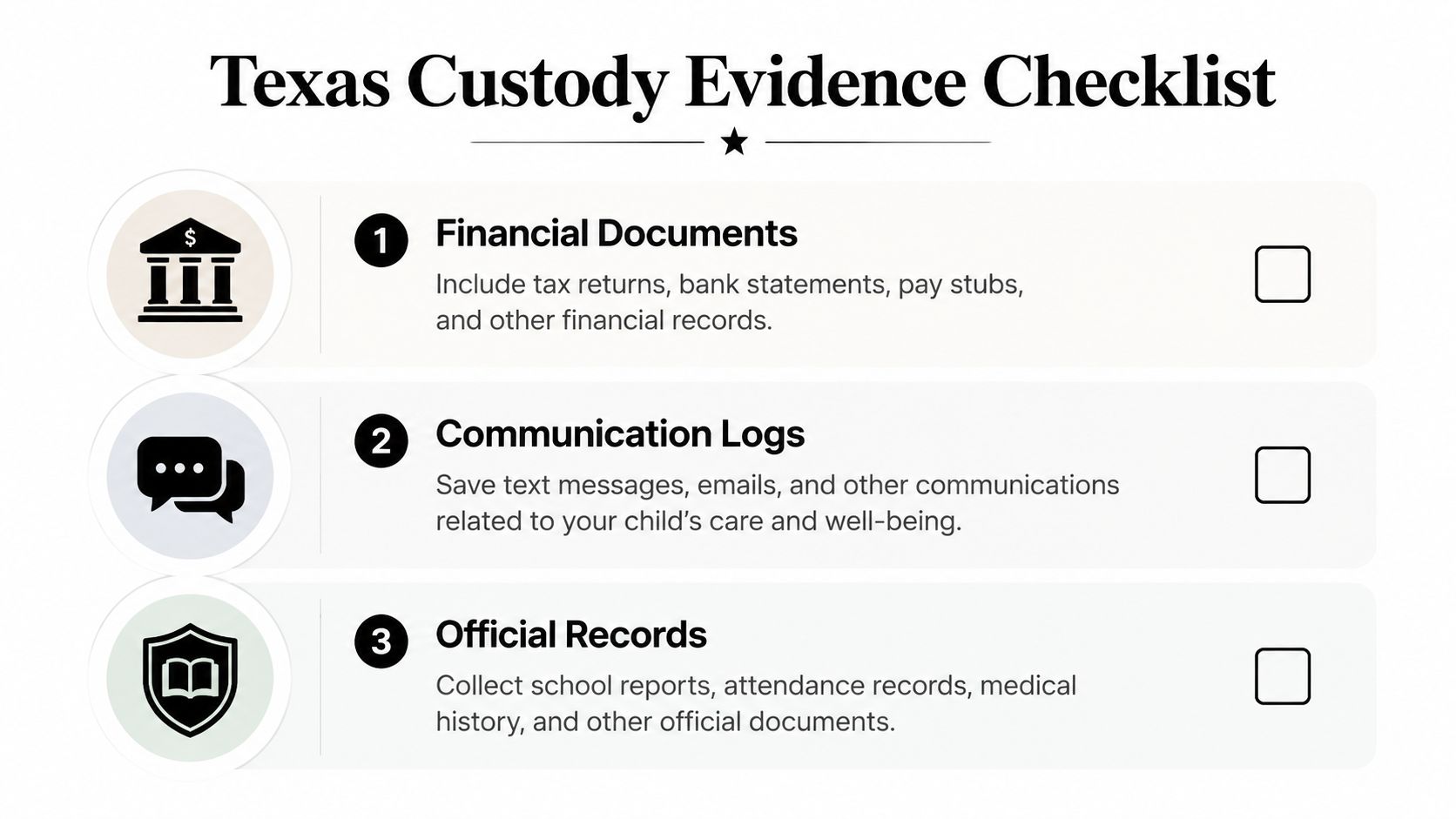
If you're in Kingwood, Porter, or Humble, the most useful mindset is simple. Gather evidence by category, not by emotion. That keeps you from overloading your file with dramatic but less relevant material.
Your parenting record
Start with the records that show what you do for your child.
Useful items often include:
- Parenting journal: dated notes about pickups, drop-offs, homework, meals, bedtime, activities, and problems that affected the child
- School involvement: attendance notices, teacher emails, conference notes, grade reports
- Medical involvement: appointment confirmations, discharge paperwork, immunization records, therapy or counseling scheduling records when appropriate
- Activity support: sports schedules, recital notices, registration emails, payment confirmations
A good journal isn't a diary of your anger. It's a log of parenting. Short, dated, factual entries are far stronger than emotional summaries.
Keep notes as if a stranger may read them later. Stick to facts, dates, actions, and what affected the child.
Home and financial stability
Judges want to know whether a child will have a reliable base. That doesn't mean the fancier home always wins. It means the court looks for consistency, safety, and adult follow-through.
Consider gathering:
- Housing records: lease, mortgage statement, proof of residence, photos of the child's sleeping area
- Employment records: work schedule, employer verification, pay stubs if relevant to availability or stability
- Financial records: tax returns, bank statements, and records showing you can meet the child's day-to-day needs
- Health records: records relating to your ability to care for the child when a health issue is part of the dispute
Many parents overshoot at this stage. Ten photos of a tidy bedroom may add less value than one clean housing document plus one school email showing your address is where the child consistently receives school-related communication.
Communication with the other parent
Communication evidence can help. It can also backfire if you present it poorly.
The strongest communication exhibits usually show one of these things:
- You gave notice
- You asked a reasonable question
- You tried to coordinate for the child
- The other parent failed to respond or acted in a way that disrupted the child
Printed texts and emails are often more persuasive when grouped by issue, not by date alone. For example, keep all school-exchange messages together and all medical-decision messages together. If you've dealt with denied visits or repeated schedule problems, this article on how to document custody violations in Texas Kingwood can help you think about what to preserve.
Third-party records that strengthen your story
Independent records often carry more weight than self-created notes. If a school, doctor, daycare, coach, or childcare provider generated the record in the normal course of life, that can make it more persuasive.
Look for:
- School records
- Medical records
- Daycare sign-in or attendance records
- Coach or activity schedules
- Witness contact information
Not every helpful person should become a witness, but identifying who observed what can matter.
What to leave out
Your file gets stronger when you remove clutter.
Usually leave out:
- Unrelated attacks: old relationship grievances that don't affect parenting
- Edited screenshots with no context
- Social media arguments that prove annoyance more than parenting concerns
- Duplicate records that say the same thing
- Anything you can't explain clearly if asked about it in court
The best evidence package for a Kingwood custody hearing is selective. It gives the judge a clean line of sight into your child's life.
How to Organize and Label Your Evidence for Court
The morning of a custody hearing in Harris or Montgomery County is a bad time to realize your proof lives in three phones, a stack of loose papers, and a photo album full of screenshots. Judges see that problem all the time. What helps your case is a file that lets the court follow your story quickly, page by page, without guessing why each document matters.
Organization is not just clerical work. It is part of persuasion. A custody case usually turns on a few themes: who keeps the child's routine steady, who communicates about school and medical care, who follows the schedule, and how each parent handles conflict. Your exhibits should be arranged to prove those themes in a way that reads like a clean timeline with supporting records, not a dump of everything that ever went wrong.
Texas Law Help explains this well in its guide to gathering and presenting evidence. The practical takeaway is simple. Build your file like a hearing notebook. Keep documents in clear sets, label them in order, and preserve original files for anything electronic so you can explain where it came from if the judge asks.
Organize by the point you need to prove
Parents often sort evidence by date or by document type because that feels orderly. For court, issue-based organization usually works better.
Use sections that match the decisions a judge is making:
- School involvement
- Medical care and follow-through
- Exchanges and possession problems
- Parent communication
- Home stability
- Any specific safety concern or pattern of unreliability
Inside each section, put the strongest exhibit first. Then add the records that support it. That structure helps you tell a coherent story. If your position is that you provide consistency, the judge should be able to open your school section and see consistency on the first few pages.
Label exhibits so anyone can find them fast
Simple labels work best.
Use names such as "Petitioner's Exhibit 1" or "Respondent's Exhibit 1," followed by a short description on your exhibit list. A good description answers two questions: what the document is, and why it matters. "Text messages" is weak. "Text messages confirming last-minute exchange change" is better.
Here is a format that works in real cases:
Sample Exhibit List for a Kingwood Custody Hearing
| Exhibit Number | Description of Document | Date |
|---|---|---|
| Exhibit 1 | School attendance record | [insert date] |
| Exhibit 2 | Pediatric appointment summary | [insert date] |
| Exhibit 3 | Text message regarding exchange time | [insert date] |
| Exhibit 4 | Lease agreement showing residence | [insert date] |
| Exhibit 5 | Email from teacher about homework support | [insert date] |
That level of detail saves time. It also makes you look prepared and credible.
Build each section around a story, not a pile
The strongest exhibit sets answer an unspoken judicial question: "What am I supposed to conclude from this?" Each important point should have a small cluster of proof that works together.
If your point is, "I reliably manage our child's school life," group records that show attendance, teacher communication, and involvement in assignments or conferences. If your point is, "The other parent disrupts exchanges," group the schedule, the messages showing the last-minute change, and any neutral record that confirms what happened.
I usually tell parents to aim for one clean proof stack per major point:
- A main record that shows the event or responsibility
- A communication that gives context
- A neutral third-party record that backs it up
That structure keeps the file focused. It also reduces the temptation to submit twenty screenshots that all prove the same thing.
Keep paper copies and original digital files
Bring a court-ready paper set if your lawyer or the court requires it. Keep a separate digital folder with the original files for texts, emails, photos, videos, and social media posts.
That matters more than people expect. A screenshot may look persuasive until someone asks when it was taken, whether anything was cropped, or whose account it came from. Original files make those answers easier. Your job is to be able to identify the document, explain how you got it, and show that it fairly reflects what you saw.
Parents who like a disciplined file system sometimes borrow ideas from other trial practice areas. The Ares checklist for personal injury litigators is not custody-specific, but it gives a useful model for exhibit lists, witness coordination, and pre-hearing file review.
Presentation affects credibility
Judges in family court care about substance first. They also notice whether a parent can present that substance clearly. A well-organized binder or folder suggests you understand your child's routines, your own records, and the issues before the court.
That does not mean buying fancy tabs and color-coded covers. It means being able to say, calmly and quickly, "Please look at Exhibit 4. This is the school email that matches the attendance record in Exhibit 3." In a custody hearing, that kind of clarity helps the judge see the larger story you are asking the court to believe.
Choosing and Preparing Witnesses for Your Case
Documents carry weight, but people often give those documents context. A teacher can explain who attends conferences. A daycare provider can describe who handles pickups. A coach can speak to attendance, punctuality, and the parent's role in the child's routine.

The best witness is usually not the person who loves you most. It's the person who observed something relevant firsthand and can explain it calmly.
Who usually helps your case
Strong custody witnesses in Kingwood, Humble, and Northeast Houston often include:
- Teachers or school staff: they can speak to attendance, parent participation, and school communication
- Coaches or activity leaders: they may have seen who reliably got the child to events
- Daycare providers or childcare workers: they can testify about pickups, drop-offs, and day-to-day consistency
- Neighbors: sometimes useful when they have direct observations of exchanges or routines
- Medical providers: especially when health needs or missed care are at issue
These witnesses tend to be useful because they don't need to exaggerate. They report what they saw.
Who often hurts more than helps
Some witnesses create more heat than light.
Be cautious with:
- New romantic partners
- Friends who only know your version of events
- Relatives who appear openly hostile to the other parent
- Anyone who hasn't personally observed the facts they want to discuss
Family members aren't automatically excluded, but judges know parents can recruit sympathetic voices. The more neutral the witness appears, the more seriously their testimony is usually taken.
A witness should support your evidence, not replace it.
Later in your prep, it can help to hear a family-law discussion of courtroom strategy and testimony style. This video gives a useful overview to think through before hearing day.
How to prepare a witness without coaching
Witness prep is not script writing. You should never tell a witness what to say. You can help them get ready to testify truthfully and clearly.
That usually means asking them to:
- Review dates and records: so they can place events in time
- Focus on firsthand observations: what they saw, heard, or did
- Avoid guessing: if they don't know, they should say so
- Stay child-focused: family court isn't interested in gossip
- Expect cross-examination: even a truthful witness may face pointed questions
I often tell people to prepare their witnesses for pace and pressure. Court can feel formal and tense. A witness who answers the question asked, pauses, and avoids arguing usually does far better than one who tries to advocate.
Match your witness to your theme
Don't call a witness just because they are available. Call them because they help prove a specific point.
If your theme is consistency, bring the person who saw your consistency. If your theme is your child's medical routine, bring the person tied to that routine. A witness with a clear lane is easier for the judge to understand and harder for the other side to undermine.
Navigating Court Deadlines for Evidence Submission
One of the most frustrating parts of custody litigation is that good evidence can still be excluded if it isn't handled correctly. Parents in Kingwood often assume the hearing itself is the first real moment to present proof. In reality, family court has procedural rules, exchange obligations, and scheduling orders that can shape what the judge will consider.
Texas Law Help specifically notes that evidence is usually presented at the hearing or trial, not attached to the original petition, and that screenshots of texts, emails, or social media posts should be printed, labeled as exhibits, and authenticated through testimony. That practical point catches many self-represented parents off guard.
Discovery is part of the process
In many contested custody cases, each side has the right to request information and documents from the other. You may hear terms like "discovery" or "Requests for Production." The name sounds technical, but the idea is straightforward. The other side asks for documents or information they believe is relevant, and you may do the same.
That means preparation isn't only about collecting records for yourself. It's also about preserving records in a way that lets you respond accurately and on time.
A practical approach includes:
- Keeping one master file: so documents don't get lost between your phone, email, and paper copies
- Saving originals: especially for messages, photos, and digital records
- Reading deadlines carefully: court orders and notices matter
- Asking questions early: if you have counsel, don't wait until the week of the hearing
Authentication matters more than parents expect
A lot of custody cases involve texts, emails, and social media. Those can be useful, but only if you can show what they are.
In plain English, authentication means proving the item is genuine. If you want a judge in Harris County or Montgomery County to consider a text message, be ready to explain who sent it, how you received it, how you captured it, and whether it changed after capture. That same issue comes up with social media screenshots.
This is one reason random screenshots pulled together the night before court are risky. Without context and foundation, they can draw objections.
Court isn't just about having evidence. It's about having evidence you can actually get in front of the judge.
Local rules and timing
Each court may have its own scheduling practices, pretrial requirements, and preferences about exchanging exhibits. That's why parents in the Kingwood area should pay attention not only to statewide rules, but also to the court handling their case. If your matter is in Harris County, this guide on navigating Harris County family court in Kingwood can help you understand the local system.
A few practical habits can prevent avoidable problems:
- Calendar every deadline the day you receive it
- Prepare exhibit copies before the last minute
- Confirm whether the court has a pretrial order
- Organize witness contact information early
- Review objections your evidence may face
Don't wait to test your evidence
The night before court is the worst time to discover that your exhibits aren't labeled, your screenshots are incomplete, or your witness can't identify a key record.
Test your file in advance. Ask yourself whether each document has a purpose, whether you can explain it, and whether it fits the issues the judge needs to decide. That kind of review is often what separates a stressful hearing from a manageable one.
When You Need a Kingwood Attorney on Your Side
Some custody matters are manageable with careful preparation. Others carry risks that make self-representation much more dangerous. The question isn't whether you're smart enough to handle it. The question is whether the stakes and complexity justify legal help.
If the case involves allegations of substance abuse, family violence, serious mental health concerns, relocation issues, special needs planning, or complicated finances, the evidentiary and procedural demands rise quickly. The same is true if the other parent already has a lawyer and is using formal discovery, objections, or emergency requests.
Signs the case may be too complex to handle alone
You should strongly consider speaking with counsel if:
- The other side is making safety allegations
- Your child has significant medical, educational, or therapeutic needs
- There are claims of hidden income or financial instability
- A witness's testimony may be challenged aggressively
- You are unsure how to admit key digital evidence
- The court's orders or deadlines are confusing
In those situations, legal help isn't a luxury. It's risk management.
Why local experience matters
A lawyer who regularly handles cases in the Kingwood area is usually better positioned to guide hearing preparation in a practical way. Local practice means understanding how to prepare exhibits for the court you're in, how hearings tend to move, and what kinds of presentation choices build or hurt credibility.
For parents in Kingwood, Humble, Porter, and Northeast Houston, a consultation can help clarify whether your case needs full representation or targeted hearing prep. Either way, getting specific advice early is often far easier than trying to repair avoidable mistakes after a hearing.
Frequently Asked Questions About Custody Evidence
Parents usually have a handful of practical questions that don't neatly fit into a legal checklist. Here are some of the ones that come up most often in Kingwood custody matters.
Quick answers to common concerns
FAQ on Custody Evidence
| Question | Answer |
|---|---|
| Can I use text messages in a Texas custody hearing? | Often yes, but they need to be properly preserved, printed, labeled, and authenticated through testimony. It's not enough to wave your phone at the judge. |
| Should I bring every message between me and the other parent? | Usually no. Bring the communications that prove a specific point tied to your child, such as notice, coordination, missed exchanges, or decision-making. |
| Is a parenting journal worth keeping? | Yes, if it's factual, dated, and consistent. A useful journal tracks parenting activity and child-related issues rather than emotional commentary. |
| Do photos help in custody court? | They can, if they prove something relevant such as the child's living space, condition of property, or a child-related event. Random family photos usually add little. |
| Can family members testify for me? | Sometimes, but neutral third parties often carry more weight. A family member is strongest when they have direct observations and can stay measured. |
| What if I don't have perfect records? | Start where you are. Gather the strongest records available, organize them clearly, and focus on accuracy rather than trying to overstate your case. |
| Do I attach my evidence to the initial filing? | Usually evidence is presented later at the hearing or trial rather than attached to the original petition. You still need to preserve and organize it early. |
| What is the biggest mistake parents make? | Confusing volume with strength. A smaller, well-labeled set of relevant exhibits is often more persuasive than a huge pile of loosely related documents. |
A few final practical notes
If you're preparing for a custody hearing in Kingwood, don't aim for drama. Aim for clarity. The strongest file usually shows steady parenting, organized proof, and a child-centered theme that holds together from start to finish.
If you're unsure whether your evidence tells that story, get another set of eyes on it before your hearing date. That step alone can keep weak exhibits out and sharpen the records that matter most.
If you're facing a custody hearing in Kingwood, Humble, Porter, or Northeast Houston, the Law Office of Bryan Fagan – Kingwood TX Lawyers offers free consultations to help you evaluate your evidence, understand your options, and build a clear plan for court. Talking with a local attorney can give you practical direction and peace of mind before your hearing.