Skip to content
A lot of parents in Kingwood reach out when life suddenly feels unstable. School pickup still has to happen. Homework still has to get done. Your child still needs dinner, reassurance, and a normal bedtime. At the same time, you're trying to understand what a Texas judge will care about if your custody case ends up in court.
You may be lying awake in Kingwood, Humble, Porter, or Northeast Houston asking questions like these: Will the judge believe me? Does my child get to choose? What if the other parent is more aggressive, more polished, or louder? Those worries are common, and they make sense.
Texas custody cases are not intended to turn on drama. Judges look for evidence, parenting, and stability. If you're searching for what judges look for in custody cases texas kingwood, the most useful answer isn't a vague statement like "be a good parent." It's understanding what facts, records, routines, and behavior help a court evaluate your child's best interests.
Facing a Custody Case in Kingwood? You're Not Alone
A parent in Kingwood may spend the morning getting a child ready for school, answering work emails from the parking lot, and wondering whether any of that daily effort will matter in court. Another parent in Humble may worry because the other side keeps sending angry messages and making big accusations. A parent in Porter may feel stuck because they know they're doing the day-to-day work, but they don't know how to prove it.
That's where many custody cases begin. Not with a legal theory, but with fear, confusion, and the sense that your family is being measured by a process you don't fully understand.
What usually surprises people is this: judges aren't looking for the parent who performs best under pressure. They're trying to identify the parent, or parenting structure, that gives the child the safest and most stable daily life. That means the details of your routine in Kingwood can matter more than courtroom emotion. Who takes the child to appointments? Who knows the teacher's name? Who keeps medications filled, checks homework, and manages bedtime without chaos?
Practical rule: Your custody case is about your child's lived experience, not your most painful argument with the other parent.
Parents across Northeast Houston often think they need a dramatic story to "win." In reality, many cases are decided by smaller, repeatable facts. Reliable exchanges. Clean communication. School consistency. Medical follow-through. A home environment that feels calm and predictable.
If you're overwhelmed, you're not behind. You just need a clearer roadmap. Once you understand what a judge is weighing, you can stop guessing and start preparing.
Understanding the Best Interest of the Child in Texas
A Kingwood parent might walk into court believing the case will turn on one big question: who loves the child more. Texas law asks a different question. The court looks for the parenting arrangement that best protects the child's well-being and supports the child's day-to-day development.
That standard is called the best interest of the child. It sounds broad at first, but judges do not treat it like a vague feeling. Texas courts rely on established factors, including the long-used framework described in the Texas Bar's discussion of Holley v. Adams.
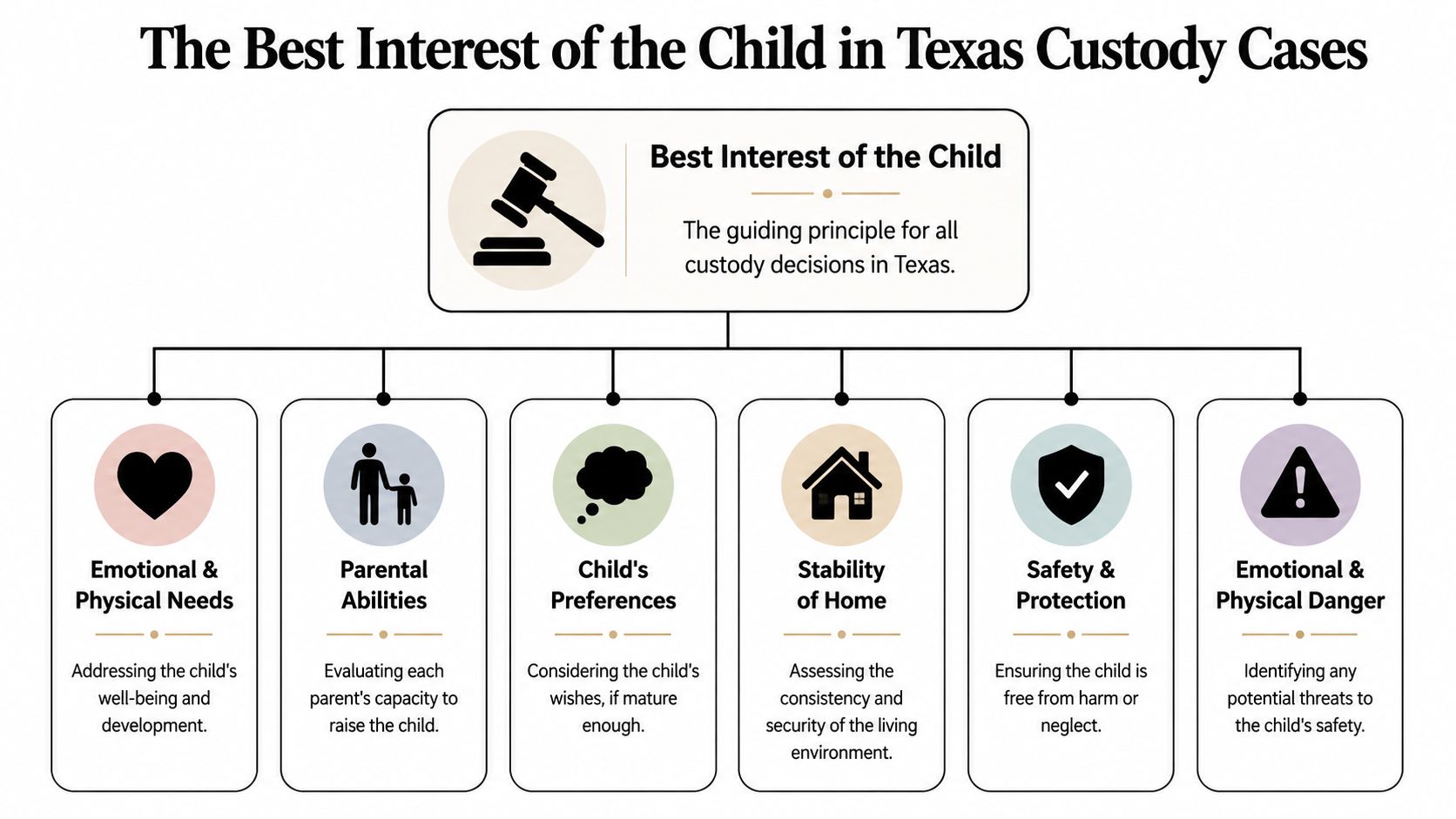
What the standard really means
In plain terms, the judge is building a picture of your child's real life. The court wants to know what happens before school, after bedtime, during illnesses, during schedule changes, and during conflict between parents. A custody case works a lot like assembling a map from small landmarks. One text message rarely decides anything. A pattern of conduct often does.
That is why judges in Harris County and Montgomery County pay attention to practical details such as:
- Daily needs: Who consistently manages meals, hygiene, transportation, homework, and emotional support?
- Safety: Is there evidence of abuse, neglect, substance misuse, untreated mental health concerns, or dangerous people in the home?
- Parenting judgment: Who makes sound decisions and follows through without constant crisis?
- Stability: Which home offers a routine the child can rely on?
- Future planning: Who can explain a workable plan for school, medical care, activities, and transitions between homes?
Parents sometimes hear "best interest" and assume the judge will choose the parent who appears more sincere in court. Judges usually look for something more concrete. They compare the claims each parent makes with the records, witnesses, and behavior surrounding those claims.
The Holley factors in plain English
The Holley framework gives the court a checklist. It keeps the analysis tied to evidence instead of personality.
| Factor | What It Means for Kingwood Parents |
|---|---|
| Emotional and physical needs | Can you meet your child's daily needs now, and keep meeting them as school, health, and social needs change? |
| Emotional or physical danger | Is there a credible risk of harm, chaos, intimidation, or unsafe conduct around the child? |
| Parental abilities | Do your choices show patience, judgment, consistency, and an ability to put the child first? |
| Programs available to assist the family | Have you used counseling, tutoring, medical care, school supports, or other services that help the child do well? |
| Stability of the proposed home | Is your household predictable, calm, and organized enough for the child to feel secure? |
| Plans for the child | Can you describe a realistic plan for education, healthcare, routines, and long-term growth? |
Here is where many parents get tripped up. Words like "stable" and "supportive" feel abstract, but judges need visible proof. Stability may show up as attendance records, appointment logs, a consistent exchange routine, report cards, prescription refill records, or testimony from someone who regularly sees the child's routine.
A related point often matters in contested cases. Judges also watch whether a parent supports the child's relationship with the other parent when it is safe to do so. If your case involves interference, false narratives, or pressure placed on the child, it helps to understand how courts evaluate signs of parental alienation in Texas custody cases.
Judges usually place more weight on repeated, documented parenting behavior than on a polished courtroom performance.
Why this standard confuses parents
The phrase "best interest" covers many family situations, which can make it feel slippery. A nurse working long shifts, a parent commuting from Humble, or a family relying on grandparents for after-school help can still present a strong custody case. The court is not grading your family against an idealized household. The court is asking whether your arrangement works, whether it is safe, and whether the child is thriving within it.
That distinction helps reduce a lot of anxiety. A demanding job does not automatically hurt you. Help from relatives does not automatically hurt you either. What matters is whether your plan is dependable, child-focused, and backed by evidence.
Some families also need support outside the legal process while the case is pending. If your child is having a hard time with the separation itself, the Children Psych guide for families in transition offers age-appropriate ideas for helping children process the changes at home.
What this means for your case
If you are trying to understand what judges look for in custody cases texas kingwood, start with a simple rule. Convert every general claim into something you can show.
Saying, "I am the more stable parent," is a conclusion. Showing school pickup records, medical follow-through, calm communication, and a workable weekly routine is proof. That is how the best-interest standard becomes an evidentiary roadmap for Kingwood parents.
Key Factors Judges Scrutinize in Harris County Courts
When a custody case lands in Harris County or affects families living around Kingwood and Northeast Houston, judges tend to focus on how parenting works in real life. They want to know whether your proposed arrangement is practical, sustainable, and safe for the child.

A parent may tell the court, "I can handle everything." The judge is more likely to ask, directly or indirectly, how that works on a Monday morning before school, during a doctor's appointment, or when work runs late. Judges aren't just reviewing identity. They're reviewing systems.
Daily caregiving carries real weight
One issue that gets overlooked is the caregiving system behind the parent. Texas Bar guidance summarized in a local family law discussion notes that courts often apply Holley factors like physical and emotional needs, danger, parental abilities, available programs, and home stability, while many cases turn on who handles school drop-off, medical appointments, homework, and routine care, as discussed in this article on how Texas courts determine child custody.
That means judges may look closely at questions such as:
- School logistics: Who gets the child to class on time in Kingwood or Humble?
- Medical follow-through: Who schedules appointments, fills prescriptions, and keeps records?
- Homework and activities: Who supervises assignments, communicates with teachers, and manages practice schedules?
- Backup plans: If work changes or a child gets sick, who has a credible plan?
These details matter because they show whether a parent can provide a steady routine instead of a hopeful promise.
Home stability is more than having a house
A stable home doesn't require perfection. It does require consistency. Judges often care less about appearances and more about whether the child has structure.
A strong home setup may include a regular bedtime, reliable meals, transportation planning, and adults who can support the child's routine without frequent disruption. If one parent has a long commute from another part of Northeast Houston, that doesn't automatically count against them. But the court may want to see how that commute affects school attendance, after-school care, and time with the child.
The court isn't grading your home like a magazine spread. It's evaluating whether your child can count on it.
The child's preference has a role, but not total control
Texas has a specific rule that many parents ask about. Under Texas law, if a party requests it, the court must interview a child who is at least 12 years old about the child's wishes in a custody suit, according to the Texas State Law Library guide on child custody. That doesn't give the child final authority, but it does mean the judge hears the child's views directly in a structured setting.
For Kingwood parents, that creates two important points.
First, don't assume a child's preference decides the case. The judge still weighs broader issues like daily care, home quality, and any history of abuse, neglect, or substance use. Second, don't pressure a child to "pick" a parent. Courts are sensitive to signs that a parent is trying to influence the child's wishes.
If you're concerned that the other parent is interfering with your relationship with your child, this guide on how to prove parental alienation may help you understand what kinds of facts and behavior patterns can matter.
Behavior problems and safety concerns
Some cases involve more than scheduling disagreements. If there are concerns about anger, substance use, neglect, or unsafe companions, judges will look for specific, credible proof. General complaints usually don't carry much weight by themselves.
What helps is consistency. The same concern appears in messages, school issues, medical records, missed exchanges, or witness observations. A judge is trying to tell the difference between conflict and actual risk.
For families in Porter, Humble, and Kingwood, this is often the turning point in a case. The court isn't looking for the parent who makes the strongest accusation. The court is looking for the parent who can support concerns with facts and still keep the focus on the child.
How to Document and Present a Strong Custody Case
Once you know what the court cares about, the next step is showing it clearly. A strong custody case is usually built like a well-organized file, not a dramatic speech. Judges need evidence they can follow.

If you're a parent in Kingwood or Humble, think of your case in categories. Your goal is to show the child's routine, your role in maintaining it, and the reliability of your home life.
Build a record of ordinary parenting
Many parents save only the most upsetting messages. That's understandable, but it's not enough. Courts often care more about the daily pattern.
Start gathering records that show your involvement:
- Parenting journal: Keep dated notes about exchanges, school issues, appointments, missed visits, and important conversations.
- School records: Save attendance notices, teacher emails, report updates, and notices showing who participates.
- Medical records: Keep appointment summaries, vaccination records, prescription information, and communication with providers.
- Activity proof: Hold onto schedules, registration confirmations, and messages about practices, lessons, or events.
- Communication logs: Preserve texts, emails, and app messages in their full context.
The strongest documentation usually does one thing well. It shows what happened, when it happened, and why it matters to the child.
Match your proof to the issue
A common mistake is bringing in a stack of papers without a clear purpose. Instead, connect each record to a point the judge needs to evaluate.
| Type of proof | What it can help show |
|---|---|
| School emails | Involvement in education and daily structure |
| Medical records | Follow-through on healthcare needs |
| Calendars and pickup logs | Reliability and time management |
| Messages about exchanges | Co-parenting behavior and consistency |
| Photos of ordinary routines | Participation in the child's life when dated and contextualized |
Texas guidance discussed in a local custody article notes that courts often look at factors such as the child's physical and emotional needs, danger, parental abilities, available programs, and home stability, while many cases turn on caregiving systems and the evidence behind them, as explained in this piece on what evidence helps in a Texas custody hearing.
Keep your presentation clean and credible
Parents sometimes undermine their own case by over-editing screenshots, submitting partial conversations, or mixing speculation with facts. Don't do that. Present materials in a way that looks dependable.
Use folders by topic. Label documents by month or category. If you use a co-parenting app, keep exports organized. If you prepare a timeline, make sure each event can be backed up by a message, document, or witness if needed.
Courtroom prep note: A simple, chronological set of records is usually more persuasive than a large pile of disorganized papers.
Video guidance can also help if you're trying to picture how a custody case is presented in practice.
Choose witnesses carefully
Not every witness helps. Family members may support you, but judges often expect them to be partial. Teachers, counselors, coaches, childcare providers, and other adults with direct knowledge can sometimes provide more useful testimony.
A good witness doesn't need to praise you in broad terms. They need to explain what they personally observed. For example, a teacher who can say you regularly attended meetings and followed up on academic concerns may be more helpful than a friend who says you're a loving parent.
Some parents also work with legal counsel to organize evidence before a hearing. That can include preparing exhibits, identifying weak points, and deciding what not to introduce. For Kingwood families who want help structuring that process, the Law Office of Bryan Fagan – Kingwood TX Lawyers handles custody representation and hearing preparation.
Navigating the Courtroom in Harris or Montgomery County
Courtroom behavior sends a message before you ever finish an answer. Judges watch how parents speak, react, and handle stress. In a custody case, your demeanor can support or weaken everything you've documented.

A calm parent often appears more credible than a parent who interrupts, argues, or treats the hearing like a personal battle. That's not about being polished. It's about showing judgment.
What judges notice quickly
The court may form early impressions from simple things:
- Punctuality: Arrive early enough to settle yourself and review your materials.
- Appearance: Dress neatly and conservatively.
- Respect: Address the judge properly and avoid reacting while the other side speaks.
- Focus: Keep your testimony centered on the child, not on punishing the other parent.
If you're preparing for a local hearing, this overview of a child custody hearing in Harris County can help you understand what the process may look like.
How to answer questions well
Parents often hurt their testimony by volunteering too much. Under stress, it's easy to ramble, argue, or turn every answer into a speech about the other parent's flaws.
A better approach is simple:
- Listen carefully.
- Answer the question asked.
- Tell the truth, even when the answer isn't perfect.
- Stop when you've answered.
If a question is confusing, ask for it to be repeated or clarified. That's better than guessing.
You don't need to sound flawless. You need to sound honest, steady, and focused on your child.
What not to do
Some courtroom habits create problems fast.
- Don't interrupt the judge or opposing counsel.
- Don't roll your eyes, laugh, sigh loudly, or make faces.
- Don't exaggerate. If you say the other parent "never" does something, be prepared for records that show otherwise.
- Don't coach your child or speak as if the child is your ally against the other parent.
This matters in Kingwood and throughout Northeast Houston because custody hearings often come down to credibility. Two parents may each say they care. The parent who appears measured, child-focused, and factual usually gives the court a more reliable foundation.
Alternatives and Aids in Your Custody Case
Not every custody dispute ends with a full trial. In fact, many families in Kingwood, Humble, and Porter resolve important issues through processes that are less combative and more practical.
Mediation can reduce damage
Mediation gives parents a structured setting to work through custody, schedules, and decision-making with a neutral third party. It can be especially useful when both parents want some control over the outcome, even if communication is strained.
For parents who want a plain-language overview before they go in, this guide on how mediation works step by step offers a useful picture of the process.
Mediation doesn't mean giving up. It means trying to solve problems in a way that may protect your child from further conflict. When it works, parents leave with a parenting plan they helped build instead of one imposed after a hearing.
Third-party professionals can shape the case
In some custody matters, the court may rely on an Amicus Attorney or Attorney Ad Litem. Parents are often confused by these roles.
They aren't there to be your personal lawyer. They're brought in to help the court better understand the child's circumstances. That may include reviewing records, talking to parents, observing family dynamics, and sharing recommendations or information with the court depending on the appointment.
This can feel intrusive, but it can also be helpful. A judge cannot be present for school drop-off, bedtime conflict, or daily transitions. A third-party professional may give the court a clearer view of how the family functions.
Why these options matter
Some parents assume the only way to succeed is to fight every issue as hard as possible. That approach can backfire, especially when the child needs stability more than escalation.
A thoughtful custody strategy may include negotiation, mediation, temporary agreements, and targeted court action only where necessary. In many Northeast Houston cases, the strongest move isn't the loudest one. It's the one that protects the child while preserving credible evidence and reasonable decision-making.
How a Kingwood Child Custody Lawyer Can Help You
The night before a custody hearing, many parents sit at the kitchen table with a stack of school papers, text messages, calendars, and photos, wondering what helps and what will be ignored. That uncertainty is normal. Loving your child and proving your parenting in court are two different tasks.
A Kingwood child custody lawyer helps turn your lived experience into evidence a judge can evaluate. In Harris and Montgomery County courts, the question is rarely whether you care. The question is whether you can show a clear pattern of stability, involvement, safety, and good judgment through records, testimony, and consistent conduct.
Your records matter. Your communication matters. Your courtroom behavior matters. Your preparation matters.
For parents searching for what judges look for in custody cases texas kingwood, the answer usually comes from the full file, not one dramatic moment. A lawyer helps you sort that file into something useful. That may include organizing attendance records, medical records, parenting calendars, screenshots, daycare information, work schedules, and witness testimony so the court can quickly understand your child's daily routine and your role in it.
Local experience also helps with the details that often decide how believable a parenting plan feels. A proposed exchange schedule has to fit real traffic patterns, school locations, and work hours. A judge in this area may want to know who handles morning drop-off, how far each parent lives from the child's school, whether grandparents provide after-school care, and how missed exchanges have been handled in the past. Generic advice often stays abstract. A local lawyer helps connect those facts to the legal standard the court must apply.
A good attorney also prepares you for presentation, not just paperwork. Court works a bit like assembling a map. If the information is scattered, incomplete, or emotional, the judge sees only fragments. If the information is organized and tied to the child's needs, the judge can follow the path. That is often the difference between sounding upset and sounding credible.
You do not have to figure that out by yourself. Legal guidance can help you make early decisions that protect your position, avoid preventable mistakes, and keep the case centered on your child rather than the conflict between parents.
If you're dealing with a custody dispute and need practical guidance from a local team, schedule a free consultation with Law Office of Bryan Fagan – Kingwood TX Lawyers. Our Kingwood office works with parents throughout Kingwood, Humble, Porter, and Northeast Houston to help them understand their options, prepare for court, and protect what matters most.