Skip to content
Your daughter is sitting at the kitchen table in Kingwood after school and says, “I want to live with Dad.” Or your son in Humble tells you he's tired of the week-to-week tension and wants one home base. When that happens, most parents have the same question: can a child choose which parent to live with texas kingwood?
The short answer is no, not by themselves.
The harder answer is that a child's opinion can matter a great deal, but only when it's presented the right way and supported by the right facts. That's where many Northeast Houston parents get tripped up. They hear “age 12” and assume the child gets to decide. Texas law doesn't work that way.
Parents also worry about the emotional side. They don't want to pressure their child, but they also don't want the court to ignore what their child is saying. Those are valid concerns. Children deserve a voice without being pushed into the middle of an adult dispute.
For families trying to support healthy decision-making at home, it can help to look at resources on building student autonomy through SEL programs. While that isn't a legal guide, it speaks to something family courts see every day: kids do better when adults let them express themselves without making them carry the final burden of the decision.
Your Child's Voice in a Kingwood Custody Case
A child's wish matters in Texas custody cases. It just doesn't control the outcome.
That distinction matters for parents in Kingwood, Porter, and Humble because expectations shape strategy. If a parent walks into court believing, “My child is old enough, so the judge has to follow their choice,” that parent may miss the bigger picture. Judges want to know why the child prefers one home and whether that preference fits the child's long-term well-being.
What worried parents usually mean when they ask this question
Most parents aren't really asking whether a child can sign a form and pick a house. They're asking things like:
- Will the judge listen: If my child has been asking for a change for months, will the court take that seriously?
- Does age matter: If my child is 12, 14, or 16, does that give their opinion more weight?
- What should I do next: Do I file something now, wait, or try to resolve it outside court?
- Can I talk to my child about it: How do I listen without accidentally coaching them?
Those are the right questions.
A child should never feel responsible for choosing between parents. The legal process should reduce that pressure, not increase it.
A local example that feels familiar
A Kingwood parent might live near the schools, while the other parent lives farther out toward Porter. A teenager may say they want to switch homes because they want less driving, more time with friends, or a calmer weekday routine. Another child may prefer a parent because that home has fewer rules.
Those are not the same situation.
Judges in Harris County often look past the headline, “the child wants X,” and focus on the underlying reason. A stable school routine, safety concerns, or repeated conflict in one home usually gets more careful attention than “Dad lets me stay up later” or “Mom is less strict.”
That's why this issue is never just about the child speaking. It's about how the child's voice fits into the full custody picture.
Understanding Texas Law on a Child's Preference
Texas law gives children a voice, but not the final call. In Texas, a child cannot unilaterally choose which parent to live with until 18. A major change in the law happened when Texas repealed Family Code § 153.008, which had allowed children 12 and older to file a formal preference. It was replaced by § 153.009, which allows children 12 and older to have a private in-camera interview with the judge. That change was made to address situations involving parental coercion, and Harris County data discussed in this review of child custody preference in Texas shows judges departed from a child's stated preference in approximately 60-65% of interviewed cases when the preference conflicted with long-term welfare.

There is no magic age before 18
Parents in Kingwood often hear some version of “once a child turns 12, they can choose.” That's one of the biggest myths in Texas family law.
Turning 12 does not mean a child gets to decide custody. It means the child may have the right to speak privately with the judge. The judge still decides what arrangement serves the child's best interest.
Think of the child's preference like one ingredient in a recipe. It may be important, but it isn't the whole meal. The judge still considers safety, stability, parenting ability, and the child's needs as a whole.
What an in-camera interview means
An in-camera interview is a private conversation between the judge and the child, usually in chambers rather than open court. The purpose is to let the child speak more freely and with less pressure.
That matters because children often feel torn. They may love both parents. They may worry that telling the truth will hurt someone's feelings. The private setting is meant to make that easier.
A few points help clear up confusion:
- Age 12 and older matters legally: Texas law specifically gives children 12 and older the right to be heard through this process.
- Younger children may still come up in evidence: But the specific interview right discussed here applies to children 12 and older.
- The judge must consider the child's wishes: That doesn't mean the judge must follow them.
- The final order remains the court's decision: Not the child's.
Practical rule: If your child is old enough to be interviewed, focus less on “getting the child to choose” and more on giving the court a reliable picture of the child's daily life.
Why the old law changed
The old preference form put too much pressure on children. It created a setting where adults could influence what a child wrote or said. The newer interview process is designed to lower that risk.
For a worried parent in Northeast Houston, that is a good thing. It means the court is trying to hear the child's voice in a safer, more protected way.
Factors That Influence a Judge's Decision
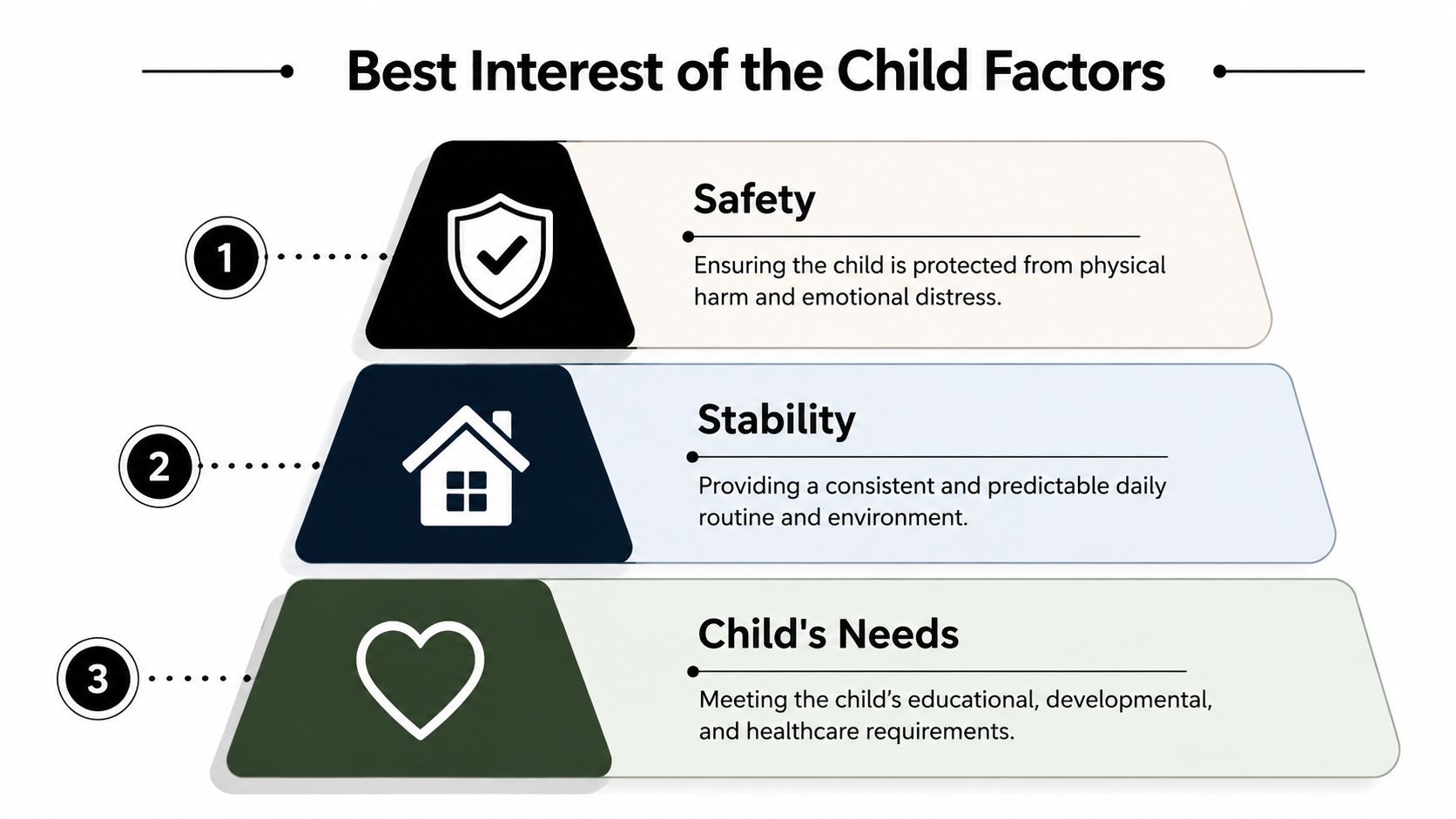
The controlling question in Texas isn't “What does the child want?” It's “What is in the child's best interest?”
That standard shapes every custody ruling in Harris County. A child's preference can be relevant, but the court weighs it alongside other facts. According to a review of Harris County family court dispositions involving minors ages 12-17, the child's expressed preference matched the final order in 38.7% of cases, and judges rejected “fun parent” reasoning in roughly 55% of cases.
What judges tend to look at closely
The best-interest standard can sound abstract until you break it into everyday concerns. In a Kingwood custody case, judges commonly focus on issues like these:
| Factor | What it can look like in real life |
|---|---|
| Safety | Exposure to violence, threatening behavior, or unsafe adults |
| Stability | Consistent school attendance, predictable routines, reliable housing |
| Emotional needs | Which parent supports counseling, structure, and healthy communication |
| Parental judgment | Whether a parent encourages the child's relationship with the other parent |
| Reason for the child's preference | A thoughtful reason carries more weight than wanting fewer rules |
A teenager who says, “I want to stay with Mom because she gets me to school on time, helps with my anxiety treatment, and I've been doing better there,” is presenting something very different from, “Dad lets me do whatever I want.”
Maturity matters as much as age
A 15-year-old may still give a shallow reason. A 12-year-old may speak with surprising clarity. Judges listen for maturity, not just birthdays.
That often surprises parents. They assume an older teen's preference will automatically carry the day. It may carry more weight, but the judge still examines whether the child understands the consequences of a change in living arrangements.
Some warning signs judges notice include:
- Scripted language: The child sounds like they're repeating an adult.
- Adult grievances: The child focuses on child support, lawsuits, or dating history instead of daily life.
- Rule avoidance: The main reason is more freedom, fewer chores, or later curfews.
- Cutoff language: The child wants to reject one parent entirely without a child-centered explanation.
For parents dealing with conflict that may be shaping a child's views, it helps to understand how to prove parental alienation. Allegations in this area are serious, and courts treat them carefully.
Courts tend to trust child-centered reasons more than parent-centered complaints.
Why this matters for Kingwood families
Local families often face practical issues that strongly affect a best-interest analysis. School continuity, commute time, extracurricular schedules, counseling access, and support from extended family can all matter. A child's preference becomes much stronger when it lines up with those kinds of facts.
That's why strong custody presentations are built on more than a child's statement. They show the full picture of the child's life.
How to Request a Judge Hears Your Child's Wishes
If your child is 12 or older and you believe their views should be heard, the usual legal step is to ask the court for an interview. Under Texas Family Code §153.009(b), a child 12 or older may be interviewed by the court in chambers, and guidance discussing Harris County practice explains that filing a motion triggers mandatory consideration. That same discussion notes that the child's preference is not binding, and in Harris County only about 25% of child-expressed preferences fully dictate outcomes.

The basic process in plain English
Parents often feel intimidated by the procedure, but the request itself is straightforward in concept.
File the proper motion
In many cases, this is a motion asking the judge to confer with the child. The exact title can vary by case posture and court practice.Set the matter with the court if needed
Some courts require scheduling steps or coordination through the court coordinator.Prepare the rest of your evidence
Don't treat the child interview as the whole case. Bring records, testimony, and other proof tied to best-interest factors.Let the child speak for themselves
The judge wants the child's own words, not a rehearsed performance.
A parent in Humble or Northeast Houston may also need to think about school records, counseling records where appropriate, attendance patterns, and witnesses who can talk about routine and stability.
What the interview usually feels like
The phrase “in chambers” sounds formal, but it usually means the child speaks with the judge in a more private setting than open court. Parents and lawyers typically are not in the room during the conversation.
That privacy is intentional. It helps lower stress and gives the child a chance to talk without feeling watched by both parents.
For many families, the smartest move is to prepare themselves, not the child. If you're getting ready for the larger hearing, this guide on how to prepare for a custody hearing can help you organize the evidence that matters.
Common mistake: asking a child to “tell the judge you want to live with me.” Even gentle pressure can look like coaching if the child repeats your words instead of their own.
What not to do
Parents sometimes damage good cases by trying too hard. Avoid these traps:
- Don't rehearse answers: Judges are good at spotting memorized language.
- Don't promise outcomes: A child should never be told the interview guarantees a move.
- Don't make the child gather evidence: That places adult responsibility on a kid.
- Don't attack the other parent through the child: It hurts credibility fast.
The strongest approach is calm and simple. Let the child know they should be honest. Then make sure the court sees the facts that support the child's daily needs.
Exploring Alternatives to a Courtroom Battle
Many custody disputes in Kingwood don't need a full courtroom fight to address a child's wishes. Sometimes the better path is a process that reduces stress, protects the child, and helps parents build a workable plan.

Mediation, evaluations, and child-focused professionals
These options serve different purposes. Choosing the right one depends on the level of conflict, the child's age, and the issues driving the dispute.
Mediation
Mediation gives parents a private setting to negotiate a parenting plan. This can work well when both parents are willing to listen and the disagreement is mostly about schedule, school routine, or a teenager's changing needs. Families considering this route can learn more about divorce mediation in Texas.Custody evaluation
A custody evaluator is a neutral professional who studies the family situation and offers recommendations. This can help when one parent says the child's preference reflects maturity and the other says it reflects pressure or instability.Guardian ad litem or amicus attorney
These professionals focus on the child's best interests. They can be useful when the child needs a voice in the process without having to carry the entire case personally.
A side-by-side look
| Option | Best for | Possible benefit | Possible drawback |
|---|---|---|---|
| Mediation | Lower to moderate conflict | More control and privacy | Requires both parents to participate in good faith |
| Custody evaluation | Fact-heavy disputes | Neutral assessment of home life and parenting | Can add time and complexity |
| Ad litem or amicus | Child-centered concerns | Gives the court another perspective on best interest | Not every case needs this level of involvement |
A practical explanation of the child interview process can also help some parents understand what the court is trying to protect:
Virtual interviews and newer Harris County practice
For some families in Kingwood and Northeast Houston, travel time and courthouse stress are part of the problem. Recent legislative updates, effective Sept. 2025 via HB 1234, introduced virtual in-camera options for children 12 and older in Harris County courts. A Texas law library guide discussing that update reports a 32% rise in virtual child interviews statewide in 2026, along with high parent satisfaction in Northeast Houston dockets, while also noting that preference-only requests had a higher denial rate. That discussion appears in the Texas State Law Library guide on child custody and support.
That option may be less intimidating for some children. It may also help families with work schedules or transportation issues.
Still, technology doesn't change the core legal standard. Virtual or in person, the child's view works best when it is supported by evidence of stability, maturity, and the child's actual needs.
Changing Your Custody Order Based on a Child's Preference
If you already have a custody order, the legal question changes. You're no longer just asking what arrangement is best. You're asking whether the court should modify an existing order.
Texas Family Code §156.101 requires proof of a material and substantial change in circumstances. A child's preference can be part of that picture, but it's not automatic. In contested Harris County cases, discussion of preference-based modification claims reports success rates of 18-22%. That same discussion says these requests do better when the preference is backed by other evidence, such as a psychological evaluation showing maturity or proof of home stability.
A Kingwood-style example
Take a teenager who has been living under one order for years and now wants to live with the other parent to attend school closer to that parent's home. On its face, that sounds reasonable.
But a Harris County judge will likely ask several deeper questions:
- Is this request tied to a real change in the child's needs?
- Will the move improve daily stability or disrupt it?
- Is the child asking for a better school fit, or more freedom?
- Does the proposed home support attendance, homework, transportation, and routine?
A teen's desire to change high schools near Kingwood may be understandable. It still has to fit the legal standard for modification.
What usually strengthens a modification request
A strong modification case often combines the child's preference with facts that show the change is workable and beneficial.
Consider support like this:
- School-related records showing attendance issues, schedule strain, or educational concerns
- Neutral professional input if maturity, emotional health, or adjustment is disputed
- Proof of home stability such as a consistent routine, reliable transportation, and support for the child's activities
- Evidence of changed circumstances since the last order, not just ongoing dissatisfaction
If the only evidence is “my child wants to switch,” the case is much harder than parents expect.
For families in Humble, Porter, or Kingwood, that's often the turning point. The child's voice may open the door, but the court usually wants more before changing an existing order.
Your Next Steps for Your Kingwood Family Law Matter
If you've been asking whether can a child choose which parent to live with texas kingwood is a simple yes-or-no question, the truth of the matter is more nuanced. A child's wishes can matter. They may even matter a lot. But Texas courts still decide custody based on the child's best interests, not the child's vote.
That means parents need a careful plan. They need to know when a judge may hear from the child, how to avoid coaching, when a modification request makes sense, and when alternatives like mediation or evaluations may better protect the family. For many Kingwood and Northeast Houston families, the strongest path is the one that combines the child's honest voice with solid evidence about safety, routine, and stability.
If you're dealing with this issue in Kingwood, Humble, or Porter, it helps to get advice specific to your court, your order, and your child's unique needs.
If your family is facing a custody question and you need clear, local guidance, schedule a free consultation with Law Office of Bryan Fagan – Kingwood TX Lawyers. Their Kingwood office works with parents across Kingwood, Humble, Porter, and Northeast Houston to explain options, protect children from unnecessary conflict, and build practical custody strategies grounded in Texas law.