Skip to content
Your child is two. They still need help with meals, bedtime, naps, and getting through a rough morning. Now your relationship is ending, and you're lying awake in Kingwood wondering what a judge will do with a child who can't explain their own needs yet.
That worry is common in Kingwood, Humble, Porter, and Northeast Houston. Parents often come into a custody case thinking the court will use a simple formula. It usually doesn't, especially when the child is under five. The younger the child, the more the court looks at routine, attachment, safety, and which parent can handle the day-to-day realities of early childhood.
If you've been searching for custody for young children under 5 texas kingwood, you probably want more than legal terms. You want to know what judges look for, what a schedule might look like, and what you should be doing right now to protect your relationship with your child. That's what this guide is built to do.
Navigating Custody for Your Young Child in Kingwood
A parent in Kingwood recently described the same fear many people feel at the start of a case. She wasn't asking who would “win.” She wanted to know whether her toddler would have to sleep in two homes right away, whether daycare pickups would change every week, and whether a court would understand that her child melts down when bedtime moves by even an hour.
That's the right question.
For very young children, custody cases aren't only about legal rights between adults. They're about building a plan a small child can successfully live with. Judges in the Kingwood area, including families going through Harris County and nearby Montgomery County courts, usually focus less on broad promises and more on concrete parenting behavior. Who handles doctor visits? Who knows the nap routine? Who can calmly manage transitions? Who can provide a steady home?
Why under-five cases feel different
A child under five changes fast. What works for a nine-month-old may not work for a preschooler. A possession schedule that makes sense today may need to expand later as the child grows more comfortable with longer separations and more transitions.
That's why these cases often feel more personal and more urgent than parents expect.
Parents also get confused by the words. In Texas, people often say “custody,” but the law talks about conservatorship, possession, and access. In plain English:
- Conservatorship means decision-making rights.
- Possession and access means the schedule for time with the child.
- Best interest of the child is the standard the judge uses to decide both.
Young-child custody cases usually turn on small daily facts, not dramatic courtroom moments.
What worried parents in Kingwood should keep in mind
If you live in Kingwood, Humble, or Porter, the local court process can feel intimidating, but the core issue is simple. The judge wants to know whether your proposed plan is safe, realistic, and age-appropriate.
A strong case often starts with ordinary details:
- Daily caregiving: feeding, bathing, soothing, bedtime, preschool prep
- Consistency: reliable exchanges, stable housing, a workable routine
- Co-parenting behavior: calm communication and fewer disruptions for the child
- Child-focused planning: a schedule designed around the child's needs, not the parents' frustrations
When parents understand that early, they make better decisions from the beginning.
What Texas Courts Consider the Best Interest of a Young Child
Texas courts decide custody cases based on the best interest of the child. For babies, toddlers, and preschoolers, that standard becomes very practical. A judge isn't looking for the parent with the best speech in court. The judge is looking for the parent, or parents, who can create a stable and safe world for a very young child.
According to a TexProtects State of the State report, the 0 to 5 age group is a peak vulnerability period for neglect, and neglect is the most common confirmed allegation by CPS. That's one reason Kingwood-area courts pay close attention to which parent can reliably meet a young child's basic needs and reduce risk.

What this standard looks like for infants
With infants, judges usually focus on attachment, physical care, and responsiveness. That means questions like these matter:
- Who handles feeding and soothing when the baby is upset?
- Who keeps up with medical appointments?
- Who notices sleep issues, rashes, illness, or developmental concerns?
- Which home can provide calm, predictable care?
An infant can't adapt to adult conflict the way an older child might. A court knows that. If one parent has been actively involved in the baby's daily life, that involvement matters.
What changes for toddlers and preschoolers
By the time a child reaches the toddler and preschool years, the court still cares about safety and attachment, but the picture gets broader. Judges often look at structure, learning, socialization, supervision, and how each parent helps the child manage daily routines.
That's where practical knowledge of childhood development becomes helpful. If you're trying to think through naps, language growth, emotional regulation, or age-appropriate routines, this guide to stages of child growth for parents can help you frame what your child needs at different ages.
The court is not applying an old maternal preference rule
Many parents still believe Texas courts automatically favor mothers for very young children. That's not how the law is supposed to work. The actual focus is evidence of nurturing, stable parenting.
A father in Humble who prepares meals, knows the daycare staff, attends doctor visits, and has a child-ready home may present a stronger case than a parent who assumes biology alone will carry the day. The same is true in reverse. Courts respond to proof.
Practical rule: Bring the judge a parenting plan that fits your child's age, temperament, and routine. General statements about loving your child won't carry the same weight as specific evidence of caregiving.
A simple way to think about best interest
For young children, best interest often comes down to three questions.
| Question | What the court is really asking |
|---|---|
| Is this child safe? | Can each parent prevent neglect, supervise properly, and provide a stable environment? |
| Is this child secure? | Will the schedule protect attachment, routine, and emotional stability? |
| Is this plan workable? | Can the parents actually follow it without constant conflict or chaos? |
That's the lens many parents need. The court isn't grading your relationship. It's evaluating whether your child can thrive under the plan you're requesting.
Possession Schedules for Children Under Five
Parents often assume Texas has one standard custody calendar for every child. That's where a lot of confusion begins. For children under five, especially those under three, courts often move more carefully.
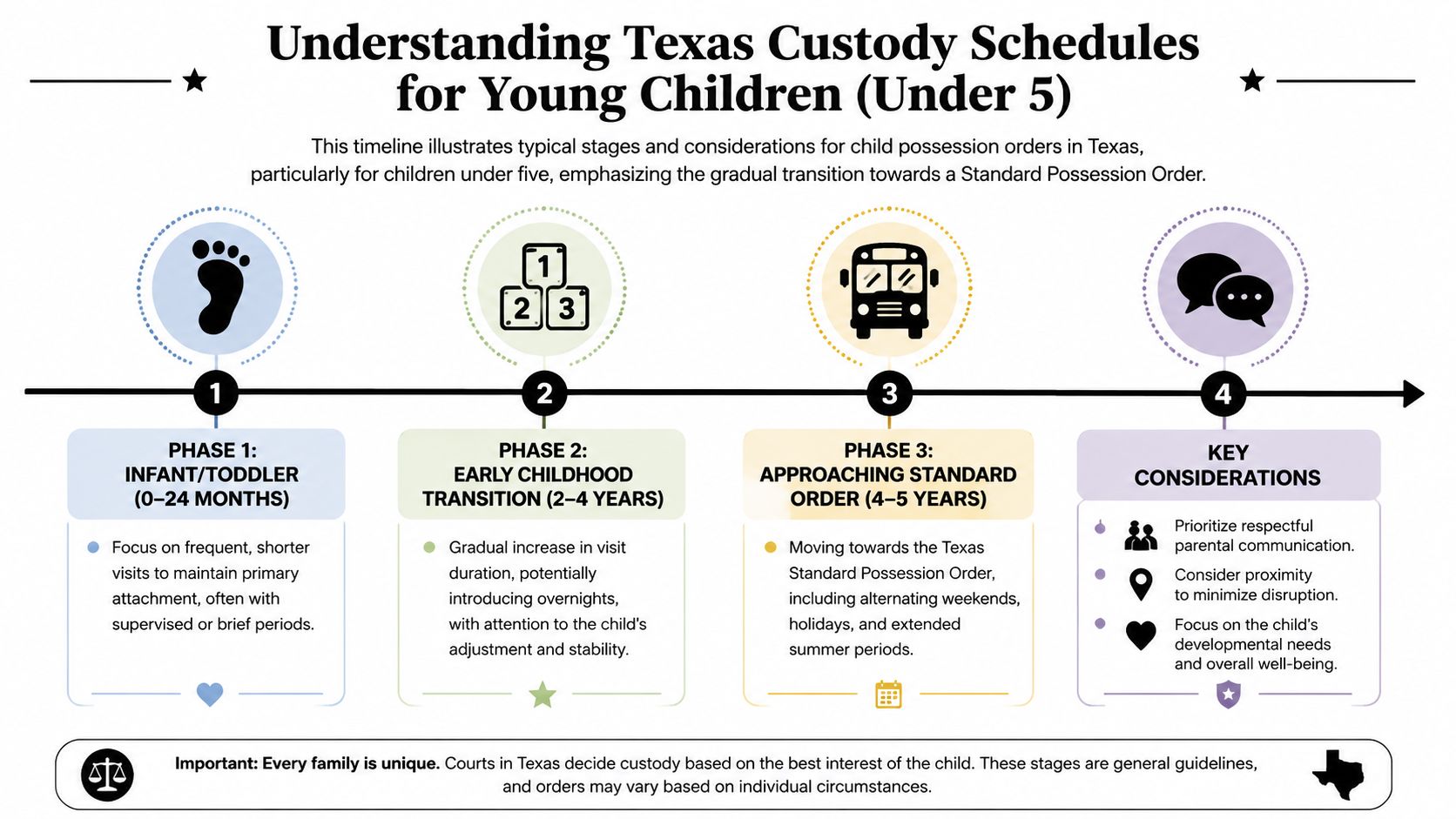
Under Texas Family Code §153.251(d), the presumption that a Standard Possession Order is in a child's best interest does not apply to children under three, and courts in Harris County and Montgomery County often use step-up schedules that begin with shorter visits and later expand to overnights. Texas Access explains that approach in its guidance on children under age 3.
Why the default order often doesn't fit a baby or toddler
The standard order was built with older children in mind. Very young children often need a different structure because long separations can be hard on attachment and routine. A baby who still depends on a steady feeding and sleep rhythm may do better with frequent, shorter contact rather than immediate weekend-style possession.
That doesn't mean the other parent gets pushed aside. It means the court may try to build the parent-child relationship in a way that feels steady rather than abrupt.
For parents in Kingwood and Northeast Houston who want to understand how the usual Texas schedule works for older children, it helps to compare it with a local overview of the Standard Possession Order in Kingwood.
A step-up schedule in plain language
A step-up schedule is exactly what it sounds like. Parenting time grows in phases as the child gets older, adjusts well, and shows readiness for more time away from the primary home.
A judge may approve something like this in concept:
| Child stage | Common court approach |
|---|---|
| Infant | Short, frequent visits focused on bonding and routine |
| Younger toddler | Longer daytime periods, with close attention to adjustment |
| Older toddler | Trial overnights or gradual expansion where appropriate |
| Preschool age | Transition toward a more regular weekend and holiday pattern |
The details vary. A court may care about distance between homes, daycare arrangements, how well parents communicate, and whether both homes can handle the child's routine.
A realistic example
Suppose parents in Porter separate when their child is one year old. One parent has been the primary bedtime and medical-care parent, but the other has stayed involved with daily care and wants substantial time.
The court may not jump straight to every-other-weekend overnights. Instead, the early order might use a pattern of short visits spread through the week so the child sees the other parent regularly. If those visits go well, the next phase may add longer daytime possession. Later, after the child matures and the parent shows consistency, overnights may begin.
That kind of schedule often feels frustrating to the parent who wants more time immediately. But from the court's perspective, it can be a child-focused bridge rather than a punishment.
A step-up plan works best when it doesn't treat growth as automatic. Each phase should be clear enough that both parents know what has to happen next.
What parents should pay attention to in each phase
Different ages raise different concerns. If you're dealing with custody for young children under 5 texas kingwood, these are the practical issues to watch:
- For infants: feeding needs, sleep rhythms, medical care, soothing, and minimizing stressful transitions
- For younger toddlers: separation tolerance, consistency between homes, and smooth handoffs
- For older toddlers and preschoolers: preschool routines, behavior after exchanges, and readiness for more overnight time
- For all ages: whether each parent follows the schedule, communicates respectfully, and keeps the child out of conflict
What not to do
Some parents sabotage their own case by demanding a schedule that doesn't match the child's stage of development. Others make the opposite mistake and agree to a vague plan that never grows with the child.
Avoid both extremes.
A strong under-five order should answer questions such as:
- When does the next phase begin?
- What conditions trigger more time?
- How are missed visits handled?
- What happens if the child struggles with transitions?
- How will holidays and birthdays work while the child is still very young?
When those details are missing, parents in Kingwood often end up back in court sooner than they expected.
Creating Your Kingwood Parenting Plan
A possession schedule tells you when the child is with each parent. A parenting plan tells you how the two of you will raise the child across two homes. For a child under five, that document matters more than many parents realize.
A vague plan might work for a few weeks. It usually falls apart the first time the child gets sick, daycare closes, or one parent wants to change a bedtime routine.

Start with decision-making rights
Texas often uses Joint Managing Conservatorship, which usually means both parents share important rights and duties. That does not always mean every decision is made jointly in real time. One parent may hold the exclusive right to make certain decisions, or the parents may need to confer before acting.
For a young child, these issues should be spelled out carefully:
- Medical care: who chooses the pediatrician, who can consent to treatment, how emergency decisions are handled
- Dental and therapy decisions: who schedules appointments and who pays uncovered costs under the order
- Daycare and preschool: who chooses the provider, who handles pickup, and what notice is required before a change
- Mental health support: how counseling or child-development evaluations will be discussed if concerns arise
Build a plan around the child's actual routine
The best parenting plans in Kingwood tend to read like a practical family handbook. They address the ordinary details that trigger conflict when left unstated.
Consider including terms about:
- Sleep routines: bedtime windows, naps, favorite comfort items, and where sleep medications or monitors are kept
- Food issues: allergies, bottle or meal schedules, and whether parents must share updates about dietary changes
- Transportation: exact exchange locations, who drives, and what happens if traffic or weather causes delays
- Communication: when parents will update each other about illness, injuries, school events, or daycare concerns
Co-parenting apps can help reduce conflict
Parents often ask whether texting is enough. Sometimes it is. Sometimes it turns every exchange into an argument. In higher-conflict cases, co-parenting apps can create a cleaner record and lower friction.
According to the DFPS Parent Helpline custody information, emerging Texas law such as HB 1234, effective January 2026, is beginning to require judicial consideration of parental mental health and co-parenting apps in high-conflict cases involving young children. Using tools like OurFamilyWizard can show a court that you're trying to keep communication structured and child-focused.
If every pickup turns into a debate, move communication into one consistent system before the conflict defines your case.
A checklist for under-five parenting plans
Here's what many parents in Humble, Porter, and Kingwood forget to include.
- Health details: pediatrician, pharmacy, insurance card access, medication instructions
- Daycare logistics: provider name, pickup authority, backup care plans, notice before changing centers
- Developmental concerns: how speech, behavior, or learning concerns will be raised and documented
- New relationships: rules about introducing new romantic partners to a very young child
- Travel and handoffs: notice rules, exchange safety, and who provides car seats
- Photos and updates: how often parents will share milestone information without turning it into constant monitoring
The real value of detail
Some parents resist detailed plans because they want “flexibility.” Flexibility only works when trust is high. In many custody cases, what parents call flexibility is really uncertainty.
A well-drafted plan protects both parents and makes life calmer for the child. It also gives the court something solid to enforce later if one parent stops cooperating.
A Step-by-Step Guide to the Custody Process
The legal process feels overwhelming when you're already worried about your child. It helps to break it into parts. Most under-five custody cases in the Kingwood area move through a series of practical stages, and each stage gives you a chance to build the record the judge will rely on.

Step one begins with filing
A case usually starts when one parent files a petition. If the parents were married, that may happen within a divorce. If they weren't, it may be a suit affecting the parent-child relationship.
For families in Kingwood, filing often means dealing with Harris County, though some nearby families may be in Montgomery County depending on where they live and where prior orders exist. The filing asks the court to make orders about conservatorship, possession, support, and related issues.
At this stage, many parents make an early mistake. They file with broad emotional accusations but very little usable detail. Courts need facts tied to the child's needs.
Step two is often the temporary orders phase
Temporary orders are the rules that control the case while it's pending. In under-five cases, this hearing can shape the direction of everything that follows because it may establish the first possession schedule, exchange rules, and decision-making structure.
A temporary orders hearing often addresses:
- Where the child will primarily stay
- What possession schedule starts immediately
- How daycare, medical care, and exchanges will work
- Whether communication limits or protective terms are necessary
What happens early matters. If you begin the case with a practical schedule that works, that pattern may influence later negotiations.
Step three is collecting proof of your parenting
Many good parents underperform in this area. They know they love their child, but they haven't organized evidence that shows what they do.
For children ages three to five in Harris County, Texas Access guidance on possession time notes that over 65% of custody orders incorporate graduated overnights, and documenting a history of frequent short contact and involvement in the child's routine is important for a parent seeking expanded time as the child grows.
That means your evidence should be specific.
Useful evidence often includes
- Parenting journals: notes about meals, naps, doctor visits, daycare pickup, bedtime, and daily care
- Messages: texts or app communications showing cooperation, scheduling, and involvement
- Photos and calendars: records of school events, pediatric visits, and ordinary parenting time
- Witnesses: daycare staff, relatives, or others who have seen you caring for the child
- Records: medical paperwork, daycare records, and anything showing your role in decision-making
If you're preparing for court, this local guide on how to prepare for a custody hearing can help you think through organization and presentation.
Courtroom reality: Judges usually trust patterns more than promises. A month-by-month record of hands-on parenting often carries more weight than saying, “I'm ready to do more now.”
Step four may involve negotiation, mediation, or evaluation
Not every case goes straight to trial. Many settle through negotiation or mediation once both sides understand the likely concerns of the court. In young-child cases, that often leads to phased possession plans, detailed exchange terms, and future review language.
Some cases also involve a social study or custody evaluation. If that happens, the evaluator may look at your home, your communication, your understanding of the child's needs, and how realistic your proposed schedule is.
Parents sometimes panic and try to “perform” for the evaluator. That usually backfires. The better approach is to be organized, calm, honest, and child-focused.
Here's a short video that helps many parents understand how custody issues develop during a Texas family law case:
Step five is final orders, but not the end of parenting work
If your case settles, the agreement is written into final orders. If it goes to trial, the judge signs an order after hearing evidence. Either way, the written language matters. Every detail about exchanges, overnights, rights, notice periods, and holiday time should be clear enough that neither parent has to guess.
For parents in Northeast Houston, the smartest mindset is this: the court order is not a rough draft. It's the operating manual for your child's life between two homes.
Modifying and Enforcing Your Custody Order
Young children don't stay young for long. A schedule that fit a toddler may not fit a child starting preschool. A parent's work hours may change. One household may move. That's why custody orders sometimes need to be updated.
This is especially important because Texas law gives fathers about 33% of custody time under a Standard Possession Order, according to this Texas family law breakdown. For non-custodial parents in the Kingwood area, it's often wise to seek a customized order when possible and consider modification later as the child grows and circumstances change.
When modification makes sense
A modification asks the court to change an existing order. The legal standard is more specific than saying, “I want something different.” Usually, you need a meaningful change in circumstances and a request that still serves the child's best interest.
For families in Kingwood, Humble, and nearby communities, common examples include:
- The child's age and development: a child who was too young for regular overnights may now be ready
- A parent's work schedule: a new job may create more reliable parenting time
- School or daycare changes: preschool routines can reshape pickup and overnight plans
- Relocation issues: distance between homes can make the old order impractical
If your life has changed and the current order no longer fits, this page on custody modification in Kingwood explains the issue in more detail.
Enforcement is different from modification
Parents often mix these up. Modification changes the order. Enforcement asks the court to act because someone violated the order already in place.
If the other parent refuses exchanges, keeps the child beyond the ordered time, or ignores decision-making provisions, don't try to rewrite the rules on your own. Document what happened. Save messages. Follow the order yourself. Then talk with a lawyer about enforcement options.
Informal side deals can create bigger problems
Parents sometimes make verbal swaps for convenience. That can work in the short term, but repeated informal changes can muddy the facts later. If the arrangement keeps shifting without a written court-approved change, proving what was supposed to happen becomes harder.
Follow the signed order unless the court changes it. Convenience today can become conflict tomorrow.
The strongest long-term strategy is to treat the first order as a foundation, not a final guess. Build it carefully, document your parenting, and update it properly when your child's needs change.
Your Partner for Family Law in Kingwood Texas
Custody cases involving young children ask a lot from parents. You're trying to protect your child, manage your own stress, and make decisions that may affect your family for years. The good news is that Texas law does give courts room to create age-appropriate plans for babies, toddlers, and preschoolers. The challenge is presenting a plan that is suitable for your child.
For parents dealing with custody for young children under 5 texas kingwood, the main ideas are clear. Courts care about safety, stability, routine, and proven parenting behavior. Under-three cases often need phased schedules instead of a default standard order. Parenting plans should be detailed, practical, and built around real life in Kingwood, Humble, Porter, and Northeast Houston.
If you're worried that the process feels too technical, that's normal. Family law language can sound cold, but at its heart, the work is human. It involves bedtime, daycare pickup, doctor visits, favorite snacks, separation anxiety, and learning how two homes can support one child.
Parents usually do best when they act early and stay organized. Keep records. Focus on your child's needs. Avoid emotional messaging that won't help in court. Ask for a schedule your child can handle, not just the one you wish the court would grant immediately.
Local guidance matters too. Families in Kingwood often want advice that fits the courts, communities, and daily realities of this area, not a generic article written for the entire state. A parent commuting through Humble or working in Northeast Houston may need a different plan than someone who lives a few streets away from the other parent in Kingwood.
You don't have to figure all of this out alone. Good legal guidance can help you understand your options, prepare for temporary orders, build stronger evidence, and create a parenting plan that protects your child now and as they grow.
If you need help with a young-child custody case, Law Office of Bryan Fagan – Kingwood TX Lawyers offers compassionate, local guidance for families in Kingwood, Humble, Porter, and Northeast Houston. A free consultation can help you understand your options, what local courts may look for, and how to build a practical plan for your child's future.