Skip to content
Your shared calendar is full of color blocks, school reminders, and shift notes. One parent leaves Kingwood before sunrise to get downtown. The other works hospital hours that change every week. The kids still need lunch packed, homework signed, and a clear answer to one question: where am I sleeping tonight?
That's where a lot of parents in Kingwood, Humble, Porter, and Northeast Houston get stuck. The problem usually isn't that either parent wants less time with the children. It's that work schedules, commute times, and real life don't fit a generic custody template.
A workable custody schedule for working parents Kingwood Texas families can follow needs to do three things at once. It has to protect the child's routine, fit the parents' jobs, and be written clearly enough that a Texas court can approve and enforce it. If one of those pieces is missing, conflict tends to show up fast.
Starting Your Custody Plan The Right Way in Kingwood
Start with the week you are currently living, rather than the week you wish you had. Parents often sit down to create a schedule and immediately start bargaining over fairness. That is usually the wrong first move. The better question is simpler: when is each of you available to parent without constant scrambling?
For many families in Kingwood and nearby Humble, the first draft fails because it ignores the daily pressure points. School drop-off might be easy for one parent but impossible for the other. A weekend-heavy plan may look equal on paper, yet it can leave one parent carrying almost all homework, doctor appointments, and weekday responsibilities.
Build from real routines
Write down the fixed parts of life first.
- Work hours: Include commute time, overtime patterns, and on-call expectations.
- School anchors: Note drop-off, pickup, tutoring, and extracurriculars.
- Child needs: Younger children often need more frequent transitions or more predictable bedtime routines.
- Support system: Grandparents, sitters, and after-school care matter, but they shouldn't replace a parent's actual parenting time without acknowledgment.
Parents who are overloaded often benefit from outside organization help before they even start negotiating. If your home life already feels stretched thin, these practical work-life balance tips can help you identify where the schedule is failing before it becomes a legal fight.
Practical rule: If a proposed schedule depends on perfect communication every day, it probably won't hold up under stress.
Think in terms of stability, not slogans
“Equal” doesn't always mean “workable.” “Traditional” doesn't always mean “best.” In Kingwood family cases, the strongest schedules usually come from parents who stop arguing about labels and start solving logistics.
A good starting plan should answer basic questions clearly. Who handles Monday mornings? What happens if a shift runs late? Where do exchanges happen if the child has soccer in Atascocita or tutoring in Humble? If your plan leaves those details vague, the conflict doesn't go away. It just gets postponed.
Understanding the Texas Standard Possession Order
Texas gives parents a framework, not just a warning label. In many cases, the legal starting point is the Standard Possession Order, often called the SPO. When parents can't reach a mutual agreement, Texas courts apply the SPO as the default custody arrangement, creating an approximate 60/40 split of parenting time, with about 60% going to the custodial parent and about 40% to the non-custodial parent, according to this explanation of the Texas Standard Possession Order.

For a plain-English look at how that framework works, it helps to review a dedicated guide on the Texas Standard Possession Order.
What the SPO usually looks like
The SPO is built around predictability. For many families in Kingwood, Porter, and Northeast Houston, that predictability is useful. Everyone knows the basic rhythm. School calendars, weekend plans, and transportation can be organized with fewer surprises.
Under the verified guidance above, the non-custodial parent typically receives alternating first, third, and fifth weekends plus a weekday period during the school week. The schedule also changes depending on how far apart the parents live.
Here's where distance matters in real life:
| Distance between parents | School year Thursday period | Weekend period |
|---|---|---|
| Within 50 miles | From school release until next morning drop-off | Standard weekend pattern |
| 51 to 100 miles | 6 p.m. to 8 p.m. on Thursday | Friday 6 p.m. to Sunday 6 p.m. |
That matters for local families more than people think. A parent living in Kingwood and another living elsewhere in the greater Houston area may still fall within that distance-based structure, but traffic, school location, and work hours can make the practical experience very different.
What works well about the SPO
The SPO tends to work best when:
- Parents have fairly standard work hours: A parent with a regular weekday schedule can often manage the built-in exchange times.
- Children need a predictable routine: Repeated weekends and a consistent weekday possession period can reduce confusion.
- Conflict is already high: A structured order gives fewer opportunities for arguments about “what was supposed to happen.”
A schedule that is easy to explain to a teacher, coach, or caregiver is usually easier for a child to live with.
Where the SPO can break down
For working parents in Kingwood, the biggest weakness of the SPO is that it assumes a fairly traditional rhythm. It can be hard on parents who work nights, rotating shifts, offshore schedules, or emergency response jobs.
It can also create hidden imbalances. One parent may receive the predictable workweek role while the other gets more fragmented time. That isn't always wrong, but it often becomes a problem when the child has school projects, recurring appointments, or extracurricular activities spread across both homes.
Texas law does allow flexibility. The verified guidance notes that judges have room to modify the SPO for unique circumstances, and that matters for families whose jobs don't fit a standard calendar. The same source also notes that Texas Family Code Chapter 153 recognizes that rigid schedules don't work for every family, including emergency services workers whose shifts don't line up with standard possession calendars.
Compare the framework to daily life
A working parent in Humble may prefer the SPO because it's familiar and easy to follow. A hospital employee in Northeast Houston may find it almost impossible without repeated swaps. Neither reaction is unusual.
The best way to look at the SPO is this:
- It's a legal default
- It's not the only acceptable schedule
- It's often a starting point for negotiation
- It's only useful if the child can thrive inside it
If your schedule already requires frequent trades, late pickups, or last-minute family help, a custom plan may serve your family better than trying to force your life into the default model.
Popular Custody Schedule Templates for Working Parents
A parent leaves Kingwood before sunrise for a hospital shift. The other parent has a more predictable office schedule, but gets tied up when school lets out. In that family, the right custody schedule is not the one that looks the most equal on paper. It is the one the child can count on every week without constant text-message trades.
Texas parents usually end up comparing a handful of repeat schedules. The most common are the 2-2-3, 3-4-4-3, 5-2-2-5, and week-on/week-off patterns. Family law practitioners and Texas custody guides regularly discuss these formats because they are familiar to courts, easy to write into orders, and adaptable to real work routines.
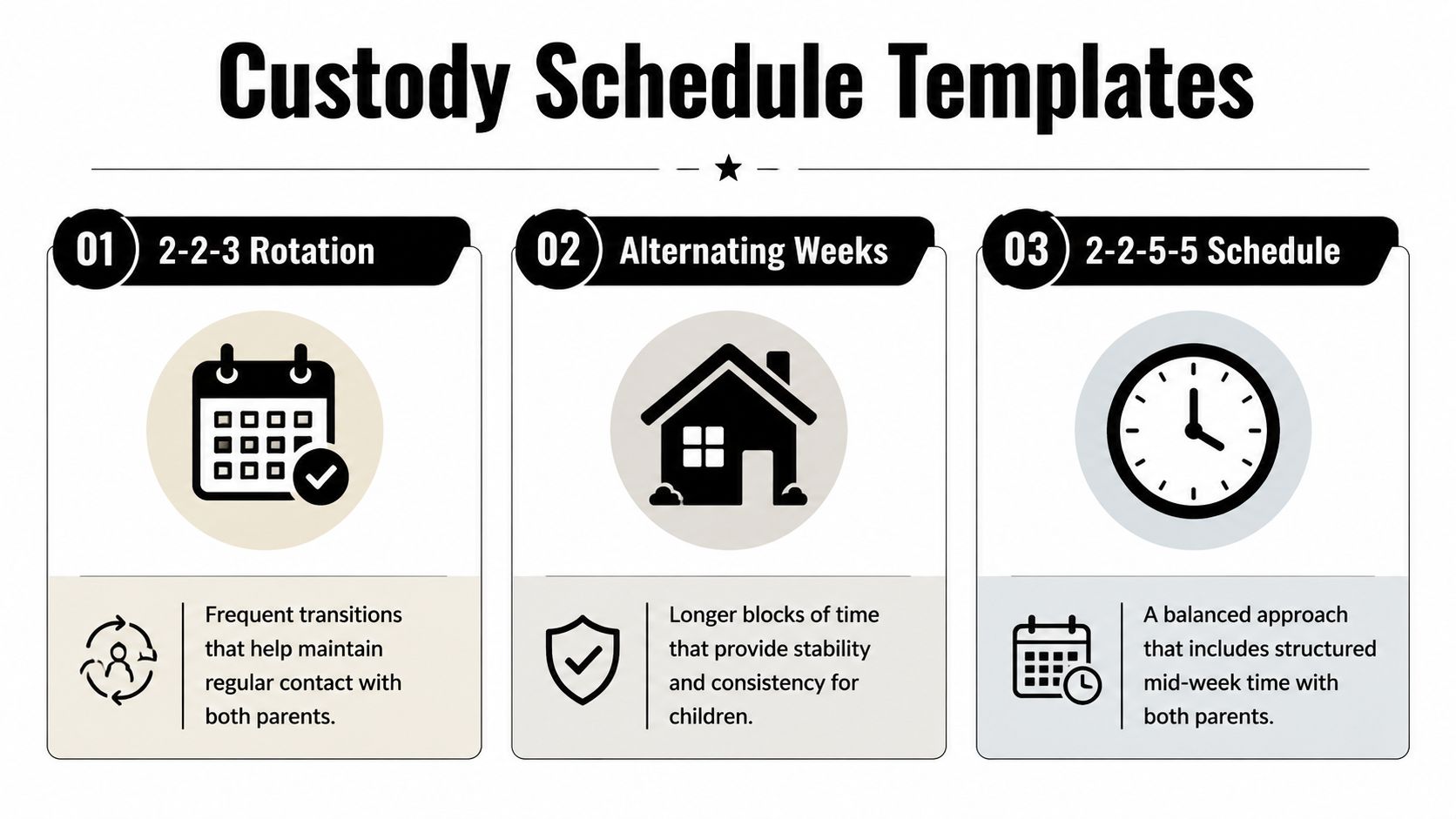
These schedules fit within the broader Texas custody process, which many parents first compare on the firm's child custody representation page.
The templates parents ask about most
No template solves every problem. Each one makes a trade-off between stability, handoffs, school logistics, and how long a child goes without seeing the other parent.
2-2-3 schedule
This schedule repeats across two weeks. One parent has two days, the other has two days, then the first parent has three days. The next week flips.
This often works for:
- parents who want frequent contact with younger children
- parents who live close enough for easy school pickups and drop-offs
- families with flexible exchange routines
Common problem:
- frequent transitions create wear and tear fast. Backpacks get left behind, medications get missed, and children can feel like they are always packing
Week-on week-off
This is the easiest schedule to read on a calendar. One parent has seven days, then the other parent has seven days.
This often works for:
- older children who do well with longer blocks of time
- parents with steady jobs and predictable after-school coverage
- lower-conflict co-parents who want fewer exchanges
Common problem:
- seven days can be a long stretch for a younger child, especially if one parent has usually handled homework, therapy, or school communication
3-4-4-3 schedule
This plan gives each parent both school nights and weekend time over a repeating two-week cycle. It usually feels more balanced than alternating weeks, but with fewer handoffs than a 2-2-3.
This often works for:
- school-aged children who benefit from a repeating routine
- parents who want regular contact without exchanging every few days
- families that can stay organized with a shared calendar
Common problem:
- it is easy to lose track of whose day it is unless both parents follow the same calendar and exchange rules
Why the 5-2-2-5 schedule gets so much attention
The 5-2-2-5 schedule gets a lot of attention for good reason. It gives each parent the same weekdays every week, with weekends alternating. That structure often fits school life better than a schedule that keeps shifting.
A practical example helps. If one Kingwood parent in oil and gas is reliably available Mondays and Tuesdays between projects, and the other parent has more flexibility on Wednesdays and Thursdays, a 5-2-2-5 plan can lock those weekday responsibilities in place. The child knows where homework gets done, where band practice pickup happens, and which parent handles Tuesday night reading logs.
As discussed in this discussion of 50/50 custody planning in Texas, courts look closely at school consistency, work obligations, and whether the plan serves the child's best interest. That is why this format often makes sense for working parents with recurring availability, even if their jobs are demanding.
Local practice point: The schedules that hold up best usually assign clear weekday jobs, not just equal overnight counts.
Comparison of Common Custody Schedules
| Schedule | How It Works | Best For… | Potential Challenge |
|---|---|---|---|
| 2-2-3 | Parents alternate 2 days, 2 days, then a 3-day block | Younger children and parents wanting frequent contact | Many exchanges |
| Alternating Weeks | Each parent has 7 consecutive days | Older children and families wanting fewer handoffs | Long stretches away from the other parent |
| 3-4-4-3 | Two-week repeating cycle with 3 and 4 day blocks | Families wanting a predictable pattern with moderate transitions | Harder to track without good organization |
| 5-2-2-5 | Same weekdays stay with the same parent, weekends alternate | Working parents needing school-week consistency | Requires careful planning for activities and transportation |
What usually works and what usually does not
In Kingwood, the schedule itself is only half the job. The details around it decide whether it works in real life.
What tends to help:
- School-based exchanges: pickup from school and return to school cut down on driveway conflict
- Duplicate daily items: clothes, chargers, toiletries, and school basics in both homes reduce last-minute scrambling
- One shared calendar: both parents use the same app or calendar, and both update it
What creates trouble:
- Open-ended exchange terms: phrases like “after work” invite arguments because work rarely ends at the same time every day
- A schedule built for appearances: equal-looking plans often fail if one parent still carries most of the driving, homework supervision, and school communication
- Too many informal swaps: children stop knowing where they will sleep, and parents start disputing what was agreed
The right template depends on the child's age, the distance between homes, school demands, and the parents' work reality. For Kingwood families in healthcare, plant work, trucking, public safety, and other shift-based jobs, the better plan is often the one with fewer improvisations, clearer exchange language, and a routine that survives a hard workweek.
Custom Schedules for Shift Work and Remote Jobs
Standard schedules often break down fast for families in Kingwood who work in healthcare, public safety, transportation, or oil and gas. A nurse working rotating shifts, a firefighter on a repeating duty cycle, and a parent who spends part of the month offshore don't live by the same calendar as an office worker.

That gap is real. Verified guidance notes that current custody content heavily emphasizes standard work hours and often fails to address Kingwood's shift workers, healthcare professionals, and oil and gas employees. The same verified source also states that Texas courts will approve “any possession schedule parents agree on”, making custom schedules possible when they are clearly written and workable, as discussed in this Texas custody schedule Q&A.
Shift-based schedules can be court approved
Parents sometimes think a judge will reject anything that doesn't look familiar. That's not usually the core issue. The problem is proposing a plan that's vague, hard to enforce, or built around changing work patterns with no backup language.
A strong custom plan for Northeast Houston families usually includes:
- A repeating cycle: If a parent works a repeating shift pattern, the possession schedule should match that cycle
- Exact exchange rules: Time, place, and backup location
- Holiday language: Shift workers can't rely on assumptions
- A make-up procedure: If overtime or a call-in disrupts possession, the order should say how missed time gets handled
Examples that fit local work patterns
A firefighter or EMT may need a repeating schedule tied to duty blocks. A hospital employee may need a two-week or monthly rotation that follows posted shifts. An oil and gas worker may need longer blocks of possession during off-duty periods rather than frequent short visits that are impossible to exercise.
Here's the practical point. The child's life still needs a stable center. Even custom schedules should preserve school continuity, bedtime routines, and clear transportation responsibility.
If your job changes every week, your order should still tell everyone where the child will be without requiring a new argument each Sunday night.
For parents trying to visualize the legal side of custom possession planning, this video gives useful background:
Remote and hybrid work need special wording
Remote work creates a different kind of confusion. A parent may say, “I'm home, so I should have more time.” But being physically at home and being available to parent are not always the same thing.
For remote or hybrid jobs, the schedule should address:
Possession versus availability
If one parent is working remotely during the other parent's court-ordered time, that does not automatically change possession.Childcare during work hours
If a parent is technically home but tied to meetings all day, the order may need language about supervision, after-school care, or a right of first refusal.Documentation
Shared calendars, parenting apps, and written confirmations matter. Parents who track exchanges, cancellations, and make-up time usually avoid a lot of later disputes.
One practical option is to use OurFamilyWizard, TalkingParents, or a shared Google Calendar for schedule records. Another option is to work with counsel to draft detailed language before the order is entered. The Law Office of Bryan Fagan can help parents turn those work-based routines into language a Texas court can review and enforce.
Negotiation Mediation and Presenting Your Plan to the Court
A lot of Kingwood parents reach this stage after months of making it work by text message. One parent covers a hospital shift. The other handles school pickup. Then Thanksgiving comes up, a turnaround schedule changes at the plant, or a new supervisor ends the flexibility that made the informal plan possible. What felt manageable starts breaking down fast.
A workable custody schedule needs two things. Agreement between the parents, and language a Texas court can sign and enforce.

Parents usually have more control when they reach a detailed agreement instead of leaving the schedule to a judge. That matters even more for Kingwood families with shift-based work. A standard proposal may not fit a nurse working three 12s, an oil and gas employee rotating on-call weekends, or a parent whose remote job changes week to week. Courts can approve custom terms, but only if the plan is specific, realistic, and tied to the child's routine.
If you may need a hearing, it helps to review how to prepare for a Texas custody hearing before you walk into court.
What productive negotiation looks like
Effective negotiation begins with the aspects of life that are not easily adjusted. School start times. Commute realities. Sleep schedules for younger kids. Medical appointments. Work obligations that are fixed.
Then test the schedule against real life. I often tell parents to put one full month on paper before they call it done. Include early release days, one extracurricular activity, a missed shift, and a holiday handoff. If the plan falls apart on paper, it will fall apart faster once school and work pressure hit.
A useful draft usually answers questions like these:
- Who picks up when daycare closes early?
- What happens if a parent is called in for an overnight shift?
- Which exchange location makes sense with traffic between Kingwood, Humble, and downtown commutes?
- How much notice is required before swapping time?
- Who is responsible for school communication on each parent's days?
Broad demands do not help much here. “Equal time” and “standard possession” are starting points, not finished plans.
Why mediation works for many working parents
Mediation gives parents a structured setting to solve details that keep causing friction. For many families, it is the first time both sides are forced to talk about the actual mechanics of parenting instead of arguing from position.
That can be especially useful in cases involving rotating shifts or irregular work calendars. A parent in healthcare may know next month's schedule but not the next quarter. A parent in oil and gas may have periods of heavy travel followed by long stretches at home. Mediation gives room to build around that reality with terms for notice, makeup time, backup childcare, and holiday adjustments.
A judge can impose a schedule. Parents often know the child's routine well enough to write a better one.
How to present the plan to the court
Once an agreement is reached, the next job is drafting it clearly. Courts do not enforce assumptions. They enforce written terms.
The order should spell out:
- Exact possession periods
- Holiday and summer schedules
- Exchange times and locations
- Transportation duties
- Communication rules between parents
- Special terms for shift work, overtime, travel, or remote work
- What happens if work changes require a temporary swap
That last point matters more than many parents expect. A solid order does not need to predict every future problem, but it should address the problems your family is likely to face. For working parents in Kingwood, that often means writing in notice requirements, calendar sharing, and clear rules for temporary changes.
After the paperwork is signed and approved by the court, the schedule becomes an enforceable order. That gives both parents something better than a loose understanding. It gives them a plan they can rely on.
Adapting Your Schedule When Life and Work Changes
Even the strongest parenting plan will eventually run into real life. A new promotion changes travel demands. A child starts a different school. One parent moves from Kingwood to another nearby area for work. A remote job becomes hybrid, or a hybrid job becomes fully in-office.
Texas custody orders can be modified when circumstances change enough to justify revisiting the arrangement. In practice, that means a parent should not just stop following the current order because the schedule no longer feels convenient. The safer move is to review whether the change is significant enough to support a legal update.
Remote work has created new gray areas
Verified guidance on this issue notes that work-from-home flexibility creates new ambiguity for parents. Questions come up quickly. If a parent now works remotely, should that affect possession? If someone is home but working during the other parent's time, does that create a violation? The same verified source notes that Texas SPO guidance focuses on distance but does not fully answer newer telecommuting disputes, as discussed in this article on sample custody schedules and remote-work questions.
That issue is becoming more common around Northeast Houston. Parents who once assumed office schedules are now renegotiating pickup times, after-school care, and whether increased at-home availability should matter.
Signs it may be time to modify
A modification may be worth discussing when:
- Work changed substantially: A parent now travels much more or much less
- School needs changed: The child's academic or activity schedule no longer fits the order
- The exchange system keeps failing: Late handoffs and repeated missed periods become the norm
- A move affects the child's routine: Commute time, school stability, or distance now creates problems
If you're dealing with one of those situations, reviewing the process for a Kingwood custody modification can help you see what next steps may fit.
Don't self-help your way into a bigger problem
Parents sometimes think they can “just try” a new routine and formalize it later. That can work when both sides cooperate fully. It can also collapse overnight if one parent changes their mind.
Get advice before you stop complying with the current order. For many Kingwood, Humble, and Porter families, the most affordable path is still a negotiated update filed with the court. The important part is making the change official before conflict turns a manageable issue into a contempt allegation.
Your Next Steps and Common Questions
Most parents don't need a more complicated custody plan. They need a more honest one. If your work hours are demanding, your commute is long, or your child's school week already feels rushed, the right answer is usually the schedule that reduces chaos, not the one that sounds best in conversation.
That is particularly accurate for a custody schedule for working parents Kingwood Texas families can realistically maintain. The strongest plans are grounded in the child's routine, written with exact language, and flexible enough to account for the actual work patterns common across Kingwood, Humble, Porter, and Northeast Houston.
A simple way to move forward
If you're trying to make progress, take these steps in order:
List your actual availability
Include commute time, shift rotation, and recurring work obligations.Map your child's fixed routine
School, tutoring, therapy, sports, and medical needs should be visible on one calendar.Choose a draft schedule that fits real life
Don't start with labels like “standard” or “equal.” Start with what your child can live with consistently.Stress-test the plan
Run it through a school week, a holiday, and a work emergency.Put it into legal language
A handshake agreement is not enough if conflict starts later.
Common questions parents still ask
How are holidays and summer usually handled
Most parents create separate holiday and summer provisions that override the regular weekly schedule. Those details should be written clearly, especially if one parent works rotating shifts or has seasonal work obligations.
Should we include a right of first refusal
Sometimes yes. Sometimes no. This provision can help when one parent is unavailable and the other wants the chance to care for the child before a sitter or family member steps in. It can also create constant arguments if it's written too broadly. The wording matters.
How do parents handle extracurriculars and childcare costs
That depends on the order and the parents' agreement. The cleaner approach is to decide in advance who enrolls the child, who transports the child on each possession day, and how shared expenses will be addressed. Ambiguity is where resentment grows.
What if one parent keeps changing the schedule informally
Informal flexibility is fine until it becomes one-sided. If repeated changes are creating conflict, missed time, or confusion for the child, it may be time to formalize the routine. Good records help.
What if I'm carrying too much at home and at work
That strain shows up in custody disputes more often than people admit. If you're balancing parenting, work, and household management, these essential tips for high-achieving working mothers may offer useful support outside the legal side of the issue.
The important thing is this: you don't have to solve every custody question in one night at the kitchen table. You do need a plan that works in everyday life and can hold up when life gets messy.
If you're sorting out a parenting plan in Kingwood, Humble, Porter, or Northeast Houston, Law Office of Bryan Fagan – Kingwood TX Lawyers can help you evaluate schedule options, draft workable court language, and prepare for negotiation, mediation, or court. Schedule a free consultation at the Kingwood office to talk through your family's work schedule, your child's routine, and the custody arrangement that makes practical sense.