Yes, text messages can be used in Texas family court, including in Kingwood cases, but they usually have to satisfy the Texas Rules of Evidence. Those rules were formally adopted in 1998, and in modern family cases a judge won't rely on a text unless the person offering it can show it is authentic, relevant, and properly presented.
If you're sitting at your kitchen table in Kingwood, Humble, or Porter scrolling through months of messages from your co-parent or spouse, you're probably asking two different questions at once. The first is legal: “Can I use these?” The second is practical: “Will these matter?”
That second question is where many people get stuck. They save a few upsetting screenshots and assume that alone will carry the day. Sometimes those messages help. Sometimes they barely move the needle. In many Northeast Houston family cases, the core issue isn't whether a text exists. It's whether the text tells a believable, useful story about parenting, safety, honesty, or compliance with court orders.
Your Texts and Your Case A Kingwood Resident's Guide
A Kingwood parent sits down for a consultation, opens a phone, and scrolls through months of messages. There are late-night arguments, excuses for missed pickups, a few apologies, and one or two texts that feel explosive. The hard question is not only whether those messages can be shown to a judge. It is whether they help tell a clear, believable story about what has been happening at home and with the children.
That difference matters.
In family court, a single ugly text often gets more attention from the person reading it than from the judge deciding the case. Judges in custody and divorce cases usually look for patterns. Do the messages show repeated last-minute cancellations? Ongoing refusal to share school information? A steady habit of threats, insults, or manipulation? Or do they show one bad evening in the middle of otherwise normal communication?
A text thread works a lot like a timeline on a wall. One pin may catch your eye. A line of pins across several weeks often says much more.
A spouse in Humble may have messages pointing to hidden spending or inconsistent explanations about money. A parent in Northeast Houston may have calm, child-focused responses that show steady cooperation while the other side keeps escalating. Those are different facts, but the same principle applies. The message that persuades is usually the one that fits into a larger pattern the court can trust.
Where confusion usually starts
People often assume a screenshot by itself will carry the point. It may not. Others place all their hope on one dramatic exchange. In many cases, the more persuasive proof is less dramatic and more consistent.
For example, ten ordinary texts showing repeated failure to follow the pickup schedule can carry more weight than one angry outburst. The first set helps a judge see behavior. The second may only show emotion.
That is why context matters so much. Dates matter. The full conversation matters. What happened before and after the message matters too.
What to do first
Start preserving complete conversations, not just the worst sentence. Keep the date, time, phone number or contact information, and enough surrounding messages so the exchange makes sense. If the texts relate to missed visits, late returns, or repeated violations of a parenting plan, this guide on how to document custody violations in Texas in Kingwood can help you organize the bigger picture.
That practical habit helps in two ways. It protects you from the other side claiming the message was taken out of context. It also helps your lawyer sort useful evidence from material that is upsetting but legally less important.
Your phone may contain helpful evidence. What usually persuades a Kingwood-area judge, though, is not digital drama. It is a reliable record showing patterns tied to parenting, safety, honesty, finances, or compliance with court orders.
The Three Legal Hurdles for Text Message Evidence
A text message must pass through three checkpoints before it holds significant value in court. The process resembles entering a secure building in Montgomery County or Harris County. The first hurdle determines whether the message is relevant to the case. The second confirms its authenticity. The third evaluates whether evidentiary rules permit the court to consider it for your specific purpose.
That framework helps simplify a subject that often feels intimidating.
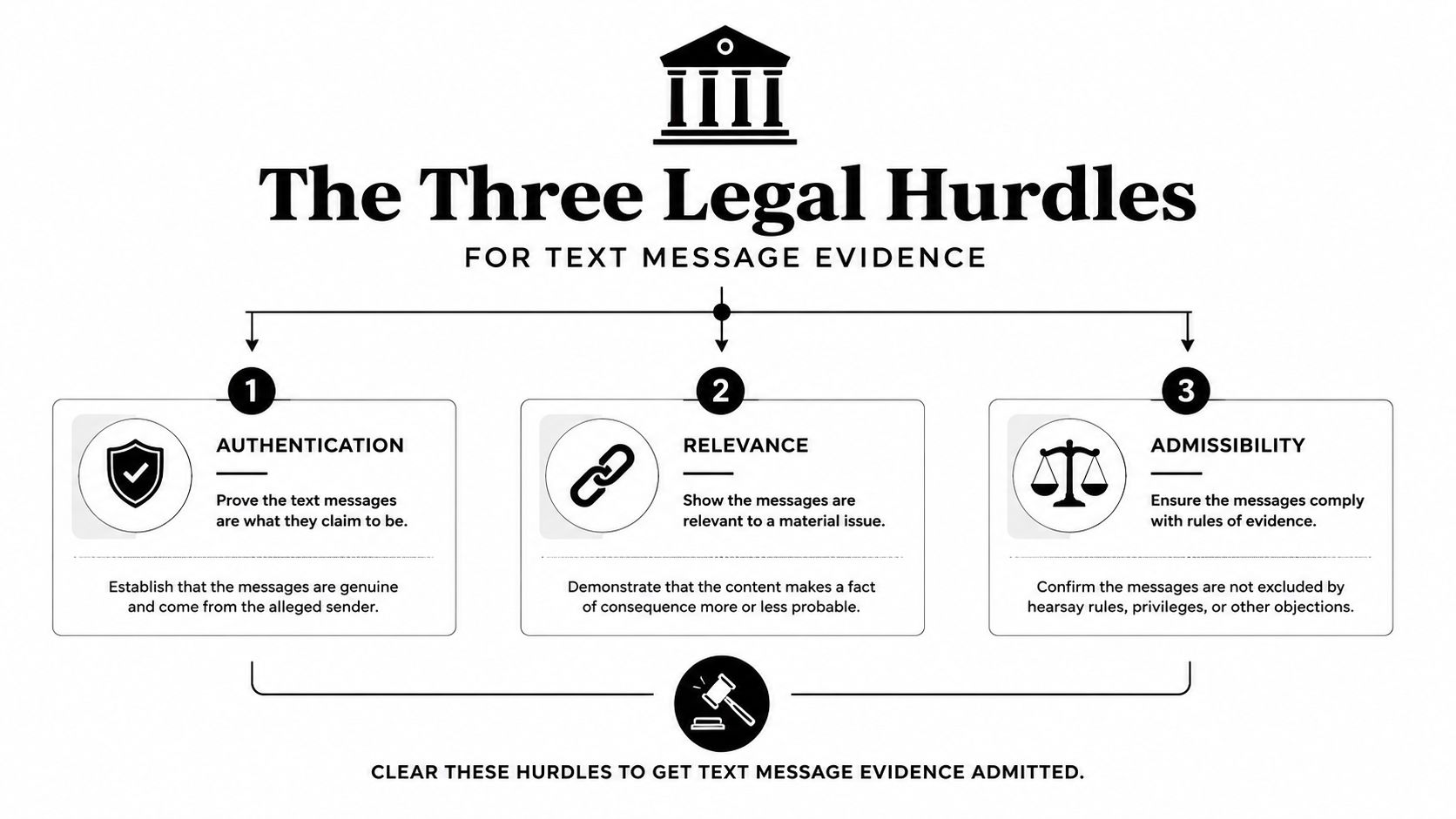
Texas courts don't treat texts like casual conversation. Under Texas law, digital messages are evaluated under the Texas Rules of Evidence, especially relevance and authentication, and those rules were formally adopted in 1998. In custody disputes, judges make conservatorship and visitation decisions based on the child's best interests under Texas Family Code Chapter 153, so texts may matter when they show cooperation, harassment, threats, or refusal to follow orders, as explained in this discussion of Texas evidence rules and digital messages in family cases.
Hurdle one is relevance
A judge first asks a simple question. Does this text help decide something in the case?
If you're arguing that the other parent repeatedly refused exchanges, a message saying, “I'm not bringing him tonight,” may be relevant. If you're in a divorce and disputing who paid a household bill, a text discussing that payment may be relevant. If the message is just an insult with no connection to parenting, property, support, or safety, it may not carry much weight.
Relevance is why random bad behavior doesn't always become useful courtroom evidence. Family judges in Kingwood-area cases want to know how the message connects to a disputed issue.
Hurdle two is authentication
Many self-represented parties run into trouble at this stage. Authentication means proving the message is what you say it is.
A screenshot alone may not answer key questions:
- Who sent it: Was it really your spouse or co-parent?
- When was it sent: Is the date visible and complete?
- Was anything omitted: Are there missing messages before or after it?
- Was it changed: Could someone have edited the image?
A text with the sender's number, full thread, contact continuity, and supporting testimony is usually stronger than a cropped image with a single angry sentence.
Hurdle three is hearsay
Hearsay sounds technical, but the basic issue is straightforward. Courts are cautious about out-of-court statements offered to prove what they say is true.
That doesn't mean texts are useless. It means the reason you're offering the message matters. Sometimes a text comes in because it shows notice, intent, state of mind, or the other party's own statement. Sometimes it doesn't.
A good text exhibit doesn't just prove someone typed words. It connects those words to a real issue the judge must decide.
If you're facing divorce, custody, child support, or enforcement issues in Kingwood or Humble, it helps to review these questions with counsel before a hearing. Families often start with the broader Kingwood family law legal services page so they can identify which kind of dispute they have and what evidence rules are likely to matter most.
Proving Your Texts Are Authentic in a Texas Courtroom
Authentication is usually the part that worries people most, and for good reason. In plain English, the court wants proof tying the message to a particular sender, device, or account. If that connection is weak, the other side may argue the message was edited, taken out of context, or sent by someone else using the phone.
Texas family-law practitioners have noted that judges are often more persuaded by complete device extractions or metadata-backed exports than isolated screenshots because screenshots can be edited or leave out surrounding context. Better authentication lowers the chance of alteration arguments and increases the evidentiary weight of the message, as discussed in this Texas overview of Rule 901 and text-message authentication.

Why screenshots often aren't enough
Screenshots are easy to take and easy to misunderstand. A cropped image may hide the contact information. It may leave out a prior exchange that changes the meaning. It may not show the date clearly. And because editing tools are common, the other side may attack the screenshot even if it's genuine.
That doesn't mean screenshots are worthless. It means they're usually stronger when backed up by other proof.
For example, if a Humble parent has a screenshot showing “I'm keeping the kids this weekend,” that message becomes more convincing if the parent can also show the full thread, the same number used over time, and testimony that the parties regularly communicated through that number.
What makes a text look more reliable
Courts often find text evidence more persuasive when it includes context and continuity. Helpful details may include:
- Visible phone numbers or account identifiers: These help tie the message to a person.
- Complete conversation threads: A longer thread can show the meaning of the exchange.
- Consistent communication history: Repeated messages from the same number strengthen the link.
- Dates and times: Timing matters in custody exchanges, support disputes, and enforcement claims.
- Device or export records: These can preserve more information than a simple screenshot.
If a message matters, save the whole conversation before anything gets deleted or replaced.
Some people also look for practical background reading on digital records and signatures when they're trying to understand how electronic information is treated under Texas law. A useful general reference is this Closer Innovation Labs Corp. legality overview, which helps explain how Texas approaches electronic records more broadly.
What to do before your hearing
If you think a text may become evidence in a Kingwood family case, take careful steps early.
- Stop deleting messages. Even if the thread is upsetting, don't clean it up.
- Save the full thread. Include dates, names, and surrounding messages.
- Take backups seriously. Cloud backups, phone backups, and exports may preserve context better.
- Avoid forwarding pieces around. Every extra step can create confusion about the original record.
- Tell your lawyer where the text lives. Original phones, tablets, and synced accounts can matter.
Presentation also matters. You usually won't walk into court and hand a judge your phone. Instead, the messages are typically prepared as exhibits with identifying information, relevant pages, and supporting testimony.
That's one reason people often work with counsel before trial. In practice, attorneys may help sort messages, identify the strongest threads, and format them for use at a hearing. One local option for that kind of case preparation is Law Office of Bryan Fagan – Kingwood TX Lawyers, which handles family law matters involving divorce, custody, and related evidence issues in the Kingwood area.
Navigating the Hearsay Rule and Its Exceptions
A Kingwood parent often walks into my office with a screenshot and one worried question: “Can the judge even look at this?” The answer depends less on the fact that it is a text message and more on what the message is being used to prove.
Hearsay is an out-of-court statement offered to prove the truth of the statement. That definition sounds technical, but the courtroom question is usually straightforward. Why do you want the judge to read this text?
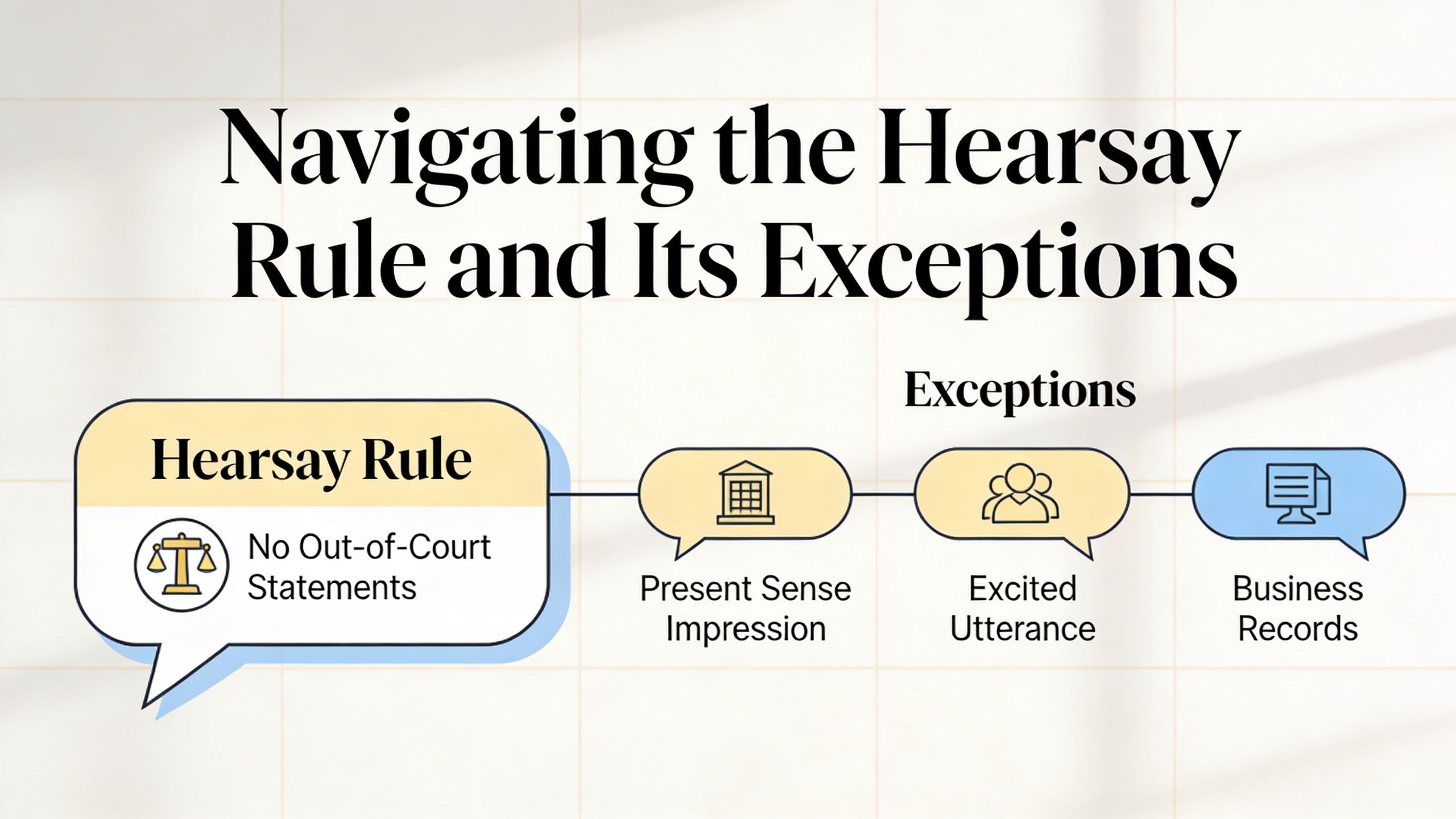
A text can be used for different purposes, and that purpose changes the hearsay analysis. If a parent texts, “I'm keeping the kids overnight and you can't stop me,” you may offer that message to show the statement was made, the parent's attitude, or a refusal to follow the schedule. That is different from offering a message to prove some outside fact is true.
The easiest category is often the other party's own words. In Texas family court, a parent's own statement can often be used against that parent. Lawyers call this an admission by a party-opponent. You do not need to memorize the label. The practical point is what matters.
Here are common examples:
- Possession dispute: “I'm not bringing him back until Monday.”
- Substance use concern: “I've been drinking. Please get the kids.”
- Income issue: “I'm getting paid off the books.”
- Credibility issue: “Don't mention that I moved out.”
Those messages tend to carry weight because they come from the person whose conduct is at issue. A judge usually sees them very differently from a relative repeating gossip by text.
That distinction trips people up all the time.
If your sister texts, “He is always drunk around the kids,” the court may treat that as hearsay if you offer it to prove he was in fact drunk around the kids. Your sister may need to testify herself, or your lawyer may need another exception or another way to prove the same point. The text alone may not do the job.
Purpose matters just as much as authorship. A message may be admitted to show notice, state of mind, effect on the recipient, or the fact that a threat or refusal occurred. A parent who sends ten messages canceling exchanges may create persuasive evidence of a pattern, even if each text raises a slightly different evidentiary issue. That is one reason what judges look for in Texas custody cases often comes back to repeated conduct, not one dramatic screenshot.
A simple way to sort this out is to picture three buckets:
- The other parent's own statements. These are often the cleanest texts to offer.
- Statements from third parties. These draw more objections and need closer analysis.
- Texts offered for a limited purpose. The message may be used to show notice, intent, hostility, or refusal, rather than to prove every fact inside the message is true.
That last bucket is where family cases often get won or lost. A text saying, “School starts in ten minutes and you still haven't brought her back,” may matter even if the judge is not using it to prove every detail in the sentence. It may show the sender gave notice, the exchange problem happened in real time, or the other parent was aware of the schedule.
So if you are sorting through messages on your phone, do not ask only, “Is this hearsay?” Ask two better questions. Who wrote it? What pattern does it help prove?
Those questions usually lead to better evidence choices.
What Really Persuades a Kingwood Judge
The conversation now shifts from legal theory to courtroom reality. People usually save the most dramatic message on their phone. Judges usually care more about the most revealing pattern.
In custody fights, the key question is often not whether one parent sent one ugly text. It's whether the messages, taken together, show a steady course of conduct that affects the child's best interests. Texas family-law guidance has emphasized that judges usually care less about one angry message and more about patterns such as repeat cancellations, refusal to co-parent, threats, or messages that contradict claims of stability, as noted in this discussion of what kinds of texts matter most in custody disputes.
Patterns beat isolated outbursts
A single mean message may show poor judgment. A months-long thread showing chronic refusal to share school information, repeated missed exchanges, and hostile communication tells a much stronger story.
That's because judges in Kingwood-area custody cases are trying to answer practical questions:
- Which parent communicates reasonably?
- Which parent follows orders?
- Which parent puts the child first?
- Which parent creates chaos around exchanges, school, or medical care?
A text exhibit is strongest when it helps answer those questions.
Text Message Evidence Impact in Court
| High-Impact Evidence (Shows a Pattern) | Low-Impact Evidence (Often Ignored) |
|---|---|
| Repeated texts canceling possession periods at the last minute | One rude comment during an argument |
| Ongoing refusal to share school, medical, or schedule details | One vague complaint with no child-related issue |
| A series of threats or harassing messages over time | A cropped screenshot with no context |
| Messages that repeatedly contradict sworn claims of stability or cooperation | Random personal insults unrelated to custody or support |
| Multiple texts showing refusal to follow a court order | An emotional exchange where both sides escalated |
How to think like the judge
If you want to know whether your messages will matter, ask whether they show a parenting pattern, not just a bad mood.
A useful way to sort them is by category:
- Schedule interference: Missed pickups, late returns, refusal to allow possession.
- Co-parenting failures: Refusal to answer child-related questions, withholding information, unnecessary conflict.
- Threats or intimidation: Statements that create fear or pressure the other parent.
- Contradictions: Messages that conflict with what someone later tells the court.
- Instability indicators: Texts that undermine claims about housing, sobriety, or availability.
If you're trying to evaluate whether your evidence fits the kind of factors family courts usually weigh, this article on what judges look for in custody cases in Texas in Kingwood gives a helpful overview of how those decisions are made.
The most persuasive message is often not the angriest one. It's the one that fits a longer, consistent pattern the judge can trust.
Best Practices for Collecting and Presenting Texts
Good evidence can lose value if it's handled poorly. The most common mistakes happen before court ever starts. Someone deletes part of a thread, takes scattered screenshots, renames contacts in a confusing way, or shows up expecting the judge to scroll through a phone during a hearing.
A better approach is methodical and calm.

Preserve first and sort later
Don't start by editing. Start by preserving.
If a message thread may matter in a Kingwood divorce or custody case, keep the original conversation intact. Save backups. Avoid deleting embarrassing messages, even if you think they hurt you. Missing pieces often create more problems than the original text itself.
Some practical habits help:
- Keep the original device: If possible, don't trade it in or reset it while the case is pending.
- Save full threads: Don't just capture the “best” line.
- Maintain dates and contact details: Those details help establish context.
- Avoid selective forwarding: Forwarded texts can lose useful identifying information.
Organize by issue, not emotion
Once the messages are preserved, organize them into themes that match the case.
A parent in Northeast Houston might create folders or labels such as:
- Missed possession exchanges
- School and medical communication
- Threats or harassment
- Support or financial admissions
- Messages showing cooperation
This makes your evidence easier to review and easier to present. It also helps your lawyer spot patterns faster.
Bring order to the evidence before you bring it to court.
Prepare for exhibit use
Courtroom presentation is different from personal recordkeeping. Judges usually want clear exhibits, not a pile of screenshots with no explanation.
That often means:
- Chronological arrangement: Put messages in time order.
- Short summaries: Note what issue each group of texts relates to.
- Supporting documents: Match texts to calendars, orders, exchange logs, or school records where appropriate.
- Review for completeness: Make sure the conversation is not misleading through omission.
If you're preparing for a hearing in Kingwood, Humble, or Porter, this guide on how to prepare for a custody hearing can help you think through documents, exhibits, and courtroom expectations.
One more practical point matters. Treat every future text like a judge might someday read it. Even while you're collecting evidence, keep your own messages brief, child-focused, and respectful. The strongest exhibit file in the world won't help much if your own recent texts undercut your credibility.
Your Next Steps for Your Family Law Case in Kingwood
A parent in Kingwood can walk into court with 200 screenshots and still leave frustrated. Another parent may bring 20 well-chosen messages, tied to dates, school records, or exchange problems, and make the stronger point. That is how text evidence often works in family court. Volume matters less than clarity.
Your next step is not to save everything and hope for the best. It is to decide what story your messages tell about parenting, credibility, safety, or compliance with court orders. Judges usually learn more from a steady pattern than from one explosive exchange. A week of missed pickup texts, repeated refusals to share school information, or a long stretch of calm child-focused communication can say far more than a single angry message sent at midnight.
That is also why getting advice before a hearing can help. A lawyer can look at your texts the way a judge is likely to see them, identify which conversations support your position, and flag messages that may hurt more than help. For many parents, that outside view is the difference between bringing in a phone full of conflict and presenting a focused record of what has been happening.
You do not need to solve this alone.
If you are dealing with a custody, divorce, or enforcement matter in Kingwood, Humble, Porter, or Northeast Houston, the Law Office of Bryan Fagan – Kingwood TX Lawyers offers free consultations at the Kingwood office. You can talk with a local attorney about your text messages, your court concerns, and the next practical steps for protecting your family and presenting your case clearly.