Skip to content
When you're fighting for your child's well-being in Kingwood, proving parental alienation can feel like an overwhelming and lonely battle. It’s not enough to just feel like the other parent is turning your child against you; you have to show a Texas family court a clear, undeniable pattern of manipulative behavior.
This means you need to become a meticulous record-keeper, gathering every email, text, and third-party observation you can. The goal is to build a compelling case that proves this behavior is actively harming your child's well-being. For families in Kingwood and the surrounding Humble area, understanding how to present this evidence is the first step toward protecting your child.
What Is Parental Alienation in Texas
It's a deeply painful and confusing experience for any parent. One minute, your relationship with your child is strong; the next, you're met with resistance, anger, or even fear. You start to question yourself. Is it something you did? Is this just a phase?
But parental alienation is far more than a simple rough patch. Under Texas law, it’s recognized as a deliberate and sustained campaign of psychological manipulation by one parent to poison the child's relationship with the other.
This isn't about the occasional disagreement over screen time or a child being upset after a disciplinary talk. We're talking about a calculated effort to erase you from your child's life, creating unwarranted hostility and fear where a loving bond once existed. At The Law Office of Bryan Fagan, we understand how devastating this can be for local families in Northeast Houston.
Identifying the Signs in Kingwood and Humble
Judges in Harris and Montgomery County family courts are experienced. They've seen it all, and they won't be moved by vague accusations. They need to see a clear and consistent pattern of behavior that goes well beyond the normal friction of co-parenting.
Think of yourself as building a case, brick by brick. Each documented incident, no matter how small it seems at the time, adds another layer of proof.
Some of the most common red flags include:
- Constant Badmouthing: The other parent relentlessly criticizes you, your new partner, your family, or even your home in front of the child.
- Restricting Contact: They consistently sabotage your scheduled parenting time, block your calls, or conveniently "forget" to give your child messages.
- Sharing Adult Information: They burden the child with inappropriate details about the custody case, always painting you as the one to blame.
- Forcing the Child to Choose: The child is put in the impossible position of having to pick a side, leading to intense loyalty conflicts.
The Impact on Your Child
Let's be clear: this behavior is incredibly destructive to a child's mental health. It can lead to severe anxiety, depression, and lasting psychological trauma. The emotional tightrope they're forced to walk is something no child should ever have to endure.
And this problem is more widespread than you might think. A staggering 2017 poll estimated that over 22 million adults in the U.S. have been targeted by parental alienation. That’s a massive number of children caught in the middle.
Often, this dynamic involves a high-conflict personality. Getting a handle on the tactics used when co-parenting with a narcissist can shed light on the manipulative patterns you're seeing.
Ultimately, your case isn't about proving you're the "better" parent. It's about demonstrating to the court that the other parent's specific actions are causing real harm to your child. That is the heart of any parental alienation claim in Texas—protecting the child's best interests above all else.
This table breaks down the specific behaviors that Kingwood family courts often recognize as key indicators of parental alienation. Use it to help you identify and categorize what you're experiencing.
Key Indicators of Parental Alienation for Texas Courts
| Behavior Category | Specific Examples | Why It Matters in Court |
|---|---|---|
| Undermining Authority | Telling the child to ignore your rules; calling you "stupid" or "clueless" in front of the child; reversing your disciplinary decisions. | This shows a direct attempt to destroy your parental authority and portray you as an incompetent parent, which is not in the child's best interest. |
| Interfering with Communication | Not answering the phone during your designated call times; confiscating the child's phone; "forgetting" to pass on messages or gifts. | This demonstrates a deliberate effort to sever the child's connection to you, violating standard possession orders that mandate open communication. |
| Creating Loyalty Conflicts | Asking the child to "spy" on you; making the child feel guilty for having a good time with you; forcing them to choose between parents for holidays. | Courts see this as placing an unfair emotional burden on the child, forcing them into a role of mediator or informant, which is psychologically damaging. |
| Erasing Your Presence | Removing your photos from the child's room; referring to your new spouse as "mom" or "dad"; planning conflicting activities during your time. | This is evidence of an attempt to psychologically erase you from the child's life, which directly contradicts the Texas policy of frequent contact with both parents. |
By documenting these types of incidents with dates, times, and direct quotes, you move from making general complaints to presenting a structured, evidence-based argument that a judge can act on.
Building Your Case: The Detailed Evidence Log
When you're fighting a parental alienation case in a Texas court, your word alone isn't enough. A judge needs to see a clear, factual, and undeniable pattern of manipulative behavior. Your single most powerful weapon in a Kingwood custody battle is a meticulously kept evidence log—a journal that methodically transforms your painful experiences into concrete proof.
This log is far more than a diary. Think of it as a strategic tool. It creates a detailed timeline of conduct that shows a judge in Harris or Montgomery County precisely how the other parent is chipping away at your relationship with your child. The key is to be relentlessly objective and specific, documenting facts, not just feelings.
This process often follows a predictable, destructive path. The other parent manipulates situations, undermines your authority, and you must be there to document every single step.
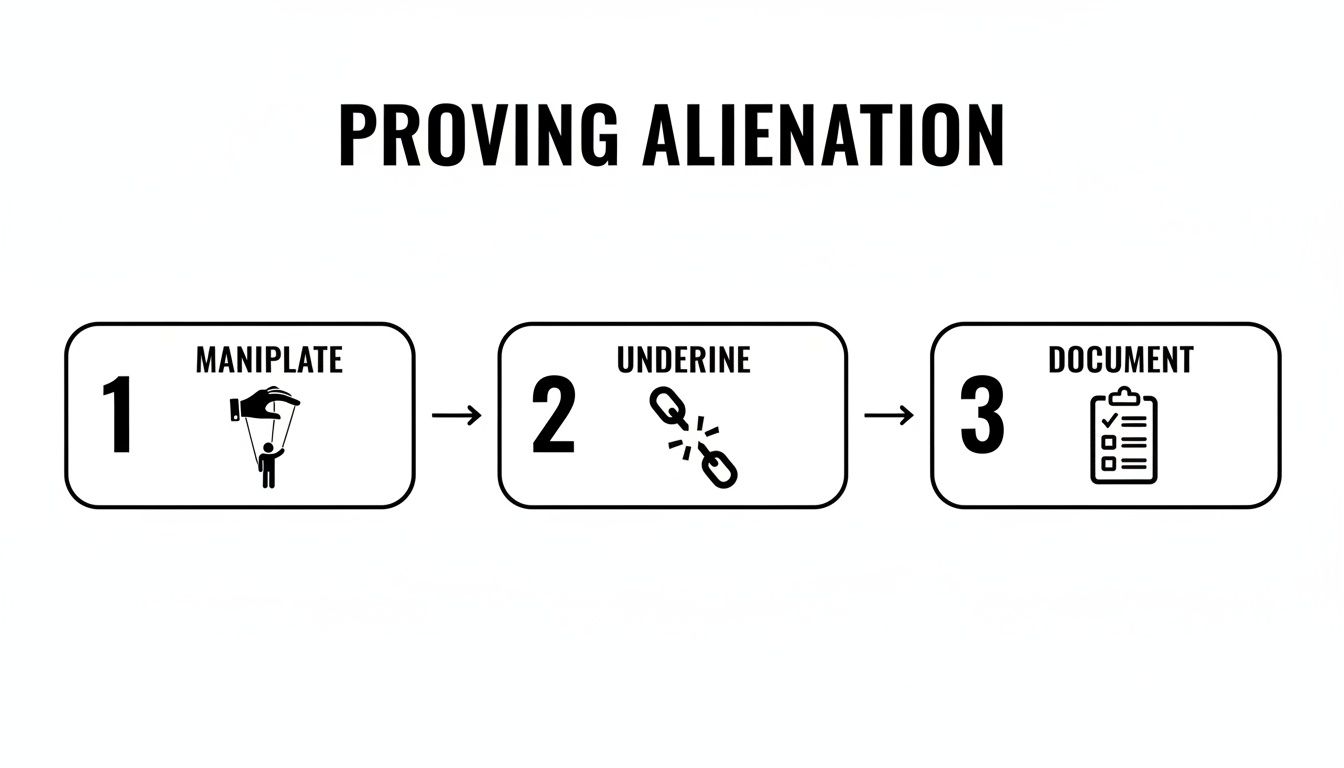
As you can see, your documentation is the crucial countermeasure. It’s how you break the cycle and bring the truth to light in court.
What Goes Into the Log?
Consistency is everything. Every entry, no matter how small it seems at the time, adds another piece to the puzzle. Your log needs to be straightforward and easy for a judge to scan, allowing them to quickly understand the frequency and nature of the alienating behavior.
Our Kingwood attorneys usually recommend clients use a simple spreadsheet or even a dedicated notebook with these columns:
- Date and Time: Be exact. Pinpoint the specific date and time of the incident.
- Description of Incident: Write a factual, objective summary. Instead of saying, "She was being difficult again," write, "Scheduled 7 PM call went unanswered. Called twice. Received text at 7:25 PM from other parent stating, 'He's busy, try tomorrow.'"
- Witnesses: Who else saw or heard this? A family member? A teacher from your child's Humble ISD school? Even a neighbor in your Kingwood community can be a witness.
- Child's Reaction/Quotes: This is critical. Document exactly what your child said or did. Did they repeat a negative phrase that could only have come from the other parent? For example, "Johnny said, 'Mommy says you don't really want to see me, you just don't want to pay her money.'" These quotes can be incredibly powerful.
- Relevant Evidence: Make a note of any corresponding text, email, or photo you have. This cross-references your log with your other physical evidence.
Your evidence log is the backbone of your entire case. It provides the context for every text message, every witness statement, and every professional evaluation, weaving individual events into a compelling narrative of alienation.
Turning Subjective Pain into Objective Facts
The real power of a log is its ability to strip away emotion and present the court with cold, hard facts. It’s the difference between telling a judge, "He always sabotages my time," and showing the judge a log with ten documented instances over two months where your visits were canceled at the last minute for flimsy reasons.
Here are a couple of practical, step-by-step examples of how this looks in practice:
Example 1: A Canceled Visit
- Date: October 26, 2024, 6:00 PM
- Incident: Other parent texted at 5:45 PM to cancel my weekend possession, which was supposed to start at 6:00 PM. The reason given was, "Child has a slight cough." This is the third weekend in a row canceled for a minor ailment.
- Witnesses: None (text message saved).
- Evidence: Screenshot of text message.
Example 2: Alienating Language
- Date: November 2, 2024, 7:15 PM
- Incident: During our nightly phone call, my daughter said, "Daddy told me you left us because you didn't love us anymore."
- Witnesses: My mother, who was in the room and heard the call on speakerphone.
- Evidence: Entry in call log.
Keeping this log can feel like reliving the pain over and over, but it is absolutely essential. This detailed record is what empowers us at The Law Office of Bryan Fagan to build a formidable, persuasive case on your behalf. If you're struggling with how to document what's happening or need help organizing your notes into a court-ready format, we're here to help. Schedule a free consultation at our Kingwood office, and let's start building your case today.
Gathering Evidence Beyond Your Own Words

While your personal journal is the cornerstone of your case, a judge in a Kingwood courtroom needs to see more than just your side of the story. To truly prove parental alienation, you have to build a wall of corroborating evidence—proof that comes from outside sources.
This external evidence demonstrates that the alienating behaviors aren't just your interpretation of events; they are real, observable actions that others have witnessed. Your words paint the picture, but third-party proof provides the frame, giving it the structure and credibility it needs to stand up in court.
Documenting Digital Communications
A huge amount of evidence today is digital. Text messages, emails, and even social media posts can be a goldmine for showing a pattern of manipulation and interference. The trick is capturing this evidence correctly so it's actually admissible in a Texas court.
Having the messages on your phone isn't enough. You need to preserve them properly.
- Take Crystal-Clear Screenshots: Make sure every screenshot clearly shows the date, the time, and who sent the message. Don't crop anything out.
- Save Entire Email Threads: Download the full email chain as a PDF. This preserves the complete context of the conversation, preventing the other party from claiming a message was taken out of context.
- Archive Social Media Posts: If the other parent is posting disparaging comments about you or photos that clearly undermine your relationship with your child, save them. Screenshots work, but archiving tools can be even better.
These digital breadcrumbs often provide irrefutable proof of intent. A text from the other parent saying, "Don't bother calling tonight, she doesn't want to talk to you," is infinitely more powerful than you simply telling the judge it happened.
Leveraging Neutral Witnesses
Some of the most compelling evidence you can present comes from neutral, third-party witnesses. These are people who have no skin in the game but have seen the alienation and its effects firsthand. These are the teachers, coaches, and counselors in your local Kingwood community whose main concern is your child’s well-being.
Think about the people in the Humble or Porter area who interact with your child regularly. Their unbiased observations can be a game-changer.
Key Insight: A teacher's testimony about a child's sudden behavioral problems or a coach's observation of newfound anxiety before visiting you can provide the objective validation a judge needs to see the real-world harm being done.
Potential witnesses who can offer powerful testimony include:
- Teachers or school counselors
- Coaches and extracurricular leaders
- Therapists or pediatricians
- Family friends or trusted neighbors
As you gather statements, it’s critical to understand how to evaluate information sources to ensure you're presenting credible, reliable evidence.
Obtaining Official Records
Official documents are another layer of indisputable fact. These records come from institutions and are considered objective by the court. The formal legal process for obtaining them is called discovery, a phase where we can formally request information from the other parent and from third parties like schools and doctors' offices.
You can learn more about the specifics of this process and see how powerful it can be by reading about discovery in Texas divorce cases.
Important records to track down include:
- School Records: Attendance logs can show a pattern of your child being "sick" only on your weekends. Report cards might reveal a sudden, unexplained drop in grades.
- Medical Records: These documents can prove the other parent took your child to appointments without telling you or even removed you as an emergency contact, effectively cutting you out of your child's medical care.
- Therapy Notes: If your child is in counseling, these notes (which often require a court order to obtain) can offer a professional's insight into your child's emotional state and the source of their distress.
Piecing all of this together can feel like a monumental task, but you don't have to navigate it alone. At The Law Office of Bryan Fagan, our Kingwood team has deep experience building these evidence-rich cases. Schedule a free consultation with us today, and we can help you craft a strategy to gather the proof you need to protect your child and your parental rights.
Using Expert Testimony to Strengthen Your Case

Sometimes, the emotional damage from parental alienation runs so deep that only a trained professional can really see it, unpack it, and explain it to a judge. Your detailed logs and witness statements are absolutely essential, but nothing drives the point home quite like the objective, clinical validation that Texas family court judges in Kingwood respect.
These experts aren’t hired guns for one side or the other. Their job is to evaluate the entire family dynamic and report their findings with one goal in mind: the child's best interest. A neutral expert's opinion can completely reframe the case, moving it away from a messy "he said, she said" fight and toward a clinical assessment of your child’s well-being.
The Role of Mental Health Experts
When you're dealing with parental alienation, bringing in a mental health expert isn't just a good idea; it's a strategic necessity. They are trained to see the subtle but devastating harm being done to a child—the kind of harm that doesn’t always show up in a text message or on a report card.
For parents navigating the court system in Northeast Houston, a few key professionals can make all the difference:
- Child Psychologist or Therapist: If your child is already in therapy, their therapist has a direct window into their emotional state. They hear the anxieties and can often trace them back to the alienating parent's behavior. Their testimony can be incredibly powerful.
- Custody Evaluator: This is a neutral expert, often appointed by the court, who performs a deep-dive investigation into the family. They interview everyone—parents, the child, teachers, even relatives—to give the court a comprehensive recommendation.
- Amicus Attorney: In Texas, the court can appoint an amicus attorney to specifically represent the child’s best interests. This lawyer acts as the judge’s "eyes and ears," investigating the entire situation and reporting back. Their final report often carries enormous weight.
A custody evaluator's final report is often the most powerful piece of evidence in a high-conflict case. It provides the judge with a neutral, expert analysis of the family system, free from the emotional bias of the parents.
What Happens in a Custody Evaluation
We understand that the thought of a custody evaluation can be nerve-wracking for parents in Humble or Porter. It’s an incredibly thorough process, but knowing what to expect can take some of the fear out of it. The evaluator is basically a detective, piecing together a complete picture of your child's world.
A typical evaluation will usually involve a few key steps:
- Parent Interviews: You and your co-parent will be interviewed separately. This is your chance to discuss your parenting approach, your concerns, and the history of your relationship.
- Child Interviews: The evaluator will talk with your child in an age-appropriate way to understand their perspective and their relationship with each of you.
- Observations: The expert will watch you interact with your child, and they'll do the same for the other parent. This is where they see the parent-child dynamics firsthand.
- Psychological Testing: In some cases, psychological assessments or personality tests might be used to get a clearer picture of any underlying issues.
- Document Review: The evaluator will want to see everything you’ve collected—your journal, the emails, school records, and any other evidence you have.
This whole process results in a detailed report that includes the evaluator’s recommendations for custody and visitation. Getting one started means filing a formal motion with the court, which is a step our firm handles for our Kingwood clients.
Ultimately, expert testimony isn't just about proving alienation happened. It’s about showing the court a clear path forward to start healing the damage. At The Law Office of Bryan Fagan, we work with a network of trusted local professionals whose expertise can be instrumental in these tough cases. If you believe your child is a victim of alienation, schedule a free consultation at our Kingwood office. We can talk through whether a professional evaluation is the right next step for protecting your family.
Taking Decisive Action in a Texas Court
Gathering powerful evidence is a huge accomplishment, but it’s really only half the battle. Now comes the hard part: using that evidence to protect your child in a Texas family court.
For parents we work with in Kingwood, this is the moment we shift from defense to offense. You've been meticulously documenting the harm, and now it's time to take that proof and seek the court's intervention.
This is where your detailed journal, the saved text messages, and those witness statements become the bedrock of a strong legal case. With this arsenal of proof, a skilled family law attorney can file specific legal documents—we call them motions—to formally ask the court to step in and stop the alienation.
Filing the Right Motions in Court
A "motion" is simply a formal legal request. We are asking a judge to make a specific ruling or order something to happen. In parental alienation cases, we don't just show up and tell a sad story; we use targeted legal tools designed to address the exact issues you're facing.
Choosing the right motion is critical. Here in the Humble and Porter areas, these are a few of the most effective motions we often file:
Motion to Enforce Possession or Access: Is the other parent constantly sabotaging your time? Blocking calls, scheduling conflicting activities during your weekends, or flat-out denying visitation? This motion is our go-to for asking a judge to force them to follow the court-ordered schedule. It’s a direct response to interference.
Motion for a Psychological Evaluation or Custody Evaluation: This is a big one. We ask the court to appoint a neutral mental health expert to evaluate the entire family. As we've covered, this expert's objective opinion can be the key to proving the psychological damage your child is suffering.
Motion to Modify the Parent-Child Relationship: This is a major step. If we can prove a material and substantial change in your family's circumstances—and severe alienation certainly qualifies—this motion asks the judge to fundamentally change the custody order. This could mean ordering supervised visitation for the alienating parent or even changing who gets to decide where the child lives.
A well-drafted motion, backed by your solid evidence, turns your private frustrations into a formal legal challenge. The court and the other parent must respond. It's the first real step toward getting your relationship back on track.
Practical Steps to Protect Your Child
Filing these motions isn't about revenge. It's about protecting your child and repairing your bond. A judge's one and only focus is the child’s best interest, so the solutions we request are aimed at healing the family, not just pointing fingers.
For example, within these motions, we can ask the judge for very specific remedies:
- Reunification Therapy: This isn't just regular counseling. It's a specialized therapy focused on rebuilding a damaged parent-child relationship in a safe, structured environment.
- A Court Injunction: This is a direct order from the judge telling the other parent to stop specific bad behaviors, like disparaging you in front of your child. Violating it has serious consequences.
- Appointment of an Amicus Attorney: We can ask the court to appoint an independent attorney whose only job is to represent what's best for your child, giving them a voice in the process.
Figuring out which motions to file and the right timing requires a solid understanding of local court procedures in Harris and Montgomery Counties. It’s a complicated chess match, and knowing how to prepare for a custody hearing in Texas is absolutely vital.
If you feel it's time to stop documenting and start acting, we're here. The Law Office of Bryan Fagan can help you evaluate your evidence and map out a legal strategy. Schedule a free, confidential consultation at our Kingwood office to talk through your options and finally take that first step.
How a Kingwood Family Lawyer Can Help You Succeed
Trying to prove parental alienation on your own is an uphill, emotionally exhausting battle. You might have a mountain of evidence, but getting it in front of a Harris County judge in a way that makes a real impact requires legal expertise. This is where an experienced Kingwood family law attorney becomes your most critical ally.
Our job is to take your collection of facts—your journals, texts, and witness accounts—and weave them into a powerful legal narrative that the court can understand and act on.
We live and breathe the local legal system. We know the specific rules for admitting evidence and the right way to question the other parent to reveal their manipulative tactics. It’s one thing to have the truth on your side; it’s another to prove it in a courtroom. Our firm is local, experienced, and client-focused, providing trusted representation right here in Kingwood.
Building Your Legal Strategy
Working with a lawyer is about more than just filing documents. We develop a comprehensive game plan tailored to your unique situation.
This often involves:
- Bringing in the right experts. We can connect you with respected local child psychologists or custody evaluators whose objective, professional testimony often carries significant weight with a judge.
- Filing the right motions at the right time. Whether we need to enforce your visitation schedule or formally request a psychological evaluation, timing and procedure are everything.
- Managing all communication. We'll handle all interactions with the other parent and their attorney, creating a buffer that shields you from unnecessary conflict and stress.
The stakes couldn't be higher. One wrong move can have a devastating and long-lasting impact on your relationship with your child. For many parents, proving alienation is a critical first step toward changing the custody arrangement. You can learn more about that process in our guide on how to get sole custody in Texas.
This legal fight is as much about procedure as it is about the facts. Having a guide who knows the system isn't just a benefit—it's essential for protecting your parental rights and your child's best interest.
You don't have to face this fight by yourself. The Law Office of Bryan Fagan is here to offer the legal strength and support you need. Schedule a free, confidential consultation at our Kingwood office today. Let's start building a plan to protect your family.
Common Questions We Hear About Parental Alienation
When you’re facing a custody battle in places like Kingwood or Porter, and you suspect alienation is at play, a million questions run through your head. The legal process can be a maze, and you need clear, practical answers. Let’s tackle some of the most frequent and urgent questions we get from parents just like you.
How Long Does It Take to Prove Parental Alienation in Texas?
Honestly, there’s no single answer. Proving alienation isn't a quick process because it's all about demonstrating a consistent pattern of behavior over time. The timeline really hinges on how complex your situation is and how solid your evidence is.
A few things can affect how long it takes:
- The strength of your documentation: If you walk in with a detailed, organized logbook full of specific examples, dates, and times, you’re already ahead of the game.
- Court-ordered evaluations: Sometimes, a judge will order a custody evaluation or a psychological assessment. These are incredibly thorough but can easily add several months to your case.
- How the other parent responds: A cooperative co-parent is rare in these situations. If they fight back with their own motions and denials, it will inevitably draw things out.
From our experience in Northeast Houston courts, these cases can take anywhere from a few months to well over a year. The goal isn’t speed; it’s being meticulous and building an undeniable case.
Can I Record Conversations with My Child or My Ex?
This question comes up all the time, and it’s a big one. Texas is a "one-party consent" state. What that means is you can legally record any conversation—phone or in-person—that you are a part of, without telling the other person.
So yes, you can legally record a phone call with your ex-spouse. But recording your child? That’s where things get tricky. While it might be technically legal if you're in the room, think about how a judge might see it. You could be accused of doing the very thing you're fighting against: putting your child in the middle of a parental conflict. It’s a strategy that can seriously backfire.
Key Takeaway: Just because you can record a conversation under Texas law doesn't always mean you should use it in court. This is a move you absolutely must discuss with your attorney first, as the risk of it being perceived negatively by a judge is very real.
Is This Really Alienation, or Is My Kid Just Mad at Me?
This is the toughest question of all, and it's what keeps most parents up at night. It’s crucial to separate true, calculated alienation from a child's normal, legitimate feelings. A teenager who's angry because you grounded them isn't being alienated—they're just being a teenager.
A Texas judge is trained to look for the difference. A child’s genuine anger is usually specific and makes sense (e.g., "I'm upset because Mom said I couldn't go to the concert"). Alienation, on the other hand, often feels different. The child’s complaints might be vague, completely irrational, or sound like they’re reciting a script written by the other parent.
The real question is about the source of the animosity. Does it stem from the child's own experiences and relationship with you, or has it been systematically planted and watered by your ex?
Figuring out these details on your own is overwhelming. You don’t have to do it alone. If these questions are hitting close to home, the team at The Law Office of Bryan Fagan – Kingwood TX Lawyers can help bring clarity to your situation. We offer a free, no-pressure consultation at our Kingwood office to talk through your case and figure out the best way to protect your relationship with your child. You can find us online at https://kingwoodattorneys.com.