Skip to content
A lot of parents in Kingwood, Humble, Porter, and Northeast Houston end up here the same way. A paycheck shrinks, overtime disappears, a medical bill lands at the worst possible time, or a job changes before the court order can catch up. Then one child support due date passes, and panic sets in fast.
If you're searching for what happens if you miss child support payments texas kingwood, you're probably not looking for a lecture. You want to know how bad this can get, how quickly it can escalate, and whether there's still time to fix it. Those are fair questions.
Texas treats child support as a court-ordered obligation, not a flexible monthly bill. But missing a payment doesn't mean your future is over. It does mean you need to understand the timeline, know the pressure points, and act before a late payment turns into a much larger legal problem.
The Moment a Payment Is Missed A Kingwood Parent's Guide
A common Kingwood scenario goes like this. A parent living near Northpark or working in Northeast Houston gets hit with an unexpected expense, makes rent, keeps the lights on, and tells themselves they'll catch up on child support next month. That feels temporary. Legally, though, the problem starts immediately.
The first thing many parents get wrong is assuming a missed payment will be added to the next one without much consequence. In Texas, it becomes a court-enforceable debt. That means the issue isn't just between two parents. It can involve the Office of the Attorney General, employers, credit reporting, licenses, liens, and eventually the court.
Practical rule: Silence makes almost every child support problem worse. A parent who acts early usually has more options than a parent who waits for a hearing notice.
Parents in Humble and Porter also often ask whether a good reason, like job loss or illness, automatically pauses support. It doesn't. Until a court changes the order, the old amount usually stays in place. That's the part that catches many people off guard.
If this is happening in your life right now, take a breath and focus on the next step, not the whole mountain. Save records. Confirm what was paid and what wasn't. Don't assume the state records are wrong, but don't assume they're right either. That matters even more now because payment processing issues can sometimes create confusion separate from actual nonpayment.
Understanding Child Support Arrears and Compounding Interest
Arrears means unpaid child support that has already come due. Once a payment is missed, it doesn't disappear at the end of the month. It stays attached to your case as an enforceable debt.
That distinction matters because many parents think of missed support like being "behind on a bill." Texas treats it more seriously than that. You're not just late. You're accumulating arrears, and those arrears can keep growing.
How the debt grows
Texas law applies 6% yearly interest on arrears, and missed payments can continue to accumulate indefinitely. One clear example: missing 12 months of $500 per month creates a $6,000 principal debt, and that debt adds $360 in interest in the first year alone, as explained in this discussion of missed child support payments in Texas.
A lot of parents in Kingwood underestimate how quickly this changes the shape of the problem. At first, the issue feels like cash flow. After enough time passes, it becomes a debt problem that follows you into other parts of life.
Why small gaps turn into bigger cases
Think about a parent in Porter who misses a few payments while changing jobs. They may believe they'll make it up once work stabilizes. But if no modification is filed and no payment arrangement is reached, each missed amount adds to the principal, and interest keeps attaching to the unpaid balance.
That means the legal problem grows even during periods when no new court date has been set.
| Issue | What it means in plain language |
|---|---|
| Missed payment | The monthly amount wasn't paid when due |
| Arrears | The unpaid amount becomes a running legal debt |
| Interest | Texas adds yearly interest to the arrears |
| Delay | Waiting usually increases the total owed |
A missed payment is stressful. A missed payment plus months of inaction is what usually turns stress into a crisis.
What parents often misunderstand
Some parents believe they can offset missed support by buying clothes, paying for sports, or covering extra expenses directly. That may feel fair, but it usually doesn't replace the court-ordered payment unless the order specifically allows it.
Others think a verbal agreement with the other parent protects them. It often doesn't. If the order says one thing and your payment history shows another, the written order is what the court will usually enforce.
For Kingwood families, the practical lesson is simple. The earlier you respond, the smaller the problem usually is. If your income has changed, the legal fix is usually a modification, not wishful thinking. If you're already behind, the focus shifts to containing arrears before enforcement steps start closing in.
The Enforcement Timeline What Happens After a Missed Payment
Texas child support enforcement usually doesn't arrive as one dramatic event. It tends to unfold in stages. For parents in Kingwood and nearby Northeast Houston communities, understanding that sequence can help you act before the hardest consequences appear.
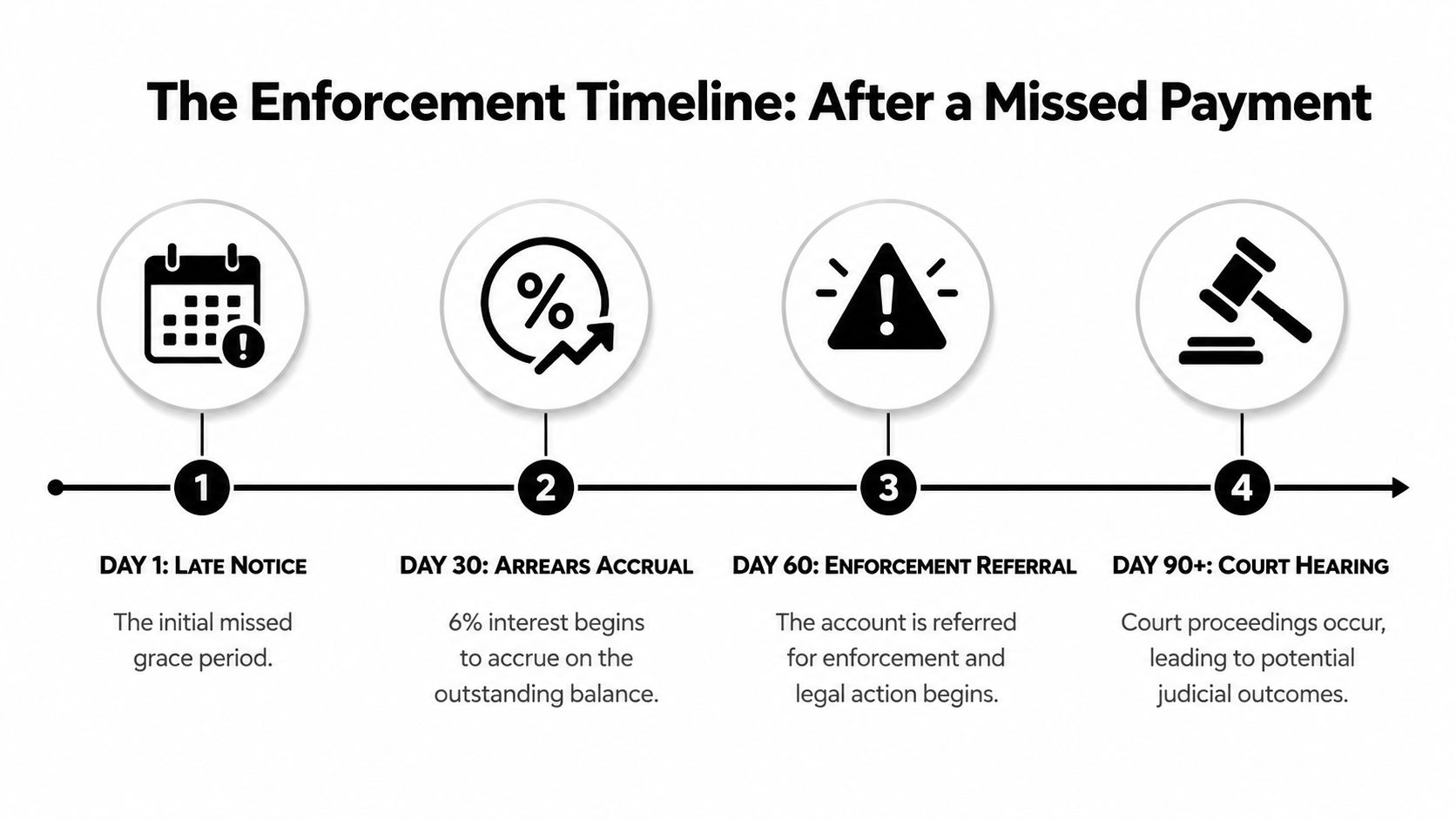
Stage one after the payment is missed
The case doesn't vanish just because the payment wasn't made. The unpaid amount remains tied to your order, and the account can move toward enforcement. At this point, many parents are tempted to wait, especially if they expect money soon.
That waiting period is risky. Once the state sees a delinquency pattern, the matter can shift from a private family problem to an enforcement matter with the Office of the Attorney General.
Stage two after delinquency begins
Texas can move quickly. After 30 days of delinquency, the Office of the Attorney General can trigger an IRS tax refund interception, and an Income Withholding Order can seize up to 50% of net resources. Texas law also allows a property lien under Section 157.317 to attach to property, which can block the sale or refinancing of a Kingwood home until the debt is resolved, as described in this overview of Texas legal remedies for missed child support payments.
For many readers, this is the moment the problem feels real. It's no longer just a late payment. It can now interfere with work, taxes, and property decisions.
If you're already behind, collect your order, payment history, proof of income, and any notices you've received before you call anyone. Those documents shape what options you actually have.
Stage three when administrative pressure builds
This is often where families in Humble and Kingwood get blindsided. Administrative enforcement can affect daily life before a judge ever hears testimony.
A parent may deal with:
- Employer involvement: An Income Withholding Order can be sent to payroll.
- Tax refund loss: Expected refund money may be diverted to support arrears.
- Title problems: A lien can interfere with selling or refinancing property.
- State notices: Warning letters may arrive before stronger action follows.
Parents who want to understand how judges have handled similar enforcement disputes sometimes benefit from finding legal case precedents before making decisions about strategy. That kind of review can help frame realistic expectations, especially when a case is headed toward court.
Stage four when the case moves toward court
Judicial enforcement is the stage most parents fear, and for good reason. Once a motion to enforce is filed, the issue can become much more serious. The court will look closely at the order, the payment record, and whether the nonpayment was willful.
The exact path can vary by case and county practice, but the pattern is familiar. Notices are sent. A hearing is set. The parent who owes support may have to explain the nonpayment to the judge. If they ignored earlier chances to address the problem, their room to negotiate may be much smaller.
A timeline that makes sense in real life
Here is the practical version many parents in Northeast Houston need:
- The payment is missed. The debt starts.
- Delinquency continues. State collection tools can start activating.
- Administrative consequences appear. Payroll, taxes, and property may be affected.
- Court enforcement follows. A hearing can bring much tougher outcomes.
The most important takeaway isn't fear. It's timing. Parents who respond early often still have room to request changes, explain circumstances, or work toward a manageable plan. Parents who ignore the case often find out too late that the timeline kept moving without them.
A Deeper Look at Texas Child Support Penalties
Once enforcement starts, the consequences don't all hit in the same way. Some affect your paycheck. Some affect your ability to travel, drive, work, or use your property. Others put you directly in front of a judge.

Wage garnishment and employer involvement
For many parents, wage withholding is the first major shock. Once an Income Withholding Order reaches an employer, child support comes out of earnings before the parent can decide how to juggle bills that month.
In a place like Kingwood or Northeast Houston, where many people work for large employers or established payroll departments, wage withholding can move in a very routine way. The employer is not choosing sides. The employer is following a legal directive.
That creates real-life pressure fast:
- Reduced take-home pay: Household budgeting gets tighter immediately.
- Workplace embarrassment: Some parents worry about payroll or HR learning private details.
- Less flexibility: You can't promise to catch up later if withholding is already in place.
License suspensions and property liens
Administrative penalties can spill into basic daily life. If you're trying to commute through Humble, take kids to school, or maintain a professional license needed for work, a suspension issue can ripple through everything else.
A property lien creates a different kind of problem. A parent may feel stable because they own a home or other assets, only to discover that a lien blocks a refinance or sale when they most need financial breathing room.
Here's a simple comparison:
| Penalty | Daily impact |
|---|---|
| Wage withholding | Shrinks available income |
| License suspension | Can disrupt driving, work, or professional status |
| Property lien | Can block a sale or refinance |
| Court contempt | Can lead to direct court sanctions |
Passport problems for traveling professionals
For Kingwood residents who travel internationally for work or family reasons, passport restrictions can be especially disruptive. Under the federal Passport Denial Program, a Texas parent who owes $2,500 or more in child support arrears can be reported to the U.S. Department of State, which may refuse to issue or renew a passport, according to this explanation of failing to pay child support in Texas.
That matters a lot in this area. Many local professionals rely on travel for energy, engineering, sales, and related work. A child support issue can suddenly become an employment issue.
Some penalties are inconvenient. Passport denial can shut down a job opportunity, a family trip, or an urgent international plan with very little warning.
A short overview can help clarify how courts and agencies treat these cases in practice:
Contempt of court and possible jail exposure
The most serious enforcement tool is contempt. When the court believes a parent failed to follow a valid child support order, the judge can impose penalties that go far beyond collection.
In Texas, courts can stack contempt consequences for intentional nonpayment under Family Code Chapter 157, and the source material also notes that missed support can expose a parent to criminal nonsupport charges in severe cases under Penal Code Section 25.05, including potential jail time and fines in qualifying situations, as discussed earlier in the article's cited materials. What matters for a parent reading this is not memorizing every statute. What matters is understanding that nonpayment can shift from debt collection into a liberty issue.
Parents often ask whether jail is automatic. It isn't. But ignoring notices, missing hearings, or doing nothing while arrears grow can put a case on a much more dangerous track.
Proactive Steps You Can Take to Avoid Enforcement
The best move is usually not to wait for the state to force the issue. Texas courts and agencies generally respond better to parents who address the problem early than to parents who disappear and hope it passes.
If your income dropped, your hours changed, or your expenses shifted because of a real life event, action matters more than explanation. Good intentions don't modify a child support order. A filed request does.

Start with records, not panic
Before you make calls or respond emotionally, gather the documents that show the full picture. In child support matters, details drive outcomes.
Focus on:
- Payment proof: Bank records, receipts, withholding records, and confirmation numbers.
- Income changes: Termination letters, pay stubs, medical leave papers, or reduced-hours notices.
- Case documents: Your court order, any notices, and any communication from the Attorney General.
- Child-related expenses: Keep them organized, even if they don't replace support, because they may still matter in the broader context.
Ask whether modification is the right tool
One of the biggest mistakes parents in Kingwood and Humble make is assuming they can wait until they are far behind and then explain everything at once. Courts usually want you to seek relief when the problem starts, not after months of missed payments.
If your circumstances changed in a meaningful way, a formal modification may be the most practical step. This guide on how to modify child support in Texas is a useful starting point for understanding that process.
Use a crisis checklist
When money is tight and notices are arriving, simple decisions are easier than broad legal theory. Use a short checklist.
- Confirm the amount owed. Don't guess.
- Identify why the payment was missed. Job loss, reduced hours, illness, or another major change.
- Stop making informal assumptions. A text message with the other parent usually doesn't replace a court order.
- Prepare a timeline. Judges and lawyers need clear dates.
- Get advice before the hearing date if one has been set.
Key point: A parent who asks for help before enforcement reaches court usually has more room to protect income, property, and future options.
Don't confuse negotiation with avoidance
Some parents hear "payment plan" and think they can promise whatever sounds reasonable. That can backfire. A useful plan has to fit the actual numbers, the court order, and the arrears history.
A thoughtful legal strategy may include a request for modification, a response to enforcement, or negotiations around a manageable path forward. The right approach depends on whether the issue is temporary hardship, long-term income change, disputed accounting, or a state processing problem.
For parents in Porter and Northeast Houston, the practical lesson is simple. Do something before the case starts doing things to you. That doesn't mean rushing blindly. It means responding while options still exist.
What If the State System Is the Problem The ChAMP Issue
Not every missing payment means a parent refused to pay. That's what makes the ChAMP issue so confusing for Kingwood families.
The Texas Attorney General's ChAMP payment system, launched in 2025, has experienced significant failures that caused payments to be deducted from paychecks but not delivered to custodial parents for weeks, creating confusion about whether enforcement should begin or whether the state system itself is the problem, as reported in this coverage of the Texas ChAMP payment system issue.
How to tell the difference
If you're the parent expecting payment, don't assume delay automatically means defiance. Ask for proof of withholding or payment transmission first. If you're the paying parent, keep every payroll stub, deduction record, and account screenshot that shows the money left your check.
That distinction matters because a true nonpayment case and a state processing failure are not the same thing. Filing the wrong kind of enforcement action too quickly can increase conflict without solving the actual problem.
What to do in Kingwood and Harris County
When ChAMP-related confusion is in play, treat the case as a records problem first. Build a clean paper trail. Then get guidance on whether the delay belongs in an enforcement action, an administrative follow-up, or both. Families dealing with that process can review this page about child support enforcement in Harris County to better understand the local framework.
The big takeaway is simple. If support was withheld but not delivered, the issue may be system failure, not intentional nonpayment. That difference can change the right legal response.
How Our Kingwood Lawyers Protect Your Future
When child support trouble starts affecting your paycheck, license, travel plans, or court dates, you need more than general advice. You need someone who can sort out whether the issue is arrears, enforcement, accounting error, or a breakdown in state processing.
For many parents in Kingwood, Humble, and Northeast Houston, legal help matters most in four moments: when a modification should have been filed, when an enforcement notice arrives, when a hearing is scheduled, and when records don't match what happened. Those moments move fast.
A local attorney can help by reviewing the order, checking payment history, identifying weaknesses in the opposing claim, preparing evidence for court, and pushing for a workable strategy before the case becomes harder to contain. If you're unfamiliar with court paperwork and hearing status, this overview of understanding legal case records can make the process easier to follow.
Parents who need direct help with missed payments, arrears disputes, or enforcement defense can start by reviewing this page for a child support lawyer in Kingwood. The goal isn't just getting through one hearing. It's protecting your long-term ability to work, support your child, and move forward without the case controlling every financial decision.
Frequently Asked Questions About Texas Child Support
A lot of parents reach this point after the first scare. The wage withholding hits late, the online payment record looks wrong, or a hearing notice shows up and suddenly the questions become very practical.
Here are the ones Kingwood parents ask most often.
Can you really go to jail for missed child support
Yes, it can happen. Jail usually enters the picture after the case has already moved through the enforcement process and a judge decides the parent had the ability to pay and did not comply with the order.
A common Kingwood example is a parent who misses several payments, ignores court notices, and shows up to the hearing with no records, no explanation for job loss, and no earlier request to modify support. That looks very different from a parent who lost work, kept partial payments flowing, saved proof of income changes, and asked for help before the arrears grew. Judges look closely at that difference.
Can bankruptcy erase child support debt
No. Child support arrears are treated differently from credit cards, medical bills, and many other debts.
That surprises people, especially after a financial crisis. Bankruptcy may affect other parts of your budget, but it usually does not erase past-due child support. If support is part of a larger debt problem, the better question is how to protect income, address arrears correctly, and avoid making the enforcement timeline worse.
Does child support debt end when the child turns 18
Past-due support usually stays owed. A child becoming an adult may change the current support obligation depending on the order, but arrears do not vanish with time.
Parents often confuse the end of ongoing support with the end of the debt. Texas treats those as separate issues. If unpaid support built up over the years, collection efforts can continue after the child turns 18.
Can a parent deny visitation because support wasn't paid
No. Support and visitation work like two separate tracks in the same court order. One problem on one track does not automatically cancel the other.
So if support was missed, the other parent generally cannot decide on their own to block court-ordered visitation. And if visitation was denied, that usually does not let a parent stop paying support. Both problems can be addressed, but they have to be addressed through the proper legal process.
What should I do first if I know I can't make the next payment
Act before the due date if you can. Start by checking the exact amount due under the order, gathering proof of your income change, and saving every payment record you have.
Then look at the reason for the problem. If your hours were cut or you lost a job, a modification review may be needed. If you already paid and the state system is not showing it correctly, treat that as an accounting issue immediately. That matters in cases involving payment posting problems, including the ChAMP confusion that left some Texas parents unsure whether the record matched reality.
A missed payment is like a small leak under the sink. If you deal with it early, you may be fixing paperwork and cash flow. If you wait, you may be dealing with damage to your paycheck, licenses, and court position.
If you're dealing with missed child support payments in Kingwood, Humble, Porter, or Northeast Houston, the Law Office of Bryan Fagan – Kingwood TX Lawyers can help you understand your options and take the next step with confidence. Whether you need help with modification, enforcement defense, arrears issues, or confusion involving state payment delays, our local team offers practical guidance specific to your situation. Schedule a free consultation at our Kingwood office and talk with a lawyer who understands both Texas law and the local courts that may affect your case.