Skip to content
You can't unilaterally deny court-ordered visitation in Texas, even if you're scared, without risking contempt, fines up to $500 and 10 days in jail for a first offense, and harsher penalties after that. But if your child is in real danger, Texas gives Kingwood parents a legal path to act immediately. You need to move fast through the court, not around it.
If you're in Kingwood, Humble, Porter, or Northeast Houston and your child is supposed to go on a visit with a parent who has started acting dangerously, this probably doesn't feel like a legal question. It feels like a knot in your stomach. You may be staring at the clock, reading old text messages again, replaying what your child told you, and wondering whether handing your child over would be reckless.
That fear is valid.
What matters now is what you do next. Texas judges take child safety seriously, but they also expect parents to follow the order until a judge changes it. If you act on fear alone, you can hurt your own custody position. If you act with evidence and the right filings, you can protect your child and protect yourself.
A Kingwood Parent’s Worst Fear
A parent in Kingwood calls after midnight because exchange is the next morning. The other parent has been sending erratic messages, talking about drinking again, and recently showed up late with the child in the car looking exhausted and unsettled. The child now says, "I don't want to go back."
That parent isn't trying to start a fight. They're trying to keep their child safe.
In Humble and Northeast Houston, these situations happen in ordinary neighborhoods, apartment complexes, school parking lots, and exchange locations that once felt routine. The danger isn't always dramatic. Sometimes it's a pattern of instability. Sometimes it's a new boyfriend in the home, a threat made over text, or a child describing conduct that makes your heart sink.
Fear doesn't excuse self-help
The hard truth is that Texas family courts separate fear from proof. A parent may believe a visit is unsafe and still get punished for blocking it without court approval. That's why the right question isn't just, "Can I deny visitation for safety reasons texas kingwood?" The better question is, "How do I protect my child today without handing the other side a contempt case tomorrow?"
Your instinct may be to stop the visit first and deal with court later. In Texas, that sequence can backfire badly.
The better move
If the risk is real, your job is to create a legal record immediately. That can mean contacting police if there's an immediate threat, reporting to CPS when appropriate, gathering evidence, and asking the court for emergency relief. Judges in Harris County want parents to use legal tools like emergency orders, protective orders, and modification requests, not private enforcement.
For Kingwood families, that shift in mindset matters. You are not powerless. You just need to act in a way the court will respect.
Why You Cannot Simply Withhold Your Child
A possession order is a court command. It isn't a suggestion, a parenting preference, or a rough guideline for cooperative weeks only. If a judge signed it, you are expected to follow it unless another judge changes it.

Texas has become much tougher on parents who interfere with visitation. According to this Texas visitation enforcement discussion, parents cannot unilaterally deny court-ordered visitation, and SB 2794, effective September 1, 2025, requires clear and convincing evidence that denial is necessary to prevent substantial harm. That same source states that a violation can bring fines up to $500 and 10 days in jail for a first offense, plus make-up visitation and attorney's fees, and that unauthorized denial leads to contempt in 70% of cases.
A court order is binding, even when emotions run high
Think of your possession order like a binding legal map. You may hate the route. You may believe the route is dangerous. But you don't get to redraw it yourself. You have to ask the court to redraw it.
That's where many parents in Kingwood get in trouble. They think, "I have a good reason, so the judge will understand later." Sometimes the judge does understand the fear. But the judge may still punish the violation if you didn't seek legal relief first.
What judges usually see when a parent withholds
When a parent blocks visitation without an order, the court often sees one of three things:
- A contempt problem: You violated a signed court order.
- A control problem: The other side argues you're using the child to punish them.
- A credibility problem: If your allegations aren't well documented, the judge may doubt the seriousness of your safety claim.
That third issue is often the most damaging. Once the judge sees you as reactive instead of responsible, every future hearing gets harder.
If you aren't sure what your current schedule requires, review a Standard Possession Order in Kingwood before making a decision. Many parents misread exchange times, holiday terms, and notice requirements.
What the law expects instead
Texas law doesn't expect you to ignore danger. It expects you to use the legal process fast. In practical terms, that means:
- Follow the current order unless an immediate threat makes emergency action necessary
- Call law enforcement if the danger is immediate
- File for court relief right away
- Bring evidence, not just suspicion
Practical rule: If your concern is serious enough to cancel visitation, it's serious enough to put in front of a judge immediately.
For parents in Humble, Porter, and Northeast Houston, this is the line to remember. You don't protect your child by breaking the order first. You protect your child by getting a new order fast.
What Courts Consider a Legitimate Safety Risk
Not every bad co-parenting situation is a legal safety emergency. A parent being rude, unreliable, immature, or difficult does not automatically justify stopping visits. Harris County judges want objective proof of danger.
According to this review of denying visitation in Texas, Texas courts modify visitation for safety reasons in only about 12% to 15% of petitions, which tells you how high the bar really is. The same source identifies the main grounds in those cases as physical or emotional harm at 35%, documented substance abuse at 28%, and criminal activity at 22%. It also states that in emergencies, filing for a TRO with CPS substantiation succeeds in 65% of cases, while violating a visitation schedule without a court order results in contempt in 55% of enforcement suits.
Concerns that usually get a judge's attention
Judges respond to facts that can be verified. In Kingwood-area cases, that often means evidence such as:
- Substance abuse tied to parenting time: failed drug tests, intoxicated driving allegations, rehab records, or repeated alcohol-related incidents
- Criminal conduct that creates a direct risk: recent violence, weapons issues, active dangerous behavior, or credible threats
- Physical or emotional harm to the child: injuries, severe anxiety linked to visits, documented disclosures, or reports from mandated reporters
- Unsafe home conditions: dangerous adults in the residence, accessible drugs, neglectful supervision, or hazardous living conditions
- Family violence evidence: police reports, medical records, or witness accounts showing violence in or around the home
Concerns that usually are not enough by themselves
Some parents are shocked by this, but these complaints often don't carry the day unless tied to stronger evidence:
| Concern | Court reaction |
|---|---|
| The other parent is rude or disrespectful | Usually not enough |
| The child says the parent is "mean" | Needs context and proof |
| The other parent has a new partner you dislike | Usually irrelevant unless there is danger |
| The home feels chaotic | Must be tied to actual risk |
| You suspect drug use but have no proof | Weak without documentation |
The question a judge asks
A Harris County judge is usually asking a version of this: What specific harm is likely to happen to this child if the current order continues? Not "Why are you worried?" Not "Why don't you trust the other parent?" Those matter emotionally, but they don't win emergency relief.
If you can describe the danger in one sentence and back it up with records, your case becomes much stronger.
Parents in Northeast Houston often make the mistake of bringing a stack of grievances instead of a focused safety case. A shorter file with strong proof beats a long rant every time.
The Legal Path to Protecting Your Child in Kingwood
If the visit is unsafe, move through the court immediately. Don't sit on the problem, and don't hope it fixes itself by the next exchange. Delay makes danger harder to prove and makes your own conduct easier to attack.
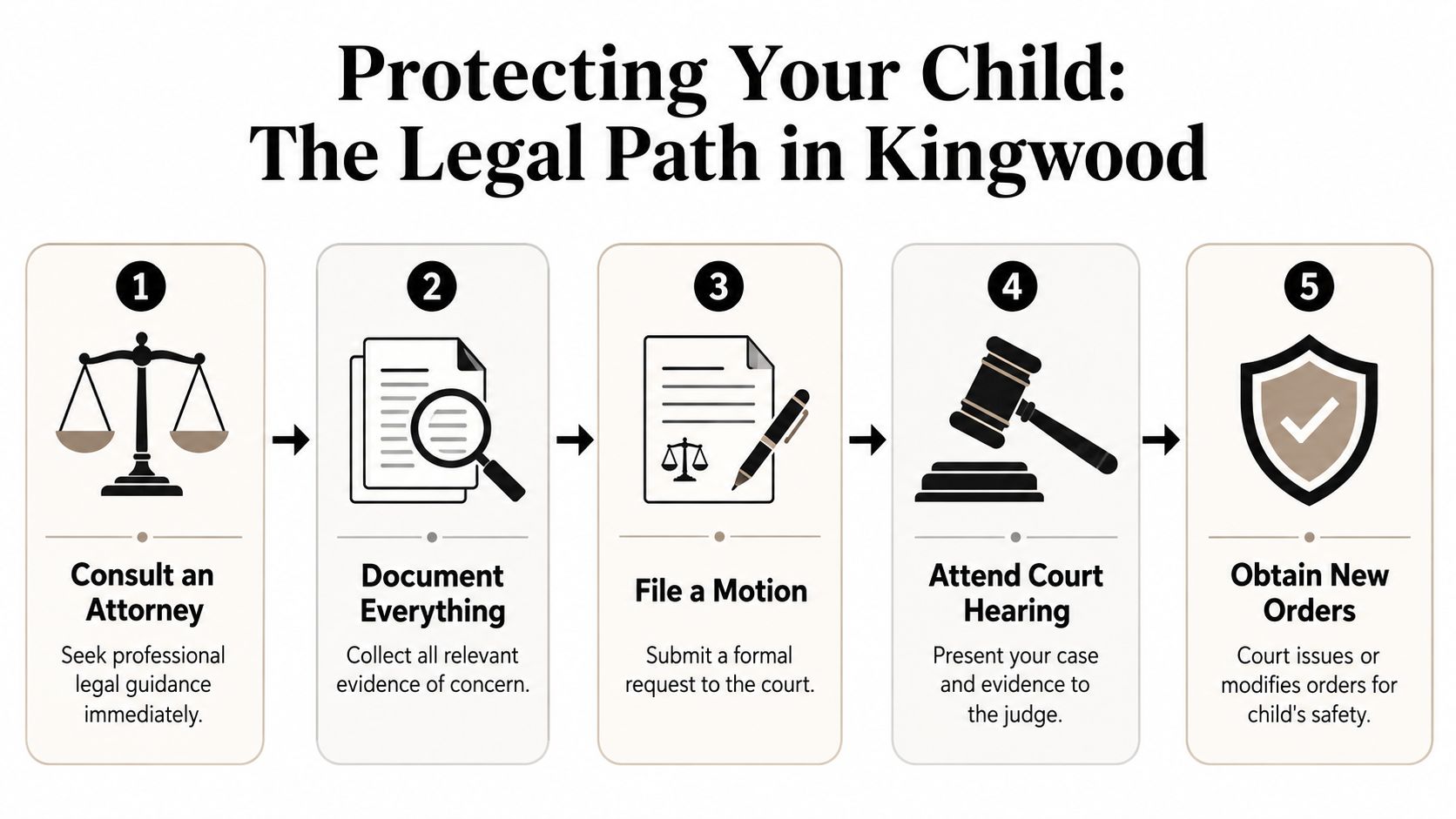
A useful starting point is understanding the emergency relief process. If you need local guidance on urgent filings, review this page about an emergency custody order in Kingwood.
According to this discussion of safety concerns under Texas Family Code §153.004, a parent seeking to legally deny visitation must meet a stringent evidentiary threshold and often needs proof of family violence within the last two years. That same source says courts prefer supervised visitation over total denial, and supervised settings in Harris County are available for $10 to $20 per hour. It also reports that anecdotal fears without documentation lead to modification denials 70% to 80% of the time, while documented evidence shifts outcomes toward supervised access in about 60% of filings.
Step one, treat this like an emergency if it is one
If there is an immediate threat, call police. If the child faces abuse, neglect, or dangerous exposure, report it so there is an official record. If family violence is involved, a protective order may be the right route. If the problem is urgent but tied to possession and access, a TRO and motion to modify may be the better fit.
The worst move is doing nothing while collecting anxiety.
Step two, file for court relief fast
In Kingwood-area cases, emergency action often involves one or more of these filings:
- A motion to modify possession or access: asking the judge to change the current order
- A TRO: asking for temporary immediate limits while the case is pending
- A protective order: used when family violence or threats are part of the picture
- A request for supervised visitation: often the most realistic and court-friendly form of immediate protection
Courts are often more comfortable narrowing risk than eliminating contact entirely. That's why supervised visitation, neutral exchanges, and temporary restrictions are so common in serious cases.
Step three, ask for the right remedy
Many parents ask for too much and lose credibility. If your facts support supervision, ask for supervision. If your concern is intoxicated driving, ask for sober exchange conditions, public exchange points, or testing provisions if your lawyer believes they fit your case.
A judge is more likely to grant targeted protection than a broad shutdown unsupported by proof.
Here are common remedies a Kingwood parent may request:
- Supervised visitation
- Public exchange at a police station or neutral site
- No overnight possession
- Temporary suspension pending hearing
- Therapeutic intervention for the child
- Restrictions on third-party contact
Judges often see a parent as more credible when the requested relief matches the proven risk instead of sounding punitive.
Step four, show up organized
When you walk into a Harris County courtroom, your presentation matters. Bring a timeline. Bring exhibits. Bring witness names. Bring your proposed order. A judge should be able to understand the problem quickly.
Use a simple structure:
| What happened | When it happened | Proof you have | What you want the judge to do |
|---|---|---|---|
| Threat made | Date and time | Text screenshot | Suspend unsupervised exchanges |
| Child returned injured or distressed | Date | Photos, doctor record | Supervised visits only |
| Intoxication concern | Date of incident | Witness, police report, video | Alcohol restrictions and monitored exchange |
Step five, follow the new order exactly
Once emergency relief is entered, follow it to the letter. Don't freelance. Don't add your own conditions. Don't deny extra time unless the order allows it. The whole point is to put the court between your child and the risk.
For parents searching can I deny visitation for safety reasons texas kingwood, that's the answer in practice. You don't deny first and explain later. You file first, prove the danger, and get the judge to change the rules.
Building Your Case With Compelling Evidence
Most custody disputes are won or lost on documentation. A worried parent may be telling the truth and still lose if the proof is weak. Judges hear accusations every day. They pay attention when those accusations are backed by records.
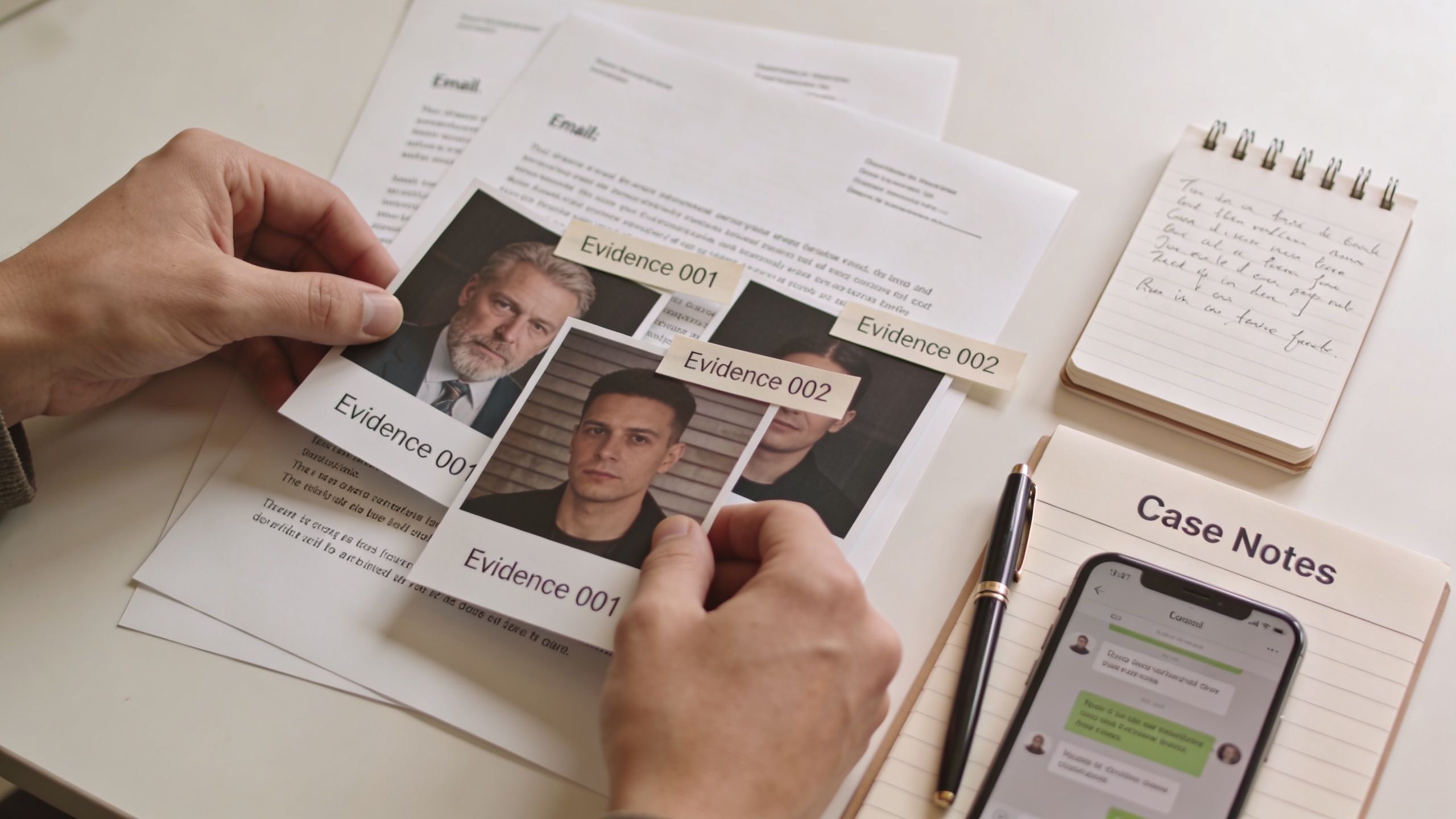
If you're preparing for a hearing in Harris County, this guide on how to prepare for a custody hearing can help you think through what to gather and how to present it.
What strong evidence looks like
A compelling file usually includes a mix of official records and everyday proof. Start gathering:
- Text messages and emails: threats, admissions, intoxicated messages, missed exchanges, or unstable behavior
- Photos and videos: injuries, dangerous home conditions, visible intoxication, damaged property, or the child's condition after visits
- Police records: reports, incident numbers, body-cam references if available through proper channels
- Medical records: ER records, pediatric notes, counseling referrals, or treatment records connected to the concern
- CPS paperwork: reports, findings, safety plans, or notices connected to the child
- Witness statements: teachers, relatives, neighbors, coaches, babysitters, or other adults with firsthand knowledge
- Your own timeline: a clean, dated chronology of incidents
What weakens a case fast
Bad evidence doesn't just fail to help. It can make you look manipulative.
Avoid these common mistakes:
- Editing screenshots in a sloppy way
- Submitting rumors from third parties
- Mixing safety concerns with old relationship grievances
- Showing up with disorganized stacks of paper
- Relying on "everybody knows" claims
Judges trust records more than outrage.
Evidence rule: If a neutral outsider can verify it, bring it. If it depends entirely on your interpretation, support it with something stronger.
Organize the file like a timeline, not a vent session
Don't dump a pile of documents on your lawyer or the court. Build a simple incident log. Put each event in order. Attach the supporting exhibit behind it. Label everything clearly.
A practical structure looks like this:
- Incident date
- What happened
- Who saw it
- What record exists
- Why it affects the child
- What court relief fits that incident
That method does two things. It makes your lawyer faster, and it makes your case easier for the judge to trust.
For families in Kingwood, Humble, and Porter, the strongest cases usually aren't the loudest ones. They're the ones built carefully, with dates, records, and a clear explanation of risk.
The High Cost of Acting Alone The Three-Strikes Law
If you're tempted to keep your child home and sort it out later, stop and think through what that could trigger. Texas has become much more aggressive about custodial interference.

According to this overview of Texas SB 2794, effective September 1, 2025, the law creates a three-strikes rule for custodial interference. The source states that penalties escalate from a Class C misdemeanor with a fine of $500 or less on the first offense to a state jail felony with 180 days to 2 years of imprisonment and a $10,000 fine on the third offense. It also notes that unilateral denial without a TRO or protective order can create both civil and criminal exposure, with 15% jail outcomes for felony-level strikes.
This is no longer just a family court issue
Years ago, some parents treated denied visitation like a messy civil dispute. That's a dangerous assumption now. In Kingwood and across Harris County, repeated interference can move beyond contempt and into criminal territory.
That matters for more than obvious reasons. A criminal charge can affect employment, reputation, future custody litigation, and how a judge views your judgment as a parent.
How the escalation works
Here's the practical takeaway:
| Level | Exposure |
|---|---|
| First strike | Criminal penalty at the lower level, plus family court consequences |
| Repeat conduct | More serious sanctions and a much uglier litigation posture |
| Third strike | State jail felony exposure and major long-term fallout |
Parents often think, "I only denied one weekend." But cases rarely stay that simple. Once communication breaks down, one denial becomes two, then holiday conflict, then a police call, then an enforcement motion with exhibits showing a pattern.
This short video gives useful context on why immediate legal guidance matters before that pattern forms.
The smarter move is controlled legal action
If you're right about the danger, you still need to act in a way that doesn't give the other side an advantage. If you're wrong, or if you can't prove it yet, a unilateral denial can damage your case faster than almost anything else.
The law gives you a shield. It punishes you when you try to become the judge yourself.
For parents in Northeast Houston, that means getting your concerns into the proper court file right away. It also means resisting advice from friends who say, "Just keep the child home." Friends don't show up to defend your contempt hearing.
What to Do When Your Child Refuses to Go
This is one of the hardest situations a parent faces. Your child is crying, refusing to get in the car, or telling you they're scared. Everything in you wants to say, "Then you don't have to go."
Texas doesn't make it that simple.
According to this discussion of visitation refusal in Texas, when a child is over 12, courts may consider that child's preference under §153.009, but parents still have a duty to facilitate visitation. That source also states that denying visitation based on the child's word alone led to custody loss in 22% of recent Northeast Houston appeals, and that Harris County filings related to visitation refusal rose 35%, with 52% of those cases resulting in court-ordered counseling before custody modification was considered.
A child's refusal is not a free pass
Even older children don't get to overrule a court order on their own. Judges know children can be afraid for real reasons, but they also know children can absorb conflict, pressure, and loyalty binds. If you say, "She refused to go, so I let her stay," the court may hear, "I failed to facilitate visitation."
That can create a serious problem for you, even if your concern is genuine.
The right response in the moment
If your child refuses to go, focus on calm documentation and lawful action:
- Stay neutral: don't coach, pressure, or lead the child into repeating accusations
- Document the refusal: note the date, time, exact words used, and anyone present
- Seek professional support: therapist notes or evaluations can matter when the issue is fear-based
- Notify your lawyer quickly: especially if refusal is repeated
- Ask the court for help: counseling, supervised visits, or a modification may be appropriate
A judge takes a frightened child more seriously when the parent responds with calm documentation instead of emotional escalation.
What courts often do instead of immediate denial
In these cases, courts frequently look for a middle ground. That may include counseling, therapeutic support, or structured visitation before a bigger change is made. For Kingwood parents, that's frustrating, but it often reflects how courts separate a child's distress from legal proof of danger.
So if your son or daughter refuses to go, don't ignore it, and don't make a private custody decision on the driveway. Treat it as evidence that needs to be preserved and presented properly.
Your Local Advocates for Child Safety in Kingwood
When you're afraid for your child, you need a plan, not generic advice. The law in Texas gives you options, but it also punishes parents who improvise. That's the central truth in these cases.
If you're in Kingwood, Humble, Porter, or Northeast Houston, the right move is usually straightforward. Keep the focus on the child's safety. Gather proof. Use emergency legal tools when needed. Ask for targeted relief that fits the risk. Follow every court order exactly.
What parents should remember
These are the points that matter most:
- Your fear may be justified: don't ignore warning signs
- Your response has to be legal: self-help can hurt your custody case
- Evidence changes outcomes: records beat accusations
- Courts often prefer supervision over cutoff: ask for relief that matches the facts
- Fast action matters: delay weakens both protection and credibility
Why local knowledge matters
A Kingwood family law issue isn't handled in the abstract. It moves through local courts, local filing practices, local judges, and local expectations about evidence and urgency. Parents in Northeast Houston need advice that fits that reality, not broad internet answers written for no specific courthouse.
If you've been searching can I deny visitation for safety reasons texas kingwood, the answer is clear. Not on your own. But absolutely through the court when the facts support it.
You don't have to choose between protecting your child and following the law. Done correctly, you do both.
If you're facing a visitation safety crisis in Kingwood, Humble, Porter, or Northeast Houston, Law Office of Bryan Fagan – Kingwood TX Lawyers can help you act quickly and strategically. Schedule a free consultation at the Kingwood office to talk through your options, protect your child, and build a plan that holds up in court.