Skip to content
A custody order can feel settled until real life changes. A new work schedule in Northeast Houston, a child who starts struggling in school, a move that no longer fits the current order, or growing tension around exchanges in Kingwood can make the old plan stop working. When that happens, parents usually aren't looking for a fight. They're looking for a workable path forward that protects their child.
That's where a modification comes in. If you're searching for a custody modification attorney in Kingwood, Texas, you're probably trying to answer a practical question: can the court update our current order so it fits the family we are now, not the family we were when the paperwork was signed?
Parents in Kingwood, Humble, Porter, and Northeast Houston ask that question every day. The answer depends on the facts, the timing, and how well the case is prepared. Texas family law gives you a legal path to request change, but Harris County courts expect more than frustration or a verbal agreement. They expect proof, a clear request, and a child-focused reason for making the change.
When Your Family's Needs Change in Kingwood
A common situation starts subtly. One parent gets a new job closer to Downtown Houston or farther out toward Porter. A child's therapy, tutoring, or school routine changes. Pickup times that once made sense now cause conflict every week. The order on paper still exists, but daily life in Kingwood no longer matches it.
That disconnect creates stress fast. Parents often try to patch it with texts, side agreements, and “we'll just do this for now.” Sometimes that works for a short stretch. It usually breaks down when schedules tighten, relationships sour, or one parent decides to go back to the exact language of the existing order.
Signs the current order no longer fits
You may need to look at a formal modification when:
- School needs have changed and the current schedule interferes with attendance, tutoring, or specialized support.
- Work obligations shifted and the parent who could once handle weekday care no longer can.
- Health or developmental concerns grew and the child now needs a more structured routine.
- Conflict increased because the order leaves too much room for interpretation.
When a child has educational or developmental needs, legal decisions often overlap with school and medical systems. For parents sorting through that issue, Guiding Growth's take on evaluation legalities is a useful outside resource for understanding how those decisions can affect a family's legal planning.
A modification isn't about rewriting history. It's about updating the legal framework so your child's daily life works better now. In Kingwood cases, one issue that often drives the need for change is where the child is allowed to live. If relocation is part of your situation, it helps to understand the practical problems that come with geographic limits in existing orders. This discussion of mastering geographic restriction in Kingwood custody cases gives a grounded overview.
Practical rule: If your family reality has changed for more than a short temporary period, treat that as a legal issue, not just a scheduling issue.
Understanding Custody Modification in Texas Law
Think of your current order as your family's official rulebook. It tells each parent what rights and duties they have, where the child primarily lives, and how possession and access work. A modification is the legal process for changing that rulebook.
That's different from enforcement. Enforcement asks the court to make someone follow the order already in place. Modification asks the court to replace part of the order because the existing terms no longer fit the family's current circumstances.
Modification versus enforcement
This distinction matters because parents often choose the wrong path.
| Situation | Better fit |
|---|---|
| One parent keeps ignoring pickup times in the current order | Enforcement |
| The schedule itself no longer works because of a major life change | Modification |
| A parent refuses to pay support required by the order | Enforcement |
| You need to change custody, visitation, or support terms | Modification |
Texas law sets a specific threshold for changing an order. Under Texas rules summarized by Texas Law Help's custody modification guide, a court may modify a child custody order only if the change is in the child's best interest and there has been a material and substantial change in the circumstances of the child or a person affected by the order, or if the child is at least 12 and voluntarily expresses a preference about the primary custodian to the court in writing or in person.
That's why these cases aren't won by saying, “This feels unfair.” Courts in Harris County want a legal reason to reopen the order.
What Kingwood parents usually need to decide first
Before filing, get clear on the problem:
- Order problem or behavior problem. Is the written order outdated, or is the other parent not following it?
- Temporary frustration or real change. Judges look for meaningful change, not a rough month.
- Targeted request or broad rewrite. Narrow, practical requests often work better than asking to change everything.
If you're dealing with changes to visitation, custody, or support in Harris County, Custody & Support Modifications in Kingwood refers to modifying existing custody, visitation, and support orders in Harris County.
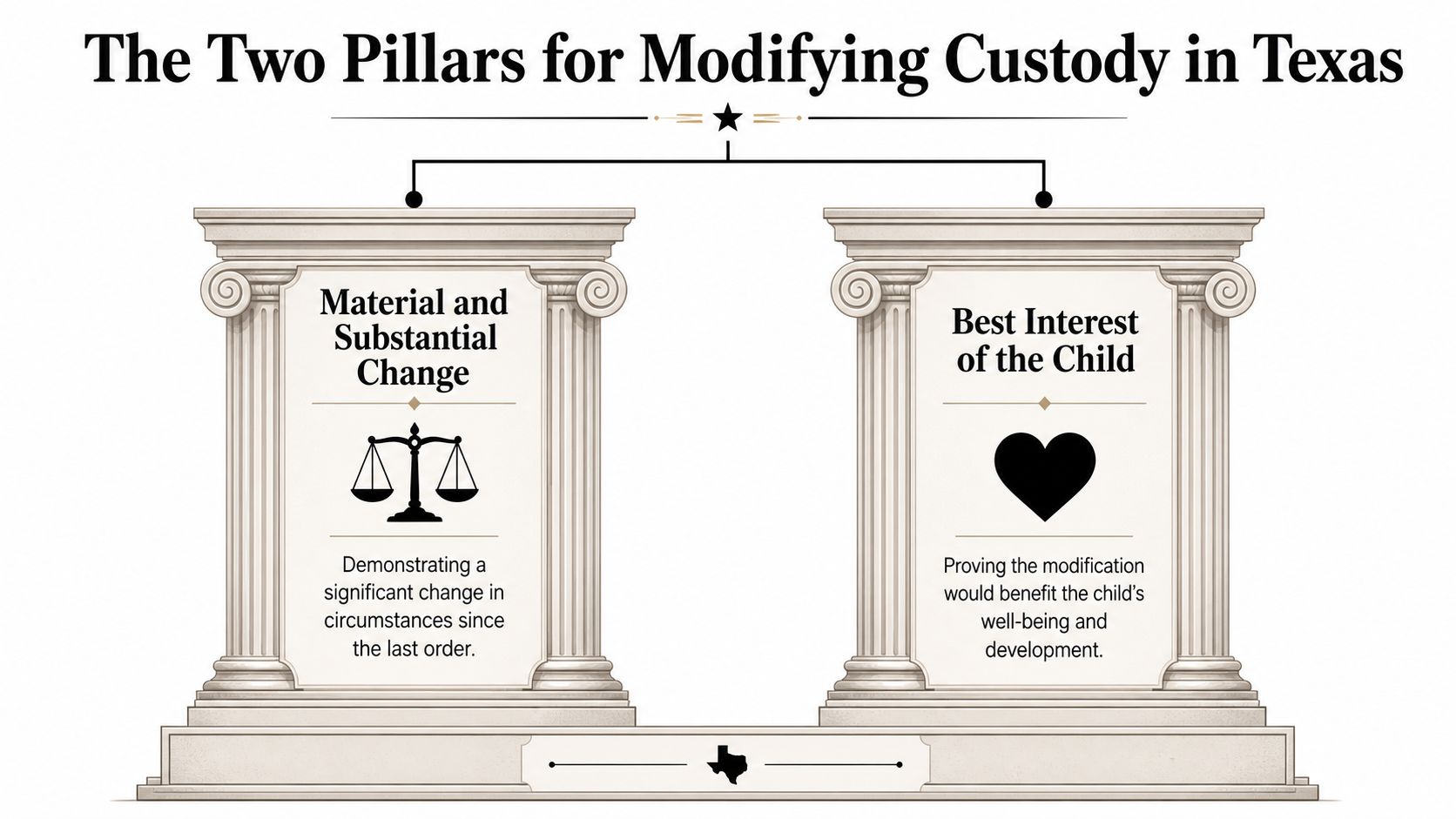
The Two Pillars for Modifying Custody in Texas
Texas modification cases stand on two legal pillars. If either one is missing, the request usually fails. Courts don't change custody because one parent is more frustrated, more vocal, or more organized. They change it when the legal standard is met and the evidence supports the change.
Material and substantial change
This is the gatekeeper. The court first asks whether something important has changed since the last order was signed.
A useful way to think about it is this: if the old order was built for one set of facts, have the facts now changed enough that the structure no longer fits? Minor inconvenience usually won't do it. Significant life changes might.
According to McCarty Larson's explanation of Texas child custody modification, a successful Texas custody modification requires proof of two legal elements: a material and substantial change in circumstances since the prior order, and that the proposed modification is in the child's best interest. That same discussion identifies common benchmarks for material change such as documented relocation outside a court-ordered geographic restriction, major employment shifts affecting availability, or new health and safety concerns.
Examples that can support this first pillar include:
- Relocation issues that affect where the child can live or attend school
- Work schedule changes that alter a parent's real availability for the child
- Safety concerns involving substance abuse or unstable living conditions
- Educational or medical developments that require a different parenting structure
The key word is documented. Courts don't want general claims. They want records, messages, school information, medical information, and testimony that show what changed and why it matters.
Best interest of the child
The second pillar is the point of the whole case. Even if a major change happened, the court still asks whether your proposed fix serves the child.
Many parents tend to lose focus. They spend all their energy proving the other parent is difficult, but they don't show how the requested change improves the child's daily life. Judges in Harris County usually respond better to practical, child-centered evidence than to broad personal attacks.
A strong modification case answers one question clearly: how will this change help the child live more safely, more consistently, or more successfully?
That can involve stability in school, reliable transportation, improved routines, better access to care, or a home schedule that matches the child's actual needs.
Where support issues can overlap
Sometimes custody changes and support issues move together. A shift in primary care, possession time, or each parent's role may require a separate look at support. In those situations, a Child Support Attorney in Kingwood handles establishing, modifying, and enforcing child support in Harris County.
Navigating the Modification Process in Kingwood Courts
Knowing the legal standard is one thing. Building a case in the courts that serve Kingwood is another. Most families here are dealing with Harris County, though some addresses near the edge may involve Montgomery County. Filing in the right place, with the right request, matters from the start.
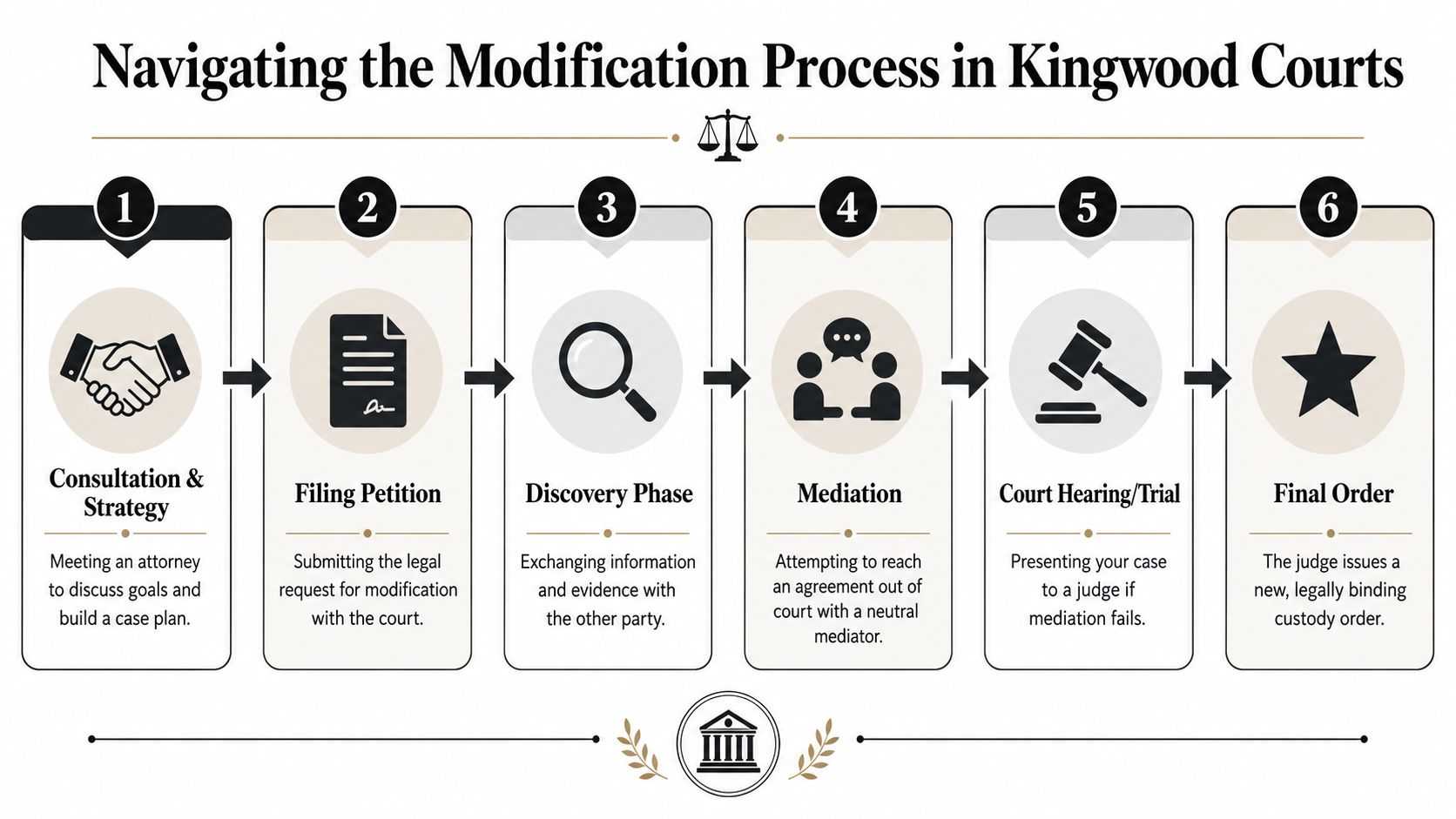
Early in the process, it helps to see the road ahead.
The basic path through the case
Most modification cases follow a familiar sequence:
Review the current order
Start with the signed order, not memory. Parents often act on what they think the order says.Define the requested change
Be specific. Are you asking to change primary custody, visitation terms, a geographic restriction, or support?File the petition
The pleading has to match the relief you need.Serve the other parent
The other side must get formal notice unless service is properly waived.Exchange information and prepare evidence
This includes documents, communications, school records, medical records, and witness testimony when appropriate.Attempt resolution, often through mediation
Many family courts expect serious settlement effort before trial.Present the case to the judge if needed
If no agreement is reached, the court decides based on the evidence.
A short video can help make that sequence easier to visualize.
What evidence usually helps
Parents in Kingwood and Humble often ask what “proof” looks like. It usually isn't one dramatic piece of evidence. It's a consistent set of facts that fit together.
Useful evidence may include:
- Calendar records showing who exercised time with the child
- School documents reflecting attendance issues, performance concerns, or special needs
- Medical records when health or treatment needs changed
- Employment records if work hours or location now affect parenting time
- Texts and emails that show the schedule problem, not just the conflict
- Witnesses such as teachers, counselors, or others with direct knowledge
For a practical look at how proof is organized, this guide on evidence needed for a custody case in Harris County, Texas is a useful local reference.
What works and what usually doesn't
What works in these cases is focus. Judges respond to parents who identify a narrow problem, gather reliable proof, and propose a solution the court can enforce.
What usually doesn't work is filing on emotion alone. A stack of angry messages without context won't carry a case. Neither will broad complaints that never connect the requested change to the child's well-being.
Courtroom mindset: Bring the judge a solvable problem supported by records, not a relationship history supported by frustration.
Common Mistakes to Avoid in Your Modification Case
Some modification cases are lost before the hearing ever starts. Not because the parent lacked a legitimate concern, but because they handled the situation in a way that damaged credibility or weakened the proof. In Kingwood and Northeast Houston, the same mistakes show up again and again.

Moving first and asking later
This is one of the biggest errors. Many Texas orders limit the child's residence to a county and surrounding counties. Parents sometimes assume they can move, get settled, and then ask the court to approve it afterward.
That approach can put you in violation of the order. As explained in this discussion of geographic restriction issues in Texas custody matters, Texas law typically limits a child's residence to a specific county and surrounding counties, and moving outside that zone without court approval creates a violation that forces a modification filing. Many parents think they must move first and fix the order later, but judges are “not going to be very happy” with that approach. Filing before the move is the safer strategy.
Relying on informal agreements
Parents often say, “We both agreed to this by text.” That may help explain what happened, but it doesn't replace a signed court order. If the current order says one thing and your informal arrangement says another, the written order still controls until the judge changes it.
Treating the child like a messenger
Children shouldn't carry legal messages between parents or feel responsible for the outcome. That harms the child and often harms the case. Judges notice when a parent appears to be pulling the child into the conflict.
Weak documentation and delayed action
Two other mistakes often travel together:
- Waiting too long so the facts get blurry and records disappear
- Keeping poor records and trying to recreate events from memory
A better approach is simple:
- Save communications that show the actual issue
- Keep a parenting log with dates, missed exchanges, and school concerns
- Collect records early before the case becomes urgent
- Stay inside the current order unless the court changes it
Parents who act carefully usually present better. Parents who improvise often walk into court with a story but no structure.
How a Kingwood Attorney Protects Your Family's Future
A modification case asks you to do several things at once. You have to read the existing order closely, identify the legal basis for change, gather evidence, make strategic decisions about negotiation, and present a child-focused request to the court. That's difficult to do when you're also living through the stress that made the case necessary.

Texas law keeps the standard tight. Under Texas Family Code Section 156.101 as summarized here, a court may modify a custody, visitation, or support order only if there has been a material and substantial change in circumstances and the modification is in the child's best interest. Both elements have to be proven in courts serving Kingwood, Humble, and Northeast Houston.
What a local attorney actually does
A local family lawyer doesn't just file forms. Good representation usually means:
- Translating your concerns into legal issues the court can rule on
- Screening weak arguments out early so the case stays focused
- Organizing evidence into a usable presentation
- Preparing for mediation with realistic goals and fallback positions
- Protecting you from avoidable mistakes such as overreaching or violating the current order
For families comparing options, the Law Office of Bryan Fagan – Kingwood TX Lawyers is one local firm that handles family law matters in the Kingwood area, including modification-related issues.
If you're unsure when legal help becomes necessary, this article on when you should hire a custody lawyer in Kingwood, TX offers a practical starting point.
What to bring to a consultation
A productive first meeting usually starts with a short, organized file. Bring:
- Your current court order
- A timeline of what changed
- Recent texts or emails tied to the issue
- School or medical records that matter
- Your proposed solution, even if it's only a draft idea
- Questions about immediate risks, including moves, school enrollment, or compliance problems
Bring facts first. Conclusions can wait. A clear timeline and the actual order often answer more questions than a long emotional summary.
Frequently Asked Questions About Custody Modification
Can I change custody if my order is still new
Sometimes, but there's an important limit. A petition to modify the child's primary physical residence is generally barred for one year after the original order unless one of these exceptions applies: the current primary custodian consents, the child's present environment endangers physical health or emotional development, or the primary custodian has voluntarily surrendered care for at least six months, as explained in Texas Law Help's article on modification within one year of a current order. If your order is recent, the first step is reviewing whether your facts fit an exception.
Can my child tell the judge where they want to live
A child who is at least 12 may express a preference to the court about the primary custodian, but that doesn't automatically control the result. The court still looks at the broader circumstances and the child's welfare. A child's preference can matter, but it's one piece of a larger decision.
How much does a custody modification cost
The cost depends on the issues, the level of disagreement, the amount of evidence involved, and whether the case settles or goes to a hearing. Some cases are fairly contained. Others require substantial preparation. The most reliable way to understand likely cost is to have a lawyer review your current order and the change you're considering.
Does family law ever overlap with property issues
Yes. Sometimes a custody matter is part of a larger divorce or post-divorce situation where home ownership and marital property questions also matter. If that's part of your background, this explanation of property ownership for married couples can help you understand one common ownership concept, even though Texas families need advice grounded in Texas law and their own orders.
What's the best first step
Start with the signed order and a written timeline of what changed. That keeps the conversation concrete and helps you avoid acting on assumptions. If you're in Kingwood, Humble, or Northeast Houston, a local consultation can tell you quickly whether you're dealing with a real modification case, an enforcement issue, or a problem that needs a narrower fix.
If your current custody order no longer fits your child's needs, schedule a free consultation with Law Office of Bryan Fagan – Kingwood TX Lawyers. Our Kingwood office works with families in Kingwood, Humble, Porter, and Northeast Houston who need clear guidance on custody, support, estate planning, criminal defense, and civil matters. A focused review of your order and your recent changes can help you understand your options and take the next step with confidence.