A lot of parents in Kingwood call a lawyer at the same point. School is in session, drop-offs are tense, texts with the other parent are getting worse, and a hearing date suddenly makes everything feel real. The first question usually isn't legal theory. It's simple: what do I need to bring to court?
That's the right question. In Harris County, custody cases rarely turn on who sounds more upset in the courtroom. They usually turn on who can show a clear, organized, dated record of daily parenting, the child's needs, and compliance with local court procedure. If you live in Kingwood, Humble, Porter, or Northeast Houston, that preparation can take a stressful situation and make it manageable.
Preparing for Your Harris County Custody Case
A parent in Kingwood might walk into this process thinking custody court is mostly about telling the judge what happened. Then the paperwork starts. The hearing notice arrives. The other side makes accusations. You realize fast that memory alone won't carry a case.

The good news is that custody preparation is less mysterious than it feels at first. Most strong cases start with the same basic work. Gather records. Organize them by topic. Match each document to a date. Focus on facts that show your child's routine, your involvement, and the choices that support your child's stability.
If you're trying to get your footing before a hearing, this practical guide on how to prepare for a custody hearing in Kingwood is a good starting point. It helps parents sort out what matters now versus what can wait.
Practical rule: Start building your file before you think you “need” it. The best custody evidence is usually created during normal parenting, not after a court date is set.
The Best Interest of the Child Standard in Harris County
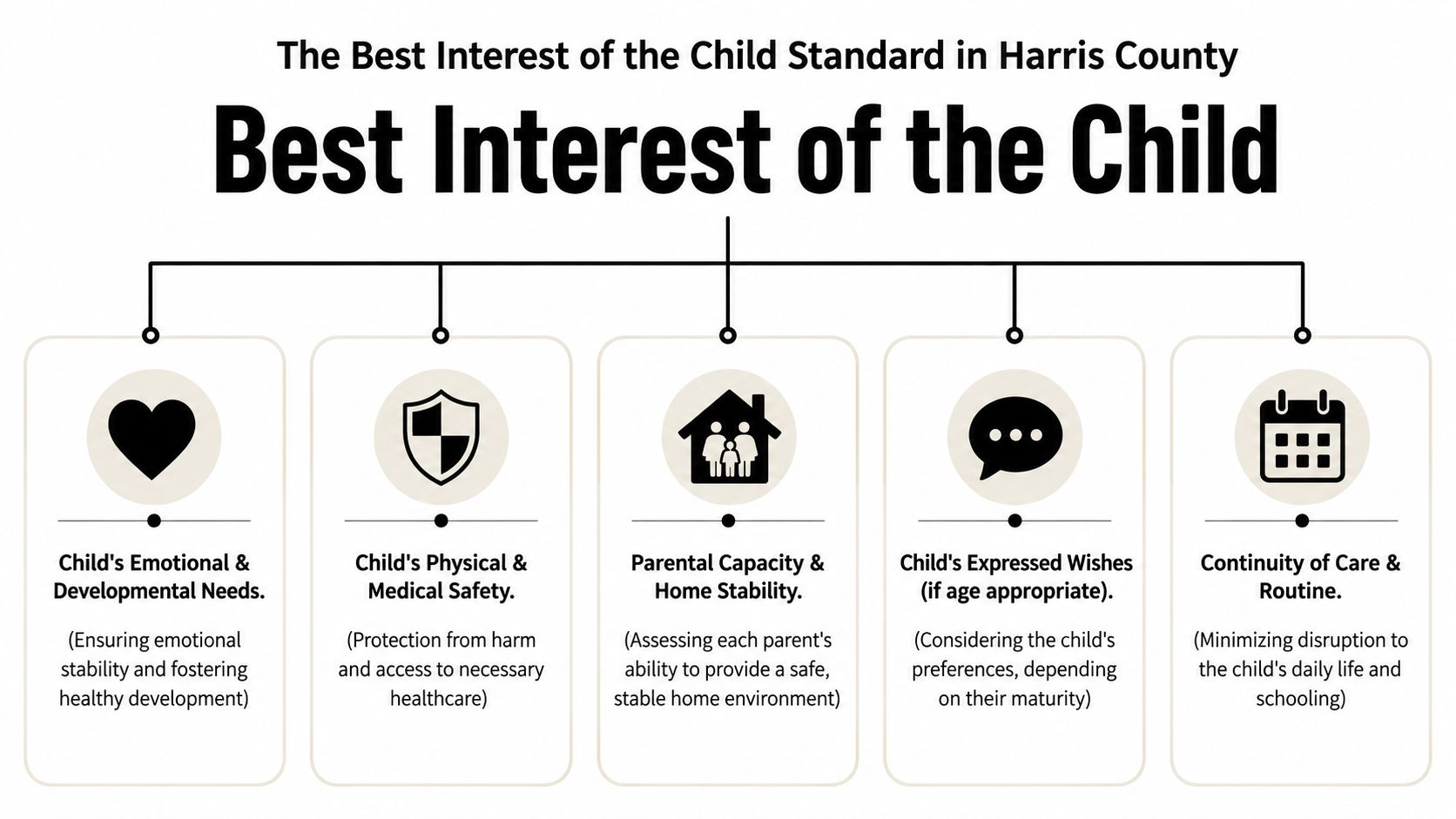
Every custody case in Harris County comes back to one idea. What arrangement is in the child's best interest? That standard shapes what evidence matters and what gets ignored.
A judge doesn't need a stack of random screenshots with no context. A judge needs proof that ties your parenting to your child's day-to-day well-being. That means your evidence should show how you meet needs, keep routines steady, communicate responsibly, and make decisions that support the child rather than escalate conflict.
For a deeper local explanation, this page on how judges decide custody in Harris County, Texas gives useful context for parents in Kingwood and Humble.
What judges are really looking for
Think in terms of categories, not emotions.
- Your child's daily needs: school attendance, homework help, medical appointments, therapy, meals, sleep routines, and transportation.
- Home stability: who keeps the child's schedule moving, who handles unexpected issues, and whether the home environment is consistent.
- Decision-making: whether you communicate about the child in a practical way and follow through on responsibilities.
- Safety concerns: any conduct that affects the child's physical or emotional safety.
- Continuity: whether your proposed arrangement supports normal life instead of constant disruption.
In real custody disputes around Northeast Houston, the strongest presentation usually isn't dramatic. It's calm, specific, and tied to dates.
Evidence has to connect to parenting
Parents often make one big mistake. They collect proof of the other parent being difficult, but they never connect it to the child.
That's not enough. If the other parent sent angry messages, ask: did that interfere with exchanges, school communication, medical care, or the child's routine? If the issue involves online conduct, parents sometimes need help proving what was posted and when. In those situations, a resource like Verifying OnlyFans for child custody can help explain how digital evidence may be documented and authenticated before it becomes part of a broader custody strategy.
The court cares less about whether you're offended and more about whether the evidence shows an effect on the child's best interests.
A useful mindset is this: every exhibit should answer one of two questions. What does this show about the child's needs, and what does it show about each parent's ability to meet them?
That same practical mindset helps in other family planning decisions too. For some households in Kingwood, custody planning overlaps with longer-term family documents, and an Estate Planning Attorney in Kingwood handles wills, trusts, and estate plans for Kingwood families.
A Parents Evidence Toolkit for a Custody Case
Once you understand the legal standard, the next step is building a usable toolkit. In Harris County, the best evidence usually has one thing in common. It's specific, dated, and easy to verify.
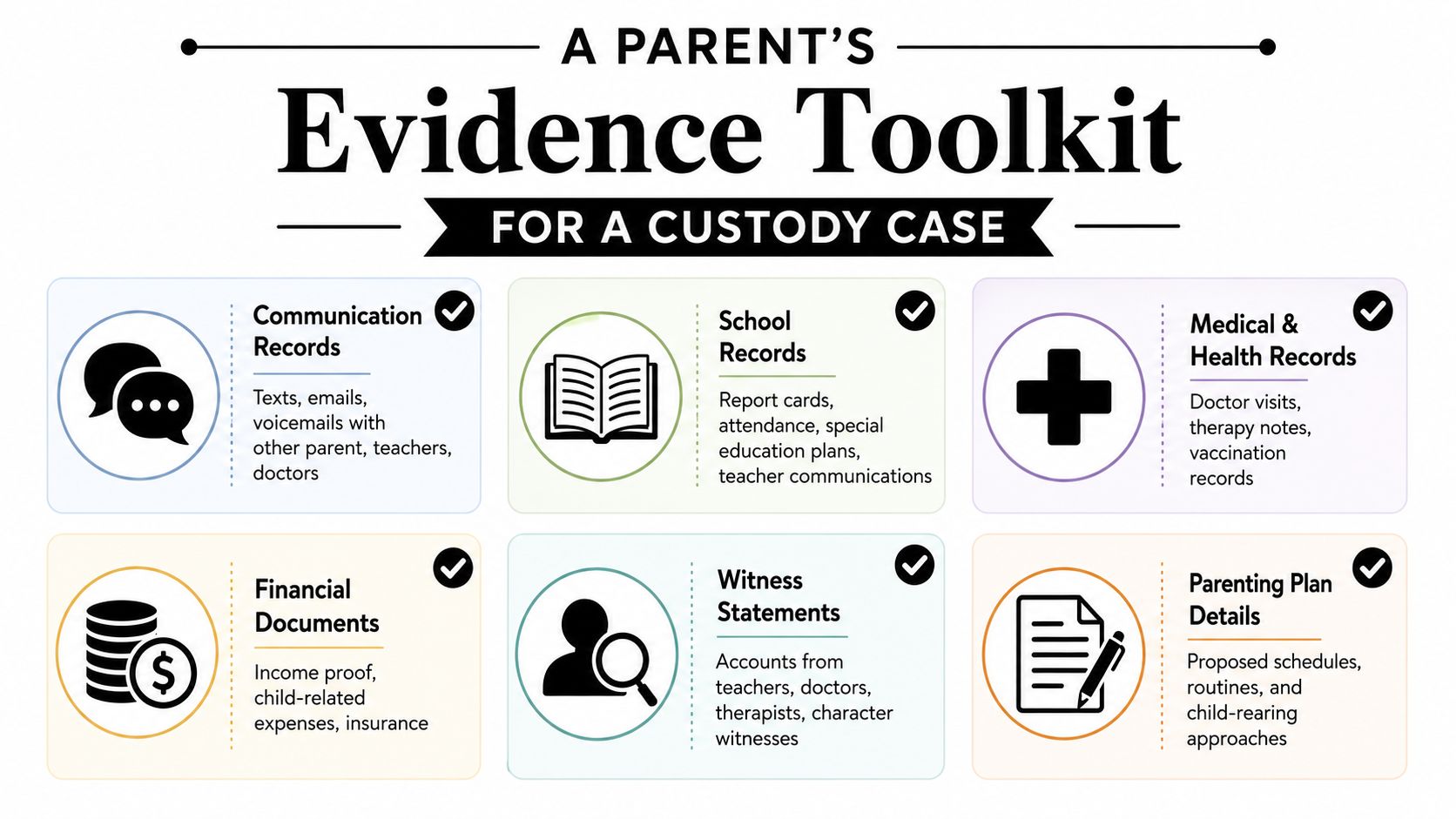
One Texas custody guide explains that daily-parenting evidence is often strongest when it comes from records tied to specific events, including texts, emails, school records, report cards, and a parenting journal documenting pickups, drop-offs, and communication attempts, as discussed in this guidance on what evidence to bring to family court in Texas.
Communication records
Texts and emails often matter more than parents expect. They can show cooperation, refusal to share information, missed exchanges, or repeated efforts to involve the other parent in the child's life.
Use communication records carefully.
- Keep complete threads: isolated screenshots can look misleading.
- Prioritize child-related topics: schedule changes, school issues, medical care, activity costs, and pickup details.
- Preserve teacher and doctor communication: portal messages, appointment confirmations, and follow-up instructions can be persuasive.
If your child goes to school in Kingwood or Humble, teacher emails and attendance alerts can become part of a larger timeline that shows who is responding and who is staying engaged.
Here's a short video that helps explain how custody evidence is often approached in practice.
Records that show daily parenting
A strong custody case usually includes proof of ordinary life. That's what judges trust because it's hard to fake consistently over time.
Examples include:
- School involvement: report cards, attendance records, teacher conference notes, behavior reports, and special program paperwork.
- Medical involvement: pediatric visits, dental visits, therapy scheduling, prescription pickup records, and after-visit summaries.
- Routine care: calendars showing pickup and drop-off patterns, childcare receipts, activity registrations, and meal or supply purchases tied to the child.
A parent in Porter who regularly takes a child to speech therapy should preserve appointment reminders, invoices, and communication with the provider. A parent in Humble who coaches the child's team can keep registration emails and schedule confirmations. Small records build a reliable picture.
Financial and practical support documents
Custody cases aren't only about affection. They also involve the practical side of raising a child.
A useful file may include:
| Evidence type | Why it helps |
|---|---|
| Pay stubs or income proof | Shows your financial picture and supports support-related issues |
| Insurance documents | Helps the court understand coverage for the child |
| Child-related receipts | Shows who pays for ordinary needs |
| Proposed parenting schedule | Gives the judge a workable plan instead of a vague request |
A judge can work with a detailed plan. A judge can't do much with “I just want what's fair.”
Witnesses can help, but documents usually lead
Teachers, counselors, doctors, coaches, and daycare staff may have relevant information. Still, most custody cases are stronger when witness testimony supports a paper trail rather than replacing it.
That's an important trade-off. A friend saying you're a good parent is nice. A school record showing you attended meetings and handled attendance issues is better. In Harris County, documents usually carry more weight than general character praise.
How to Collect and Preserve Evidence the Right Way
Parents often lose ground in custody cases not because they lacked evidence, but because they handled it poorly. They waited too long, deleted messages, mixed personal notes with guesses, or saved screenshots without dates.
The better approach is simple. Create a system you can maintain every day.
Start a real-time journal
A contemporaneous journal is one of the most useful tools in a custody case. That means you write entries as events happen, or close to it. The point is accuracy.
Include facts like:
- Exchange details: pickup time, drop-off time, who was present, and whether the exchange happened as ordered.
- Child-related concerns: missed homework, illness, medication issues, or comments the child made that need follow-up.
- Your involvement: helping with assignments, taking the child to appointments, contacting teachers, or arranging childcare.
Retrospective journals are weaker because they look reconstructed. Daily logs are more credible because they read like normal recordkeeping.
Write what happened, not what you think a judge will want to hear.
Preserve texts and emails correctly
Written communications can disappear. Phones break. Threads get deleted. Apps change. If a message matters, preserve it now.
A good practice looks like this:
- Screenshot the full exchange, not just one message.
- Make sure dates and times appear in the image.
- Save messages by topic or date so they can be found quickly later.
- Back them up in more than one place, such as secure cloud storage and a local drive.
- Do not delete negative messages from the other parent.
If you're dealing with texts as evidence, this explanation of whether text messages can be used in Texas family court is worth reviewing.
Build a filing system you can actually use
Some parents overcomplicate this. They create ten folders, then stop updating them. Others save everything into one giant phone album, which isn't much better.
Use a structure that mirrors how a case gets prepared:
- Communications with other parent
- School records
- Medical and therapy records
- Journal entries
- Photos and videos
- Financial and insurance documents
- Proposed schedules and court papers
If you prefer paper, use binders. If you prefer digital, use folders with clear names. Either way, label things by date. A clean file from a Kingwood parent is easier for an attorney to review and easier to use in court.
Mastering Harris County's Specific Court Rules and Deadlines
A parent can walk into a Harris County temporary orders hearing with a neat binder full of texts, report cards, and photos, then lose ground because pay records were never exchanged, proposed child support paperwork was missing, or exhibits were not submitted the way that court expects. That happens more often than people realize. In this county, good evidence still has to arrive on time, in the right format, and with the required financial documents attached.
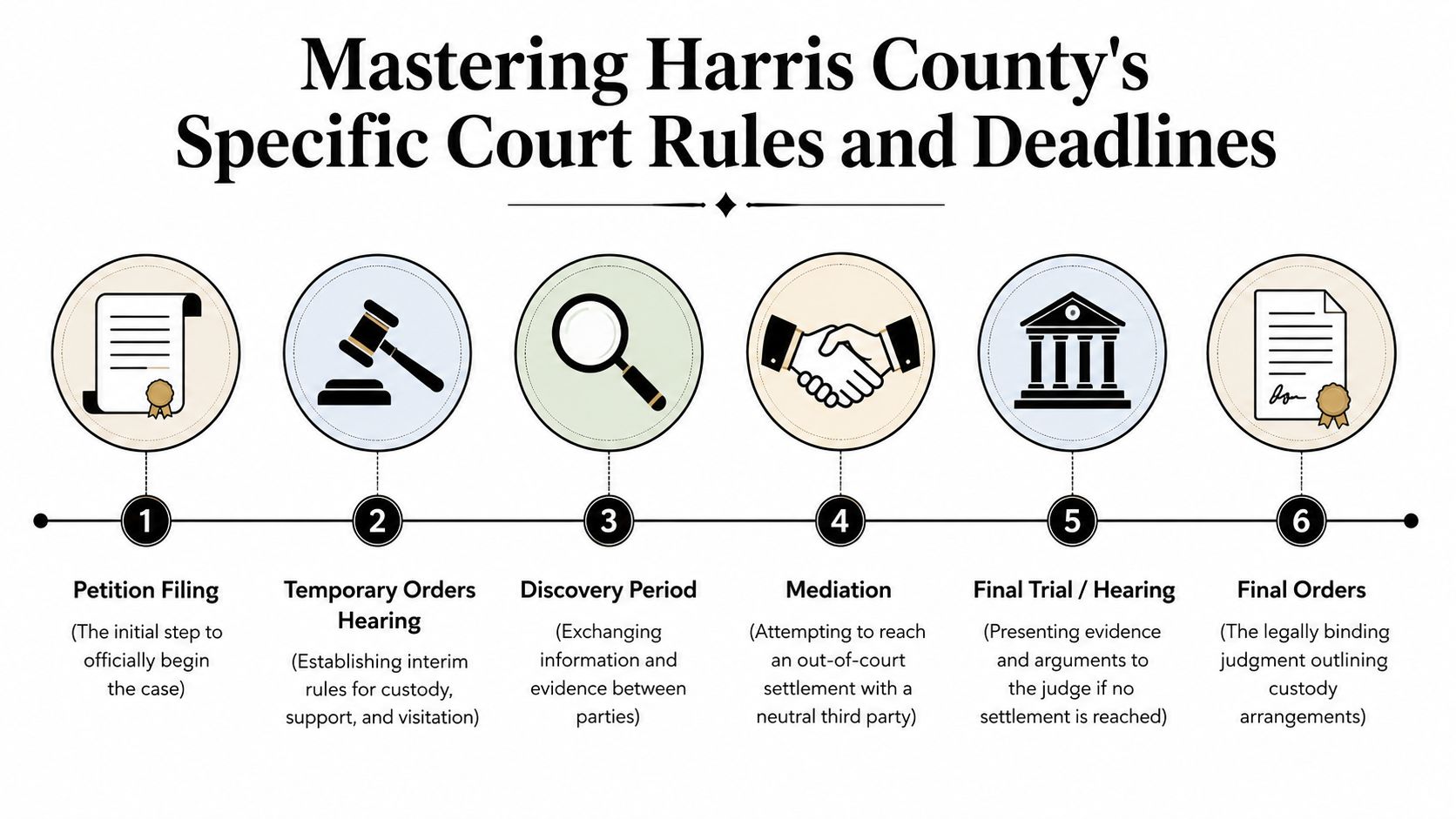
That is one of the biggest procedural traps in Harris County family court. Parents often treat custody proof and court-required disclosures as the same thing. Local judges do not. If conservatorship, possession, or child support is being decided, the court usually expects both categories to be handled correctly.
Here is the practical split:
| Category | What it usually includes |
|---|---|
| Court-required disclosures | Financial Information Statement, tax returns, pay stubs, inventory, proposed child-support findings, proposed property division |
| Persuasive custody exhibits | school records, medical records, attendance records, communication logs, calendars, photos, journals |
Temporary orders deserve their own preparation timeline. Final trial has a different one. Waiting to organize everything until the week before court creates avoidable problems, especially if support, reimbursement claims, or insurance coverage are part of the case.
Financial paperwork matters even in a case that feels mostly about parenting.
A lot of parents are surprised by that. They want to focus on missed pickups, school performance, or medical decision-making, but Harris County courts still want the financial picture if child support is on the table. Missing those records can make a parent look unprepared, even if the parenting evidence is solid.
Another local issue is format. Harris County courts commonly require evidence to be submitted electronically for hearings, often through cloud-storage links or other court-approved methods. That means a phone full of screenshots is not enough. Files need clear names, dates, and a structure your lawyer, the court coordinator, and the judge can follow without guesswork.
I tell parents to prepare as if the court will look at their file quickly, because that is often what happens. Judges tend to give more weight to evidence that is easy to verify, easy to place in time, and tied to a specific issue the court has to decide. Clean records beat a cluttered document dump.
There is also a filing point some parents miss at the start of a SAPCR case. Texas Law Help notes that for SAPCR cases filed after September 1, 2025, a certified copy of each child's birth certificate is required. If that rule applies to your case, add it to your opening checklist early instead of scrambling after the clerk or court flags it.
In Harris County, strong evidence helps only if it is disclosed, labeled, and submitted under the local rules the judge expects you to follow.
For a plain-English overview of how these courts are set up and what Kingwood families should expect, Harris County Family Courts: A Kingwood Resident's Guide explains the court structure and local workflow clearly.
From Evidence Binder to Courtroom Success Your Next Steps
The week before a Harris County custody hearing is when a lot of good cases start to wobble. A parent has screenshots on a phone, school emails in three inboxes, a few medical records, and a strong sense that the judge will understand the situation once everything is explained. Harris County family courts do not work that way. The parent who usually does better is the one who can hand the court a clean, dated, well-labeled set of exhibits tied to the exact issues the judge must decide.
That is the shift from collecting evidence to using it well.
Build a case the judge can absorb quickly
Judges in these courts often have limited time and crowded dockets. They are not sorting out every chapter of the relationship. They are looking for reliable proof about parenting decisions, stability, safety, follow-through, and whether the proposed orders serve the child's best interest.
A persuasive presentation usually has three features.
First, it is organized by issue, not by emotion. If the dispute centers on school performance, attendance, and who handles weekday structure, group those records together. If the dispute involves medical follow-up or missed exchanges, keep those records in their own section.
Second, it is anchored in dates. Harris County judges often give more weight to records that show a pattern over time than to one heated incident pulled out of context.
Third, it stays tied to the child. A parent who shows routines, communication, appointments, and practical planning usually comes across better than a parent who spends the hearing scoring points against the other side.
Know the difference between persuasive proof and clutter
Parents often ask what helps in court. The answer is usually less dramatic than people expect.
- Usually helpful: full text conversations with dates and names visible, school attendance records, report cards, medical records, pharmacy logs, calendars, exchange logs, receipts, and a consistent parenting journal.
- Usually weak: cropped screenshots, social media posts, long written statements with no supporting record, and broad claims such as “they are never involved.”
- Usually helpful: a proposed parenting plan that covers exchange times, school nights, holidays, transportation, and how the child's routine will work.
- Usually weak: asking for broad relief without a workable schedule the court can sign.
That trade-off matters in Harris County. Local judges tend to respond well to evidence that is easy to verify and easy to connect to a decision they must make today.
Credibility in a custody case usually comes from discipline. Clear records and a focused presentation carry more weight than a stack of grievances.
Courtroom presentation has its own rules
Strong facts can still get lost if the presentation is sloppy. An exhibit may be relevant and still draw an objection. A text thread may matter and still need proper foundation. A document may support your position and still be less useful at a temporary orders hearing than at trial.
That is why presentation strategy matters. The order of proof matters. The labeling matters. The decision about what to leave out matters too.
The Law Office of Bryan Fagan – Kingwood TX Lawyers handles family law matters for parents in Kingwood, Humble, and nearby communities, including custody disputes, child support issues, and related court proceedings. In cases like these, counsel often helps parents separate three categories: records the rules require, records the judge is likely to care about, and records that add bulk without helping the result.
Your next steps
Keep this part simple and practical.
- Pull your core records now. Start with school, medical, counseling, daycare, and parent communications.
- Sort them by issue and date. Use folders with plain labels such as school, medical, exchanges, and expenses.
- Match each exhibit to a point you need to prove. If a record does not help establish stability, involvement, safety, or compliance, it may not belong in the hearing set.
- Prepare the file in the format your court expects. In Harris County, that often means organized electronic exhibits rather than a loose collection of phone screenshots.
- Review everything before deadlines hit. Late disclosure, mislabeled files, or incomplete records can create problems that have nothing to do with the merits of your parenting case.
For parents in Kingwood, Humble, Porter, and Northeast Houston, that should be reassuring. The court is not looking for a perfect parent. The court is looking for a parent who can show, with reliable proof, how the child's needs are being met and what plan makes sense next.
If you feel overwhelmed, that is normal. Harris County family court can be demanding, especially for parents who have never had to deal with court coordinators, exhibit deadlines, or electronic submission rules before. Preparation helps. A calm, organized file gives your lawyer something useful to work with and gives the judge something clear to trust.
If you need help sorting out the evidence needed for a custody case in Harris County, Texas, schedule a free consultation with Law Office of Bryan Fagan – Kingwood TX Lawyers. Our Kingwood office works with parents in Kingwood, Humble, Porter, and Northeast Houston to review records, explain local court requirements, and help build a practical plan for the next step.