
Divorce rarely begins in a courtroom. For many residents in Kingwood, Humble, Porter, or Northeast Houston, it starts at the kitchen table. One person is trying to figure out whether to move money into a separate account for bills, whether they can stay in the house, whether the kids will keep their school routine, and whether filing first changes anything.
That early uncertainty is where good strategy matters most. A Harris County divorce has legal deadlines, local court practices, and practical pressure points that can affect your home life long before a final decree is signed. If you wait to get organized until the case feels “serious,” you may already be reacting instead of leading.
This guide is written the way a local family lawyer would explain it to a neighbor. Clear steps. Straight answers. Real trade-offs. If you need a broader overview of local filing procedure, this guide on filing for divorce in Harris County from Kingwood is a useful companion.
Your Guide to Navigating Divorce in Northeast Houston
A typical Northeast Houston divorce problem doesn't look dramatic from the outside. It looks like two parents in Kingwood trying to keep a school pickup routine intact while one spouse worries that the other will empty an account. It looks like a Humble homeowner asking whether leaving the house will hurt their position. It looks like a Porter parent wondering if “being reasonable” now will turn into a schedule they can't undo later.
Those are strategy questions, not just emotional ones.
The biggest mistake people make at the beginning is treating divorce as a single event. It isn't. It's a sequence of decisions, and the early decisions usually have the most practical impact. Where the children sleep this week, who pays the mortgage this month, who has access to records, and what routine gets established before the first hearing can influence the rest of the case.
Early stability often becomes the baseline the court is asked to preserve.
That doesn't mean every divorce turns into a fight. Some don't. But even cooperative cases benefit from planning. When people understand the process, they make fewer unforced errors. They save time, preserve credibility, and negotiate from a position of clarity instead of panic.
For families across Kingwood and Northeast Houston, the most useful approach is simple. Get the facts. Protect the records. Think carefully before making big moves. Then build a plan around the issues that matter most: children, housing, cash flow, and property.
The Crucial First Steps Before Filing for Divorce
The strongest divorce strategy in Harris County usually starts before the petition is filed. Good preparation is quiet, organized, and practical. You don't need courtroom drama. You need clean information and a realistic picture of your family's finances.
Texas requires at least 6 months of state residency and 90 days of county residency before filing, so venue has to be confirmed first. After that, the smart move is record preservation. One practical Houston divorce guide explains that the case then moves through formal notice, answer, disclosures, mediation or discovery, and finally decree drafting, while uncontested matters can sometimes finish in a few months and contested cases involving custody or complex assets commonly take a year or longer. That's why early document control matters so much, as noted in this Houston divorce workflow overview.
Start with what you can prove
Before filing, gather documents you can access lawfully and safely. Make copies, store them securely, and organize them in a way your attorney can use.
A practical checklist includes:
- Income records: recent pay stubs, tax returns, bonus information, and any proof of self-employment income.
- Bank and credit records: checking, savings, credit cards, and loan balances.
- Property records: deeds, mortgage statements, vehicle titles, retirement account statements, and business documents if applicable.
- Child-related records: school calendars, medical information, daycare arrangements, and any schedule that shows who has been handling daily care.
- Monthly expense details: utilities, insurance, groceries, tuition, activities, and recurring automatic payments.
If you're preparing for a first meeting with counsel in Kingwood, this checklist on what to bring to a consultation with a Texas family lawyer can help you avoid a second trip and a delayed strategy session.
Build a working inventory
Many spouses know the broad outlines of their finances but not the details. That's a problem. In divorce, vague understanding provides an advantage for the better-informed party.
Use a simple inventory with three columns:
| Category | What to list | Why it matters |
|---|---|---|
| Assets | House, vehicles, bank accounts, retirement, business interests, valuable personal property | You need a full picture before discussing division |
| Debts | Mortgage, credit cards, personal loans, tax debt, medical balances | Debt allocation can affect settlement as much as asset division |
| Monthly cash flow | Income in, required bills out, child-related costs | Temporary support and housing decisions depend on this |
What works and what doesn't
Some pre-filing moves help. Others usually backfire.
- Helpful: organizing records before service, documenting routine parenting involvement, and understanding the household budget.
- Risky: hiding money, deleting messages, changing passwords to shared records without legal advice, or making threats during arguments.
- Often unwise: moving out impulsively without a parenting and housing plan.
Practical rule: If a judge reviewed your actions later, would they look organized and child-focused, or reactive and punitive?
In Kingwood and Humble cases, the clients who tend to fare better are not always the loudest or most aggressive. They're the ones who can show the court a stable plan supported by documents.
Filing the Petition and Winning the Temporary Orders Phase
A common belief holds that the final trial is the center of a divorce case. In Harris County, that's often the wrong focus. The more consequential battleground is usually the temporary orders phase.
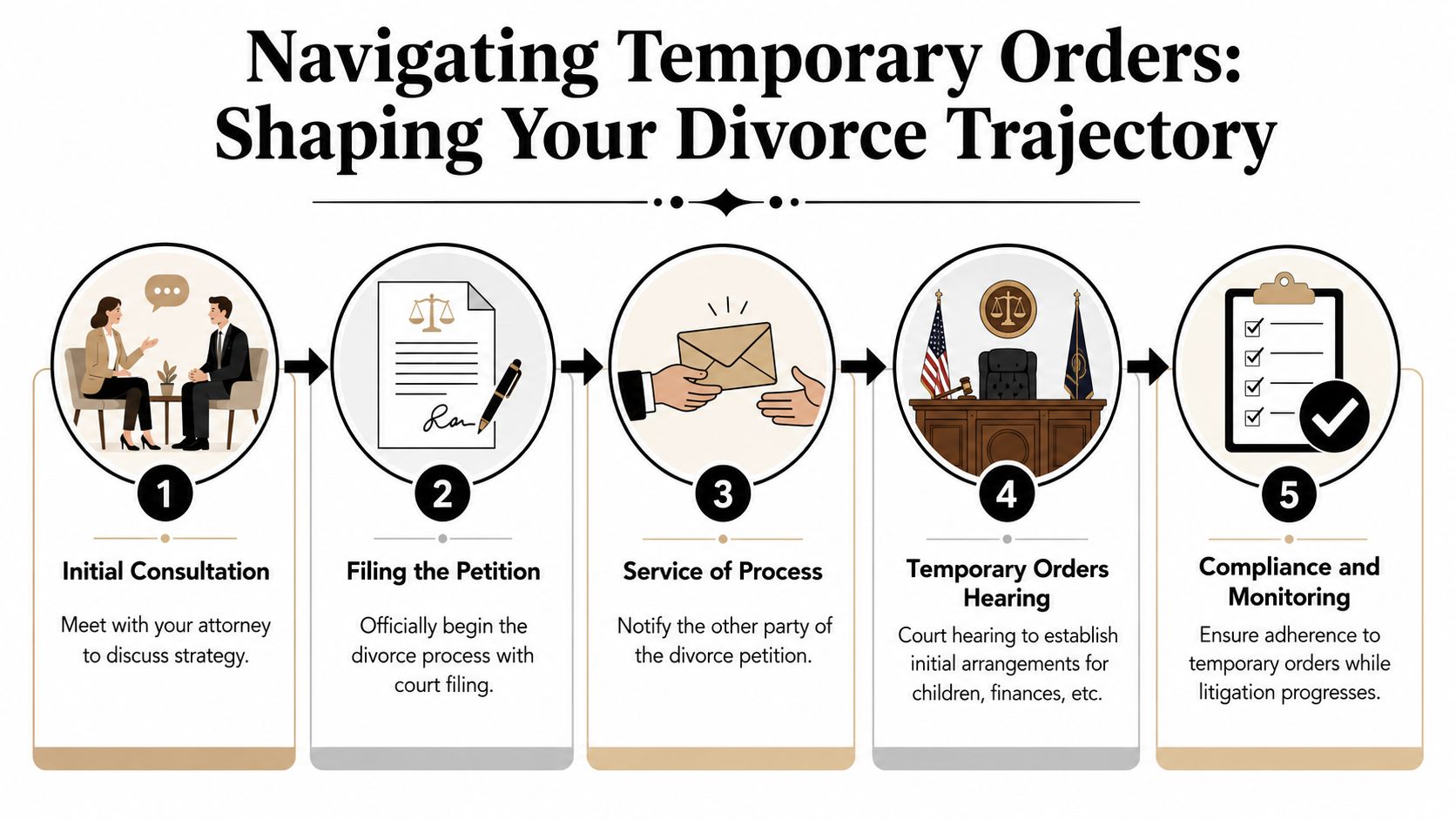
Local self-represented resources highlight a gap in public guidance. Temporary hearings and standing-order compliance are central procedural steps, and the first 2 to 8 weeks after filing can shape parenting time, housing, cash flow, and document access long before trial. That concern appears directly in the Harris County resources collected through these self-represented family law links.
Why temporary orders matter more than people expect
Temporary orders can address who remains in the home, how bills get paid, where the children stay, and what schedule applies while the case is pending. Once a temporary arrangement is in place, it often becomes the working pattern everyone lives under for months.
That practical reality creates an advantage.
If one parent has a stable temporary possession schedule that fits school, activities, and exchanges, the other side has to explain why the court should disrupt it later. If one spouse has temporary use of the home and responsibility for certain bills, that arrangement influences settlement conversations about refinancing, selling, or buying out equity.
The issues to prepare before the hearing
Temporary orders are not won by broad complaints. They are shaped by specific, organized facts. In a Kingwood divorce, the useful questions are concrete:
- Parenting time: Who has been getting the children ready for school, handling transportation, managing homework, and attending appointments?
- Housing: Who can realistically stay in the marital home? Is staying there tied to school continuity for the children?
- Cash flow: Which bills must be paid immediately to keep the household functioning?
- Records and property access: Does either spouse control accounts, devices, mail, or business information?
- Conduct concerns: Are there problems involving wasteful spending, interference with the children, or refusal to share information?
For parents dealing with urgent possession questions, this page on temporary custody orders in Texas is especially relevant.
What works in this phase
A good temporary-orders presentation is disciplined. It focuses on immediate needs, stability for the children, and preserving the marital estate. It avoids turning the hearing into a full trial on every grievance from the marriage.
This approach usually works better than:
- airing every personal complaint
- assuming the judge will “figure out” missing details
- asking for relief that can't be supported with documents or testimony
- agreeing to a short-term arrangement without considering how it may affect the final negotiation
Don't ask for a temporary arrangement you couldn't live with for an extended period. You may be living with it longer than you expect.
For Northeast Houston families, this is often the point where legal representation changes the tone of the case. A prepared lawyer can frame the dispute around evidence and workable relief instead of emotion and improvisation. The Law Office of Bryan Fagan – Kingwood TX Lawyers handles family law matters that involve these temporary-order issues, including custody, support, and property access.
Strategies for Property Division and Child Custody
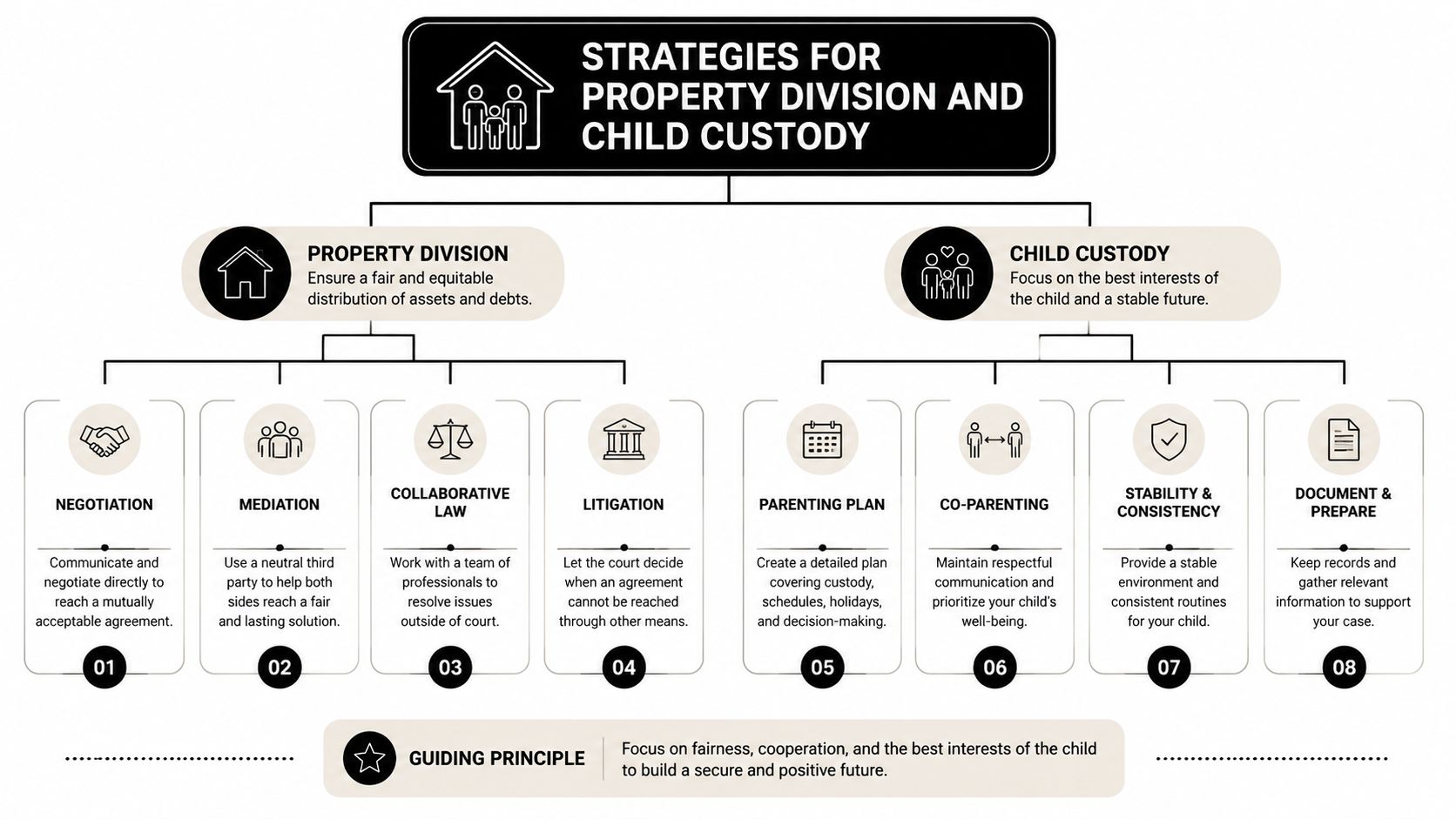
Property and parenting usually drive the hardest decisions in a Harris County divorce. They also require different kinds of thinking. Property division is about classification, valuation, and documentation. Child custody is about stability, decision-making, and what arrangement serves the children best in daily life.
Property division starts with classification
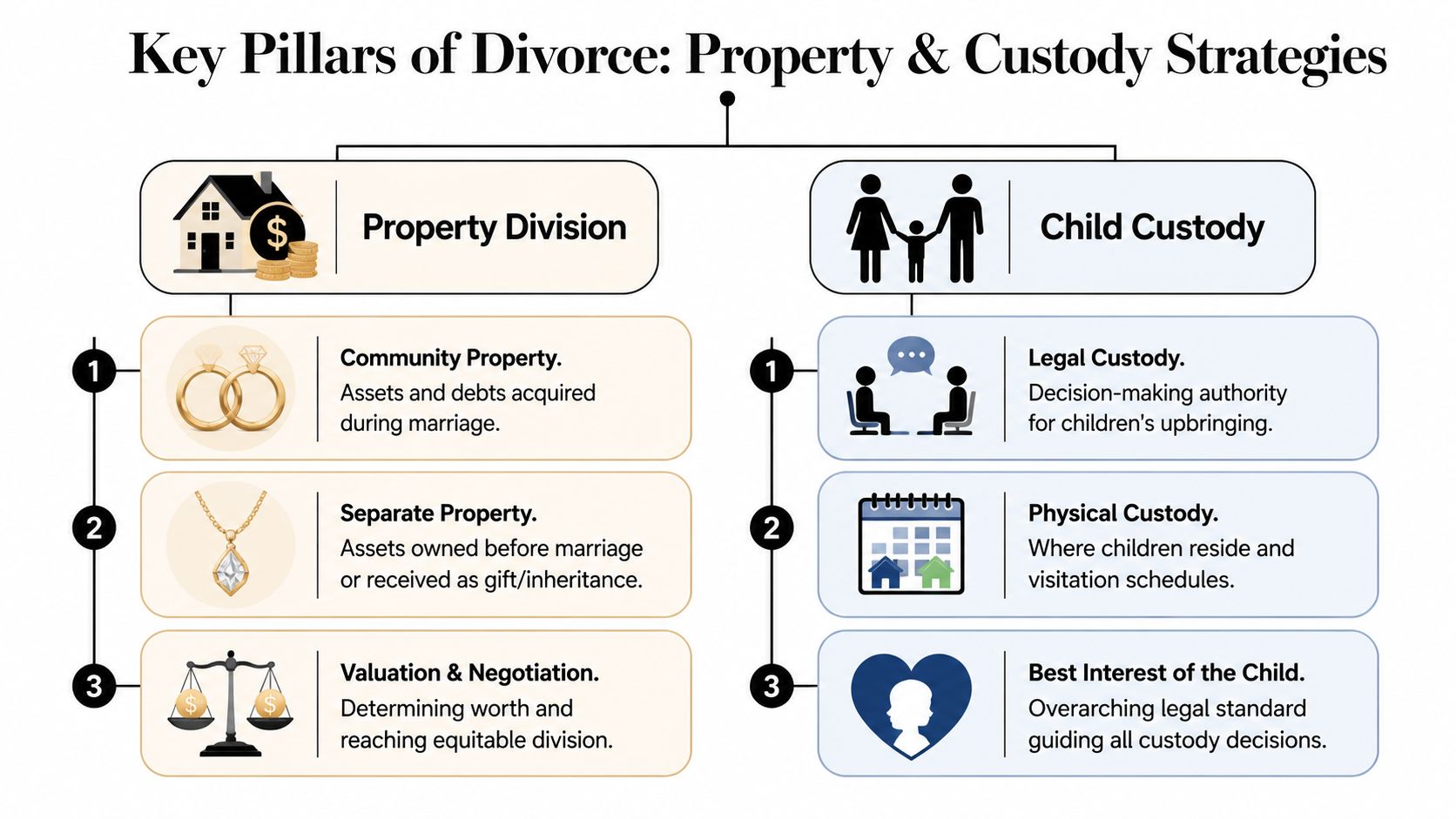
Texas follows community-property principles. In plain language, property acquired during the marriage is often part of the marital estate, while some property owned before marriage or received by gift or inheritance may be separate property. The legal labels matter, but the strategy starts with proof.
A Kingwood family might need to sort through a house, retirement savings, vehicles, credit-card balances, and perhaps a small business or side income. A Porter couple may have land, tools, or equipment tied to work. A Humble family might be less concerned with luxury assets and more concerned with whether one spouse can keep the home.
Three practical questions help:
| Question | Why it matters |
|---|---|
| When was this asset acquired? | Timing often affects whether an item is argued to be community or separate |
| What documents trace ownership? | Statements, deeds, and account histories can support or weaken claims |
| What is the real-world value and burden? | An asset with debt, taxes, or upkeep isn't the same as cash |
One frequent mistake is fighting over headline assets while ignoring the cost of keeping them. A spouse who insists on keeping the house needs to think beyond sentiment. Can they carry the mortgage, insurance, taxes, and maintenance after divorce? A retirement account may look less useful in the short term than cash flow and housing stability.
Child custody strategy is built around routine
In Texas family cases, people often say “custody” to mean everything involving the children. In practice, the key issues are decision-making, possession and access, and support. The best plans are specific enough to work on a school morning in Northeast Houston, not just broad enough to sound fair in a conference room.
Harris County courts place real importance on parenting education. A local family law resource explains that most courts in the county require a parenting course before custody hearings can proceed, and most courts also require mediation before temporary-order hearings in cases where custody is at issue. That same resource states that over 90% of mediated cases in Texas family courts result in settlements, and that parties must produce certain financial items no later than 10 days prior to trial, as outlined in this Harris County custody and divorce guide.
That means strategy is not just about what outcome you want. It's also about satisfying local requirements on time.
Here's a helpful overview for parents who want a broader family-law background:
Create a parenting proposal the court can use
A strong parenting proposal usually includes:
- A workable weekly routine: school drop-offs, exchanges, extracurriculars, and holiday expectations.
- A communication plan: how parents will share updates about school, health, and activities.
- Decision-making details: who handles medical, educational, and extracurricular choices, or how those decisions will be shared.
- Transportation logistics: especially important in a spread-out area like Northeast Houston where traffic and school location matter.
Judges tend to respond well to parenting plans that sound like they were built for the children, not for the parents' argument.
Child support questions also overlap with taxes, budgets, and household planning. If you're trying to understand one narrow issue that often causes confusion, this explanation of is child support taxable gives a straightforward tax-focused answer.
For families needing more direct help with conservatorship and possession issues, the firm's child-custody service pages on the Kingwood site are a logical next step.
The Path to Resolution Through Mediation
A lot of clients walk into mediation expecting a soft process. In reality, good mediation is disciplined negotiation. It's one of the few moments in a divorce where both sides can shape the outcome in detail instead of handing the decision to a judge who has limited time and limited room for customization.

For many Harris County cases, mediation isn't a side issue. It's a central decision point. That matters for Kingwood and Humble families because mediation lets you address school schedules, property division, debt allocation, possession exchanges, and move-out timing with more precision than a rushed courtroom hearing often allows.
What to bring into mediation
Mediation goes better when the work is already done. The people who struggle most are usually the ones who arrive with positions but not proof.
Bring or prepare:
- A current inventory: assets, debts, and disputed items.
- Support documents: statements, pay information, and any proposal tied to cash flow.
- A parenting framework: not just “I want more time,” but an actual schedule.
- Bottom lines and trade-offs: know what matters most and what you can exchange to get it.
For example, one spouse may care more about keeping the house through the school year. The other may care more about retirement funds, sale timing, or a cleaner debt split. Mediation is where those differences can become a structured deal.
What actually helps during negotiation
The best mediation strategy is rarely “start extreme and see what happens.” That can stall progress and make the other side defensive. A more effective approach is to separate issues into categories.
| Issue type | Better mediation approach |
|---|---|
| Parenting | Focus on routine, transportation, holidays, and decision-making |
| Home | Decide whether someone stays temporarily, refinances, buys out, or sells |
| Accounts and debts | Match each item with records and a proposed allocation |
| Support | Tie requests to actual monthly needs and available income |
Another mistake is treating every point as equal. They aren't. If you fight with the same intensity over a couch, a retirement account, and a school-week schedule, you weaken your credibility. Pick your priorities.
Settlement isn't surrender. It's the process of choosing the risks you can control over the risks you can't.
Mediation can also expose weak arguments early. That's helpful. If a proposal sounds good emotionally but falls apart when matched against records, schedules, or court expectations, it's better to learn that in mediation than at trial.
For local families who want a lawyer-guided negotiation process rather than a hearing-driven one, the mediation resources on the Kingwood site are worth reviewing before the session.
Your Final Strategy If Trial Becomes Necessary
Some Harris County divorces don't settle. When that happens, the right strategy is not to reinvent the case at the end. It's to bring together the work already done well: strong temporary orders preparation, organized records, a coherent property analysis, and a parenting proposal grounded in daily life.
Trial rewards clarity. The judge needs a usable picture of your family, your finances, and your requested outcome. That means your documents must be complete, your requests must be realistic, and your testimony must stay focused.
Prepare like the judge is seeing your life for the first time
By the time trial arrives, you may feel like the facts are obvious. They aren't obvious to the court. They have to be presented in a clean, supported way.
That usually means:
- Final document review: making sure required financial materials are organized and ready.
- Issue narrowing: identifying what is disputed and what can be agreed.
- Witness preparation: especially for any testimony about parenting roles, finances, or property history.
- Courtroom discipline: answering directly, avoiding speeches, and staying calm under pressure.
The strategic thread through the whole case
A solid divorce strategy in Harris County isn't built on one dramatic moment. It's built on consistent decisions.
The spouse who verifies filing requirements, preserves records, and prepares for temporary orders starts with more control. The parent who presents a stable school-week plan usually comes across better than the parent who argues in generalities. The party who enters mediation with a supported proposal is more likely to shape the settlement than the one who reacts.
For Kingwood, Porter, Humble, and Northeast Houston families, local knowledge matters too. Court procedures, standing orders, scheduling realities, and expectations around preparation all affect how a case unfolds. Even when trial becomes necessary, much of the outcome traces back to what happened at the beginning.
If you're facing divorce, don't wait until the pressure is unbearable to get answers. A focused plan can protect your children, your finances, and your footing in the case from the very start.
If you're ready to talk through your options with a local team, schedule a free consultation with Law Office of Bryan Fagan – Kingwood TX Lawyers. The Kingwood office helps clients across Kingwood, Humble, Porter, and Northeast Houston understand their rights, prepare for temporary orders, and build a practical strategy for divorce and family law matters.