When you're in the middle of a divorce or a custody dispute, everything can feel up in the air. The uncertainty is stressful for you, but it’s even harder on your kids. For families here in Kingwood, a temporary custody order in Texas is designed to bring immediate stability and structure to that chaos. It's the court's way of setting the ground rules for parenting while your case moves forward, creating a clear road map before any final decisions are made.
At The Law Office of Bryan Fagan, we understand what our neighbors in Kingwood, Humble, and Northeast Houston are going through. Our goal is to provide practical, step-by-step guidance to help you protect your family.
Your Guide to Temporary Orders in Texas
It helps to think of a temporary order as the official playbook for your co-parenting life during your lawsuit. This isn't just a set of friendly suggestions—it's a legally binding document that both parents are required to follow to the letter. For families here in Kingwood, Humble, and the greater Northeast Houston area, getting this initial stage right is absolutely critical.
The main goal is to keep life as normal and predictable as possible for your children. A judge will step in and lay out the rules for several key areas to make sure your kids have a routine they can depend on.
What a Temporary Order Covers
A Texas judge will make calls on the big-ticket items affecting your child's daily life. The whole point is to establish a new normal that's clear, consistent, and safe for everyone.
To give you a better idea, here's a simple breakdown of what a judge in the Kingwood area will decide in a temporary order. This table shows you exactly what's on the line for your family.
Key Elements of a Texas Temporary Custody Order
| Component | What It Means for Your Kingwood Family |
|---|---|
| Conservatorship | This is the legal term for custody. The judge will name one parent as the "primary" conservator, which means that parent gets to decide where the kids live. |
| Possession and Access | This is the visitation schedule. The order will spell out precisely when each parent has the children, including weekdays, weekends, and holidays. |
| Child Support | The court will calculate a temporary child support amount based on state guidelines. This ensures the child’s financial needs are covered right away. |
| Geographic Restrictions | The order almost always limits where the child can live, usually to Harris County and its neighbors. This keeps both parents close and involved in their child's life here in the Kingwood community. |
As you can see, these orders go right to the heart of your day-to-day life.
At the heart of every decision is the guiding principle of Texas law: the “best interest of the child.” This standard is not just a phrase—it is the lens through which a judge evaluates every piece of evidence to create a safe and nurturing environment for your children.
Why Temporary Orders Matter So Much
Under Texas law, the court’s number one job is to protect the “best interest of the child.” To do that, judges use temporary orders to lock down things like housing, school, and parenting schedules while the case is ongoing—a period that can easily last from 6 to 18 months. For a family in Kingwood, this means a decision made in a short hearing can control your daily life for a very long time. You can learn more about this by reviewing these additional insights on Texas family law procedures.
Because these early rulings often set the stage for the final outcome, it's incredibly important to put your best foot forward from day one. The "temporary" arrangements have a funny way of becoming permanent. At The Law Office of Bryan Fagan, our Kingwood lawyers know just how much hangs in the balance at that first hearing. Our team is here to make sure Kingwood families walk into court feeling prepared and supported. If you’re facing a custody battle, contact our Kingwood office today for a free consultation to talk about your family and how we can protect your future.
Emergency Orders vs. Standard Temporary Orders

When you're dealing with a custody case in Kingwood, it's crucial to know that not all temporary orders are the same. Most families will go through the standard process, but some high-stakes situations call for an emergency order. Here’s a good way to think about it: a standard temporary order is like a carefully planned road map for the months ahead, setting out all the stops and rules. An emergency order? That's like slamming on the brakes to avoid an immediate and certain crash.
Standard temporary orders are the norm. They are put in place after both parents have had a chance to present their case to a judge. These hearings are scheduled with plenty of notice, giving everyone time to prepare. The main goal is to create a stable, predictable routine for the child while the rest of the case moves forward.
An emergency order, which lawyers often call a Temporary Restraining Order (TRO) with extraordinary relief, is a much more drastic and immediate tool. It’s typically sought ex parte, which is a legal way of saying a judge can grant it based on just one parent's side of the story, often without the other parent even knowing a hearing is happening. This is a powerful legal move, and it's reserved for true crises that threaten a child's safety.
When Is an Emergency Order Justified?
Because an emergency order can instantly take away a parent's rights, even for a short time, the bar for getting one is incredibly high. A judge in Harris or Montgomery County will only sign off if there's a credible, immediate threat to a child's physical health or emotional well-being.
The Texas Family Code is very clear on this. It allows a judge to issue an emergency order only if "the court finds that there is a clear and present danger of family violence." This isn't about petty arguments or different parenting styles; it's about imminent harm.
A gut feeling or general suspicion just won’t cut it. You have to show up with concrete evidence of a serious and immediate risk. Situations that might rise to this level include things like:
- Credible threats of child abduction, especially if a parent has the means and intent to leave the state or country.
- Proof of recent drug or alcohol abuse that directly endangers the child.
- Documented instances of physical or sexual abuse against the child or someone else in the home.
- A parent experiencing a severe mental health crisis that makes them incapable of providing safe care.
The Higher Burden of Proof
To even have a shot at an emergency order, you must file a sworn affidavit—a written statement you make under oath—that spells out the immediate danger. This is no time for vague complaints. Your affidavit needs to be packed with specific facts: dates, times, locations, and detailed descriptions of what happened.
For instance, just saying the other parent is "unstable" is a non-starter. You’d need to back that up with hard evidence, like a police report from a recent domestic disturbance, threatening text messages, or photos showing a dangerous living situation. For our clients in the Humble and Porter areas, we always emphasize that gathering this proof is the most critical first step.
What Happens After an Emergency Order Is Issued?
If a judge does grant the emergency order, it's really just a temporary patch. Texas law is strict about this: a full hearing must be scheduled very quickly, usually within 14 days.
At that follow-up hearing, the other parent gets their chance to respond and tell their side of the story. The judge will then listen to both sides and decide what to do next—either let the emergency order expire or convert it into a standard temporary order that will remain in place for the rest of the case.
Knowing whether your situation needs a standard or an emergency order is a critical judgment call. At The Law Office of Bryan Fagan, our Kingwood attorneys can help you assess the danger and act swiftly to protect your child. If you believe your child is in immediate danger, please schedule a free, urgent consultation with our team today. We are here to help our Kingwood community members.
The Best Interest of the Child: The Guiding Principle in Every Texas Custody Case
Every single decision a Texas judge makes about your children, whether it's during a quick temporary hearing or a full-blown trial, boils down to one guiding principle: the best interest of the child. It sounds simple enough, but this isn't about what feels fair to the parents or what's most convenient for their schedules. It’s a powerful legal standard that forces the court to look at the world entirely through the child’s eyes.
For families here in Kingwood and across the Houston area, really grasping what this means is the first step toward building a successful case. A judge isn't just going to look at who has a nicer home or makes more money. Their job is to dig much deeper, analyzing your family's unique circumstances to figure out what will create the safest, most nurturing, and most stable environment for your kids.
To help them do this, Texas law gives judges a roadmap called the "Holley Factors." These came from a historic Texas Supreme Court case and now serve as a checklist for evaluating what truly serves a child's best interests.
What Are the Holley Factors?
You can think of the Holley Factors as the specific questions a judge is trying to answer about each parent. They're not looking for a single "gotcha" moment; instead, they weigh all these factors together to paint a complete picture of the family. If you're heading into a temporary orders hearing, presenting clear, compelling evidence that speaks directly to these points is absolutely crucial.
Here are some of the key questions a judge will be asking, put in plain terms:
- The Child’s Needs: What does this specific child need to thrive, both emotionally and physically, now and in the years to come? This is about more than just food and shelter—it includes love, guidance, and emotional support.
- Parental Abilities: Who has been the primary caregiver? The court will look at which parent has historically been the one to handle things like doctor’s visits, homework help, and day-to-day routines.
- Stability of the Home: A judge is looking for consistency. They'll assess the stability of each parent's home life, favoring an environment that is predictable and secure for the child.
- Any Present or Future Danger: Is there anything about a parent's home or lifestyle that could put the child in physical or emotional danger? This is where issues like family violence, neglect, or substance abuse come under intense scrutiny.
How This Applies to Your Kingwood Family
These aren't just abstract legal theories; they are directly relevant to your life here in Kingwood, Humble, or Porter. The evidence you bring to court should be designed to answer the judge’s questions about these factors.
For instance, to prove your "parental abilities," you might show how you've always handled your child's enrollment and parent-teacher conferences at the local Humble ISD school. To demonstrate a stable home, you could provide proof of your long-term residence in your Kingwood neighborhood and your involvement in community activities.
A judge’s decision is fundamentally a human one. They are trying to piece together a story of your family life to make the best possible choice for your child. Your job is to provide them with the clear, compelling chapters that show you as a stable, loving, and capable parent.
On the flip side, anything that suggests instability can seriously damage your case. Constantly moving, having a chaotic work schedule that requires a revolving door of babysitters, or showing an inability to communicate peacefully with the other parent are all red flags for the court. For parents hoping to be named the primary caregiver, it is vital to understand how to get sole custody in Texas, which often means proving the other parent presents a risk according to these very factors.
Ultimately, every document you file and every word you say in court should connect back to this core standard. At The Law Office of Bryan Fagan, we specialize in helping Kingwood families frame their stories in a way that resonates with judges. If you're facing a custody hearing, give our Kingwood office a call for a free consultation. We can help you build a case that puts your child’s best interest front and center.
How to Prepare for Your Temporary Orders Hearing
Walking into a temporary orders hearing is, without a doubt, one of the most critical moments in any Texas custody case. These hearings move fast—often lasting less than an hour—but the decisions made can set the stage for your family’s life for many months, and sometimes even years. For families in Kingwood, Porter, and the surrounding Northeast Houston area, being thoroughly prepared isn't just a good idea; it’s absolutely essential for protecting your rights and your child's well-being.
The secret to a successful hearing is to shift your mindset away from emotional arguments and toward hard, factual evidence. A Harris or Montgomery County judge needs clear, organized information to make a ruling based on the “best interest of the child” standard. This means your preparation needs to be all about gathering documents and weaving them into a compelling, evidence-based story.
Gathering Your Essential Evidence
Long before you set foot in the courtroom, you need to start collecting the paperwork that tells the story of your role as a parent. Think of yourself as an archivist for your child's life, pulling together tangible proof of your involvement and your ability to provide a stable, loving home.
Your evidence file should be well-organized and include things like:
- Financial Records: This means recent pay stubs, bank statements, and tax returns. This isn't just about money; it’s about proving you have the financial stability to support your child and helps the judge accurately calculate child support.
- Child-Related Documents: Gather school report cards, attendance records, and medical or immunization charts. These items paint a picture of your direct involvement in your child’s education and health.
- Communications Log: Keep a detailed, factual log of every conversation you have with the other parent. Save text messages, emails, and messages from parenting apps, but focus on the substance—discussions about schedules, medical decisions, and school matters.
- Proposed Schedules: Don’t just tell the judge what you want; show them. Create a clear, written proposal for a possession schedule and a monthly budget outlining your child’s expenses. This demonstrates that you’ve put serious thought into a workable plan for the future.
This infographic breaks down the key factors a judge weighs, which should be the roadmap for how you gather your evidence.
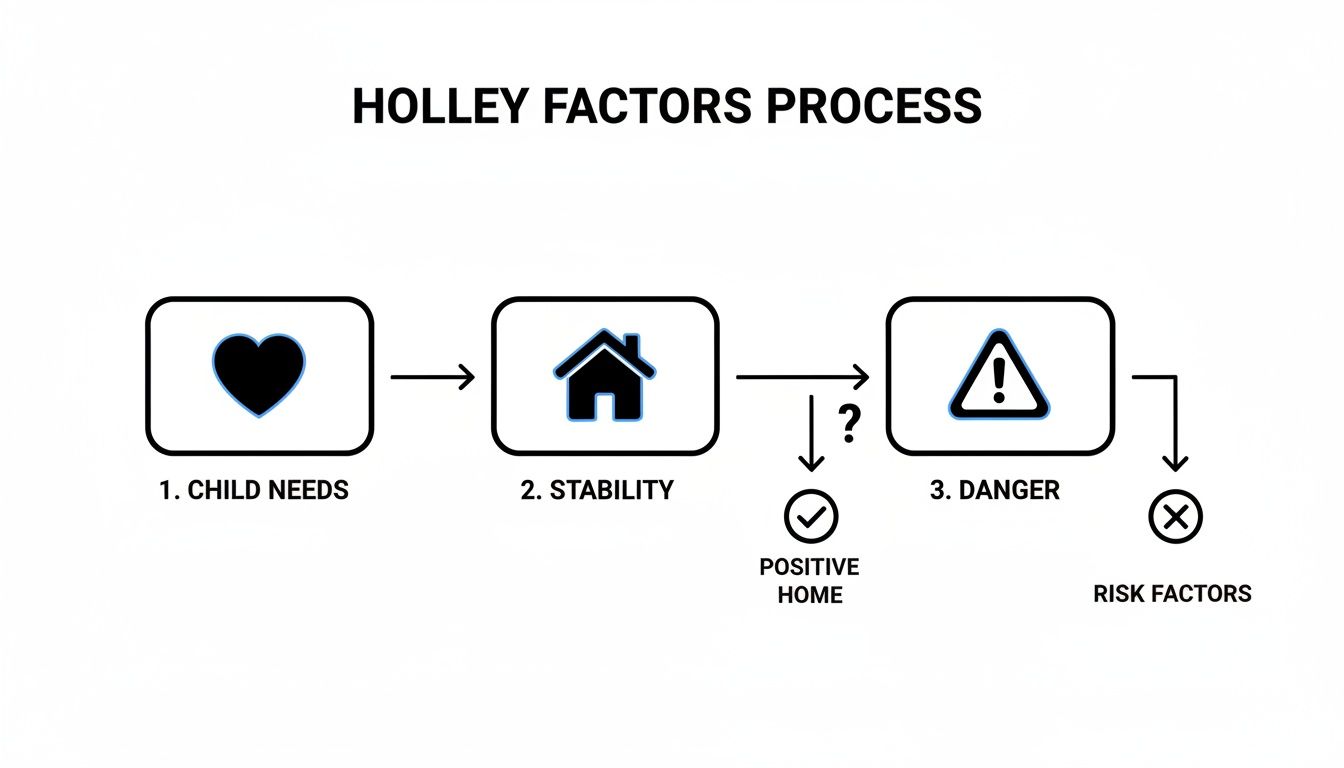
As you can see, a judge is constantly balancing a child's needs, the stability each parent can offer, and any potential dangers. Your job is to present solid evidence that speaks to each of these points.
Crafting a Persuasive Sworn Affidavit
One of the most powerful tools you have is a sworn affidavit. This is your written testimony, submitted to the judge before the hearing, where you lay out the facts of your case under oath. It’s your first and best chance to tell your story in a clear, concise, and persuasive way.
A strong affidavit isn't a place to vent or list complaints. It’s where you connect specific facts to the best interest of your child. For instance, instead of saying, "The other parent is irresponsible," you would state, "On March 15, April 2, and April 10, the other parent was over an hour late picking up our child from daycare, requiring me to leave work early to do so." That level of specific, provable detail is what gets a judge’s attention.
Your affidavit should read like a factual report, not an emotional diary. Stick to what you can prove with documents or your own firsthand knowledge. A well-written affidavit can practically win your hearing before you even say a word in court.
Setting Realistic Expectations for the Hearing
You need to understand a hard truth: temporary orders often become the template for the final orders. A parent who is named the temporary primary conservator during a quick hearing is very likely to keep that role in the final decree unless something major changes. This is why getting it right from the start is so important.
Because these hearings are so brief, you won't have time to tell your life story. Your testimony has to be direct, focused, and powerful. An experienced Kingwood family law attorney is invaluable here. They know how to cut through the noise, make sure your most important points are presented effectively, and navigate all the proper court procedures. If you're looking for representation, knowing some of the strategies for lawyer lead generation can help you find a qualified attorney who fits your needs.
Preparation is everything. At The Law Office of Bryan Fagan, we work hand-in-hand with our Kingwood clients to build a solid, evidence-based case right from the very beginning. If you have a temporary orders hearing on the horizon, call our office today for a free consultation. We’ll help you walk into that courtroom prepared and confident.
How Recent Texas Laws Affect Your Custody Case
Texas family law isn't a dusty old rulebook; it's constantly evolving to better serve the needs of children. For families right here in Kingwood and Humble, keeping up with these changes isn't just a good idea—it's essential. These updates can directly shape the outcome of your temporary custody orders, so knowing what's new is crucial.
Recently, Texas lawmakers made some significant updates that have really changed the game, especially when it comes to parenting schedules and what happens when someone violates a court order.
The New Default: The Expanded Standard Possession Order
In the past, judges almost automatically defaulted to what's called a Standard Possession Order (SPO). But that's changed. Now, the Expanded Standard Possession Order (ESPO) is the presumed starting point for any parents living within 50 miles of each other. This is a huge deal for co-parents across Northeast Houston.
So, what does this mean for your family? It means the court now begins with the assumption that the ESPO is the right schedule, unless one parent can prove it isn't practical or isn't in the child's best interest. This shift often gives the non-primary parent significantly more time with the kids right from the start, even during the temporary orders phase. If you'd like to dive deeper, you can learn about the latest in Texas family law reforms here.
Let's break down what an ESPO might look like for a local Kingwood family. It generally allows the non-primary parent to:
- Pick up the child directly from school on their designated Thursdays and Fridays.
- Keep the child all the way through the weekend until school starts again on Monday morning.
This arrangement creates longer, more consistent blocks of time and cuts down on the back-and-forth exchanges, which many child development experts agree helps create stability. It's a real departure from the old model, which might have only included a brief dinner visit on a Thursday.
Cracking Down: Stricter Enforcement for Violations
Along with updating the possession schedules, Texas has also given judges more power to enforce temporary custody orders. The message is loud and clear: these orders are not optional guidelines. They are legally binding commands that demand strict compliance.
If your co-parent in Kingwood or Porter is constantly showing up late, denying you court-ordered time with your child, or making unilateral decisions, the consequences are now much more serious.
Judges have been given enhanced authority to act decisively when a parent flouts an order. This could mean ordering make-up parenting time, imposing fines, forcing the non-compliant parent to pay your attorney’s fees, and in the most extreme cases, even jail time for contempt of court.
This increased emphasis on enforcement makes documentation absolutely critical. If you're dealing with a co-parent who refuses to follow the rules, your best defense is a detailed log of every single violation. Keep track of dates, times, and exactly what happened.
The legal landscape is always changing, but our focus on helping Kingwood families never wavers. At The Law Office of Bryan Fagan, we make it our business to stay ahead of every legislative update so we can offer you the sharpest, most effective legal strategy. If you're wondering how these new laws might impact your specific situation, reach out and schedule a free consultation with our Kingwood office today.
What Happens After a Temporary Order Is Signed?
Getting a judge to sign your temporary custody order is a huge step forward, but it's important to see it for what it is: the beginning of a new phase, not the finish line. Once that order is in place, you really have two main jobs: following it to the letter and knowing what to do if life throws you a curveball.
Living by the terms of the order is non-negotiable. We constantly remind our Kingwood clients that how you act during this "temporary" period is basically an audition for the final hearing. A judge will be looking closely at your behavior. When you consistently stick to the possession schedule and co-parent without drama, you're building a powerful case that you are a stable, reliable parent who truly puts your child first.
When Life Changes the Plan
That said, a temporary order isn't carved in stone. Life here in Northeast Houston doesn't always go according to plan, and Texas family law is built to accommodate that reality. If something major happens—what the law calls a "material and substantial change"—you have the right to ask the court to modify the order.
A material and substantial change is a significant event that directly affects your child's well-being, making the current orders impractical or no longer in their best interest.
So, what does that actually look like for a family in Kingwood or Humble? It could be any number of things:
- One parent unexpectedly loses their job and can no longer meet child support obligations.
- A parent gets a great job offer that requires them to move out of the area.
- A child develops new medical issues or educational needs that require a different schedule.
Getting a handle on these rules now is crucial, because the same principles apply to the final orders that will shape your family's future for years to come. You can learn more about how courts create those long-term plans in our guide to shared custody in Texas.
At The Law Office of Bryan Fagan, our Kingwood attorneys have been through this process thousands of times. If your circumstances have changed and the current order just isn't working anymore, schedule a free consultation with us. We can help you figure out the best path forward for your family.
Your Top Questions About Temporary Orders, Answered
When you're dealing with a custody case, it feels like a million questions pop into your head at once, especially when it comes to your kids. For families here in Kingwood and across the Northeast Houston area, figuring out temporary custody orders can be a major source of stress. We've put together some plain-English answers to the questions we hear most often from our clients to help clear things up.
Our aim is to give you straightforward, practical information so you can feel more confident and prepared for what’s ahead.
How Long Do Temporary Custody Orders Last in Texas?
Think of a temporary custody order as the set of rules you'll live by for the entire length of your divorce or custody case. Here in Harris or Montgomery County, that usually means the order will be in place for 6 to 18 months. It's the legally binding "rulebook" for how you and the other parent will handle things until you either settle the case or a judge makes a final decision after a trial.
It’s incredibly important to take these orders just as seriously as you would a final order. Why? Because the arrangements you live by for months often set a strong precedent for what the judge decides in the end.
Can I Move Out of Kingwood With a Temporary Order?
Probably not without permission. Almost every temporary order we see includes a geographic restriction. This basically locks in the child's residence to a specific county, like Harris County, and sometimes the counties right next to it. If you want to move with your child outside that designated zone, you have to get the other parent's written agreement or get the judge's approval first.
Trying to move without permission is a serious misstep that can have major legal blowback. Before you even think about relocating—even to a nearby town like Humble or Porter—you need to speak with an attorney.
Following the geographic restriction is not just a suggestion; it is a direct command from the court. Unauthorized moves can jeopardize your custody rights and result in serious penalties, demonstrating to the judge an unwillingness to co-parent or follow court directives.
What if the Other Parent Violates the Temporary Order?
It's frustrating when the other parent doesn't follow the rules, like refusing to let you see your child during your scheduled time. The good news is, you have legal options. The first, and most important, step is to document everything. Keep a detailed log of every single violation, noting the date, time, and exactly what happened.
With that evidence, your Kingwood attorney can file a Motion for Enforcement with the court. A judge has the power to hold the other parent in contempt, which could mean fines, ordering make-up visitation time, making them pay your attorney's fees, or in serious cases, even jail time. Recent changes to Texas law have actually made enforcement actions more potent, so acting quickly is key.
Do We Have to Go to Court for Temporary Orders?
Not always. If you and the other parent can actually agree on all the key issues—like custody, visitation schedules, and child support—your lawyers can write up what's called an "Agreed Temporary Order." This document gets sent to the judge to be signed, and you get to skip the stress of a contested hearing.
Going this route is almost always less expensive, less public, and a lot less draining on everyone involved. Our Kingwood attorneys are experienced negotiators who prioritize finding common ground for families in Northeast Houston. We always look for the cooperative path first and will support you in reaching a peaceful resolution if possible.
At The Law Office of Bryan Fagan – Kingwood TX Lawyers, we know you need clear answers and a smart plan. We are proud to serve the Kingwood community, providing the experienced and compassionate guidance your family deserves. Schedule a free, no-obligation consultation with our local attorneys today. Visit us at https://kingwoodattorneys.com.