A lot of contract problems in Kingwood don’t start in a boardroom. They start with trust.
A neighbor hires a contractor to remodel a kitchen in Forest Cove. A small business owner in Humble orders inventory for a busy season. A family in Porter agrees to sell equipment, split work on a side business, or pay for services over time. Everyone nods. Texts are exchanged. Maybe there’s a written estimate. Maybe there’s only a handshake and a promise that “we’ll make it right.”
Then the work stalls. Payment never comes. Materials don’t match what was promised. One side says the deal changed. The other says it didn’t.
That’s where breach of contract disputes begin. They feel personal because they usually are. But Texas law treats them as a legal problem with specific rules, specific proof, and specific remedies. If you live in Kingwood, Humble, Porter, or Northeast Houston, it helps to understand those rules before you decide whether to push harder, settle, or file suit.
When a Handshake Agreement Goes Wrong in Kingwood
A common story goes like this. A Kingwood homeowner hires someone to build a patio cover before summer. The contractor gives a price, the homeowner sends a deposit through Zelle, and everyone agrees the job will be done by a certain date. A week later, the contractor says material costs changed. Then communication slows down. Then the crew stops showing up.
The homeowner isn’t just angry. They’re stuck. Do they wait? Hire someone else? Demand the money back? Sue?
That same pattern shows up in all kinds of local disputes. A vendor misses delivery for a school fundraiser in Northeast Houston. A lawn care provider finishes only half the work in Porter. A business partner in Humble stops honoring a payment agreement. The facts change, but the feeling doesn’t. You relied on a promise, and now you’re left with the cost, delay, and uncertainty.
Broken promises are common legal disputes
Contract fights aren’t rare. In the nation’s largest counties, state courts disposed of an estimated 366,000 civil contract disputes in a single year, and those cases made up nearly half of all disposed tort, contract, and real property matters, according to the Bureau of Justice Statistics report on civil cases in large counties.
That matters because people often assume a contract case is unusual or extreme. It isn’t. Courts deal with them all the time, and so do Texas lawyers.
Practical rule: If a dispute involves a promise, performance, money, or missed deadlines, treat it seriously early. Waiting often makes the proof harder to gather.
Why these cases feel confusing
Many Kingwood residents hesitate because they aren’t sure whether what happened “counts” as a real contract problem. They may wonder:
- Was it enough that we agreed by text?
- Does a handshake count in Texas?
- What if I also made mistakes?
- What if the other side says the terms changed?
Those are fair questions. The answer usually depends on the details, not just on who feels more wronged. That’s why the first step is understanding what Texas recognizes as a binding agreement in the first place.
What Is a Legally Binding Contract in Texas
A contract is just an enforceable agreement. In plain language, one side promises to do something, the other side agrees, and both intend the promise to matter legally.
Consider a house plan. If you don’t know what is being built, who approved it, and what each side is giving in return, you don’t really have a useful blueprint. A court looks at contracts in a similar way.
The core pieces of a valid contract
Texas contract disputes usually turn on a few basic building blocks.
- Offer: One person or business proposes specific terms. “I’ll install your fence for this price by this date.”
- Acceptance: The other side clearly agrees to those terms.
- Exchange of value: Each side gives something. That might be money, labor, goods, access to property, or a promise to do or not do something.
- Intent to be bound: Both sides mean for the agreement to have legal consequences, not just to be casual talk.
If one of those pieces is missing, the case gets harder. A vague conversation about “working something out later” may not be enough. A detailed estimate, signed proposal, email chain, invoice, or text thread often helps show the agreement was real.
Does it have to be in writing
Not always. Some agreements can be verbal and still be enforceable. But verbal agreements create proof problems. People remember conversations differently, especially after money has changed hands or a project has gone bad.
A written contract is safer because it answers the questions that usually trigger lawsuits:
- What exactly was promised
- When was performance due
- How much was to be paid
- What happens if there’s a delay or dispute
- Whether changes had to be in writing
That’s why local businesses in Kingwood and Humble should put even simple deals in writing. A one-page agreement is usually better than relying on memory.
The best contract is often the one that feels boring when you sign it. Clear dates, clear prices, and clear duties prevent emotional fights later.
Common points of confusion
People often think “I didn’t sign a formal contract” means “I have no case.” That isn’t always true. Emails, text messages, invoices, purchase orders, and partial performance can all matter.
On the other hand, people also assume every promise is enforceable. That’s not true either. General discussions, loose plans, and incomplete negotiations may fall short.
A good way to pressure-test your situation is to ask whether an outsider could identify the terms without guessing. If the answer is no, the dispute may involve more than one legal issue, including whether a contract existed at all.
For local business owners sorting out shared ventures, ownership expectations, or informal operating arrangements, this often overlaps with business structure questions. A helpful starting point is this discussion of joint venture vs. partnership, because many contract disputes begin when people never clearly defined their relationship.
Why written terms matter in real life
A written agreement doesn’t prevent every breach of contract claim. It does make three things easier:
- Proving the deal existed
- Showing who failed to do what
- Calculating damages
Without that paper trail, many disputes become credibility contests. And credibility contests are expensive.
The Four Elements of a Breach of Contract Claim
When someone files a breach of contract case, the court doesn’t decide it based on who seems more upset. The court looks for proof of specific legal elements.
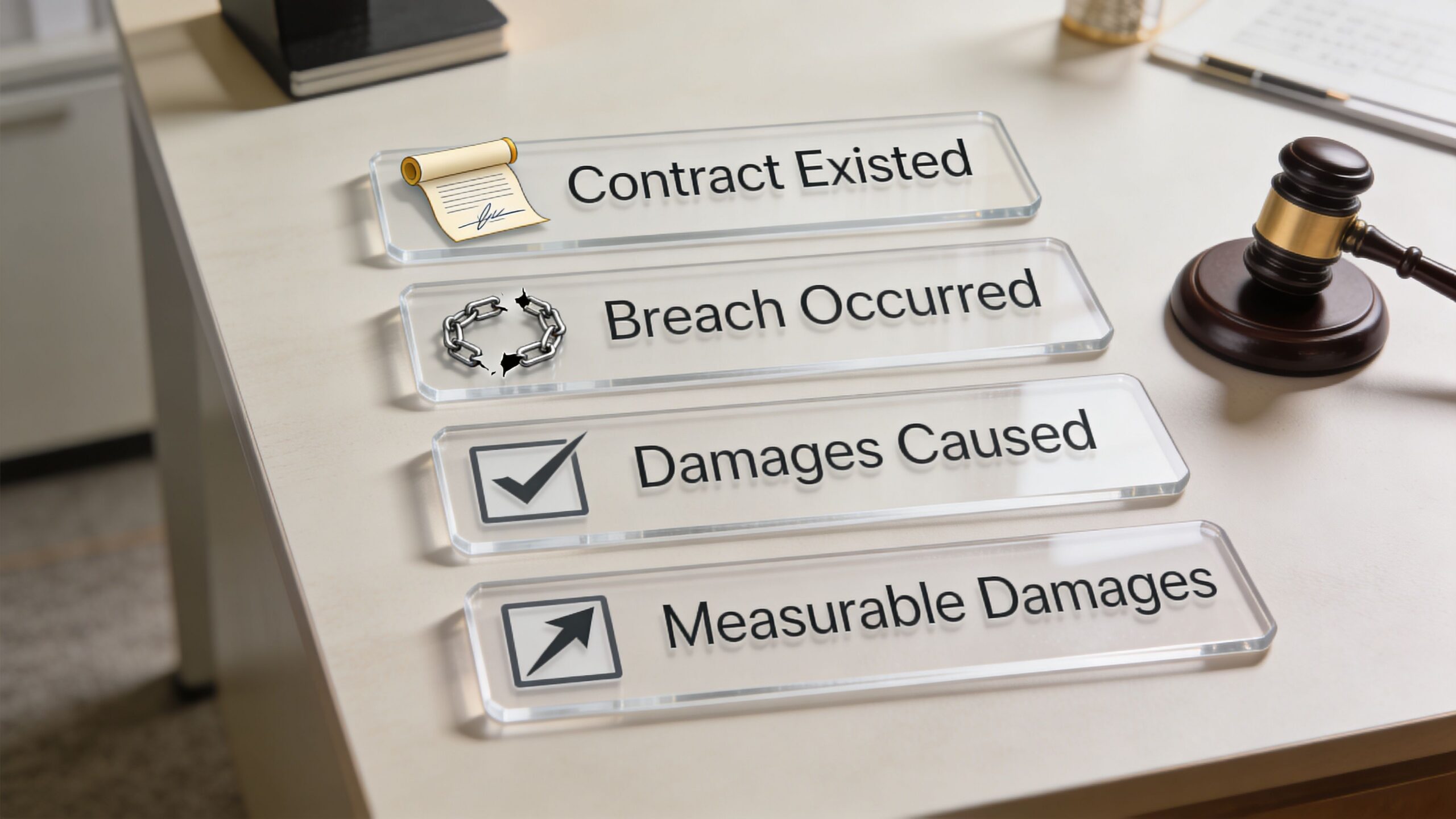
A plaintiff must prove four key elements, and failing to prove even one is a major reason many claims fall apart. One cited benchmark says an estimated 70% of claims with incomplete documentation fail in business litigation, as explained in this article on contract management and breach elements.
If you want a plain-English refresher on the basic elements of a contract, that resource helps explain why courts focus so heavily on formation before they ever reach the breach itself.
First element: a valid contract existed
You have to show there was a real agreement. Not a hope. Not a rough plan. Not “we talked about it.”
A Kingwood example would be a contractor agreeing to replace flooring for a set price, with a written estimate, deposit, and a message confirming the start date. That looks much stronger than a vague conversation at a job site.
Second element: you performed, or had a legal excuse
You usually must show that you did what you were supposed to do. If you promised payment, did you pay? If you promised access to property, did you provide it? If you had a valid reason you couldn’t perform, that may matter too, but it needs support.
This trips people up. A person who stopped paying because they were frustrated may still have a claim, but the reason for stopping matters. Courts want to know whether your own conduct affected the dispute.
Third element: the other side failed to perform
This is the actual breach. It can be a complete failure, delayed performance, defective performance, or a clear refusal to do the job at all.
A home renovation example is easy to picture in Northeast Houston. You hired someone to install cabinets by a deadline, you paid according to the agreement, and they either never installed them or installed something materially different from what the contract required.
Fourth element: you suffered actual damages
You need more than annoyance. You must show a real loss caused by the breach.
That could include money paid for unfinished work, the extra cost of hiring a replacement contractor, or lost income tied directly to the failed agreement. The stronger your records, the easier this part becomes.
A practical checklist before you call a lawyer
Use this quick test if you’re in Kingwood, Humble, or Porter and trying to assess your position:
- Contract proof: Gather the signed agreement, estimate, invoice, emails, and text messages.
- Your performance: Save payment receipts, delivery confirmations, photos, and notes showing you did your part.
- Their nonperformance: Document missed deadlines, incomplete work, rejected materials, or refusal messages.
- Damages: Pull together repair bids, replacement invoices, accounting records, and bank statements.
Here’s a useful overview if you want to hear the issue discussed visually before you decide your next step.
A contract case often turns less on outrage and more on records. Judges and arbitrators can only evaluate what you can prove.
Understanding the Different Types of Contract Breaches
Not every breach carries the same weight. Some are frustrating but fixable. Others cut so severely into the agreement that the deal is effectively over.
A useful way to understand this is through one running example. A Kingwood bakery orders supplies for a large event at a community center. The order includes flour, specialty decorations, and delivery by a firm date.
Minor breach
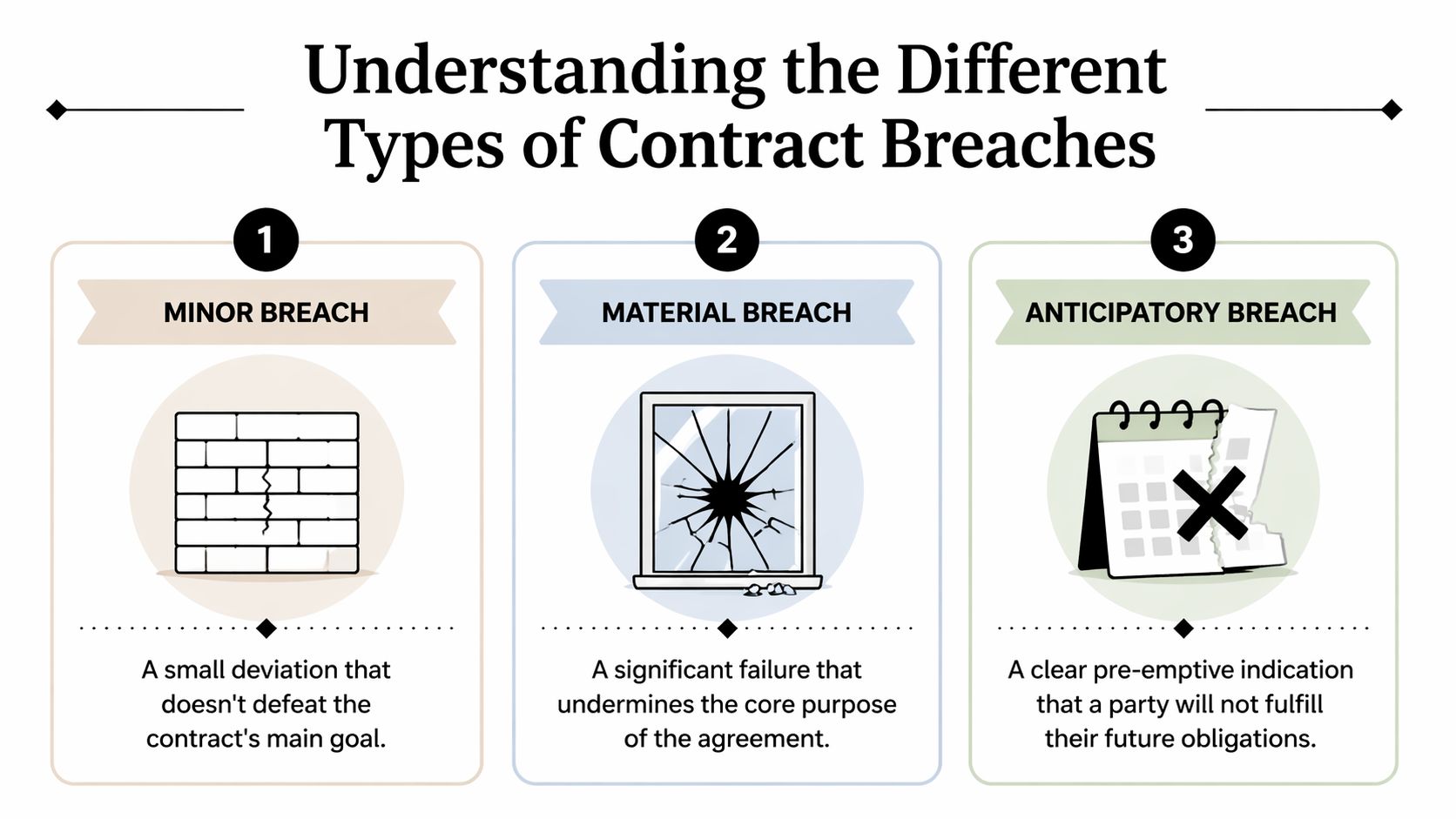
The supplier delivers on time, but the boxes contain a comparable brand of one ingredient rather than the exact brand listed. The bakery can still make the order. The event can still happen.
That’s often a minor breach. The contract’s main purpose survives. The bakery may have a claim for the difference in value or any direct loss, but the deal itself usually continues.
Material breach
Now change the facts. The supplier never delivers the core ingredients at all. The bakery can’t fill the event order. It scrambles to buy emergency replacements at a higher cost and risks losing the client relationship.
That looks more like a material breach. The missed performance undermines the central purpose of the agreement. In many cases, the non-breaching party can stop its own performance and seek damages.
Fundamental breach
Take it one step further. The supplier’s conduct leaves the bakery with almost none of what it bargained for. Maybe the order is so late, so incomplete, or so unusable that the entire event contract collapses.
That may rise to a fundamental breach. The harm is so severe that it effectively destroys the benefit of the bargain. According to this explanation of the main types of contract breach, material and fundamental breaches make up 65% of litigated disputes globally.
Anticipatory breach
Now another version. A week before delivery, the supplier calls and says it won’t deliver anything. Nothing has been missed yet, but the refusal is clear.
That’s an anticipatory breach. Texas courts can treat a definite refusal to perform as a breach before the due date arrives, which allows the other side to respond sooner instead of sitting still and hoping for the best.
Local reality: In business disputes around Kingwood and Humble, timing can matter as much as price. A late delivery before a wedding, fundraiser, or launch event can be just as damaging as a non-delivery.
Types of Contract Breaches and Their Impact
| Type of Breach | Description | Example | Typical Remedy |
|---|---|---|---|
| Minor Breach | A small deviation that doesn’t destroy the contract’s main purpose | Wrong product brand delivered, but usable | Limited damages, contract often continues |
| Material Breach | A serious failure that undermines the core value of the deal | No essential goods delivered for an event | Damages, possible right to terminate |
| Fundamental Breach | A failure so severe that the promised benefit is largely lost | A builder abandons a major project | Termination and broader damages claims |
| Anticipatory Breach | A clear statement or act showing future performance won’t happen | Vendor says in advance it will not deliver | Early legal action, mitigation, damages |
Why classification matters
People often ask, “Did they breach the contract?” The better question is, “What kind of breach was it?” The answer affects whether you should keep performing, send a demand, terminate the deal, or try to cover your losses immediately.
If you treat a minor breach like a total collapse, you can create new problems for yourself. If you treat a material breach like a small inconvenience, you may miss your chance to protect your rights early.
Navigating a Breach of Contract in the Kingwood Area
A Kingwood contract dispute often starts in an ordinary way. A contractor misses a deadline on a home project in Trailwood. A vendor changes pricing after work begins for a Humble business. A business partner in northeast Houston says, “Let’s fix it later,” and later never comes.
At that point, both sides can make the problem worse without meaning to. The party claiming a breach may overreact, cut off communication, or stop performing too soon. The party accused of breaching may say too much, admit facts casually, or make side promises that create a second dispute. A better first step is slower and simpler. Get the facts in order.
Start with the paper trail
Contracts are a lot like a set of building plans. If people start arguing in the driveway without looking at the plans, everyone remembers the project differently.
Pull together the full file: the signed contract, bids, scope of work, change orders, invoices, payment records, emails, texts, photos, delivery notices, and voicemail messages. Then put events in date order. A clear timeline often answers questions that angry messages never will.
Keep your notes factual. “Work stopped on Tuesday” helps. “They cheated me” is a conclusion. If you are the one accused of breaching, this same discipline protects you too. It may show the other side approved a delay, changed the scope, or failed to do its part first.
Read the contract before you react
Many people assume a contract fight in the Kingwood area automatically means filing suit in Harris County or Montgomery County. Some agreements send disputes to mediation or arbitration first. Others require written notice and a chance to cure before anyone can seek stronger remedies.
That fine print matters. FINRA publishes dispute resolution services statistics, and those figures reflect a broader practical point. A fair number of contract disputes are handled outside a courtroom, depending on the industry and the wording of the agreement.
Missing a notice requirement or filing in the wrong forum can cost time and money. It can also weaken a position that might have been strong.
Be careful with “quick fixes”
After a deal starts to wobble, people often try to save the relationship with a hallway conversation or a few text messages.
That instinct is understandable. It also creates proof problems.
If payment terms changed, delivery dates moved, or the scope expanded, confirm the change in writing right away. Even a short email can help: what changed, when it changed, and who agreed. Without that record, both sides may later tell a different story about the same conversation.
Delay can shrink your options
Texas contract claims are generally subject to time limits, but the practical lesson is straightforward. Waiting too long can turn a fixable dispute into a harder one.
Memories fade. Records disappear. Witnesses move. A small problem also has time to spread into others, especially when the contract is tied to payroll, inventory, subcontractors, or a local business relationship that still needs to function next week.
This is one reason early legal advice helps both sides. The wronged party can protect evidence and assess next steps. The accused party can avoid accidental admissions and evaluate whether there is still a path to resolve the issue before positions harden.
Put real numbers on the dispute
People often know they are upset before they know what the case is worth. Those are not the same thing.
In a straightforward consumer matter, damages may be limited to repair costs, refunds, or the price of replacement work. In a business dispute, the math can get more complicated. You may need to sort out unpaid invoices, extra completion costs, delayed revenue, inventory losses, or whether claimed lost profits are supported by records.
Outside financial analysis can help organize that proof in higher-value cases. Resources on Forensic Accountants for Contract Dispute give a useful picture of how damages are documented and tested.
For some local owners, the contract fight is only part of the problem. If the dispute is tied to a business breakup, ownership conflict, or a failed joint venture, our page on partnership dissolution issues in Texas businesses may help you see the larger structure of the dispute.
A practical checklist for Kingwood residents
- Gather every contract-related record in one place.
- Create a dated timeline of what each side promised and did.
- Check for notice, mediation, arbitration, or cure provisions.
- Confirm any contract changes in writing.
- Calculate the financial impact with receipts, bids, invoices, and accounting records.
- Get legal advice before sending a demand letter, terminating performance, or filing suit.
Handled early, some contract disputes can still be resolved without a full court fight. Handled carelessly, even a small disagreement can turn into an expensive local mess for everyone involved.
Common Defenses and Available Remedies in Texas
A Kingwood homeowner hires a contractor, pays a deposit, and the job stalls. The homeowner feels cheated. The contractor says the owner changed the scope, delayed access, and never approved the next draw. Both sides may walk into the dispute convinced the law is obviously on their side.
Contract cases rarely work that way.
Texas law looks at two different questions. First, does the accused party have a defense that excuses performance or weakens the claim? Second, if there was a breach, what remedy fits the facts? Those are different issues, and mixing them up causes a lot of confusion.
Common defenses
If you believe you were wronged, defenses matter because they can limit or defeat recovery. If you have been accused of breaching, defenses show that a dispute is not always the same thing as legal fault.
Common defenses include:
- No enforceable contract: The alleged agreement may have been too indefinite, never fully accepted, or missing terms the law needs to enforce it.
- The other side breached first: If the accusing party failed to do its own part, that can excuse later performance by the defendant.
- Misrepresentation or fraud: A party may argue it entered the agreement based on false information.
- Impossibility or impracticability: In some situations, performance may be excused because an event outside the party’s control made the promised act impossible or commercially unrealistic.
- Waiver or modification: The parties may have changed the deal by words, conduct, or later writings.
- Lack of damages: Even if a breach happened, the claimant still must show actual loss that the law will compensate.
A simple way to view defenses is this. They work like explanations the court is willing to test, not excuses a party gets to announce on its own. A contractor cannot just say, "It got harder, so I stopped." But if the owner blocked site access, changed the job repeatedly, or supplied false information that affected performance, those facts can matter a great deal.
Available remedies
When a breach is proven, the court focuses on the remedy that best addresses the harm.
- Actual damages: Money intended to place the injured party in the position it would have occupied if the contract had been performed.
- Consequential damages: Related losses that were foreseeable and recoverable under the facts and the contract terms.
- Specific performance: A court order requiring performance. This usually appears in disputes involving unique property or something money cannot fully replace.
- Liquidated damages: A preset amount written into the contract, if the clause meets Texas requirements and is not treated as a penalty.
- Attorney’s fees when allowed: In some Texas contract cases, fees may be recoverable by statute or contract terms.
Texas courts and statutes address several of these remedies, including attorney’s fees in qualifying contract claims. If you want a broader view of how these disputes are handled, our Kingwood civil law services for contract and business disputes page gives helpful local context.
How defenses can change the outcome
This is the part many neighbors find frustrating. Winning the argument that "something went wrong" does not automatically mean winning the remedy you want.
For example, a business owner may prove a vendor missed a deadline but still struggle to recover broad lost-profit claims without solid proof. On the other side, an accused party may not defeat the whole case, yet still reduce exposure by showing the other side caused delays, accepted late performance, or failed to limit its own losses.
That dual perspective matters in Kingwood. The wronged party needs to document losses carefully and ask for a remedy the court can realistically award. The accused party needs to avoid reflexive denials and look closely at the paper trail, because a good defense often comes from dates, emails, change orders, texts, and payment records.
Sometimes the smartest first move is a clear written demand, not a lawsuit. For a practical overview of structure and purpose, this guide to a legal demand letter for payment can help you understand how parties often frame the dispute before filing.
How a Kingwood Contract Lawyer Protects Your Interests
Contract disputes wear people down because they combine money pressure with uncertainty. You may know something went wrong, but still not know what to do first, what to say, or what not to say.
A lawyer helps by turning a messy story into a legal strategy.
What legal help usually looks like
A contract attorney can review whether you have a strong claim, a defensible position, or both. Sometimes the biggest service is telling a client that a bad situation is still fixable without filing suit. Other times it’s spotting a deadline, clause, or defense that changes the whole case.
That work often includes:
- Analyzing the contract: identifying key terms, notice rules, forum clauses, and weak points.
- Preserving your position: helping you avoid harmful admissions or sloppy modifications.
- Drafting a demand: laying out the breach, requested cure, and timeline for response.
- Negotiating a resolution: aiming for payment, performance, release terms, or a clean exit.
- Preparing for litigation or arbitration: organizing evidence, witnesses, and damage proof.
Why local guidance matters
A Kingwood-area dispute is never just about legal theory. It’s about the court, the county, the witnesses, the business relationships, and the practical cost of pursuing the claim. A local lawyer understands the rhythm of disputes that affect homeowners, contractors, vendors, families, and small businesses in Kingwood, Humble, Porter, and Northeast Houston.
Some contract fights also overlap with broader business or civil issues. If your matter is part of a larger dispute, reviewing the firm’s civil law services in Kingwood can help you see how contract claims fit into the bigger picture.
The real value
The core value isn’t just filing paperwork. It’s making sure you don’t lose a good claim through delay, poor records, bad communication, or misunderstanding of your options.
If you’ve been wronged, a lawyer helps you prove it clearly. If you’ve been accused, a lawyer helps you respond without making things worse.
Frequently Asked Questions About Contract Disputes
What if our contract was only verbal
A verbal agreement can still matter, but it’s usually harder to prove. In Kingwood and Humble disputes, the case often turns on texts, emails, invoices, payment records, and whether both sides acted as if a real deal existed.
Is it worth suing for a smaller amount
Sometimes yes, sometimes no. The amount in dispute is only one factor. You also need to consider proof, collectability, business impact, and whether a demand letter or negotiated settlement could solve the problem faster.
What if I’m the one accused of breach
Don’t assume the other side is automatically right. Review the contract, preserve your records, and avoid emotional explanations by text or email. Defenses may exist, especially if the facts are incomplete or the agreement changed.
How much does it cost to hire a lawyer for a breach of contract case
That depends on the size and complexity of the dispute, whether early settlement is possible, and whether the case goes to court or arbitration. The best way to get a clear answer is through a direct consultation based on your documents and timeline.
If you’re dealing with a breach of contract issue in Kingwood, Humble, Porter, or Northeast Houston, the Law Office of Bryan Fagan – Kingwood TX Lawyers offers practical, local guidance suited to your situation. Whether you’re trying to enforce an agreement, defend against a claim, or figure out your next move, you can schedule a free consultation at the Kingwood office and get clear answers from a team that serves this community every day.