If you're reading this in Kingwood, Humble, Porter, or somewhere else in Northeast Houston, there's a good chance life feels unsettled right now. Maybe you and the other parent are separating. Maybe there's already a court order, but the schedule isn't working anymore. Maybe you're losing sleep over one question that keeps coming back: what happens to my child?
Custody cases are emotional because they touch the center of family life. School mornings. Bedtime routines. Doctor visits. Holidays. The law talks about conservatorship, possession, access, and best interest. Parents usually just want to know where their child will live, who makes important decisions, and how to protect stability.
That gap between legal language and real life is where many families get stuck. In Kingwood and nearby communities, parents often feel pressure to make smart decisions quickly while also trying to keep conflict from getting worse. There isn't much room for confusion when your child is involved.
There is also a clear need for local guidance. In the Kingwood area, there are at least 9 dedicated child custody attorneys, and those lawyers have gathered over 732 client reviews on legal directories, which shows just how often local families need help with custody questions and disputes in this community, as reflected in Kingwood child custody attorney listings on Avvo.
A good guide should make this simpler, not harder. You shouldn't need a law degree to understand what a judge is looking for or what your next step should be. You need plain English, realistic examples, and a practical sense of what happens in Harris County courts serving Kingwood families.
Introduction Navigating Your Family's Future in Kingwood
A custody case usually starts with a very ordinary moment. You drop your child off at school in Kingwood. You pack a lunch, answer a work message, and try to act normal. But underneath all of that, you're wondering whether you'll still have the same time with your child next month.
That's why it's important to slow the situation down and name what you're dealing with. In Texas, what is commonly referred to as "custody" is divided into two main ideas. One is the power to make decisions for a child. The other is the schedule for when each parent has the child. Once you separate those pieces, the process starts to feel more manageable.
Why legal language feels harder than it should
Texas family law uses words that sound formal, but the ideas are familiar. Think of parenting after separation like running a small family organization. Someone has to make decisions about school, health care, and daily needs. Someone also needs a clear calendar for overnights, weekends, holidays, and exchanges.
That doesn't mean parenting becomes cold or mechanical. It means the court wants structure where conflict used to live.
Many parents aren't fighting over whether they love their child. They're struggling over how to create a workable plan after the family structure changes.
What a local parent usually needs first
Most parents in Kingwood, Humble, and Northeast Houston need answers to four questions right away:
- What does Texas call custody: The legal term is usually conservatorship.
- Will the court expect us to share rights: Often, yes, unless the facts show that a different arrangement is necessary.
- How is the schedule decided: Through agreement, mediation, or a judge's order.
- What should I do today: Start organizing facts, records, and a timeline.
Those first steps matter because early decisions can shape the rest of the case. When you understand the terms, the process stops feeling like a wall of paperwork and starts looking like a set of decisions you can work through one by one.
The Language of Texas Custody Conservatorship Explained
A lot of Kingwood parents come into my office using one word, custody, to describe three different concerns at once. They want to know who makes major decisions, where the child lives most of the time, and what the parenting schedule will look like. Texas separates those questions into different legal terms, which is why the paperwork can feel harder than the actual problem.

Once you sort the labels, the system starts to make more sense.
Conservatorship means decision-making authority
Conservatorship is the part of a case that deals with parental rights and duties. It answers questions like who can consent to medical care, who can make education decisions, who can receive school records, and who can decide the child's primary residence.
A useful comparison is a team project with assigned roles. Both parents may stay involved, but the court still has to spell out who has authority to make which call, and whether those decisions must be shared or can be made independently.
Texas courts often favor an arrangement called Joint Managing Conservatorship. That usually means both parents keep meaningful rights regarding the child, even if one parent has more parenting time or the exclusive right to choose the child's main home. Joint does not always mean equal. It means the court expects a workable division of responsibility unless the facts show that shared authority would be a poor fit.
Joint Managing Conservatorship and Sole Managing Conservatorship
Joint Managing Conservatorship, or JMC, is the arrangement many parents hear about first. In a JMC order, rights may be shared in one of three ways. Some rights are exercised jointly. Some rights belong to one parent alone. Some rights can be exercised independently by each parent when the child is with them. That detail matters because two orders can both be called joint conservatorship while giving parents very different levels of control.
Sole Managing Conservatorship, or SMC, gives one parent much broader authority over major decisions. Courts usually reserve that structure for cases involving serious concerns such as family violence, substance abuse, neglect, severe conflict, or a long pattern of one parent failing to act responsibly. It is less common, but it is part of the conversation in harder cases, including some modification cases and cases involving grandparents or other relatives seeking a larger role.
If you are also trying to sort out similar legal terms, this guide on the difference between guardianship and conservatorship helps clear up a confusion that comes up often in non-traditional family situations.
Possession and access describe parenting time
This is the part many parents mean when they say they want custody.
Possession refers to the periods when a parent has the child. Access refers to the ability to see or communicate with the child. In everyday terms, this is the calendar. Weekends, Thursday dinners, holiday rotations, summer weeks, pickup times, and exchange locations all fall into this category.
That distinction matters in practice. A parent can share conservatorship and still have a dispute about possession. A parent can also have generous possession time without having final decision-making authority on every issue. Those are separate parts of the order, and separating them often helps people ask for the right solution.
What this means in more complicated family situations
The vocabulary becomes even more important when the facts are not simple.
In a relocation case, for example, the legal fight may center on who has the right to determine the child's primary residence and whether there is a geographic restriction. In a modification case, the question may be whether the current conservatorship terms or possession schedule still fit the child's life. In grandparent or other non-parent cases, the issue can shift again, because the court has to address standing, parental rights, and whether a non-parent should receive conservatorship or possession at all.
Those situations often confuse parents because everyone uses the same casual word, custody, to describe very different legal problems. The court does not treat them as the same problem.
A plain-English way to read a proposed order
If you are reviewing draft paperwork, break it into three buckets:
- Who makes major decisions
- Who decides the child's primary residence
- When each person has the child
That simple sort can prevent a lot of confusion. It also helps during consultations, mediation, and settlement talks because you can point to the part you want to change instead of arguing in general terms.
Clear language protects families. It helps a parent who may need to modify an order later. It helps a parent considering a move outside Kingwood understand the limits of the current order. It also helps grandparents and other caregivers see whether they are dealing with conservatorship, possession, or a different legal path entirely.
What Best Interest of the Child Really Means in Kingwood Courts
The phrase best interest of the child appears in almost every custody case, but many parents hear it and still don't know what a judge will look at. In practice, this standard is a series of grounded questions about a child's daily life, safety, needs, and future.
A judge in a Kingwood-area case isn't trying to reward one parent for being more persuasive. The judge is trying to choose the arrangement that best supports the child's well-being.
The questions behind the legal standard
When courts apply the best-interest standard, they often focus on themes parents can recognize right away. Is the child safe? Is the home stable? Which parent has shown sound judgment? Can the adults support the child's relationship with the other parent when appropriate?
That means evidence tied to real life usually carries more weight than general accusations. School performance, attendance, medical follow-through, communication patterns, and each parent's consistency all matter.
| Factor | What it Means for Your Kingwood Family |
|---|---|
| Child's emotional needs | The court looks at who meets the child's day-to-day emotional needs and provides comfort, routine, and support. |
| Child's physical needs | Judges consider meals, housing, supervision, medical care, and dependable daily care. |
| Stability of each home | A stable home in Kingwood, Humble, or nearby often matters more than promises about future changes. |
| Parenting abilities | The court examines how each parent handles school, health care, discipline, and communication. |
| Plans for the child | A parent should be able to explain a realistic plan for school, activities, and daily life. |
| Safety concerns | Any evidence of violence, neglect, substance abuse, or harmful conduct can strongly affect the outcome. |
| Ability to co-parent | Judges notice whether a parent encourages healthy communication and follows through on agreements. |
| Child's circumstances and routines | Continuity matters, including school attendance, extracurriculars, and established support systems. |
What this looks like in real life
A parent may sincerely love their child and still struggle to present a strong case if they can't show consistency. Another parent may not say much in court but may have records showing school involvement, regular medical follow-up, and steady housing. Courts tend to focus on the second kind of proof.
For many co-parents, calendars become one of the clearest ways to show consistency and reduce conflict. If you're trying to build a more reliable routine, these tips for busy co-parents offer practical ideas for organizing schedules, exchanges, and communication.
The best-interest standard is not abstract. It usually comes down to whether a judge can trust your plan to work on a school day, a sick day, and a holiday.
Where parents often misread the situation
Three misunderstandings come up often in custody disputes:
- "My child wants to live with me, so that decides it." A child's wishes may matter in some situations, but they don't automatically control the outcome.
- "I was the better spouse, so I should win custody." Marital fault and parenting ability are not the same issue.
- "If the other parent is difficult, I should cut them out." Courts usually prefer a child-focused plan, not a revenge-focused one.
A calmer, more organized parent often makes a stronger impression than a louder one. That's true in mediation and in court.
The Step-by-Step Custody Process in Harris County
It is 7:30 on a Tuesday night in Kingwood. Your child has school the next morning, your phone has three unread messages from the other parent, and you are trying to figure out what happens after a custody case starts. That uncertainty is often what makes the process feel so heavy.
The good news is that Harris County custody cases usually follow a clear sequence. The details can change if your case involves a modification, a planned move, or a grandparent or other non-parent seeking rights, but the basic road map stays fairly consistent.
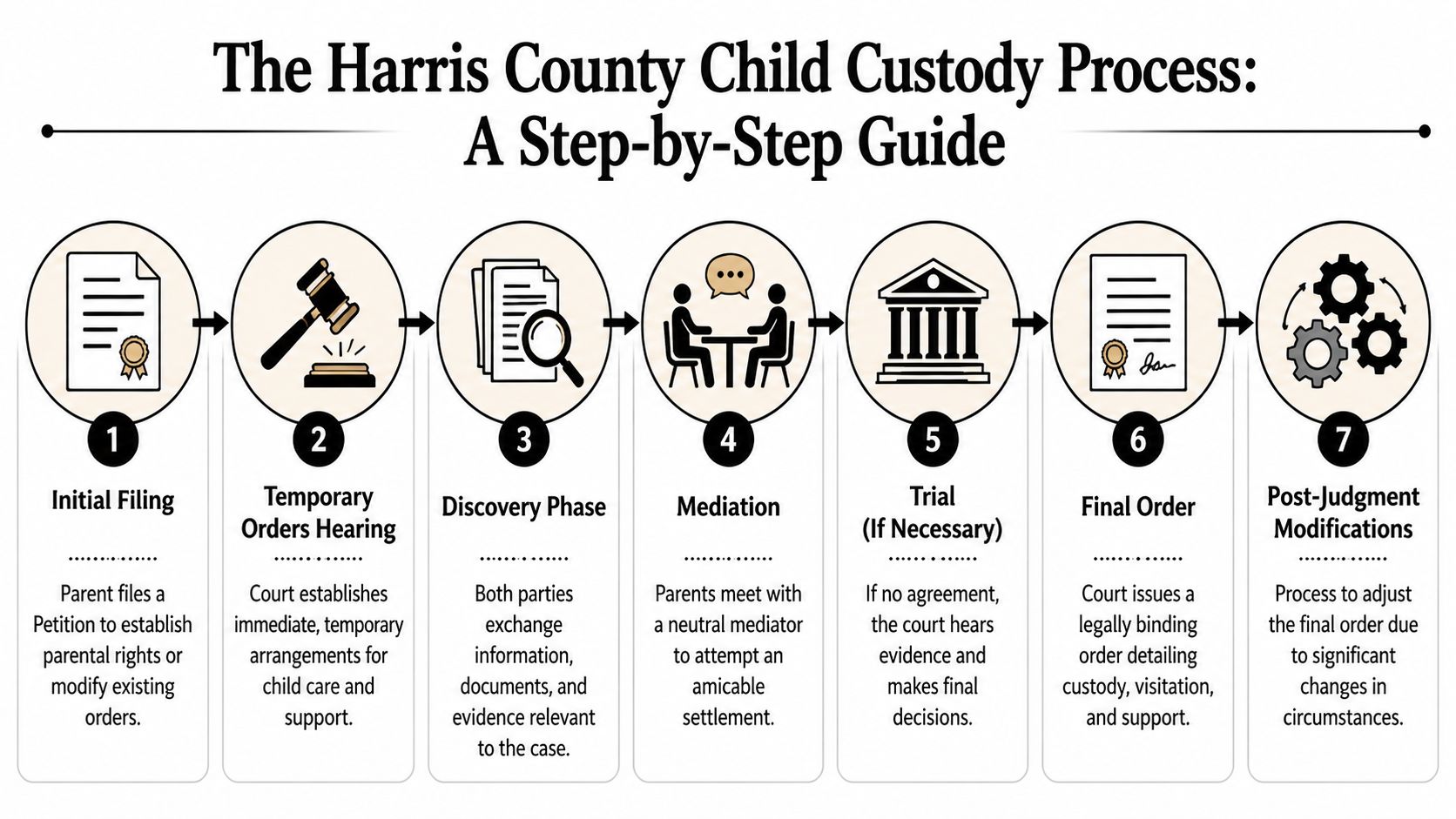
Step one through step three
Initial filing
A case starts when someone files a petition asking the court to create or change orders involving the child. In a standard case, that may mean setting conservatorship, possession, and support for the first time. In a modification case, it means asking the court to revise an order that already exists. In some families, the person filing is not a parent at all. A grandparent or another caregiver may be the one asking the court for standing and orders.Service and response
The other side must receive formal notice and get a chance to answer. This step is less about drama and more about procedure. If paperwork is late, incomplete, or served the wrong way, the case can stall before the core issues are even discussed. Parents who want a plain-English overview of filing and service often find FaxZen's guide to court filings useful for understanding the mechanics.Temporary orders
Families still need rules while the case is pending. The court can enter temporary orders about where the child stays, how exchanges work, who makes medical or school decisions, and whether child support will be paid during the case.
Temporary orders work like training wheels. They are there to keep daily life stable while the larger dispute is being sorted out. They are temporary, but they matter a great deal because they often become the pattern everyone lives under for months.
A short video can also help make the process feel more concrete.
Step four and step five
After the immediate issues are addressed, the case usually shifts into fact-gathering and problem-solving.
Discovery
Each side requests information and documents from the other. That can include school records, medical records, calendars, photographs, messages, employment information, and financial records if support is disputed. In relocation cases, discovery may also focus on the reason for the move, the distance involved, school options, and how the child would maintain contact with the other parent. In cases involving grandparents or other non-traditional family arrangements, discovery often centers on who has provided day-to-day care.Mediation
Many Harris County courts expect parents to try mediation before trial. A mediator does not act as a judge. The mediator helps the adults work through disagreements and test whether a practical settlement is possible.
Mediation is often where parents can build a schedule that fits real life in Kingwood. School start times, long commutes, extracurriculars, and holiday travel rarely fit neatly into a one-size-fits-all order. Parents usually know those pressure points better than the court does, which is why negotiated agreements can be more workable than orders written after a short hearing.
A good parenting plan should make sense on an ordinary Wednesday, not just sound fair in a courtroom.
Step six and step seven
If mediation resolves everything, the agreement is written up and submitted to the judge for approval. If it resolves only part of the case, the remaining issues continue.
If no full agreement is reached, the case goes to trial. At trial, each side presents testimony, records, and other evidence. The judge then signs final orders covering conservatorship, possession, access, and often child support. Those orders are legally binding.
For some families, the final order is the end of the case. For others, it becomes the foundation for later changes. A new job in another city, a child's changing needs, a parent returning after a long absence, or a grandparent's caregiving role can all lead to a new round of court proceedings. That is why it helps to understand the process as a series of stages rather than a single hearing.
How to think about your role in the process
Your lawyer handles the legal strategy, but you are still a central part of the case. The court only sees snapshots. You are the one living the routine, tracking the problems, and gathering the details that show what your child needs.
Calm, organized parents usually put the court in a better position to trust their requests. Show up on time. Follow temporary orders. Keep communication focused on the child. If your case involves a modification, relocation, or a non-parent claim, small facts often carry more weight than big accusations.
That steady approach does more than help your case. It also gives your child more stability while the adults work through a difficult season.
Building Your Case Essential Documentation and Evidence
Most custody cases are won or lost in the details. Not dramatic speeches. Not clever text messages. Details.
If you tell the court you're the parent who keeps life steady for your child, you need records that show it. Documentation turns your story from "my word against theirs" into something concrete.
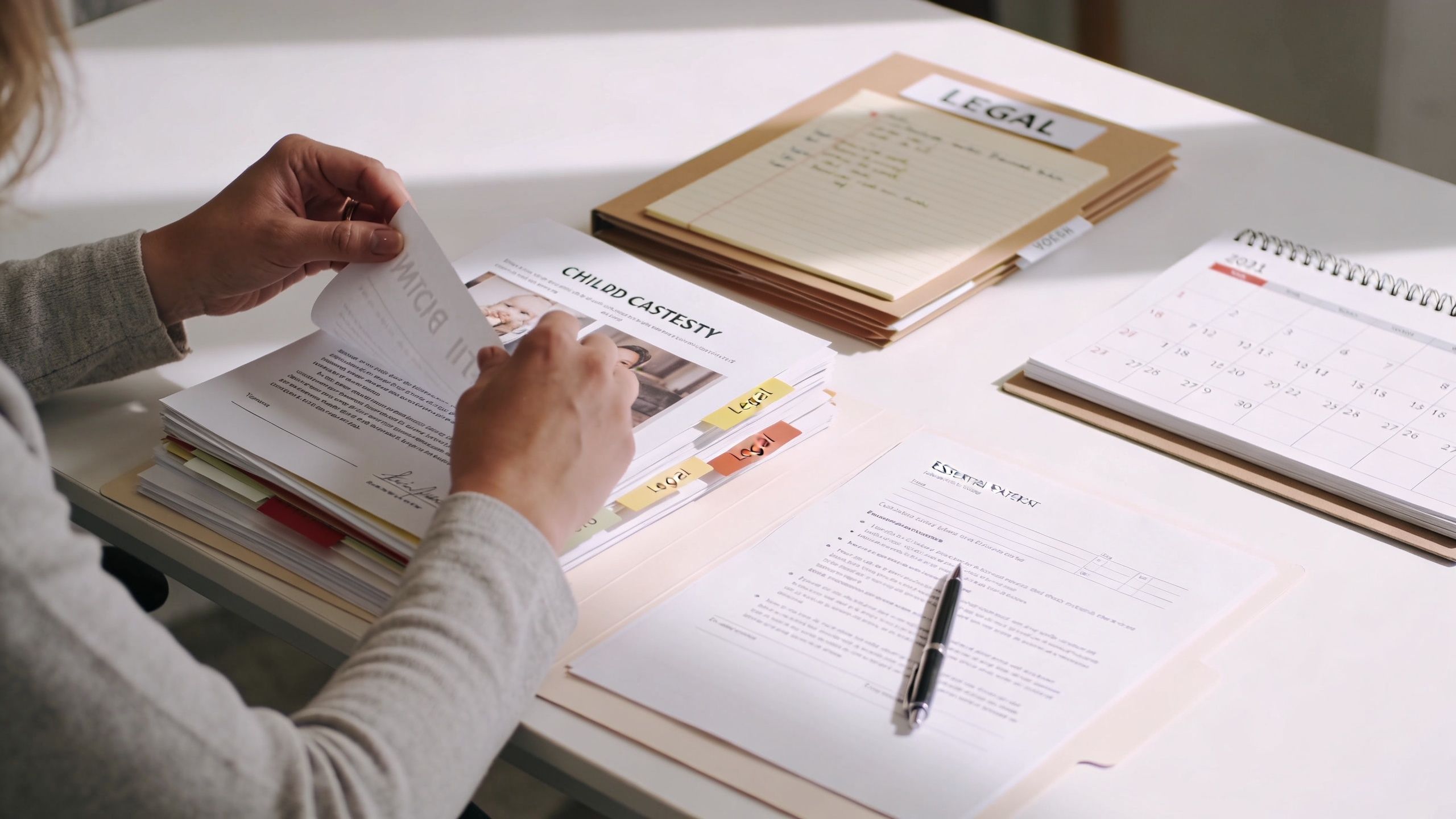
Start with a parenting file
Create one place where you keep everything related to your child and the case. A simple folder system, whether digital or paper, is often enough.
Include items like these:
Calendar records
Keep a day-by-day log of overnights, exchanges, missed visits, late pickups, and school events.Communication records
Save texts, emails, and app messages that show scheduling discussions, important decisions, or repeated noncompliance.School documents
Report cards, attendance notices, teacher emails, behavior notes, and event calendars can show involvement and consistency.Medical information
Appointment summaries, vaccination records, prescriptions, and communications about treatment matter when health issues are disputed.Activity proof
Photos from school functions, sports schedules, recital programs, and volunteer sign-in records can help show participation in your child's life.
Keep a journal that sounds like a record, not an argument
A good parenting journal is factual. Date. Time. Event. Result.
For example, "March 3, child had fever of 101, I took her to urgent care, sent the discharge paperwork to other parent at 6:12 p.m." is useful. "Other parent never cares and always disappears when things get hard" is much less useful.
That difference matters because judges trust records that read like observations.
If you're getting ready for an upcoming court date, this guide on how to prepare for a custody hearing is a helpful next step for organizing your evidence and your presentation.
What to avoid
Bad evidence can weaken a strong case. Parents in Kingwood sometimes hurt themselves by over-documenting the wrong things or collecting information in a way that looks vindictive.
Avoid these common mistakes:
- Recording every minor irritation: Courts care more about patterns than petty complaints.
- Editing screenshots carelessly: If a message thread looks incomplete, the other side may challenge it.
- Posting about the case online: Social media often creates problems that didn't need to exist.
- Coaching the child: Nothing damages credibility faster than making a child part of the litigation strategy.
Keep records as if a judge will read them next month. Clear, factual, and child-focused is the right tone.
The basic test for useful evidence
Ask yourself three questions before saving something for your lawyer:
- Does this relate to the child's well-being, safety, schedule, or stability?
- Does it show a pattern rather than a one-time annoyance?
- Can I explain why it matters without sounding retaliatory?
If the answer is yes, keep it. If not, it may be noise.
When Life Changes Modifying Orders and Relocating from Kingwood
A final custody order is meant to create stability, but it isn't frozen forever. Life changes. Parents remarry. Jobs shift. Kids grow. One parent may need to move across Texas, or out of state, for work or family reasons.
When that happens, the question becomes whether the court should modify the existing order.
The legal threshold is higher than many parents expect
Texas courts don't change custody orders just because one parent is unhappy. To modify an order, a parent usually must show a material and substantial change in circumstances and explain why the requested change serves the child.
That standard is demanding. Without strong documentation, including sustained records such as 6 to 12 months of parenting time logs, about 75% of modification petitions in Harris County fail, according to Houston-area family law guidance on custody modifications.
That doesn't mean modification is impossible. It means the court wants proof, not frustration.
Common situations that may justify a modification
Some changes are significant enough to justify a serious legal review. Examples include:
- A major change in work schedule: A new job may make the old exchange plan unworkable.
- Repeated denial of parenting time: A pattern of missed or blocked access can matter.
- A serious health or safety issue: The child's needs or a parent's conduct may have changed.
- Relocation plans: A move can affect school, travel time, family support, and the child's routine.
- The child's developmental changes: A schedule that worked for a toddler may not work for a middle-school student.
If you're preparing for a move, practical planning helps alongside legal planning. A basic moving checklist for an out-of-state transition can help you organize logistics while your legal team focuses on the custody implications.
Relocation cases are rarely just about distance
Parents sometimes think relocation disputes turn on mileage alone. Courts usually take a broader view. They look at what the move would mean for the child's daily life.
A judge may ask questions like these:
- Will the child need to change schools?
- How will the move affect time with the other parent?
- Is the move tied to a real opportunity, such as stable employment or family support?
- Can a new schedule preserve meaningful contact?
The stronger parent is usually the one who brings a thoughtful plan. That includes transportation ideas, school information, proposed calendar changes, and a calm explanation of why the move helps rather than disrupts the child's life.
Grandparents and other non-traditional custody situations
This is one area many local online resources barely discuss. Yet families in Kingwood and Humble know that real life isn't always a two-parent model with a clean schedule.
Sometimes a grandparent steps in because a parent is struggling with addiction, illness, incarceration, or death. Sometimes an aunt, uncle, or other caregiver has been acting as the child's stable adult. Those cases can be legally complex because the court must weigh parental rights while also looking closely at the child's present needs and safety.
If your family situation involves grandparents or another non-traditional caregiving role, specific legal advice matters. The legal path may involve conservatorship, visitation questions, temporary orders, or emergency relief depending on the facts.
For parents already dealing with changing circumstances, this page on custody modification in Kingwood can help you understand when a change in orders may be legally possible.
In modification cases, the parent who prepares early usually has more options than the parent who waits until the problem becomes urgent.
Partnering with Your Kingwood Child Custody Attorney
A lot of parents reach this stage the same way. They have read enough to know the case matters, but not enough to feel calm about what happens next. They are trying to parent, keep work going, answer messages from the other parent, and make legal decisions that could affect their child for years.
That is usually the point where legal help starts to make sense.
A kingwood child custody attorney does more than file papers. A good lawyer helps you sort a messy, emotional situation into a clear set of decisions. In a standard custody case, that may mean building a parenting plan and preparing for mediation. In a more complicated case, it may mean addressing a proposed move, a change in circumstances, or a caregiving arrangement that does not fit the usual two-parent model.
What a lawyer does in a custody case
Parents sometimes worry that hiring a lawyer means losing control of the case. A healthier way to see it is that the lawyer handles the legal framework while you provide the facts, the history, and the day-to-day reality of your child's life. It works a lot like hiring a contractor for a house problem. You still decide what matters most, but the contractor knows how to keep the structure sound.
That partnership often includes:
Turning worries into legal goals
"I'm scared of losing time with my child" is real, but the court needs a clear request. Your lawyer helps translate that fear into issues like possession schedules, decision-making rights, geographic restrictions, temporary orders, or a request to modify an existing order.Preparing documents with precise language
Custody orders live or die by details. Pickup times, holiday wording, school decision rights, travel rules, and notice requirements all need to be clear enough to follow later, especially when parents disagree.Organizing your proof
A judge does not experience your family the way you do. Your lawyer helps take texts, school records, calendars, medical notes, and witness information and shape them into a timeline that makes sense.Getting you ready for mediation or court
Many cases settle before a final hearing, but settlement still takes preparation. You need to know what to ask for, what tradeoffs may be reasonable, and what issues should stay firm.Reducing avoidable damage
Angry texts, social media posts, vague agreements, and last-minute requests can create problems fast. A lawyer helps you slow down and respond in a way that protects your case.
Law Office of Bryan Fagan – Kingwood TX Lawyers is one local firm that handles family law matters from its Kingwood office, including child custody, visitation, and related disputes.
Why local experience matters
Texas custody law applies across the state, but the experience of a case is still local. Harris County procedures, filing habits, mediation practices, and courtroom expectations shape how a case unfolds in real life.
That matters even more in cases other guides often skip over. A relocation dispute is different from an initial custody case. A modification after a parent's work schedule changes raises different questions than an enforcement case. A grandparent or other caregiver seeking rights steps into a very different legal framework than a divorcing parent. A lawyer who regularly handles these kinds of matters in the Kingwood area is more likely to spot the issue early and prepare for it correctly.
Experience is not just about years in practice. It is also about whether the attorney can explain your options in plain English and apply the law to your family's facts.
Questions to ask during a consultation
A good consultation should feel less like a sales pitch and more like getting a map before a long drive. You may not know every turn yet, but you should leave with a better sense of direction.
Consider asking:
- How would you frame the main legal issue in my case?
- What facts are likely to matter most to the court?
- What should I start documenting right away?
- Are temporary orders likely to matter here?
- Do you see this as a mediation case, a hearing case, or both?
- How do you handle cases involving relocation, modification, or non-parent caregivers?
- What should I do, and avoid doing, while the case is pending?
Those questions tell you a lot about fit. You are listening for calm judgment, honest answers, and the ability to explain a complicated process without drowning you in legal terms.
A useful consultation should leave you with more clarity than you had before you walked in.
A few quick answers parents often need
Do I need a lawyer if the other parent and I are getting along right now?
Maybe not for every step, but many parents still benefit from having an attorney review proposed terms before signing. Friendly cases can still produce unclear orders, and unclear orders often cause the next dispute.
Will hiring a lawyer increase conflict?
Not by itself. Clear legal guidance often lowers conflict because expectations become more structured and communication becomes more careful.
What if my case feels unusual?
That is one of the strongest reasons to get advice. Cases involving school changes, substance abuse concerns, special medical needs, relocation, prior orders, grandparents, or long-term caregivers often raise legal questions that are easy to miss if you assume your case is "basically normal."
What if the other parent already has an attorney?
At a minimum, get your own advice. You do not have to commit to a full court fight to understand your rights and protect your position.
Choosing the right fit
The right attorney should know the law and be someone you can work with during a hard season. You want clear explanations, realistic expectations, and steady guidance. You also want someone who understands that custody cases are not only about court dates. They are about school mornings, holiday exchanges, doctor visits, and helping a child feel secure while the adults sort out the rules.
You do not need to solve everything this week.
You need a sound next step, and you do not have to take it alone.
Frequently Asked Questions About Child Custody in Texas
Can a mother automatically get custody in Texas
No. Texas courts don't start with a rule that mothers automatically receive custody. Judges focus on the child's best interest and the facts of the family.
Does joint custody mean a perfect 50 50 split
Not always. Joint managing conservatorship usually relates to legal rights and duties, not necessarily equal possession time. Parenting schedules can still be different even when both parents share major rights.
What if the other parent keeps violating the schedule
Start documenting each violation carefully. Keep records of dates, missed exchanges, messages, and any impact on the child. Repeated violations may support enforcement or modification, depending on the pattern and severity.
Can I move away from Kingwood with my child after a custody order
Maybe, but you shouldn't assume you can move without legal consequences. Existing orders may include geographic restrictions or terms that require court approval or agreement before relocation. Moves that affect the other parent's time often trigger disputes quickly.
Do grandparents have any custody or visitation rights
In some situations, they may be able to ask the court for relief. These cases are fact-specific and often involve unusual family circumstances, such as parental incapacity or a long-standing caregiving role.
What should I bring to a custody consultation
Bring any current court orders, a timeline of major events, recent communications with the other parent, school and medical records if relevant, and a list of your main concerns. If you have a proposed schedule in mind, bring that too.
Should I talk to my child about the case
Keep those conversations age-appropriate and limited. Children shouldn't be asked to choose sides, carry messages, or report on the other parent. Courts respond better to parents who protect children from adult conflict.
How soon should I get legal advice
Sooner is usually better. Early advice can help you avoid mistakes, preserve evidence, and approach negotiations from a steadier position.
If you're facing a custody dispute, a schedule problem, or a possible modification, Law Office of Bryan Fagan – Kingwood TX Lawyers offers free consultations for families in Kingwood, Humble, Porter, and Northeast Houston. A conversation with a local attorney can help you understand your options, protect your relationship with your child, and move forward with a clearer plan.