A lot of parents in Kingwood reach out when life feels split in two. One part of the day is normal. School pickup, dinner, homework, bedtime. The other part is full of questions that won’t leave you alone. Who pays for what now? How is support calculated? What if the other parent’s income changes? What if payments stop?
If you’re sitting in Kingwood, Humble, Porter, or Northeast Houston trying to make sense of child support, you’re not alone. For many families, the hardest part is not just the law itself. It’s the uncertainty. You want to protect your child, avoid mistakes, and make sure the numbers are fair.
That’s where practical guidance matters. Many online results for child support lawyer kingwood are mostly attorney listings, but parents usually need more than a directory. They need a plain-English explanation of how Texas child support works, what rights each parent has, and what steps to take next.
Navigating Child Support in Kingwood Your First Steps
A Kingwood parent often starts here in a very ordinary moment. Maybe you are at the kitchen table after the kids are asleep, looking at a text from the other parent with a number attached to it, wondering whether that number is fair, realistic, or even close to what Texas law would require. Maybe a divorce has been filed. Maybe paternity was just established. Maybe there is already an order, but the amount no longer matches your life.

That uncertainty can make everything feel heavier.
Child support is tied to daily stability. It affects housing, groceries, school needs, medical coverage, and childcare. In other words, this is not just paperwork. It is part of the plan that helps a child keep a steady routine when parents are no longer living together.
Families in Kingwood usually do better when they start by identifying which problem they are trying to solve. The law treats these cases differently depending on the starting point. A parent asking for a first child support order is in a different position from a parent who needs to change an older order after a job loss, a raise, or a new custody schedule. A parent who has not been receiving court-ordered payments is dealing with another process entirely.
That distinction matters because child support works a lot like a road map. You do not choose the route until you know your starting point. Many websites stop at a list of lawyer names. What parents in Kingwood usually need first is a plain explanation of the road itself. What gets counted as income, what papers matter, which court orders control, and what can be done if the other parent refuses to cooperate.
A local child support lawyer helps turn a stressful question into a series of manageable steps. First, identify whether support needs to be established, changed, or enforced. Next, gather the basic financial and custody information. Then compare those facts to Texas rules instead of relying on guesses, pressure, or informal promises.
The goal at this stage is clarity. Once you know where your case stands, the process becomes far less mysterious and much easier to handle.
What Is Child Support A Guide for Texas Parents
Child support is for the child, not a punishment
Parents often walk into this issue with strong emotions. That’s understandable. But one of the most helpful ways to think about child support is this. It’s a financial co-parenting plan required by law.
In Texas, child support is designed to help meet a child’s ongoing needs after parents live apart. It isn’t a fine. It isn’t a prize. And it usually isn’t about one parent “winning.” The legal system treats support as something tied to the child’s well-being.
That shift in perspective matters. When parents see support as part of caring for their child, conversations often become more productive. The focus moves away from blame and toward practical questions like what income counts, who carries insurance, and how expenses get covered.
What child support usually helps cover
A child support order generally helps support a child’s basic living needs. In plain terms, that often includes:
- Housing-related costs: the child needs a safe place to live, whether that means rent, mortgage, utilities, or household basics.
- Food and clothing: everyday expenses don’t stop because parents separate.
- Routine care: transportation, school-related needs, and regular daily support.
- Medical support: health insurance and uninsured medical needs can become part of the overall support picture.
What confuses many parents is the idea that every single child expense gets separately reimbursed. That usually isn’t how it works. Child support is commonly a broader financial contribution rather than a running tab of every lunch, backpack, or pair of shoes.
Why parents get confused
A lot of confusion comes from the difference between custody time and financial responsibility. Parents sometimes assume that if they both love the child and stay involved, the support question should be simple. Emotionally, that makes sense. Legally, support still follows rules.
Another common misunderstanding is thinking that private verbal agreements are enough. They usually aren’t enough to protect either parent. A court order gives everyone a clear structure. Without one, payment disputes and enforcement problems become much harder.
Practical rule: If child support affects your budget, don’t rely on memory, text messages, or side agreements. Get the terms clearly documented.
What child support does not automatically decide
Child support is only one part of a larger family law case. It does not automatically decide:
| Issue | Separate from child support? |
|---|---|
| Conservatorship | Yes |
| Possession and access | Yes |
| Decision-making rights | Yes |
| Property division in divorce | Yes |
That’s why two parents can have one arrangement for time with the child and a different legal outcome for support. The issues connect, but they aren’t identical.
For parents in Kingwood, Humble, and Northeast Houston, that distinction matters early. If you’re searching for a child support lawyer kingwood, you’re often not just asking about one payment. You’re asking how the whole family structure should be formalized so your child has consistency.
How Texas Child Support Is Calculated in Harris County
A parent in Kingwood sits down at the kitchen table with a pay stub, a calculator, and a lot of worry. They want one clear answer. What will child support likely be? Texas law gives courts a starting formula, and once you see how that formula works, the process feels much less mysterious.
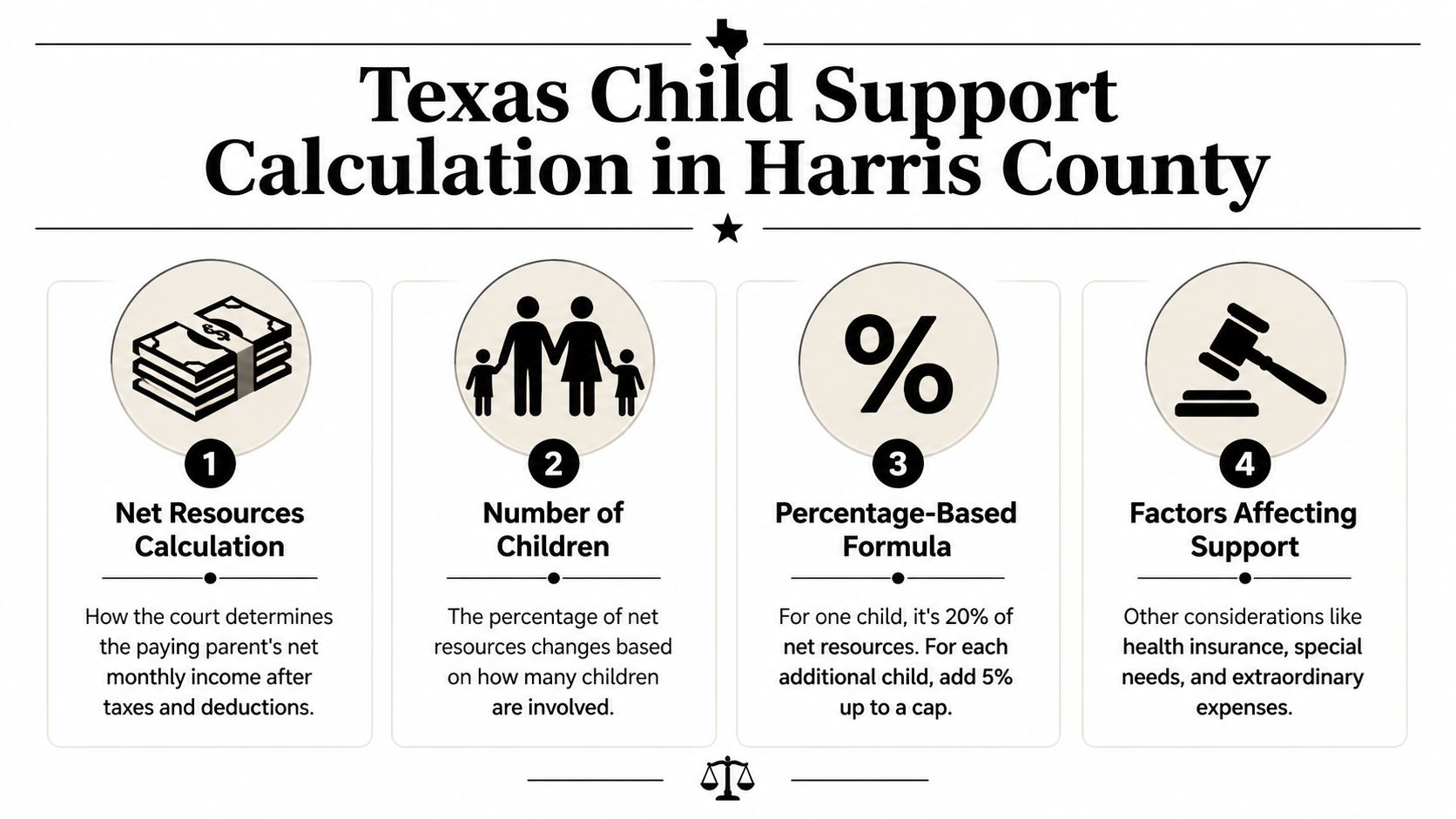
Here’s a visual overview of the calculation framework used in Harris County cases.
The guideline percentages
In many cases, the court begins with the paying parent’s net monthly resources and applies a guideline percentage under Texas law. For one child, the guideline is often 20%. For two, 25%. The percentage increases with more children before the court.
That gives everyone a common starting point. Judges in Harris County usually do not begin with a blank sheet of paper or a broad discussion about what feels fair. They begin with a formula, then look at whether the facts of the case call for any adjustment.
What net resources means
This is one of the parts that trips people up.
Net resources does not merely mean whatever lands in your bank account after payday. It is closer to a legal version of income after certain allowed deductions. Texas law looks at income, then subtracts specific items the law recognizes before the guideline percentage is applied.
A simple way to view it is like following a recipe. You do not guess halfway through. You start with the right ingredients, remove what the law says should be excluded, and then apply the percentage tied to the number of children in the case.
The basic sequence looks like this:
- Identify the parent’s income.
- Subtract deductions allowed by Texas law.
- Apply the guideline percentage.
If a parent earns a regular salary, this may be fairly direct. If a parent is self-employed, earns commissions, receives bonuses, or has uneven monthly income, the court usually needs a closer look at records to get a dependable number. For a more detailed local explanation, this guide on how to calculate child support in Kingwood can help you prepare smarter questions before a consultation.
A few examples without getting lost in math
The exact number in a case depends on the parent’s net resources and any case-specific adjustments. The structure, though, stays consistent. One child usually points the court to 20%. Two children usually point the court to 25%.
That does not make every case mechanical.
Health insurance costs can matter. Work-related childcare can matter. Unusual financial circumstances can matter. The formula is the starting line, not the full race.
The guideline amount gives the court a baseline, but the details still matter.
The Harris County reality
In real Harris County cases, the support number is often built from documents before anyone says much in the courtroom. Pay stubs matter. Tax returns matter. Insurance information matters. If the paperwork is incomplete or confusing, the court may not be looking at a full picture of income.
That is why this article is meant to do more than a directory listing ever could. Kingwood parents usually need more than a lawyer’s phone number. They need to understand what papers to gather, what the court is looking for, and why a number that seems simple on paper can become disputed very quickly.
This short video gives a useful starting point for understanding the topic before a hearing.
The income cap and real-world adjustments
Texas also places a limit on the amount of monthly net resources used in the standard guideline calculation. In higher-income cases, that can become an important issue. The guideline formula may stop at a certain point, but questions about the child’s proven needs can still require a more careful presentation.
That is where local experience helps. A W-2 income case may be mostly about accurate records. A self-employment case may turn into a dispute about what counts as real income versus business expense. Bonus income can raise timing questions. Insurance and childcare costs can affect the final support amount as well.
For many parents searching for a child support lawyer kingwood, this is the moment where the process stops feeling like simple math and starts feeling more like problem-solving. That is normal. With the right documents and clear legal guidance, there is a path forward.
Common Child Support Issues Establishment Modification and Enforcement
A lot of Kingwood parents reach this point with one practical question: what kind of child support problem am I dealing with?
That question matters because child support disputes usually fall into three different categories. You may need to get the first order in place. You may need to change an order that no longer fits real life. Or you may need the court to enforce an order that is being ignored.

Knowing which stage applies helps you choose the right paperwork, the right evidence, and the right request for the judge. That is one reason this guide goes further than a directory. A phone number alone does not tell you whether you should file a new case, request a change, or document missed payments for enforcement.
Establishment of the first order
Establishment is the starting point. The court creates a legally enforceable child support order and spells out the basic rules. Who pays. How much. When payments are due. Who provides health insurance. How uninsured medical costs are handled.
This often happens in a divorce, but it can also happen in a paternity case or another suit affecting the parent-child relationship. If there is no signed order, parents often end up relying on informal arrangements that break down under stress. One parent pays when possible. The other parent covers the gap and hopes to sort it out later. That uncertainty usually creates more conflict, not less.
A first order works like a written set of rails for the case. It gives both parents a track to follow and gives the court something clear to enforce if problems come up later.
Good records matter at this stage. Pay stubs, tax returns, proof of insurance costs, daycare information, and any facts that affect the child’s needs can shape the order from the beginning.
Modification when life changes
A child support order is based on facts at a certain moment in time. Real life rarely stays still. A parent may lose a job, start earning more, become self-employed, take on health insurance for the child, or spend a different amount of time with the child than the old order assumed.
Texas law allows support orders to be changed in some situations, including after a material and substantial change in circumstances. Reviews may also come up over time under the rules used by the state. The key point is simpler than the legal wording. If the facts have changed in a meaningful way, the order may need to change too.
Parents get into trouble when they treat a court order like a flexible household agreement. If you were ordered to pay a set amount, you usually cannot reduce it on your own because your income dropped. If the other parent agreed by text, that still may not protect you. The signed court order remains the rule until a judge changes it.
If you are trying to understand the steps, this guide on how to modify child support in Texas explains the process in a practical way.
A short delay can turn into a larger problem. Unpaid amounts can continue to build even while a parent is waiting for a hearing.
Enforcement when support is not paid
Enforcement starts after an order already exists and one side is not following it. Usually that means support is late, partial, or unpaid for a long period. Sometimes the dispute is about medical support, reimbursement, or whether payments were made outside the official system and properly credited.
This stage is frustrating because the legal question is usually narrower than the emotional one. The court is not deciding whether the situation feels unfair in a general sense. The court is looking at the order, the payment record, and the proof.
That makes documentation especially important. Keep payment histories, bank records, receipts, wage withholding records, and copies of messages that help place events in context. Parents who pay support also have rights here. If the amount claimed is wrong, if payments were missed in the accounting, or if there is confusion about what the order required, those issues can and should be raised with evidence.
Here is a simple way to separate the three stages:
| Stage | Main question | Common trigger |
|---|---|---|
| Establishment | What should the first order say? | Divorce, separation, paternity case |
| Modification | Does the current order still fit the facts? | Income change, schedule change, added expenses, other major life changes |
| Enforcement | What happens if the order is ignored? | Missed payments, partial payments, unpaid medical support |
Many families move through more than one of these stages over time. A first order is entered. Years later, a parent asks for a change. After that, enforcement may become necessary if the new order is not followed. Seeing the process this way makes child support feel less mysterious. It becomes a series of legal steps, each with a clear purpose and a clear path forward.
How a Kingwood Child Support Lawyer Protects Your Family
A parent in Kingwood often reaches out after a sleepless night, staring at a court order, a stack of pay records, and a phone full of tense messages, trying to figure out what actually matters to the judge. That moment is where legal help changes the situation. A child support lawyer helps turn a stressful story into a clear, provable case the court can act on.

Good legal counsel protects your family in two ways at once. First, it protects the child’s financial support by making sure the numbers, records, and court filings are accurate. Second, it protects the parent from preventable mistakes that can delay relief, increase conflict, or lead to an unfair result.
Where costly mistakes usually happen
Child support cases often look simple from the outside. In practice, they work more like assembling a puzzle. If a few pieces are missing, the court may not see the full picture.
Common problems include:
- Partial income records: one or two pay stubs rarely tell the whole story if overtime, self-employment income, bonuses, or job changes are involved.
- Side agreements between parents: a text message or verbal understanding does not rewrite a court order.
- Late action: waiting too long can make arrears grow or make it harder to correct the record.
- Weak organization: parents may have the right documents somewhere, but not in a form the court can use quickly.
A lawyer helps sort those pieces before a hearing. That matters because judges decide child support cases based on evidence, not on who sounds more upset or more persuasive that day.
What legal counsel actually does
A Kingwood child support lawyer does more than prepare paperwork. The job is to identify the legal issue, gather the proof that fits that issue, and present it in a way that matches Texas court requirements.
That may include reviewing income sources, checking whether support was calculated correctly, organizing medical support information, comparing the current order to the parent’s present circumstances, and preparing hearing exhibits. If a hearing is coming up, it also helps to understand what happens at a child support hearing in Kingwood, Texas so there are fewer surprises.
Lawyers also reduce avoidable conflict. In family law, that has real value. Parents may disagree strongly about money and still need to communicate about school, medical care, and daily parenting. Having counsel handle the legal side can keep the case focused on the child instead of old arguments.
Why local help matters in Kingwood
Texas child support rules apply statewide, but local practice still affects how a case unfolds. Filing procedures, scheduling, courtroom expectations, and the pace of hearings can shape how quickly a family gets in front of a judge and how prepared they need to be when that day comes.
That is why local guidance helps people in a way directory-style websites do not. A list of names does not explain what to bring, what the court is likely to ask, or whether your problem is really an establishment case, a modification request, or an enforcement action. Kingwood families usually need practical direction, not just search results.
Law Office of Bryan Fagan – Kingwood TX Lawyers handles child support matters as part of its family law practice in Kingwood.
Strong child support cases are built on accurate records, clear timelines, and careful preparation.
If you are searching for a child support lawyer in Kingwood, the key question is usually much narrower than "Who handles family law?" The better question is, "Who can explain my next step clearly, protect my rights under Texas law, and help me present the facts in a way the court can use?"
The Process What to Expect When You Contact Our Firm
The first contact is usually simpler than people expect. You don’t need to walk in with every answer. You do need a basic picture of what’s happening. Is there already an order? Are payments being made? Has income changed? Is this tied to a divorce or custody case?
The first meeting
A consultation is the time to put the story in order. Bring what you have. Common examples include pay stubs, tax returns, any existing court orders, proof of insurance, records of child-related expenses, and payment history if enforcement is an issue.
The purpose of that meeting is not to pressure you. It’s to identify the legal problem clearly. Some people come in thinking they need enforcement when the underlying issue is modification. Others assume they can wait, but the paperwork shows they need to act now.
The working plan after that
Once the issue is clear, the next steps depend on the case posture. A child support matter may involve filing a petition, responding to papers already served, gathering financial records, negotiating with the other side, or preparing for a hearing.
That process often looks like this:
- Case review: identify whether the issue is establishment, modification, or enforcement.
- Document gathering: collect the records the court will rely on.
- Strategy decision: negotiate, mediate, or prepare for litigation depending on the facts.
- Formal filing and response: place the issue properly before the court.
- Resolution path: settle if possible, or present the case at hearing if needed.
For families preparing for court, this guide to a child support hearing in Kingwood, Texas can help you understand what the process may involve.
Mediation and lower-conflict options
Not every case should become a courtroom battle. That’s especially true when parents need to preserve a workable long-term co-parenting relationship. Missed support is a serious issue, but the method of resolving it can still matter.
The same Kingwood legal aid overview cited earlier notes that enforcement is a key client concern, and that mediation or collaborative family law can offer cost-effective and less adversarial solutions, even though local guidance on those options is often limited. In the right case, those approaches can help parents solve practical disputes without increasing conflict.
What clients usually want most
Most parents aren’t asking for legal drama. They want straight answers.
- What am I required to pay, or entitled to receive?
- What documents do I need?
- Can this order be changed?
- What happens if the other parent ignores the order?
Those are good questions. A clear legal process should answer them early, not leave you guessing until the court date.
Your Partner in Kingwood for Family Law Matters
Child support can feel complicated when you’re in the middle of it. The legal rules, financial documents, and court procedures are a lot to carry when you’re also trying to take care of your child and keep daily life moving.
But there is a path forward. Parents in Kingwood, Humble, Porter, and Northeast Houston can make better decisions when they understand three things clearly. What child support is meant to do. How Texas calculates it. What to do when an order needs to be created, changed, or enforced.
A local family law attorney can help turn a stressful situation into a manageable process. If you need answers about a new case, an old order, or missed payments, schedule a free consultation at the Kingwood office and get guidance suited to your family’s situation.
Frequently Asked Questions About Child Support in Texas
Can parents agree to a child support amount different from the Texas guidelines
Sometimes, yes. Parents can reach agreements on support, but the court still has to consider whether the arrangement is appropriate for the child. Child support is generally treated as a right connected to the child’s well-being, not just a private bargaining point between adults.
That means a judge may review whether the agreement is workable and consistent with the child’s needs. If you and the other parent want a different arrangement, it’s wise to put the terms in proper legal form rather than relying on an informal understanding.
Who provides health insurance for the child
Health insurance is often handled as part of the broader support order. The court may require one parent to carry coverage if it’s available through work or otherwise reasonably obtainable. Uninsured medical costs can also be allocated between the parents.
This is one reason support discussions shouldn’t focus only on the monthly payment. A parent may look only at the transfer amount and miss the impact of insurance responsibilities and medical expense sharing.
Don’t evaluate a support order by the headline number alone. Look at the full package of obligations.
Do you still pay child support if custody is shared
Possibly, yes. Shared parenting time does not automatically erase child support. Parents often assume that a more even possession schedule means no one pays. Texas doesn’t always work that way.
Support can still be ordered because the court looks at financial responsibility and the child’s best interests, not just the calendar. If one parent earns more or carries different expenses, support may still be part of the final order.
What happens if the paying parent moves out of state
Moving away doesn’t automatically end the obligation. A valid child support order can still be enforced across state lines. Interstate enforcement can involve additional procedural steps, but the parent receiving support is not left without options because the other parent relocated.
Cases with an out-of-state parent often require careful paperwork and coordination. The key point is this. Don’t assume distance makes the order meaningless.
Can I change support after losing my job
A job loss or income reduction may support a request for modification, depending on the facts. But it’s important to act through the legal system. A parent should not assume that reduced earnings automatically reduce the court-ordered amount.
If your income has changed, gather records promptly and speak with counsel about whether a modification request makes sense. Waiting can create payment problems that are harder to fix later.
What if the other parent pays in cash and there’s no record
That creates risk for both sides. The paying parent may later struggle to prove payment. The receiving parent may face disputes about what was paid and when. Formal payment tracking is usually safer.
If your case already has spotty records, start organizing every document you have now. Bank statements, receipts, text messages, and prior ledgers may all become important.
Do I need a lawyer for child support in Kingwood
Not every case is a courtroom fight, but many benefit from legal guidance. A lawyer can help if the income picture is unclear, the other parent is self-employed, there are missing payments, or you’re not sure whether the issue is establishment, modification, or enforcement.
That’s especially true when emotions are high. Child support disputes often overlap with divorce, custody disagreements, and practical stress at home. A lawyer helps create structure when the situation feels messy.
If you need clear answers about child support, the Law Office of Bryan Fagan – Kingwood TX Lawyers offers free consultations for families in Kingwood, Humble, Porter, and Northeast Houston. A confidential conversation can help you understand your rights, your responsibilities, and the next step that makes sense for your child.