Skip to content
Walking into a Harris County Family Court for a child support hearing can be incredibly stressful. If you’re a parent in Kingwood, Humble, or anywhere in Northeast Houston, you're not just dealing with legal paperwork—you're dealing with your family's future. It’s a lot to handle, but understanding the process is the first step toward regaining a sense of control and confidence.
At The Law Office of Bryan Fagan, we want our neighbors in the Kingwood community to know that a child support hearing isn't about one parent "winning" and the other "losing." At its heart, it’s a formal process where a judge, guided by Texas law, ensures your child's financial needs are met fairly.
What Exactly Happens at a Kingwood Child Support Hearing?
Think of a child support hearing as a focused meeting where a judge reviews financial documents, listens to both parents, and then makes a legally binding decision. For families in the Kingwood area, these hearings typically arise for a few common reasons.
- Establishing Initial Support: For parents who are separating or divorcing, this hearing establishes the initial child support amount one parent will pay to the other, setting a financial foundation for the child's care.
- Modifying an Existing Order: Life happens. A significant job loss in Porter, a big promotion in Humble, or a change in your child's needs (like new medical expenses) often requires a formal hearing to modify the support amount to reflect new realities.
- Enforcing a Past-Due Order: If a parent has fallen behind on payments, a hearing is necessary to enforce the court order and create a plan for catching up on unpaid support.
No matter why you're there, the judge's focus is singular: the best interest of the child. Their job is to look at the facts and ensure your child has the financial resources they need to thrive, right here in our Northeast Houston community.
The court follows specific guidelines and calculations to make its decision. It’s a process grounded in legal standards, not just emotion. A knowledgeable child support lawyer's role in Kingwood is to help you navigate these standards effectively.
When you're headed to court, solid preparation and a clear understanding of your rights are your best allies. Our team is right here in Kingwood, and we're dedicated to helping our neighbors through this process with empathy and experience.
How Texas Calculates Child Support
If you're heading to a child support hearing in Kingwood, the first thing to grasp is how the judge arrives at the final monthly amount. This isn't arbitrary; Texas courts follow a strict formula. The entire calculation hinges on the paying parent’s “net monthly resources” and a set percentage tied to the number of children involved.
It all starts with calculating the paying parent's gross income—and we mean everything. This isn't just a base salary. The court needs the full financial picture, which often includes:
- Wages, commissions, overtime pay, tips, and bonuses
- Income from self-employment or a side business
- Revenue from rental properties
- Dividends and interest from investments
- Retirement, Social Security, or disability benefits
Once that total is tallied, the court subtracts specific items—federal income taxes (based on a single filer with one exemption), union dues, and the amount paid for the children’s health insurance. What’s left is the "net monthly resources," the core number used to determine the child support obligation.
The Guideline Percentages And Income Cap
With the net monthly resources figured out, the Texas Family Code applies a standard percentage. For one child, the guideline is 20% of the paying parent’s net resources. This increases to 25% for two children, 30% for three, and so on.
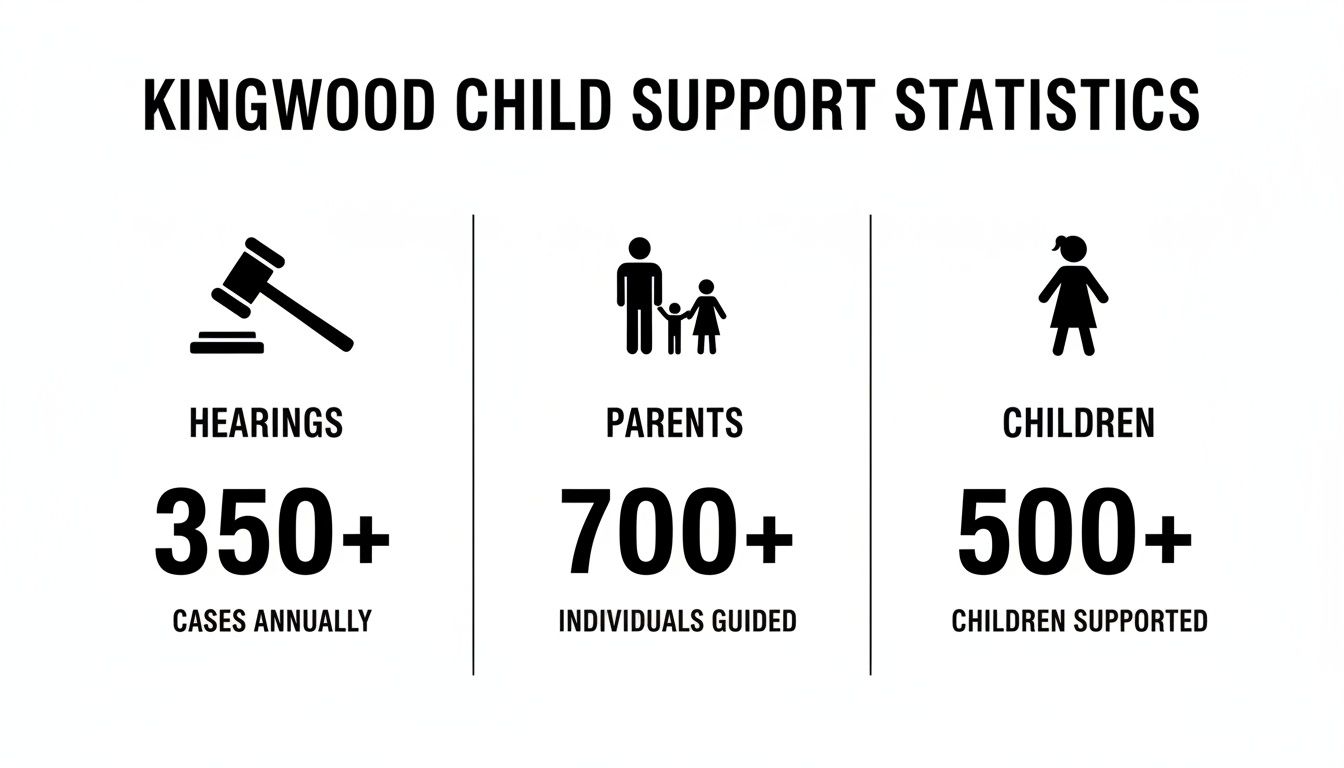
Here in the Kingwood area, our firm has guided over 700 parents through more than 350 of these hearings. The outcomes directly support over 500 local children, showing just how much these proceedings matter to families right here in our community.
Now, here’s a critical detail that impacts many families in Northeast Houston: the income cap. Texas law limits the amount of income to which the guideline percentages can be applied. For a long time, that cap was $9,200, but it has since been adjusted for inflation.
As of September 1, 2025, the statutory cap on net monthly resources increased to $11,700. This is a big deal for higher-earning families in our area. It means the maximum guideline child support payment is now significantly higher than it was just a few years ago.
To give you a clearer picture, here’s a breakdown of the standard percentages and what they look like at the new maximum cap for 2026.
Texas Child Support Guideline Percentages & 2026 Maximums
| Number of Children | Percentage of Net Resources | Maximum Monthly Support (at $11,700 Cap) |
|---|---|---|
| 1 | 20% | $2,340.00 |
| 2 | 25% | $2,925.00 |
| 3 | 30% | $3,510.00 |
| 4 | 35% | $4,095.00 |
| 5 or more | 40% | $4,680.00 |
This table shows exactly how the state's formula applies. Remember, if a parent's net resources are below the $11,700 cap, the court simply applies the percentage to their actual monthly income.
Health Insurance And Medical Expenses
The monthly payment isn't the only financial piece of the puzzle. The court will also issue orders for the children’s health and dental insurance. Typically, the judge will require one parent to maintain the insurance policy. The cost of that premium (for the children only) is then credited back to that parent during the net resources calculation.
What about costs insurance doesn't cover? Expenses like co-pays, orthodontist bills, and deductibles are usually split between the parents. A 50/50 split is common, but a judge can order a different ratio based on each parent's ability to pay. It’s absolutely crucial to bring proof of these expenses to your hearing.
For a more detailed walkthrough of the numbers, you can check out our guide on how to calculate child support in Texas.
Gathering the Right Financial Documents

Walking into a Kingwood child support hearing disorganized is a recipe for stress. Your greatest strength in the courtroom is your preparation. The judge needs a clear, factual financial story to make a fair decision, and that story is told through your documents. Get this part right, and you'll walk in feeling confident that you've presented your case thoroughly.
Whether you're working with a private attorney or navigating a case through the Texas Attorney General's office, financial transparency is non-negotiable. Both parents must lay their cards on the table. This is a fundamental part of any Texas family law case.
Your Essential Financial Checklist
First, let's talk about the essential paperwork. The court uses a specific set of documents to calculate child support, so you'll want to gather these right away.
- Recent Pay Stubs: Collect at least two months' worth of your most recent pay stubs. These are non-negotiable. They show the court your gross pay, deductions, and net income—the starting point for everything.
- Federal Tax Returns: You'll need signed copies of your federal income tax returns from the last two years, including all attachments like W-2s, 1099s, and any schedules. This gives the judge a bigger-picture view of your earning history, which is especially important if your income isn't consistent.
- Health Insurance Information: This is crucial. You must have proof of what you pay for the child's health and dental insurance. An insurance card isn't enough; you need a statement from your employer that clearly shows the premium amount for the child only.
A common mistake we see is when a parent brings a document showing the total premium for the whole family. The court only considers the specific cost to insure the children in the case. You may need to ask your HR department for a printout showing this exact figure.
Documenting Special Expenses and Other Income
The court's analysis doesn't stop with your primary job. All sources of income are considered, as are certain extraordinary expenses related to the children. Overlooking these details can significantly alter the final child support amount. For many of these documents, you'll need to know how to find your bank routing and account numbers to provide a complete picture of your finances.
Harris County Family Courts are incredibly busy. With thousands of families in Kingwood, Humble, and the surrounding areas, clear and complete documentation is what makes your case stand out and allows the judge to make a fair ruling efficiently.
To ensure your situation is represented accurately, you'll also want to bring:
- Proof of Childcare Costs: If you pay for daycare or after-school care to be able to work, bring those invoices and receipts. This is a major expense that the court can—and should—factor into its orders.
- Evidence of Special Needs: Does your child have special medical, educational, or psychological needs? You must document them. Gather every doctor's report, therapy bill, and school record that details the condition and the associated costs.
- Records of Other Income: Don't forget about income from a side hustle, rental property, or investments. You are required to disclose it. Bank statements, profit and loss statements, or 1099s for that income are all essential.
Facing a hearing is nerve-wracking, but assembling your financial records is a concrete step you can control. Being prepared is the best way to advocate for a fair outcome for you and your child. If you're in the Kingwood, Humble, or Porter area and feel overwhelmed by paperwork, give The Law Office of Bryan Fagan a call. We offer a free consultation at our Kingwood office to help you get organized.
What Happens on the Day of Your Hearing

Walking into the Harris County Family Courthouse for your child support hearing in Kingwood, Texas, can feel intimidating. We understand. The formal setting, the judge, the stakes—it’s enough to make anyone anxious. But knowing the rhythm of the day can demystify the process and help you walk in with confidence.
First impressions matter. Treat the day like a serious business meeting. Dress professionally—business casual is a great rule of thumb. Arrive early to give yourself plenty of time to get through security, find your courtroom, and calm your nerves.
Once you’re inside the courtroom, the atmosphere is formal and quiet. Your phone should be completely off, not just on silent. Always address the judge as "Your Honor," and stand when they enter or leave the room as a sign of respect.
Navigating the Courtroom Process
When the bailiff calls your case, you and the other parent will move to the tables at the front. The judge will begin by announcing the case and the purpose of the hearing.
From there, each side gets to present their case. This is where your preparation pays off. The party who filed the motion (the petitioner) usually goes first. You or your attorney will present your evidence—pay stubs, expense reports, and other documents.
This isn't the time for personal attacks or rehashing old arguments. Stick strictly to the financial facts. Emotional outbursts will only hurt your credibility and frustrate the judge.
The judge’s primary concern is what's in the best interest of the child. Every piece of testimony you give should connect back to this principle. Show the court how the support order you're requesting directly benefits your child's well-being, rather than focusing on your conflict with the other parent.
Presenting Your Case Effectively
When it's your turn to speak or answer questions, take a deep breath. Speak clearly and directly to the judge. It’s perfectly fine to have your main points jotted down in a notebook to keep you on track.
The judge will almost certainly have questions. Listen carefully and answer honestly. If you don't know the answer, it is far better to say, "I don't know, Your Honor," than to guess or make something up.
Your objective is simple: give the court a clear, truthful financial picture. For parents across the Kingwood, Humble, and Northeast Houston area, a calm, prepared, and respectful approach is the single most effective tool you have.
If you’re facing an upcoming hearing and feel lost, you don't have to figure it all out alone. A confidential consultation at our Kingwood office can provide the specific guidance you need for your unique situation.
The Judge's Ruling: What Comes Next
Once all testimony is finished and the evidence has been presented, the judge will issue a ruling. That decision becomes a formal, legally binding document known as a child support order. For any family in the Kingwood or Humble area, this order is the official roadmap for your child's financial future, and it's vital to understand every detail.
The order will spell out exactly who pays, how much they pay each month, and which parent is responsible for carrying the child’s health and dental insurance. This isn't just a recommendation—it's a directive from the court that carries the full force of law.
How Child Support Payments Are Made
In nearly every Texas case, the court will also sign an "Order/Notice to Withhold Income for Child Support." This is a standard part of the process, designed for consistency. It simply instructs the paying parent's employer to deduct the child support amount directly from their paycheck, much like taxes.
The money is sent from the employer to the Texas State Disbursement Unit (SDU) in San Antonio. The SDU then processes the payment and forwards it to the receiving parent. This creates an official payment history, which helps prevent future arguments over whether a payment was made.
What to Do When Life Throws You a Curveball
A question we hear all the time from parents in Northeast Houston is, "What if my situation changes?" The good news is that a child support order isn't set in stone. Texas law allows you to ask the court for a modification.
You can't just request a change for any reason. You must show that there has been a "material and substantial change" in circumstances. Common examples include:
- A significant change in the paying parent's income (like a job loss or a major promotion).
- The child’s primary residence changing from one parent to the other.
- The paying parent becoming legally responsible for other children.
- A child developing new needs, such as a medical condition requiring expensive care.
Here’s the critical takeaway: your child support obligation does not automatically change just because your income does. You must go back to court and file a formal Petition to Modify the order. Waiting is the worst thing you can do, as it can cause unpaid support (arrears) to pile up, creating a significant financial burden.
Courts are particularly responsive when the new, calculated child support amount would differ from the current order by 20% or more. For Kingwood parents, this means you can get a hearing in a Harris County family court to address the change efficiently. You can learn more about the child support modification process in Texas to see how these reviews work.
If you believe your situation has changed enough to justify a modification, don't wait and hope it gets better. Schedule a free consultation at our Kingwood office, and we can walk you through your legal options.
Why a Kingwood Lawyer Can Make All the Difference
You have the right to represent yourself in a child support hearing in Kingwood, Texas. But before you decide to go it alone, it's important to consider what's at stake. The judge's final order will shape your financial reality—and your child's—for years, often until they turn 18.
Going into a Harris County courtroom without a legal professional can feel overwhelming. An experienced family lawyer acts as your guide, helping you make sense of the complex financial evidence and strict legal formulas judges must follow. We know how to organize your pay stubs, tax returns, and expense reports into a clear, persuasive story that aligns with Texas law.
Having a lawyer in your corner means you have a professional who can anticipate the other side's arguments, object to improper evidence, and speak the language of the court on your behalf. It creates a more level playing field, especially if the other parent has an attorney.
Your Advocate in the Harris County Courts
Knowing the law is one thing; knowing the local courts is another. Our firm is rooted in this community, serving families right here in Kingwood, Porter, and the surrounding Northeast Houston area. We understand the specific dynamics of the Harris County family courts because we are in them day in and day out. We're not just attorneys with a local office; we're your neighbors, dedicated to providing trusted representation.
You don't have to face a child support hearing by yourself. We invite you to reach out to The Law Office of Bryan Fagan for a free, no-pressure consultation at our Kingwood office. Let’s sit down, talk through your situation, and figure out the best way to protect your family and your future.
Questions We Hear All the Time About Kingwood Child Support Hearings
When you're preparing for a child support hearing, it’s natural to have questions. We’ve been helping parents in Kingwood, Humble, and the rest of Northeast Houston for years, and we want to provide clear, practical answers.
Let's walk through some of the most common concerns.
How Long Until I Get a Court Date?
This is a common first question, and the honest answer is: it depends. The timeline for a child support hearing in Kingwood, Texas, hinges on the specifics of your case.
If you’re starting a divorce or custody case and need temporary orders quickly, the court can often schedule a hearing within a few weeks. However, if you’re heading toward a final, contested hearing where there are major disagreements, you could be looking at a wait of several months. The court dockets are busy, and more complex matters take longer to schedule.
What Happens if the Other Parent Is a No-Show?
It’s a valid concern. If you've done all the work to prepare and show up, but the other parent doesn't, the hearing can still proceed. As long as they were properly notified of the hearing date, the judge can issue a "default judgment."
This means the court will make a decision based solely on the evidence and testimony you provide. It’s a powerful reminder of why attending every court date is absolutely critical for both parties.
Can I Get Help with Extra Costs Like Daycare and Sports?
Yes, absolutely. Texas child support guidelines provide a baseline, but they aren't the final word. The court has the discretion to order contributions to other specific, necessary expenses for the child.
Childcare is the most common example, especially when it's required for a parent to work. You can also ask for help with health insurance premiums, medical bills, or consistent extracurriculars. The key is to come prepared with receipts, invoices, and clear proof of these expenses for the judge to consider them.
If your income changes significantly after the support order is finalized, you must act fast. Losing your job does not automatically stop or reduce your child support payments.
To protect yourself, you must file a formal Petition to Modify with the court. If you wait, you could accumulate thousands in arrears—a debt that is incredibly difficult to resolve. The smartest move is to contact an attorney the moment your financial situation changes to understand your options.
We know that a child support hearing can feel overwhelming. At The Law Office of Bryan Fagan – Kingwood TX Lawyers, our job is to provide the clear, practical guidance you need to feel confident. Schedule a free consultation with us at our Kingwood office to talk through your specific situation and get your questions answered by a team that's focused on our community.