
If you're in Kingwood staring at the ceiling at 2 a.m., wondering whether your marriage can be repaired or whether it's time to call a lawyer, you're not alone. The process rarely starts with a feeling of readiness. Individuals often feel overwhelmed, protective of their kids, worried about the house, and unsure how a divorce filed from a quiet neighborhood in Kingwood ends up moving through a courthouse in downtown Houston.
That gap matters. Life in Kingwood, Humble, Porter, and Northeast Houston feels local and personal. Divorce in Harris County can feel procedural, crowded, and impersonal if you don't know the system. A good legal strategy closes that gap. It takes the day-to-day realities of your family, your finances, your parenting schedule, and turns them into a case the court can work with.
Navigating Divorce in Kingwood Your First Steps
A typical first conversation starts with a simple question: "If I move forward, what happens next?" Usually the person asking already has a lot on their mind. They may be living in the same home but sleeping in separate rooms. They may be trying to keep school routines stable for the kids in Kingwood or Humble while discreetly collecting financial records at night. They may not even know whether they want a contested divorce or just need a plan.
That uncertainty is normal. What helps is replacing fear with sequence.
In Harris County, where Kingwood is located, over 15,000 divorces are filed annually, and while Texas requires a mandatory 60-day waiting period, contested cases in local courts often last 6 to 12 months because of crowded dockets, according to this Kingwood family law overview. A resident in Northeast Houston doesn't need a generic internet checklist. They need someone who understands how local filing, hearings, mediation, and court scheduling play out.
What to do before you file
The first step usually isn't filing. It's preparing.
A strong start often includes:
- Gathering core records: tax returns, pay stubs, bank statements, retirement account statements, mortgage information, and anything tied to debts or major assets.
- Protecting communication: use an email account you control and keep copies of important family and financial documents.
- Thinking about the children first: school pickup, extracurricular schedules, medical needs, and where the children have been living matter early.
- Avoiding impulsive moves: draining accounts, hiding property, or making threats almost always creates problems that are expensive to fix later.
Practical rule: The spouse who prepares calmly usually makes better decisions than the spouse who reacts emotionally.
Why local guidance changes the outcome
A kingwood divorce lawyer doesn't just explain the statute. The value is knowing how to move a case through a busy Harris County system without turning every disagreement into a courtroom fight. Sometimes that means filing quickly to secure temporary orders. Sometimes it means slowing down long enough to get a clean inventory of property before anyone starts negotiating.
If you're trying to understand the filing basics, this guide on how to file for divorce in Kingwood Texas is a useful place to start.
For most families in Kingwood and nearby communities, the first goal isn't "winning" the divorce. It's getting stable, getting informed, and making decisions you won't regret six months from now.
The Texas Divorce Process A Roadmap for Harris County
Once you decide to move forward, divorce becomes less mysterious when you break it into stages. Some cases move directly from filing to settlement. Others involve hearings, discovery, and sharper disagreements over children or money. Either way, the process has a structure.
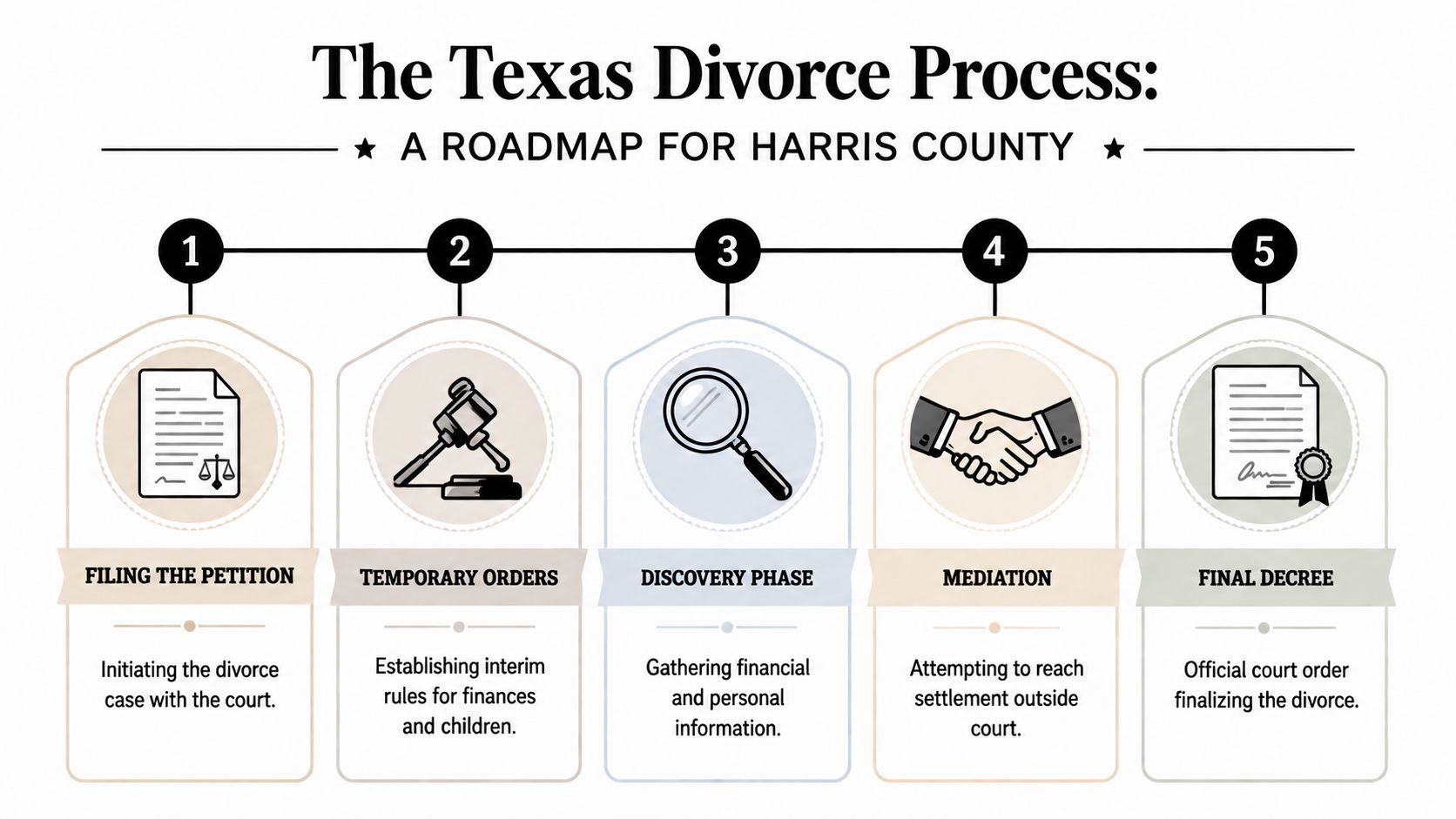
The five stages most families go through
Filing the Original Petition
One spouse files the divorce petition with the court. In Texas, most no-fault divorces are based on insupportability, which means the marriage can't continue because of conflict or discord without requiring one spouse to prove wrongdoing.Serving the other spouse or obtaining a waiver
The other spouse must receive formal notice unless they sign a valid waiver. This is often the point when a private family issue starts to feel legally real.Temporary orders
Temporary orders set ground rules while the case is pending. They can address who stays in the home, who pays which bills, temporary child support, and parenting arrangements. In practice, these orders often shape the tone of the rest of the case.Discovery and negotiation
Each side gathers information. That can include financial documents, property records, account statements, and other materials needed to negotiate from an informed position. Cases with missing records or disputed valuations usually become slower and more expensive.Mediation or final trial setting
Many cases resolve through mediation. If they don't, the court decides unresolved issues in the final decree.
Most divorce stress comes from uncertainty, not paperwork. A clear timeline lowers the temperature.
Uncontested and contested cases work very differently
Some people use the word "divorce" as if it's one process. It isn't. The path depends on whether the spouses agree.
| Factor | Uncontested Divorce | Contested Divorce |
|---|---|---|
| Agreement level | Spouses agree on major terms | Spouses disagree on one or more major terms |
| Children's issues | Parenting plan is already workable | Custody, support, or schedules are disputed |
| Property division | Assets and debts are largely agreed | Value, ownership, or division is disputed |
| Court involvement | Usually limited | Often includes hearings, discovery, and mediation |
| Emotional strain | Often lower if cooperation holds | Usually higher because conflict stays active |
| Need for evidence | Modest | Much greater, especially for finances and parenting issues |
What Harris County changes
Living in Kingwood doesn't mean your divorce happens around the corner. The county's family court machinery is bigger and slower than many people expect. Hearings may require planning around work, school pickup, childcare, and the drive into Houston. That practical burden is one reason clients in Humble and Northeast Houston benefit from early organization. Missed deadlines, sloppy records, and avoidable disputes hit harder in a crowded system.
What works and what usually doesn't
The strategies that work are often unglamorous.
- Organized documents work. Clean records shorten disputes.
- Targeted temporary orders work. Asking for only what you can justify tends to be more effective than asking for everything.
- Mediation often works when both sides have exchanged real information.
- Vague accusations don't work. Courts want specifics.
- Using children for advantage doesn't work.
- Waiting until a crisis hits usually doesn't work.
A roadmap matters because divorce isn't one decision. It's a series of decisions. Good cases are built one practical step at a time.
Protecting Your Children Child Custody and Support in Kingwood
For parents in Kingwood, this is usually the hardest part. Most mothers and fathers can tolerate a lot of uncertainty about property. They can't tolerate uncertainty about their children.

Texas courts don't use the everyday word "custody" very much. They talk about conservatorship, possession and access, and child support. The legal terms can sound stiff, but the question underneath them is simple: what arrangement serves the child's best interest?
In Kingwood courts, custody decisions are guided by the best interest of the child standard, a Standard Possession Order typically gives the non-primary parent around 140 overnights per year, and geographic restrictions are common, often requiring the child to live within a defined area such as Harris County or a neighboring county, as explained in this discussion of Kingwood custody issues.
What judges actually look at
Parents often think the court is looking for a perfect parent. It isn't. The court is looking for a stable, credible, child-focused plan.
Judges and mediators often pay close attention to:
- Consistency: Who gets the child to school, medical appointments, and activities on time?
- Stability at home: Is the child living in a reliable environment with structure?
- Communication: Can the parents exchange information without dragging the child into adult conflict?
- Involvement: Who knows the teachers, counselors, coaches, and doctors?
- Judgment: Does either parent make impulsive decisions that disrupt the child's routine?
Standard schedules and real family life
The Standard Possession Order gives many families a starting point. It's not the only possible schedule, but it gives the court a familiar framework. For families in Kingwood, Humble, and Northeast Houston, the right plan often depends on commute time, school location, extracurriculars, and the ages of the children.
A schedule that looks balanced on paper may fall apart if one parent works long shifts, travels often, or lives too far from school. That's why a practical parenting plan matters more than a performative one.
If you want a fuller picture of common parenting arrangements, this page on shared custody in Texas can help.
A workable custody order is one the parents can actually follow on an ordinary Tuesday.
Geographic restrictions and relocation problems
Geographic restrictions surprise a lot of parents. They matter because they preserve the child's connection to both parents and make possession schedules possible. In a place like Northeast Houston, relocation can turn a manageable parenting routine into a daily disruption.
A parent who wants to move after divorce usually needs to think beyond personal preference. The court will focus on school continuity, travel burden, and the effect on the other parent's access.
Child support and practical preparation
Support and custody connect, but they aren't the same issue. A parent can have substantial parenting time and still owe support. The cleanest way to handle support disputes is documentation.
Bring these to your first serious strategy meeting:
- Income records: recent pay information, bonus history, and self-employment records if applicable.
- Child expense details: health insurance, school costs, activity expenses, tutoring, and recurring medical needs.
- Schedule records: calendars, text logs, and school communication that show who has been handling daily care.
- Special concerns: counseling, developmental needs, transportation demands, or conflicts that need a structured exchange plan.
What helps parents most
Parents do best when they stop trying to prove the other parent is bad and start showing why their own plan is better for the child. Courts respond to specifics. A proposed school-week routine, exchange location, holiday rotation, and communication method is more persuasive than broad complaints.
In high-conflict cases, calm records beat angry narratives. Keep communication brief. Follow the current routine where possible. Don't ask your child to report on the other household. Those habits help in negotiations and in court.
Dividing Your Life Together Property Division in a Texas Divorce
Property division feels abstract until you start naming the pieces. The house in Kingwood. The retirement account. The pickup truck. The credit cards. The business interest. The stock options. The furniture that nobody thought about until someone started making a list.

Texas starts with a strong presumption. Assets acquired during marriage are generally treated as community property. That doesn't mean every item gets split down the middle. It means the court begins with the assumption that property acquired during the marriage belongs to the marital estate unless someone can prove otherwise.
Texas law presumes all assets acquired during marriage are community property, and a kingwood divorce lawyer can help rebut that presumption by tracing separate property, potentially preserving 40-60% more of your assets, while early temporary orders can establish financial stability and reduce future conflict, according to this Texas divorce lawyer resource.
Think of property in two baskets
One basket is community property. The other is separate property.
Community property usually includes income earned during the marriage and things purchased with that income. Separate property can include certain assets owned before marriage, some inheritances, and some gifts made specifically to one spouse. The challenge isn't usually the legal definition. The challenge is proving which basket an asset belongs in.
Documentation decides the hard cases
A separate-property claim without records is often just an argument. A separate-property claim with statements, deeds, account histories, and tracing is evidence.
These records often matter most:
- Bank statements: especially from before marriage and from accounts that stayed separate.
- Closing papers: for homes, refinances, and property purchases.
- Retirement statements: showing balances before marriage and contributions during marriage.
- Business records: ownership documents, profit records, and valuation materials.
- Gift or inheritance proof: letters, probate records, wire records, or account transfers showing where the funds came from.
Key point: Property division cases are won in the paper trail long before anyone walks into a courtroom.
The family home and retirement accounts
In Kingwood and Humble, the home is often the emotional center of the case. But a house is also a financial instrument with equity, debt, taxes, insurance, and maintenance costs. Keeping the house only works if the person keeping it can carry it.
Retirement accounts create a different kind of confusion. Many people assume a retirement account belongs entirely to the spouse whose name is on it. That's often wrong. The title on the account doesn't answer the community-property question by itself.
Business interests and high-asset cases
Family-owned businesses and professional practices need careful handling. An owner may believe the business is separate because they started it or ran it. The other spouse may believe growth during the marriage belongs to the community estate. Both issues can be legally important.
In these cases, practical strategy matters more than rhetoric. Good lawyers narrow the fight. They identify what needs valuation, what can be stipulated, and what documents need to be preserved before records disappear or memories shift.
Temporary orders can protect more than peace
Temporary orders aren't only about who pays the light bill. They can also protect property while the case is pending. If one spouse has more access to accounts, business systems, or records, temporary orders can create guardrails. That can prevent unilateral spending, unusual transfers, or abrupt financial pressure designed to force a quick settlement.
The closer your finances are to a small business operation, rental portfolio, or complex compensation package, the more important early structure becomes. A messy property case rarely becomes cleaner by waiting.
Common Divorce Scenarios in Our Community
Legal principles make more sense when you see how they play out in real homes. The facts change from family to family, but certain patterns show up again and again in Kingwood, Porter, Humble, and Northeast Houston.
A quiet split after a long marriage
A couple in Kingwood with grown children decided to divorce after many years together. There wasn't much conflict over fault. The main issue was retirement. One spouse wanted to keep the house, and both were worried about how retirement savings would be divided.
The case moved best once they stopped arguing in general terms and started listing specific accounts, debts, and desired outcomes. Mediation worked because both sides had complete account statements and a realistic view of what each could afford after divorce. What didn't work at first was treating the house like a symbol instead of an asset.
Parents with young children and a broken routine
A Humble-area family came in after informal parenting arrangements had already broken down. Pickup times kept changing. School communication was inconsistent. Each parent felt the other was being unreasonable.
The turning point came when the focus shifted from blame to structure. A detailed temporary schedule, rules for exchanges, and a simple communication plan gave both parents something concrete to follow. The legal issue was custody, but the practical problem was chaos. Once the routine stabilized, settlement became much easier.
When parents argue at a high level, the child feels instability. When parents follow a detailed schedule, the conflict usually has less room to grow.
A business owner facing a complicated property case
A Northeast Houston business owner assumed the divorce would stay simple because the marriage had no major custody dispute. It didn't. The complexity came from the books. Business income, household spending, and tax strategy had all blurred together over time.
The case required disciplined sorting. Which records showed business value? Which expenses were personal? Which assets had clear paper trails and which needed more reconstruction? The right strategy wasn't aggression. It was precision. Once the financial picture became clearer, negotiation became possible.
What these stories have in common
These scenarios look different, but the same lessons show up:
- Clarity beats assumption: people often think their spouse sees the facts the same way they do. That usually isn't true.
- Records beat memory: especially in financial disputes.
- Structure helps children: parents don't need a perfect relationship to follow a workable order.
- Early advice changes advantage: many avoidable problems begin before the petition is even filed.
A divorce case doesn't have to look dramatic to be consequential. Some of the most important decisions happen in the quiet details.
How to Choose the Right Kingwood Divorce Lawyer for You
Choosing a lawyer is often the most important decision you'll make in the entire case. The law matters, but so does the person applying it to your family. You need somebody who can explain the process plainly, prepare thoroughly, and handle Harris County realities without turning every case into a fight for its own sake.

A lot of clients start with chemistry. That's understandable, but it isn't enough. A good consultation should leave you with more than comfort. It should leave you with a sense of whether the lawyer understands your type of case, how they approach negotiation, and what they do when the other side becomes difficult.
Search behavior also shows that people are looking for more specific help. Search trends for "Kingwood divorce father custody rights" spiked 35%, and families should ask about an attorney's experience with evolving standards, including mandated mental health evaluations in contested custody cases under the 2025 Texas Health & Safety Code updates, as noted by this discussion of fathers' rights and custody issues in Kingwood.
Questions worth asking in a consultation
Not every useful question sounds dramatic. Some of the best ones are practical.
- How often do you handle Harris County family court matters for clients in Kingwood or Northeast Houston?
- What would concern you most about my case right now?
- Do you see this as a negotiation case, a temporary-orders case, or a likely trial case?
- How will you keep me informed?
- What documents should I gather before we make major decisions?
- Have you handled cases involving custody concerns tied to mental health issues or fathers' rights questions?
A focused guide on how to choose a divorce attorney can help you compare answers in a more structured way.
What should make you pause
Some warning signs show up quickly.
| Concern | Why it matters |
|---|---|
| Guarantees about outcome | No honest lawyer can promise a custody or property result before reviewing the full facts |
| Pressure to escalate immediately | Some cases need fast action, but automatic aggression can make settlement harder |
| Vague communication about fees or process | Confusion early usually becomes frustration later |
| Little interest in records | Divorce cases are often decided by details, not slogans |
| One-size-fits-all advice | A short marriage with no children is not the same as a business-owner custody case |
If you'd like to hear one perspective on what clients should look for in legal representation, this video is a helpful starting point.
A lawyer should fit your case, not your anxiety
Some clients need a highly detailed communicator. Others need a steady courtroom advocate because settlement efforts have already failed. Some need a lawyer comfortable with business records and tracing. Others need someone who can keep a parenting case from spinning into unnecessary warfare.
The Law Office of Bryan Fagan offers family law representation in Kingwood, including divorce, custody, support, property division, and mediation services. That kind of service mix can be useful for people who want one firm that can address both negotiation and contested issues as the case develops.
The right kingwood divorce lawyer should make the process clearer, not murkier. If you leave a consultation feeling more confused than when you walked in, keep looking.
Your Path Forward with a Trusted Kingwood Law Firm
Divorce changes daily life fast. Routines shift. Finances tighten. Parenting decisions that once happened informally suddenly need legal language and enforceable structure. None of that feels easy, but it does become more manageable when you understand what the court cares about and what steps will protect your future.
For families in Kingwood, Humble, Porter, and Northeast Houston, the local challenge is practical as much as legal. You're building a case in a suburban community while moving through a large Harris County court system. That means preparation matters. So does choosing counsel who can explain trade-offs clearly, help you avoid self-inflicted mistakes, and keep your case pointed toward resolution instead of needless escalation.
What a good next step looks like
A productive first meeting usually includes:
- A timeline of what's happening at home: separation, finances, parenting, and any urgent concerns.
- A document review plan: what to gather now and what can wait.
- A discussion about immediate risks: access to money, temporary parenting issues, or concerns about the home.
- A realistic strategy: settlement if possible, firm litigation if necessary.
The goal isn't to make divorce painless. The goal is to make it understandable, deliberate, and less disruptive than it would be without a plan.
If you're evaluating firms, it's also useful to understand how law firms communicate and educate clients online. Cloud Present's guide to law firm marketing offers a helpful look at how firms present information and build trust, which can make you a more informed consumer when comparing legal resources.
A trusted local law firm should give you straight answers, respect your time, and help you make decisions you can live with after the paperwork is signed. That's what matters when the emotions settle and everyday life begins again.
If you need practical guidance from a local team, schedule a free, confidential consultation with Law Office of Bryan Fagan – Kingwood TX Lawyers. Our Kingwood office works with clients throughout Kingwood, Humble, Porter, and Northeast Houston on divorce, child custody, support, and property division matters. Call to discuss your situation, ask your questions, and get a clear plan for what comes next.