A lot of people in Kingwood first look for general Texas law guides at the exact moment they feel least prepared to read one. A sheriff’s deputy has just delivered papers. A spouse says they want a divorce. A parent gets a call that their son was arrested in Humble. A family member dies, and nobody knows what happens to the house, the bank account, or the will.
That’s usually when the legal system feels bigger than life. The words are formal. The process seems hidden. Every online answer sounds either too broad or too technical to help with what’s happening in Kingwood, Porter, or Northeast Houston.
The hard part is that Texas law really is broad. The Texas Constitution, effective since February 15, 1876, is the foundation for all state law, and it has been amended over 500 times, which tells you how often the legal environment evolves and why local guidance matters for divorce, probate, and civil disputes in our area, as noted in this Texas law research primer. A statewide guide can teach principles. It usually can’t tell you how those principles play out when your case touches Harris County procedures or a courtroom serving Northeast Houston families.
If you’re sorting through records in another language, legal papers can get even more stressful. In those situations, reliable expert legal translation services can help families and attorneys work from the same clear set of documents.
Your Local Guide to Navigating Texas Law in Kingwood
A neighbor in Kingwood might sit down at the kitchen table with a letter from the court and ask the most normal question in the world: “What am I supposed to do first?” That question comes up in family law, criminal cases, probate matters, and business disputes. It’s not a sign that you’re behind. It’s a sign that the system uses language that is not part of everyday experience.

A good local guide starts by slowing things down. Before you decide what form to file, what deadline matters, or whether you even need a court hearing, you need to identify what type of problem you have. Texas law is easier to understand when you stop treating it as one giant subject and start viewing it as a set of practical lanes.
Three things usually help right away:
- Name the issue clearly: Is this about a marriage, a child, an arrest, a contract, a house, or a loved one’s estate?
- Find the right court level: Statewide rules matter, but county procedures often shape what happens in practice for Kingwood and Harris County residents.
- Protect documents early: Keep notices, orders, texts, contracts, account statements, and calendars together in one place.
Practical rule: If you’ve received official papers, don’t ignore them while you “research a little more.” Silence can create problems faster than imperfect action.
People in Humble and Porter often tell me the same thing. They found general Texas law guides online, but the guides didn’t answer the local question that mattered most. Where do I file? What does Harris County expect? Will I appear in person or remotely? What happens if the other side already has a lawyer?
Those are fair questions. They’re also the reason local context matters so much.
Understanding the Core Pillars of Texas Law
Think of Texas law like the support structure of a house. Residents in Kingwood don’t need to know every beam and bracket. They do need to know which pillar supports the problem in front of them. Once you know that, the next step gets much clearer.
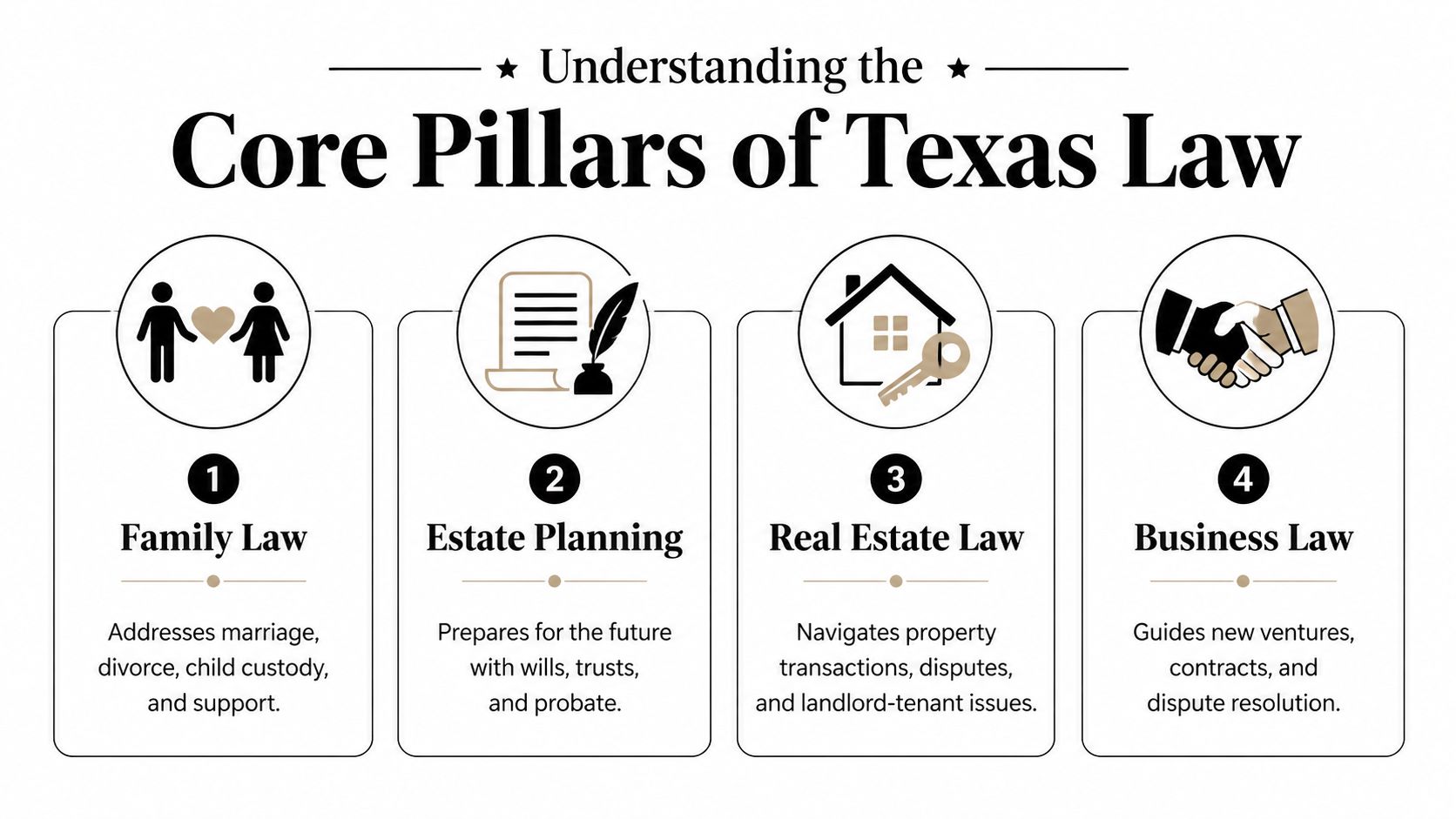
Family law
Family law covers the legal side of major household changes. That includes divorce, child custody, child support, paternity, and related court orders. In Texas, the labels can be unfamiliar. For example, what most parents call custody is often discussed in court as conservatorship.
This area of law is personal. It also moves on deadlines, required filings, and court expectations.
Estate planning
Estate planning is how you make decisions before a crisis forces them on your family. Wills, trusts, powers of attorney, and probate planning all live here. For many Kingwood families, this pillar matters long before retirement. Parents with young children, blended families, caregivers, and small business owners often need a plan sooner than they expect.
Real estate and property issues
Property law affects homeowners, landlords, tenants, and heirs. A title problem, a boundary dispute, a lease disagreement, or a house tied up after a death can all land here. In Northeast Houston, these problems often start as “just a paperwork issue” and later turn into something that blocks a sale, transfer, or possession.
Business and civil disputes
Civil law is the broad category that covers many non-criminal conflicts. Contract disputes, unpaid invoices, partnership problems, property damage claims, and business disagreements all fit here. Some can be handled informally. Others require structured litigation.
Texas lawyers don’t just look up one rule and call it a day. Texas legal practice follows a three-tiered research model. Secondary sources such as O’Connor’s Practice Guides help explain procedure, primary sources such as Vernon’s Texas Codes Annotated provide the controlling law, and Harris County local rules add a county-specific layer for cases filed in Kingwood, as outlined by the Texas State Law Library guides.
Finding your way with a quick snapshot
| Legal Area | What It Covers | Common First Step in Kingwood |
|---|---|---|
| Family Law | Divorce, conservatorship, child support, modification | Gather court papers, identify the children and property issues, check filing status |
| Estate Planning | Wills, trusts, probate, powers of attorney | List assets, identify decision-makers, locate any existing estate documents |
| Real Estate Law | Title issues, landlord-tenant disputes, ownership conflicts | Collect deeds, leases, notices, and closing or payment records |
| Business Law | Contracts, business disputes, collections, internal conflicts | Review the written agreement, preserve emails and invoices, map out the timeline |
General Texas law guides are useful when they help you sort your issue into the right lane. They become much less useful when they skip the county rules and local practice that shape real cases.
A lot of confusion comes from mixing pillars. A divorce can include business issues. A probate matter can involve real estate. A criminal charge can trigger family court consequences. That overlap is normal. The key is to identify the main doorway into the problem first.
Navigating Family Law in Harris County
Family law rarely arrives at a convenient time. A couple in Kingwood may already be living under stress before anyone files anything. Parents may agree they need a change but disagree about the children’s schedule, the house, or support. That’s where statewide information stops being enough. Harris County procedure starts to matter.

Divorce usually starts with one decision
The first practical question is whether the divorce is likely to be contested or uncontested.
If both spouses agree on the major issues, the case is usually simpler. If they disagree about children, property, debt, or support, the process gets more involved. That doesn’t always mean a trial. It does mean the paperwork, scheduling, and negotiation need more care.
A basic path often looks like this:
- One spouse files the petition
- The other spouse is formally notified
- Each side addresses temporary issues if needed
- Information is exchanged
- Settlement talks or mediation happen
- Final orders are presented to the court
For many families in Humble or Kingwood, the surprise is that filing for divorce doesn’t instantly solve living arrangements, bills, or parenting schedules. Temporary orders may be needed while the case is pending.
Custody in Texas means conservatorship
Parents usually search for “custody,” but Texas courts often use different language. Conservatorship refers to parental rights and duties. Possession and access refers to the parenting schedule. Support addresses financial obligations for the child’s care.
That shift in language matters because parents sometimes think the court is asking a different question than the one they brought in. It usually isn’t. The court is still deciding how parental decision-making and parenting time should work.
Here’s a simple way to understand:
- Conservatorship: Who makes important decisions for the child
- Possession and access: When the child is with each parent
- Child support: How expenses are shared through court-ordered support
When parents focus only on “winning custody,” they can miss the actual pieces the court will organize. A better approach is to think in terms of decision-making, schedule, and support.
Harris County procedure affects the experience
Even strong general Texas law guides can leave out the local steps that trip people up. Harris County filing requirements, court settings, and standing orders can shape the pace and tone of a case. A parent in Porter may read a statewide article and still not know what their assigned court expects for mediation, document exchange, or hearing preparation.
For a more local walkthrough, this guide on navigating Harris County family court in Kingwood helps connect general rules to what families face in this area.
A few practical habits make family cases easier to manage:
- Use one calendar: Track school events, exchanges, medical appointments, and court dates in one place.
- Keep messages clean: Assume texts and emails may be reviewed later. Write for a judge, not for the argument of the moment.
- List property early: Homes, vehicles, bank accounts, retirement plans, and debts should be identified as soon as possible.
- Separate feelings from proof: Being hurt is real. Court decisions still turn on documents, testimony, and legal standards.
A lot of Harris County family cases also move through mediation before final trial. That can be useful when both sides need structure to reach an agreement without putting every detail in front of a judge.
This video offers a helpful visual explanation for families trying to understand that process and pace:
What people often get wrong
Some spouses think moving out means they’ve given up rights to the house or the children. It doesn’t work that easily. Others think if they’ve been the more involved parent, the court will automatically mirror the exact routine they want. Courts look at many facts, not one label.
Another common problem is waiting too long to get organized. By the time a hearing is near, memories are foggy, school records are scattered, and communication has already gone off the rails. Family law gets easier to handle when you start documenting early and keep your goals specific.
If you live in Kingwood, Humble, or Northeast Houston, the best first move is usually the least dramatic one. Gather records, identify your immediate concerns, and make a plan before reacting to the latest text message or threat.
Facing Criminal Charges in Northeast Houston
A criminal case often starts with noise and confusion. Flashing lights on a road near Kingwood. A late-night phone call from Humble. A first court date that arrives before the family understands what charge was filed or what the next hearing means.
The first hours matter. So do the first words you say.
What happens after an arrest
Take a common example. Someone is arrested after a traffic stop and accused of DWI in Northeast Houston. The person is booked, released later or held for bond, and then starts hearing unfamiliar terms like magistrate warning, arraignment, bond conditions, and discovery.
That’s the point where many people make an understandable mistake. They think the case is mostly about explaining themselves well. In reality, the case is about rights, procedure, evidence, and what the prosecution can prove.
A calmer way to look at the timeline is this:
- Arrest and booking: The case begins, but it isn’t decided there.
- Release conditions or bond: The court may impose rules you must follow closely.
- Charging and court settings: Dates begin to matter fast.
- Evidence review and legal strategy: Many defenses are built here.
- Negotiation or hearing: The case may resolve short of trial, or it may need stronger litigation.
Remote hearings changed the experience
Court appearances don’t always happen the way people expect anymore. Since 2023, remote court hearings have surged 300% in Texas, and a Texas Tech Law Review study found that 70% of misdemeanor defendants reported a diminished ability to participate in virtual settings, according to this Texas Tech Law Review discussion of remote proceedings.
That matters in real life. A person accused of DWI or assault may think a virtual setting will feel easier. Sometimes it does. Sometimes it makes it harder to communicate, follow the pace of the hearing, or feel fully involved in what’s happening.
If your case may involve remote or hybrid appearances, don’t treat the format as a minor detail. It can affect how you prepare, how you communicate, and how well you understand the court’s instructions.
The most important early choices
People facing charges in Porter, Humble, and Kingwood usually need to make three decisions quickly.
First, don’t try to talk your way out of the case after the fact through informal calls, texts, or social media posts. Explanations given in panic often create new evidence.
Second, follow every release condition exactly. Missing a setting or violating a bond condition can make a bad situation much worse.
Third, get guidance from someone who handles criminal defense in this area. If you’re sorting through that choice, this resource on how to choose a criminal defense lawyer can help you focus on experience, communication, and fit.
Why general guides often fall short
A statewide criminal guide can explain rights in broad terms. It often can’t tell you how a local court handles scheduling, what to expect from a hybrid hearing, or how a prosecutor may organize certain categories of evidence.
That gap is where fear grows. People start guessing. Families rely on stories from coworkers or relatives whose cases happened years ago in another county. None of that is a good substitute for a current, local defense plan.
Criminal charges are serious, but panic isn’t a strategy. Good decisions come from understanding the process early, preserving your rights, and treating every court instruction like it matters. Because it does.
Planning Your Future with Texas Wills and Trusts
Estate planning feels different from divorce or criminal defense because there may be no immediate emergency. Still, it often starts with one. A parent dies without clear instructions. An adult child learns that the house can’t be transferred as easily as the family assumed. A surviving spouse discovers that “we meant to get around to it” leaves a lot of hard questions for the people left behind.

A will and a trust do different jobs
A will is often the simplest place to start. Think of it as a set of instructions the court reviews after your death. It can name beneficiaries, identify an executor, and express your wishes for property distribution.
A trust works differently. It acts more like a private rulebook for certain assets. Depending on how it’s structured and funded, it can help manage property during life and after death without relying on the same court process as a will.
Here’s the practical comparison most families need:
| Tool | Simple way to think about it | Common use |
|---|---|---|
| Will | Instructions reviewed through court process | Naming who receives property and who handles the estate |
| Trust | Private management rules for assets | Controlling distribution and planning for smoother asset handling |
If you want a closer local explanation of the choice, this article on the difference between a will and trust is a helpful starting point for Kingwood families.
Probate is the court process after death
Probate is the legal process used to handle a deceased person’s property. Sometimes that means validating a will. Sometimes it means determining heirs when there isn’t a valid will. The exact path depends on what the person owned, how assets were titled, and whether there’s conflict among family members.
People often hear “avoid probate” and assume probate is always a disaster. That’s too simple. Some estates move through a manageable process. Others become difficult because documents are missing, assets are unclear, or family members disagree about who should do what.
A few planning moves usually make things easier:
- Create the documents while you can: Capacity and clarity matter.
- Name the right person: The best executor or trustee is the one who’s organized, steady, and trustworthy.
- Review asset titles: A strong estate plan can still fail if assets aren’t aligned with it.
- Update after life changes: Marriage, divorce, deaths, births, and property changes should trigger a review.
A will can speak for you after death. A trust can manage assets with more privacy and control. The right fit depends on your family, your property, and how much structure you want in place.
Why Kingwood families benefit from early planning
In Kingwood and Northeast Houston, estate planning isn’t only for retirees with large estates. It matters for parents of minor children, blended families, homeowners, business owners, and adults caring for aging parents.
Without a plan, your family may spend precious energy sorting out legal authority at the same time they’re grieving. With a plan, you give them a roadmap. That’s often the primary value. Not just transferring property, but reducing confusion when emotions are already high.
General Texas law guides can introduce the terms. The local question is more personal. What happens to your specific home, accounts, beneficiaries, and family roles? That’s where customized planning becomes worth the effort.
Handling Civil Disputes in Our Community
Civil disputes often begin small. A contractor doesn’t finish the work. A business partner stops responding. A customer refuses to pay. A neighbor insists a property line or access point belongs to them. At first, Kingwood residents try to solve it informally, and that makes sense.
The problem is knowing when “give it a little more time” turns into a real legal risk.
Not every dispute needs a lawsuit
Some disagreements are better handled with a clear demand, organized records, and direct negotiation. Others are already too serious for self-help by the time you start asking that question. The key issue is usually not emotion. It’s complexity.
Ask yourself:
- Is there a written agreement: If there is, the exact language may control far more than the parties remember.
- Is the damage still growing: Delays can affect records, negotiating position, and available remedies.
- Does the dispute involve technical proof: Construction, valuation, medical issues, and business losses can require more than ordinary testimony.
- Is the other side represented: If they already have counsel, the risk of going alone increases.
Complex cases need disciplined evidence handling
In more serious civil litigation, expert witnesses can become a major issue. Texas rules draw an important line here. Draft expert reports are protected, but final reports and the data reviewed by the expert are discoverable by the opposing side, as explained in this overview of Texas expert witness rules.
That might sound technical, but the practical lesson is simple. Once a case depends on specialized opinions, evidence handling gets strategic very quickly. A small business owner in Kingwood may think a contract case is just about showing invoices and emails. It may also involve accounting, industry standards, repair estimates, or damage calculations that need careful presentation.
When self-help becomes risky
People sometimes spend months trying to “be reasonable” while the evidence gets weaker. Texts disappear. Employees leave. The property changes. The paper trail becomes incomplete.
If your dispute involves an accident claim, it can also help to read practical material on maximizing an auto accident settlement so you understand how documentation, treatment records, and negotiation posture can affect the result. Information helps. So does knowing when information alone isn’t enough.
The moment a civil dispute starts affecting property, business operations, or long-term rights, legal advice stops being a luxury and starts becoming protection.
For Kingwood residents, the biggest mistake is usually waiting until the dispute is both urgent and disorganized. Civil cases are easier to manage when the facts are preserved early and the strategy is built before positions harden.
Your Next Steps with a Local Kingwood Legal Team
The best general Texas law guides do one important job well. They help you understand the language, the categories, and the basic path. But people in Kingwood, Humble, Porter, and Northeast Houston rarely live inside “basic path” situations for long. Their issues touch Harris County procedure, local court expectations, family realities, business pressures, and the practical limits of time and stress.
That’s why local guidance matters so much. A divorce isn’t just a divorce when children, a home, and temporary orders are involved. A criminal charge isn’t just a charge when remote or hybrid hearings affect how you participate. A will isn’t just a form when your family needs a workable plan for the home, the bank accounts, and who takes the lead after a death. A civil dispute isn’t just a disagreement when records, deadlines, and expert issues start shaping the outcome.
A 2025 Texas report found that 80% of civil legal needs go unmet, with communities like Kingwood often underserved compared to larger urban centers, according to the Texas Access to Justice report. That gap shows up in everyday ways. People delay asking questions. They rely on general answers for local problems. They wait until the paperwork, deadlines, or conflict feel overwhelming.
You don’t have to approach it that way.
A better next step is simple:
- Write down the core problem in one sentence
- Gather every paper, message, and notice tied to it
- List your immediate concerns
- Ask a local attorney how Harris County procedure affects your options
That last step often brings the most relief. Not because every problem has an easy answer, but because a real answer is better than ten guesses.
If you’re in Kingwood, Humble, Porter, or nearby Northeast Houston, it helps to speak with a legal team that understands both Texas law and the local setting where your case will move.
If you need practical guidance on family law, criminal defense, estate planning, probate, or civil disputes, schedule a free consultation with Law Office of Bryan Fagan – Kingwood TX Lawyers. You’ll get a chance to talk through your situation with a local team that serves Kingwood and the surrounding community with clear answers, steady support, and a focus on what happens next.