Skip to content
When parents in Kingwood, TX, hear "shared custody," most immediately picture a perfect 50/50 split. While that's a common goal, it’s not quite how Texas law sees it. Here in our state, the concept of sharing parenting duties is the standard, but the legal system uses its own specific language that's crucial for local families to understand.
Forget what you've seen on TV. In Texas, we talk about "conservatorship" and "possession," not "custody." Understanding these terms is the first step toward building a stable future for your children right here in the Kingwood community.
What Shared Custody Really Means in Texas

Stepping into a family law case can feel like learning a new language. For families in Kingwood, Humble, and across Northeast Houston, getting a handle on these terms is the first step toward building a new, stable future for your kids. We're here to translate the legal jargon into practical advice you can use.
Here's a simple way to break it down: conservatorship is about your rights and responsibilities as a parent—the big decisions. Possession and access refer to the actual, physical time you spend with your child, which is laid out in a schedule.
The law starts with a strong presumption that parents should be named Joint Managing Conservators. This means you are expected to share the major decision-making for your child's life, from schooling to healthcare. This approach empowers both parents to stay actively involved.
The "Best Interest of the Child" Standard
Every single decision a judge in a Harris or Montgomery County courtroom makes boils down to one guiding principle: the best interest of the child. This isn't just a recommendation; it's the absolute core of Texas family law, ensuring every order supports your child’s emotional and physical well-being.
So, what does a judge actually look at? They consider a range of factors, including:
- The child's current and future emotional and physical needs.
- Any potential danger to the child, emotionally or physically.
- The parenting skills and abilities of each parent.
- The stability of the home environment each parent can offer.
This standard means that while sharing parental responsibilities is the goal, the final possession schedule has to be what’s genuinely best and most stable for your child.
At The Law Office of Bryan Fagan, our Kingwood-based team has guided countless local families through this exact process. We know how confusing the legal jargon can feel. Our job is to translate these complex rules into practical, real-world plans that actually work for your family's life right here in the Kingwood area.
We firmly believe that when you understand the law, you can make better decisions for your future. You don't have to figure this all out on your own. With a dedicated local attorney on your side, you can protect your rights and build a co-parenting plan that helps your child thrive.
If you’re facing uncertainty about what shared custody looks like for you, we're here to bring clarity. Contact our Kingwood office for a free consultation to talk through your situation and understand your options.
Understanding Joint Managing Conservatorship

When Texas family courts talk about shared parenting, their starting point is almost always what's called Joint Managing Conservatorship (JMC). It's a formal legal term, but the idea behind it is all about collaboration and ensuring both parents remain central figures in their child's life.
Instead of thinking of it as splitting up your child's time, it’s more like becoming co-CEOs of the most important venture you'll ever run: raising your child. The law in Texas strongly presumes that having two active and engaged parents is what’s best for a child, which is great news for parents in Kingwood and Humble who want to stay deeply involved.
Under a JMC, both parents share the big-picture rights and duties of raising their kids. It’s a structure built to empower you both.
The Rights and Duties You Share
So, what does co-parenting actually look like under a court order? A JMC gives both parents a specific set of rights and responsibilities they must manage together. While the details can vary from one family to the next, these shared powers typically include the authority to:
- Make decisions together about your child’s education.
- Agree on non-emergency medical, dental, and mental health care.
- Guide the moral and religious upbringing of your child.
- Access all of your child’s school, medical, and dental records.
The entire system is designed to encourage communication. For a family in Porter, that might mean sitting down to discuss which middle school is the best fit or agreeing on which soccer league to sign up for. The court expects you to find a way to work together. To get a deeper understanding of these legal roles, you can explore the difference between a guardian and a conservator in our detailed article.
Defining the Primary Conservator Role
Even when you’re sharing decisions, every child needs a primary home base. That’s where the role of the primary conservator comes into play. Although both parents are "joint managing conservators," the court will designate one parent with the exclusive right to determine the child’s residence.
A common question we hear in our Kingwood office is, "Does being the primary parent mean I have more rights?" Not necessarily. It primarily means you are the one who establishes the child's main home, usually within a specific geographic area.
This geographic restriction is a critical piece of most Texas custody orders. A judge might order that the child must live within Harris County or, even more specifically, within the Humble Independent School District. This keeps the child’s life stable and ensures both parents live close enough to make sticking to the visitation schedule practical.
The primary conservator is also usually the parent who receives child support. These payments aren't a "win" or a "loss"; they are simply meant to balance the financial load between two households, making sure the child's needs are covered no matter whose house they are at. The other parent is known as the possessory conservator, and they have a detailed schedule outlining their time—or "possession"—with the child.
Ultimately, JMC is about building a new kind of partnership focused squarely on your child's well-being. It takes good communication and a shared commitment to putting your child first. If you're a parent in Northeast Houston facing this, remember that you’re not just dividing time—you're creating a new foundation for your family's future.
Figuring out the fine print of conservatorship can feel overwhelming, but you don't have to tackle it alone. The attorneys at The Law Office of Bryan Fagan are here to offer clear, practical guidance. Schedule a free, no-obligation consultation at our Kingwood office to discuss how a JMC plan can be built to support your family.
Crafting a Practical Possession and Access Schedule

Once you've figured out the rights and duties of conservatorship, the next step is mapping out the calendar that will shape your child's day-to-day life. In Texas, we call this a possession order or a possession and access schedule. Think of it as the practical blueprint for your shared custody arrangement—it dictates exactly when your child will be with you and when they will be with their other parent.
For most families in Kingwood and the surrounding communities, the court's starting point is a template known as the Texas Standard Possession Order (SPO). This schedule is legally presumed to be in the child's best interest, and its main benefit is providing a consistent, predictable routine.
The SPO isn't a one-size-fits-all solution, but it is the go-to foundation for judges in Harris and Montgomery counties. If you're heading into a shared custody case in Texas, understanding how it works is absolutely essential.
What Is the Texas Standard Possession Order?
Imagine the SPO as the "default setting" for parenting time in Texas. It's a clearly defined schedule built to ensure both parents get regular, meaningful time with their kids.
For the non-primary parent (legally called the possessory conservator), the standard schedule usually includes:
- Possession on the first, third, and fifth weekends of any given month.
- Alternating major holidays like Thanksgiving and Christmas, which flip-flop each year.
- A solid chunk of time during the summer, typically 30 days.
So, a parent in Humble would have their child for the first weekend of the month and then again on the third. And if a month like March happens to have five Fridays, they get that fifth weekend, too. It’s this kind of framework that gives kids the stability they can count on.
While the Standard Possession Order is a solid foundation, Texas law fully recognizes that it doesn't work for every family. The ultimate goal is always the child's best interest, and sometimes that means creating a completely different schedule.
The key thing to remember is that the SPO is a starting point for discussion, not a rigid command. You and your co-parent have the freedom to agree on a custom schedule that truly fits your child's needs and your family’s unique situation.
Beyond the Standard Order: Exploring 50/50 Schedules
Lately, more and more parents in Northeast Houston are fighting for true 50/50 possession schedules, where parenting time is split right down the middle. Texas courts have become much more receptive to these arrangements, especially when parents can show how an equal split serves the child's best interest.
Getting a judge to sign off on a 50/50 schedule often comes down to a few practical realities:
- Proximity: You and the other parent need to live close enough to make frequent handoffs possible without turning your child's school and social life upside down.
- Cooperation: A successful 50/50 plan demands a high level of communication and a genuine ability to work together as co-parents.
- Child's Age and Needs: Whether a 50/50 schedule is a good idea can depend heavily on the child’s age, temperament, and how well they handle moving between two homes.
There are several popular 50/50 schedules that offer different rhythms, giving families the flexibility to find what works for them.
Common 50/50 Possession Schedules
- Week-On/Week-Off: This is one of the most straightforward 50/50 plans. The child spends one full week with Parent A, then the next full week with Parent B. It keeps exchanges to a minimum, which can be a huge plus for older kids and for parents with predictable work schedules in the Kingwood area.
- The 2-2-5-5 Schedule: This one is all about providing week-to-week consistency. The child is with Parent A every Monday and Tuesday and with Parent B every Wednesday and Thursday. The parents then alternate who gets the long weekend (Friday through Sunday). It’s a great system that ensures neither parent goes more than a few days without seeing their child.
- The 2-2-3 Schedule: With this rotation, the child is with Parent A for two days, then Parent B for two days, and back with Parent A for a three-day weekend. The next week, the pattern flips. This is often a great fit for younger children who might struggle with being away from a parent for a whole week.
To help you see the differences more clearly, here's a quick comparison of the Texas default schedule versus a popular 50/50 option.
Standard vs. 50/50 Possession Schedules in Texas
| Feature | Texas Standard Possession Order (SPO) | Example 50/50 Schedule (2-2-5-5) |
|---|---|---|
| Parenting Time Split | Roughly 45/55; one primary, one non-primary parent. | Exactly 50/50; parenting time is divided equally. |
| Weekly Routine | Child lives primarily with one parent during the school week. | Child spends specific weekdays with each parent (e.g., Mon/Tues with one, Wed/Thurs with the other). |
| Weekend Schedule | Non-primary parent has possession on the 1st, 3rd, and 5th weekends of a month. | Parents alternate having possession for the long weekend (Friday-Sunday). |
| Number of Exchanges | Fewer exchanges, typically twice per month during the school year. | More frequent exchanges, which can be beneficial for younger children. |
| Best For… | Families who live farther apart or need a more traditional, stable "home base" for the child. | Co-parenting teams who live close by, communicate well, and want a truly equal schedule. |
Ultimately, choosing the right schedule is a deeply personal decision. It requires an honest look at your family’s logistics, your child's personality, and your ability to co-parent effectively. Whether you think the Standard Possession Order is the right path or a custom 50/50 plan makes more sense, heading into court with a clear strategy is crucial.
The experienced attorneys at The Law Office of Bryan Fagan are here to help you understand all your options and fight for a possession schedule that protects your precious time with your child. If you’re ready to discuss your family’s future, schedule a free consultation at our Kingwood office today and let's build a plan that works.
Managing Child Support in a Shared Custody Plan
One of the biggest myths we have to bust for parents here in our Kingwood office is the one about child support and 50/50 custody. There’s a common belief that if you get a perfectly split 50/50 possession schedule, child support just goes away. That’s almost never how it works in Texas.
The court’s number one priority is making sure the child has a consistent standard of living in both homes. Child support is simply the tool the law uses to bridge the financial gap between two households. It’s all about ensuring your child’s needs are met, regardless of which parent’s house they're sleeping at that night.
How Texas Calculates Child Support
Texas doesn't just pull a number out of thin air. There's a specific formula called the guideline child support calculation, and it’s based almost entirely on the income of the parent paying support (the obligor).
Here’s a step-by-step breakdown of how the math works:
- Start with Gross Income: We add up all of the paying parent's income sources.
- Find the Net Resources: From there, we subtract things like federal income taxes, Social Security taxes, and what they pay in health insurance premiums for the kids. What's left is their monthly net resources.
- Apply the Percentage: The law then applies a set percentage to that net amount. For one child, it's 20%. For two kids, it’s 25%, and the percentage goes up from there.
So, if a parent in Humble has monthly net resources of $5,000 and is paying support for one child, their guideline support would be $1,000 per month ($5,000 x 20%). This formula keeps things fairly consistent across cases in Harris and Montgomery County.
Major Changes to Child Support Laws
This is a big one, so it's important for Kingwood families to be aware. The child support landscape in Texas changed dramatically in 2025. For the first time in over two decades, the state raised the income cap used for calculations. The maximum monthly net resources considered was $9,200 for years, but that figure has now jumped to $11,700.
What does that mean for you? It means the maximum guideline support for a single child is now $2,340 per month under the new law. You can read more about these updates and how they impact families in these recent changes in Texas Family Law.
The most important thing for Kingwood families to understand is that these changes are not automatic. Your existing child support order won’t just update itself to reflect the new caps.
If you think your order should be adjusted—whether you're the one paying or the one receiving—you have to take action by filing a formal Petition to Modify with the court.
Modifying Your Current Child Support Order
Life happens. If your financial situation has changed, or if your current order is just out of sync with the new Texas guidelines, it might be time to file for a modification. A modification is the only legal way to change the amount of child support you pay or receive.
For many parents in Northeast Houston, this can feel like a really intimidating process. You have to prove to the court that a material and substantial change has taken place since your last order was put in place. The good news is that these big legislative updates can be the exact reason you need to get your order reviewed. We can walk you through the specifics when you learn more about how to modify child support in Texas.
Whether you have a 50/50 schedule or a Standard Possession Order, making sure the child support amount is fair and correct is crucial for your child’s stability. We're deeply familiar with these new laws and can help you figure out if your support arrangement needs a second look.
Don't leave your finances and your child's well-being to guesswork. Schedule a free consultation at our Kingwood office, and let's talk about your situation. You'll get clear, practical advice you can actually use.
How the Custody Process Works in Local Courts
Navigating a shared custody case in Texas can feel like trying to find your way through a maze, especially when you're already dealing with so much stress. For families here in Kingwood, Humble, and across Northeast Houston, the first step to feeling in control is simply understanding the legal journey ahead.
The good news is that the process has a clear, step-by-step structure. It's actually designed to give both parents every opportunity to reach an agreement on their own terms before ever having to argue their case in front of a judge.
Whether you're starting from scratch or looking to modify an existing order, the path follows a few key stages. Having a local Kingwood attorney who knows the ins and outs of the Harris and Montgomery County courts can make all the difference in how smoothly this process goes for your family.
Filing the Petition and Serving Papers
It all starts when one parent, known as the Petitioner, files a document with the court. This is typically called a Petition in Suit Affecting the Parent-Child Relationship. It’s a formal way of telling the court what you’re asking for regarding conservatorship, possession schedules, and child support.
Once that petition is filed, the other parent, or the Respondent, has to be officially notified. This is handled through a formal process called service, where a constable or private process server physically delivers a copy of the lawsuit. It's a critical legal step that ensures everyone knows a case has begun.
Mediation: The Heart of the Process
Before you ever see the inside of a courtroom for a trial, you'll almost certainly go through mediation. In fact, most judges in our local courts absolutely require it. This is a confidential meeting where you and the other parent sit down with a neutral third-party mediator to try and hammer out a settlement.
Mediation is where you have the most power to shape your family's future. It allows you to craft a custom agreement that fits your lives, rather than leaving critical decisions up to a judge who doesn't know you or your children.
This is the moment when a skilled attorney can really advocate for your goals, whether you’re aiming for a Standard Possession Order or a specific 50/50 schedule. A good lawyer will prepare you for what to expect and guide you toward a fair compromise. We can help you understand all the factors involved as you get ready for your custody hearing.
Child support is a huge part of these negotiations, and this infographic breaks down how it's calculated.
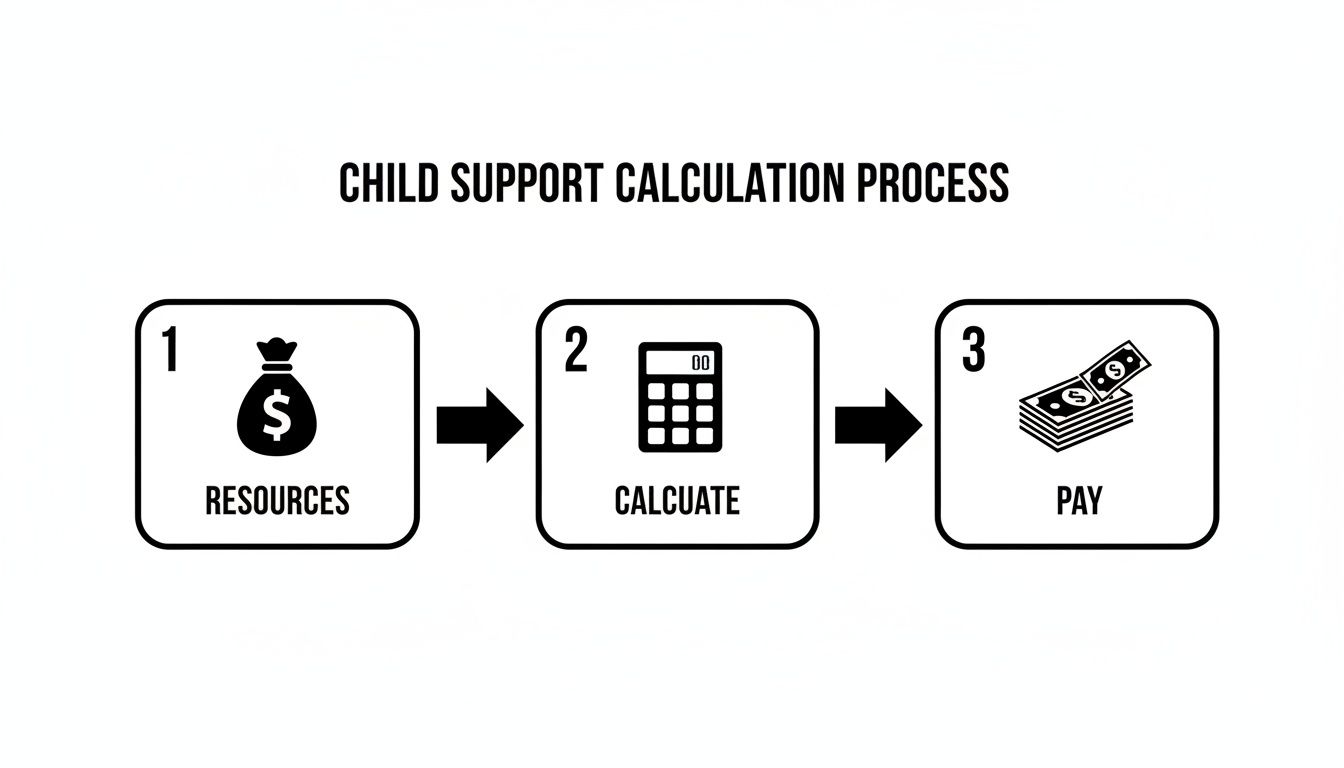
It lays out the financial side of things in three simple steps—gathering resource information, calculating the obligation, and making the payment—which helps demystify a topic that can often feel complex.
Information Exchange and Final Orders
If you can’t agree on everything in mediation, the case moves into a phase called discovery. This is the formal process of exchanging information, like financial records, text messages, and other evidence relevant to your case. It’s all about helping both sides build their arguments for trial.
Interestingly, while the court process often feels adversarial, the trend in Texas is slowly shifting toward more equitable parenting time. For instance, Texas fathers currently receive about 33% of parenting time in custody cases, which places the state at number 22 nationally for child custody equity. This is close to the nationwide average of 35%, so while progress has been made, there's still room for improvement in shared parenting.
If you reach an agreement, your attorneys will draft a Final Decree or Order. This is the legal document that contains all the terms you agreed upon. You both sign it, the judge signs it, and it becomes a legally binding court order. If no agreement is possible, your case gets set for a final trial, where a judge will hear all the evidence and make the final decisions for you.
The legal journey to establish shared custody in Texas has many steps, but you don’t have to walk it alone. The Law Office of Bryan Fagan is here to provide the clear, practical guidance you need. Contact our Kingwood office for a free consultation to discuss your case and learn how we can help you find the most sensible path forward for your family.
Common Questions We Hear in Our Kingwood Office
When you're trying to figure out shared custody in Texas, it’s completely normal to have a ton of questions. Here in our Kingwood office, we talk with parents every day who are working hard to understand their rights, protect their kids, and create a stable future.
Let’s walk through some of the questions we hear most often and give you some clear, practical answers.
Can We Really Get a 50/50 Schedule in Texas?
Yes, you absolutely can. While the law defaults to what’s called the Standard Possession Order (SPO), judges in both Harris and Montgomery counties are more and more open to true 50/50 possession schedules.
The trick is proving to the court that this setup is truly in your child's best interest. It’s not automatic.
A few things really strengthen your case for a 50/50 plan:
- You Live Close By: If both parents live near each other—say, in the same Kingwood school zone—it makes the back-and-forth much easier on the child.
- You Can Work Together: A successful 50/50 schedule demands good communication. You have to be able to cooperate and function as a parenting team, even if you’re not together anymore.
- You’ve Both Always Been Involved: If you can show that both parents have always been hands-on with everything from homework to doctor’s visits, it makes a powerful argument for keeping that dynamic going.
Our job is to help you pull together the right evidence and tell a clear story that shows the judge why a 50/50 split offers your child the best possible stability.
What Happens When We Can't Agree on a Big Decision?
This is a huge concern for parents who are named Joint Managing Conservators. The good news is that your court order is specifically designed to handle these disagreements so you don't get stuck.
Often, one parent will be given the exclusive right to make the final call on certain issues if you can't agree. For example, the parent who has the right to say where the child lives (the primary conservator) usually gets the final say on which school the child attends. This "tie-breaker" power is crucial for preventing gridlock on important decisions.
Keep in mind, this authority is meant to be used after you’ve made a genuine effort to talk it through and agree. If you find yourselves constantly at odds, it might be a sign that your order needs to be more specific, which we can address through a modification.
How Do We Change Our Custody Agreement Down the Road?
Life changes, and Texas family law gets that. To modify a court order for custody, visitation, or child support, you have to prove two key things to a judge:
- There has been a "material and substantial change" in the life of the child or one of the parents.
- Changing the order is in the child's best interest.
So, what counts as a "material and substantial change"? It could be anything from one parent taking a new job and moving out of Kingwood, to a big shift in income, or even just a teenager’s schedule and needs evolving.
The process kicks off when you file a Petition to Modify. Our Kingwood legal team can help you figure out if your situation meets that legal standard and walk you through the next steps, whether that means negotiating an agreement or heading to court.
When you're looking for an attorney to help with these issues, it's wise to understand the upfront costs, including typical lawyer consultation fees. We believe in being transparent from the start, which is why we offer free initial consultations to help you explore your options without any financial pressure.
What if the Other Parent Just Ignores the Order?
A court order isn't a suggestion—it's the law. If your co-parent is consistently violating the possession schedule or other parts of your order, you have some very real legal tools to fight back.
First, you need to document every single violation. Keep a detailed calendar or journal. Note the specific dates, times, and exactly what happened. This log will become your most powerful piece of evidence.
Once you have enough documentation, you can file a Motion for Enforcement with the court. This is you formally asking a judge to step in and force the other parent to follow the rules. A judge has a lot of power in these situations and can order things like:
- Granting you make-up possession time to cover what you lost.
- Ordering the other parent to pay your attorney's fees and court costs.
- Holding the other parent in contempt of court, which can lead to hefty fines or even jail time for serious or repeated violations.
It's critical to act when violations happen. Letting them slide can create a new, unofficial "normal" and rob your child of the stability they need. Protecting your time with your child is non-negotiable, and our Kingwood attorneys are ready to take swift action to enforce your rights.
Trying to make sense of shared custody in Texas can feel like a heavy weight, but you don’t have to carry it alone. The Law Office of Bryan Fagan – Kingwood TX Lawyers is here to give our neighbors in Kingwood, Humble, and Northeast Houston the straightforward and supportive legal help they deserve. If you have questions about your custody case, please reach out to schedule a free, no-pressure consultation with our experienced team. Let us help you find some clarity and build a better path forward for your family. Contact us today at https://kingwoodattorneys.com.