A hiring manager in Humble likes your interview. A landlord in Northeast Houston says the place is yours if the background check comes back clean. Then an old arrest or dismissed case shows up, and the whole conversation changes. That's the kind of moment that leaves people angry, embarrassed, and stuck.
If that's where you are right now, take a breath. A past mistake, or even an arrest that never should've followed you this long, doesn't have to keep running your life. Texas law gives some people a real path to clear the record. The hard part is that the rules are technical, Harris County procedure matters, and one wrong assumption can waste time.
For folks in Kingwood, Porter, Humble, and across Northeast Houston, the question usually starts as, “How do I expunge a criminal record?” The better question is this: Are you eligible under Texas law, and if so, what's the cleanest way to get it done right the first time?
That's where practical advice matters more than internet noise. If you've ever wondered how employers use screening information, this guide on how to conduct employee background checks gives useful context on why old records can keep resurfacing in hiring decisions.

Around the Harris County courts, I've seen the same pattern over and over. People wait too long because they assume nothing can be done, or they file too fast because somebody told them every record can be erased. Neither is a good move.
You don't need perfect language or a law degree to start this process. You do need the right legal path.
A Past Mistake Should Not Define Your Future
People around Kingwood often carry more than the record itself. They carry the stress of explaining it. They carry the fear that every application will turn into another rejection. They carry the frustration of knowing the case was dismissed or never led to a conviction, yet it still keeps showing up.
That's why this issue feels personal. It is personal.
What this feels like in real life
Maybe you were arrested years ago near Northeast Houston, but the case went nowhere. Maybe you completed what the court required and thought the matter was behind you. Maybe you were younger, made a bad choice, and have been doing everything right since then.
Now you're trying to move forward. You want the better job. You want a stable apartment for your family. You want to stop reliving the same story every time someone runs your name.
Texas law can help, but only if you use the right tool. In some cases, you may qualify for an expunction, which is the strongest form of relief. In other cases, what you really need is nondisclosure, which is different and often misunderstood.
The local reality in Harris County
This isn't just a paperwork problem. In Harris County, details matter. The court, the clerk, the arresting agency, and the prosecutor's office all play a role. A missing agency name, wrong cause number, or filing before you're eligible can turn a fixable case into a delayed mess.
For neighbors in Humble and Porter, that's the practical truth. The law may offer a path, but the process doesn't forgive sloppiness.
Here's my advice up front:
- Start with eligibility, not hope: Wanting an expunction doesn't make you eligible for one.
- Pull the full record first: Don't rely on memory. Arrest dates, charges, case numbers, and outcomes matter.
- Treat this as a legal procedure, not a form-filling exercise: Harris County judges expect accuracy.
Understanding Your Options Expunction vs Nondisclosure
Most confusion starts here. People use the word “expunge” to describe any kind of record clearing. In Texas, that's a mistake. Expunction and nondisclosure are not interchangeable.
Across the country, criminal record clearing developed state by state. Most states now offer some form of expungement or sealing, but the rules vary sharply by jurisdiction, and many systems distinguish between record destruction and limited public access, as discussed by the Center for American Progress on expungement and sealing. Texas is very much in that camp.
Expunction means destruction
Think of expunction as removing the record from public existence to the fullest extent the law allows. If you qualify and the court grants it, agencies that hold the record are ordered to destroy or return it according to the statute.
In plain English, expunction is the cleanest result available.
For many people in Kingwood, this is what they mean when they ask how to expunge criminal record issues from a background check. They want the arrest or case gone, not merely harder to find.
Nondisclosure means sealed from the public
An order of nondisclosure is different. It seals the record from public view, but it does not erase it. Certain government agencies and licensing bodies may still see it.
One way to conceptualize this is:
| Tool | What it does | Best fit |
|---|---|---|
| Expunction | Removes eligible records from public access and aims to treat the event as though it should no longer appear in the ordinary public record | Arrests, dismissals, acquittals, some pretrial diversion outcomes, and a narrow set of other situations |
| Nondisclosure | Blocks the general public from seeing the record, while some official entities still keep access | Cases where expunction isn't available, often tied to deferred adjudication or other specific outcomes |
Why deferred adjudication matters
A lot of Harris County confusion comes from deferred adjudication. Some people hear “case dismissed later” and assume that means expunction. Usually, it doesn't. In many situations, deferred adjudication points toward nondisclosure, not expunction. If you need a plain-English primer, this article on what deferred adjudication means in Texas is a useful starting point.
Practical rule: If your case ended in deferred adjudication, do not assume you qualify for expunction. Check the exact offense level and outcome first.
What each option means for your daily life
For a job application in Humble or a lease application in Kingwood, the difference matters.
With expunction, you're generally in a stronger position because the record is supposed to be removed from ordinary public access. With nondisclosure, the general public may not see it, but some agencies still can.
That same distinction shows up in other legal areas too. For example, Prenuptial & Postnuptial Agreements in Kingwood involve drafting and review of marital property agreements for Kingwood clients. Different legal tools solve different problems. Record clearing works the same way. You have to use the tool that matches your facts.
Are You Eligible for an Expunction in Harris County
This is the make-or-break question. Not everyone with a criminal record can get an expunction in Texas. The law is strict, and Harris County courts apply those rules every day.
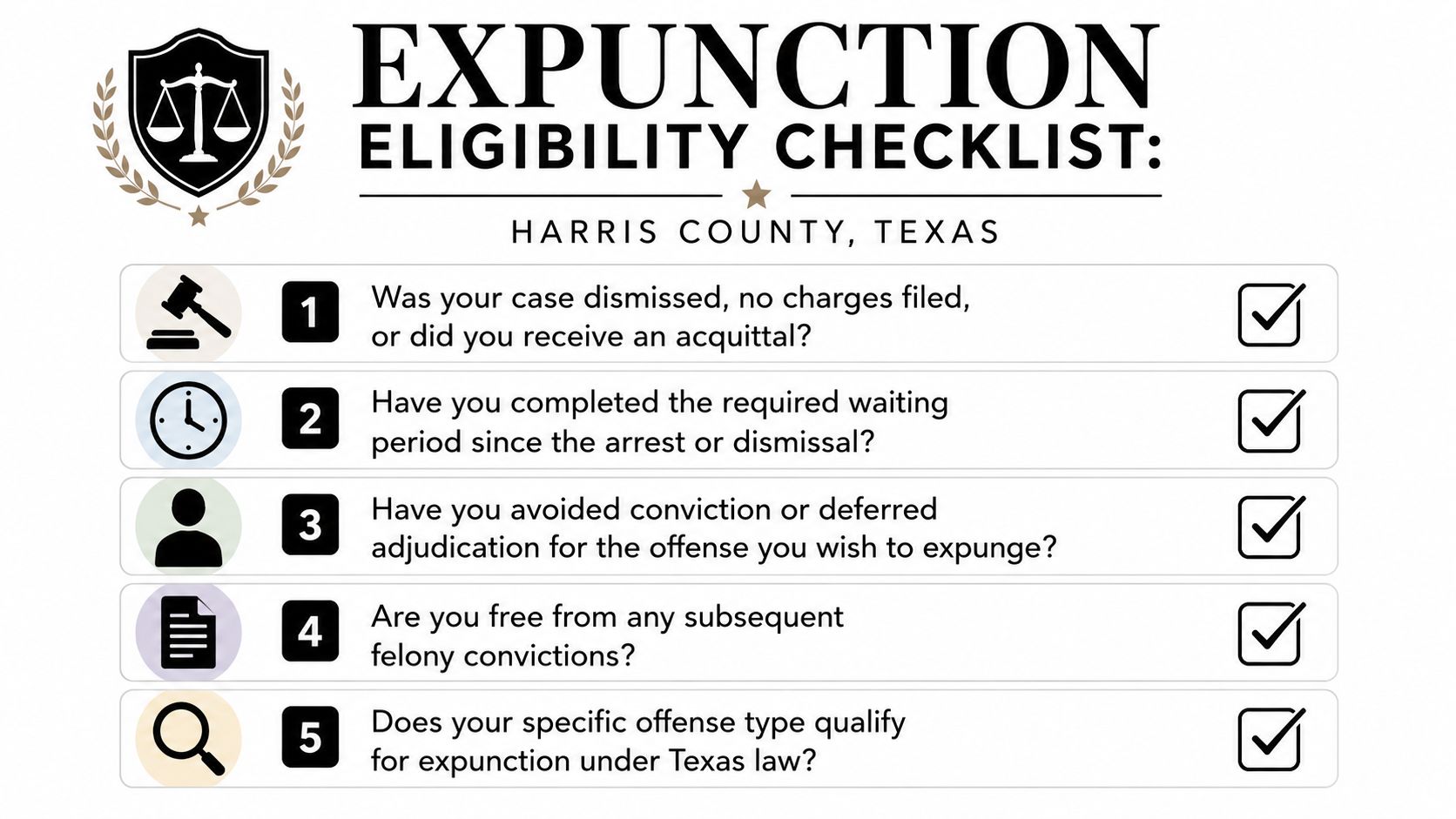
Start with the basic Texas categories
You may have a path to expunction if your situation looks like one of these:
- No charges were filed: You were arrested, but the prosecutor never filed a case.
- The case was dismissed: A dismissal can qualify, but not every dismissal leads to expunction automatically.
- You were acquitted: If a court found you not guilty, expunction may be available.
- You completed a qualifying pretrial diversion program: Some successful pretrial diversion outcomes can support expunction.
- You had a Class C misdemeanor that fits the statute: Certain lower-level matters can qualify where higher-level cases would not.
That's the broad picture. The problem is that people often stop there and assume they're clear. Don't.
Timing can sink an otherwise good case
One of the most common technical errors in record clearing is timing. In other jurisdictions, waiting periods can vary widely, and filing early or leaving one non-expungeable charge in the case can blow up the petition, as explained by People's Law on expungement timing and eligibility traps. The lesson applies in Texas too. Dates matter. Final dispositions matter. Every charge tied to the arrest matters.
Here's the checklist I'd use for any Kingwood or Humble resident trying to self-screen:
- Check the final outcome: Was it dismissed, no-billed, acquitted, or diverted in a way Texas recognizes for expunction?
- Check for waiting period issues: Some cases require you to wait before filing. Filing too early can get you denied.
- Check the offense level: A Class C result may be treated differently from a felony arrest.
- Check the entire arrest event: If one charge from the same arrest creates a problem, that can affect the whole request.
- Check your later history: New legal trouble can complicate the analysis.
Questions to ask yourself before filing
Ask these in order:
Was I convicted?
If the answer is yes, expunction is usually much harder and often not available. You may need to look at nondisclosure instead.Was this deferred adjudication?
If so, don't jump to the word expunction. Many deferred cases do not qualify for it.Do I have the paperwork proving the result?
Memory isn't evidence. The court wants documents.Am I looking at one charge or one arrest with several charges?
That difference matters more than is often acknowledged.
If your answer to any of those questions is “I'm not sure,” stop and verify before you file anything.
Harris County details matter more than people think
A lot of people in Northeast Houston search how to expunge criminal record issues and then use generic online advice written for some other state. That's risky. Texas law has its own categories, and Harris County procedure has its own expectations.
This is similar to other local court work. Enforcement of Court Orders in Kingwood involves enforcing divorce decree and custody order provisions in Harris County. Different subject, same lesson. Local procedure affects real outcomes.
The Step by Step Process for Filing Your Petition
You finally decide to clear the record, sit down at the kitchen table, pull up a generic online form, and realize none of it matches what happened in Harris County. That is where people get into trouble. A Texas expunction petition is not a fill in the blank exercise. It has to match your arrest history, your court result, and the agencies that still hold your record.

My advice is simple. Build the file before you write the petition.
Step one: gather every record tied to the arrest
Start with the paper trail, not your memory. In Harris County, small details matter. One wrong date, one missing agency, or one charge listed the wrong way can slow the case down or give an agency a reason to object.
Collect these first:
- Arrest details: Date, arresting agency, booking information, and the exact charge wording
- Court records: Cause number, court number, dismissal order, acquittal, or other final disposition
- Prosecutor information: Which office handled the case
- Agency list: Every office that may still have the record, including clerks, law enforcement, jail systems, prosecutors, and state recordkeepers
If you were arrested in Northeast Houston, that list may be longer than you expect. A Kingwood or Humble resident may deal with city police, Harris County agencies, a district clerk, and state databases. Miss one, and the record may keep surfacing later.
Step two: draft the petition with precision
This document has one job. Tell the court exactly what record should be erased and why Texas law allows it.
Be specific. Use the correct arrest date, case number, court, and disposition. Name the agencies accurately. If the petition describes the wrong event or leaves out an agency, the court cannot fix that for you.
This is also where people confuse expunction with nondisclosure. They are not the same remedy. If you are filing for an expunction, your petition should ask for destruction or return of records as the law allows. It should not read like a nondisclosure request that merely limits who can see the file.
Step three: file in the right court
File in the court that has authority over the case under Texas law and Harris County procedure. Filing in the wrong place wastes time and money.
For Kingwood and Northeast Houston residents, local court structure matters more than generic internet advice suggests. Your paperwork may trace back to an arresting agency, a county clerk, a district clerk, or a criminal court at law. If you are unsure how your case moved through the system, this overview of the steps in the Texas criminal trial process helps explain why records end up in several places.
Pay the filing fee unless you qualify for a fee waiver. Get a file stamped copy and keep it.
Step four: make sure every required agency gets notice
This part decides whether the order works in real life.
An expunction order only helps if the agencies holding the record are brought into the case and ordered to act. Courts do not wave a wand and clear every database in Texas. The agencies have to be named, served, and given the chance to respond.
Use a disciplined process:
List every agency before filing.
Do not guess.Match each agency to the arrest and case history.
The arresting department, jail, prosecutor, clerk, and state repository may all need to be included.Track service and keep proof.
If a notice problem comes up later, your file should answer it immediately.
After you've got the broad process in mind, this short video can help make the flow more concrete for visual learners in Kingwood and across Northeast Houston.
Step five: get ready in case the court sets a hearing
Some petitions are approved without a hearing. Some do not. If a hearing is set, show up prepared to prove every part of your request.
Bring organized copies of the records. Know the outcome of the case without guessing. Be ready to explain why you qualify for expunction under Texas law, not just why you want a clean slate. Judges in Harris County expect the paperwork to line up with the request.
One more practical point. An expunction does not rewrite history. It clears eligible records from the agencies covered by the order, but it does not erase private memories, news stories, or information that was never part of the official record system. That is why careful filing matters so much. You want the court order to reach every official holder of the record the law allows.
What Happens Next Timelines Costs and Courtrooms
After filing, a quick answer is often expected. That usually isn't how it works in Harris County. Courts move on their own schedule, agencies need time to respond, and any mistake in the paperwork can stretch things out.
What the timeline feels like
This process is usually measured in months, not days. Some cases move more smoothly than others, especially when the record is clean, the agencies are correctly listed, and nobody objects. Others slow down because an agency needs clarification, a hearing gets set later than expected, or the petition has to be corrected.
That delay doesn't always mean something is wrong. It often means the system is doing exactly what it does.
What you may have to pay for
Expect a few categories of expense:
- Court filing costs
- Service or notice costs
- Record retrieval costs
- Attorney fees if you hire counsel
I'm being general on purpose here. The exact total depends on the case and the county procedures in play. What matters most is understanding that the filing itself is only one piece of the cost picture.
Will you have to go to court
Sometimes yes, sometimes no.
If the petition is straightforward and nobody pushes back, the matter may be handled with less drama than you expect. If a prosecutor or agency objects, a hearing becomes more likely. When that happens, you need to be ready to explain the legal basis for expunction and show the paperwork that supports it.
For many Harris County residents, the courtroom itself creates anxiety. That's normal. If you want a better sense of how criminal cases move through the local system, reviewing the steps in a criminal trial process can make the environment feel less intimidating.
What expunction does not erase
Many online guides overlook a critical fact: even when a court grants expunction, that doesn't guarantee every private database updates overnight. Some agency records may still exist in forms the public doesn't ordinarily see, and third-party background-check databases may lag behind or hold outdated information, a problem discussed by the Cook County court guidance on expungements and adult records.
That means the practical result can look like this:
| After the order | What to expect |
|---|---|
| Public court access | The record should no longer appear the same way in ordinary public court searches |
| Government access | Some official entities may still retain or access limited information depending on the law and the agency |
| Private background databases | Updates may not be immediate, and outdated entries sometimes linger |
A signed order is powerful. It isn't a time machine for every private database on the internet.
What to do after the order is signed
Once the order is entered, keep copies. If a private screening company later reports outdated information, those copies matter. They help you challenge stale reporting and show that the court granted relief.
For people in Kingwood and Humble, this is the practical part nobody tells you enough. Winning the order is huge. Following through afterward is part of protecting the benefit of that order.
Common Pitfalls and Your Next Step in Kingwood
A lot of people in Kingwood get stuck at the same point. They know an old case is holding them back, they pull a few forms online, and they file the case they hope qualifies instead of the case Texas law allows.
That is how people lose months in Harris County.
The common mistakes are predictable. A dismissed case does not always qualify for expunction. An order of nondisclosure is not the same thing as an expunction. One missing agency can leave part of the record untouched. One wrong cause number can slow the whole case down. Filing too early can get the petition denied.
The practical lesson is simple. Start with your paperwork, not your memory. Get the final disposition, the arrest information, and any court orders tied to the case. Then match those facts to the right remedy.
Mistakes I would avoid first
- Do not guess about eligibility: Read the final court paperwork closely. The exact outcome matters.
- Do not mix up expunction and nondisclosure: Expunction deletes qualifying records from public view and directs agencies to destroy them. Nondisclosure seals a qualifying record from the public, but it still exists and many government entities can still see it.
- Do not leave out agencies: Harris County cases often involve multiple agencies, and missing one can leave your cleanup incomplete.
- Do not trust generic templates: What works in another Texas county may not fit the courts and agencies involved here in Northeast Houston.
- Do not assume the order fixes every problem overnight: As noted earlier, private background companies can keep outdated information longer than they should.
If you are deciding whether to handle this on your own or hire counsel, this guide on how to choose a criminal defense lawyer will help you ask the right questions.
Law Office of Bryan Fagan – Kingwood TX Lawyers handles criminal defense and related legal matters for people in Kingwood and nearby communities. For an expunction or nondisclosure issue, the value is straightforward. Someone reviews the record, identifies the correct remedy, prepares the petition, and handles the Harris County process with you.
If an old record is affecting work, housing, or your peace of mind, take the next step now. Get your documents together, get clear on whether you need expunction or nondisclosure, and make a plan based on your actual case.