Skip to content
Being accused of a crime in Kingwood, Humble, or anywhere in Northeast Houston is one of the most stressful experiences a person can face. The Texas legal system can feel overwhelming, with unfamiliar procedures and complex terminology that can leave you feeling lost and anxious about your future. You do not have to navigate this complicated journey alone. At The Law Office of Bryan Fagan, we believe understanding the road ahead is the first, most crucial step toward protecting your rights.
This guide is designed to demystify the essential steps in criminal trial process from beginning to end. We provide simple explanations of Texas law, tailored specifically to our Kingwood community, explaining what happens from the moment of arrest through potential sentencing and appeals. Knowledge is your most powerful tool in a criminal case, allowing you to make informed decisions and prepare for what comes next.
Our Kingwood-based team is dedicated to providing the local, client-focused representation you deserve during this difficult time. We will walk you through each stage, explaining your rights in plain English, discussing potential outcomes, and showing you how our experienced attorneys can build a strong defense on your behalf right here in Northeast Houston. Let us help you regain a sense of control and fight for the best possible outcome.
1. Arrest and Booking: The Critical First Hours
The first of the formal steps in a criminal trial process begins with an arrest and booking. This is the moment law enforcement takes a suspect into custody, a critical juncture where your actions and words carry immense weight. For our neighbors in the Kingwood and Northeast Houston area, this typically occurs at a local police station or the Harris County jail, where officials will document your personal information, the alleged offense, and take your fingerprints and photograph.

Texas law, alongside the U.S. Constitution, provides you with fundamental protections during this stage. You have the right to know the charges against you and, most importantly, the right to remain silent. Anything you say can be used against you, making silence your strongest initial defense. Understanding the immediate aftermath of an arrest is crucial, as further detailed in this article about what happens after a DUI arrest.
What This Looks Like for Kingwood Residents
- DWI Arrest: After being pulled over on a road like West Lake Houston Parkway, you might be asked to perform field sobriety tests. An arrest leads directly to the booking process at a local station.
- Felony Assault: A serious accusation could lead to an immediate arrest and transport to a Harris County detention center for booking, where your personal property is inventoried and held.
- Theft Charge: If accused of shoplifting at a local Kingwood store, you would be booked, and the details of the alleged crime would be officially recorded.
Practical, Step-by-Step Guidance
The hours following an arrest are confusing, but your response is vital. This is the foundation upon which your defense will be built.
- Exercise Your Right to Remain Silent: Politely state that you are invoking your right to remain silent and wish to speak with an attorney.
- Request Counsel: Do not answer any questions about the alleged incident without a lawyer present.
- Provide Only Basic Information: Offer your name and address but nothing more.
- Contact a Lawyer: As soon as you are able, contact a Kingwood criminal defense attorney. This is the first step toward protecting your rights and preparing for your bond hearing.
At The Law Office of Bryan Fagan, we understand how disorienting an arrest can be. Our local Kingwood team is ready to provide immediate guidance to protect your rights from the very start.
2. First Appearance / Arraignment: Your Initial Day in Court
After arrest and booking, the next critical step in the criminal trial process is the first appearance, often called an arraignment. This initial court hearing must occur promptly, typically within 48 to 72 hours of your arrest in Texas. During this proceeding, a judge formally informs you of the charges against you, explains your constitutional rights, and addresses the issue of pretrial release by setting bail or other bond conditions.
This hearing is the first opportunity for your case to be heard in a formal court setting. The judge will determine if there was probable cause for your arrest. For those navigating the system in Harris County, understanding what happens at this stage is crucial. Following the initial booking, a quick guide to booking, arraignment, and bail can help individuals understand the proceedings at their first appearance.
What This Looks Like for Kingwood Residents
- DWI First Appearance: In a Harris County District Court, a judge might set bail and require an ignition interlock device on your vehicle as a condition of release.
- Assault Charge Arraignment: For an assault charge, the judge could impose a no-contact order, prohibiting you from communicating with the alleged victim while your case is pending.
- Felony Theft First Appearance: Depending on the specifics of a felony theft case, the judge might grant a personal recognizance bond or impose supervised release with regular check-ins.
Practical, Step-by-Step Guidance
Your conduct and preparedness at the arraignment can significantly influence the early trajectory of your case. Being proactive is key to establishing a strong defense from the outset.
- Secure Legal Representation: If possible, have an attorney present. An experienced lawyer can argue for a lower bond and more favorable release conditions.
- Dress and Act Respectfully: Wear professional attire and maintain a respectful demeanor when addressing the court. First impressions matter.
- Answer Truthfully but Briefly: Only answer direct questions from the judge. Do not volunteer information about the case.
- Request Reasonable Bail: If the initial bail amount is too high, your attorney can argue for a reduction based on your ties to the Kingwood community, employment, and lack of flight risk.
The arraignment sets the stage for everything that follows. At The Law Office of Bryan Fagan, our Kingwood criminal defense attorneys can represent you at this vital hearing, ensuring your rights are protected and working to secure your release under the best possible terms.
3. Preliminary Examination (for Felonies)
For felony charges in Texas, the preliminary examination is a crucial pre-trial hearing that serves as the first major test of the prosecution's case. Often held within 10 days of the arrest, this proceeding requires the prosecutor to present enough evidence to convince a judge that probable cause exists to believe a crime was committed and that you were the person who committed it. This is a critical opportunity to challenge the state's evidence before it ever reaches a grand jury.
This hearing, known in Texas as an examining trial, is not about determining guilt or innocence. Instead, it’s a checkpoint in the steps in a criminal trial process designed to weed out weak or unfounded felony accusations. A skilled defense attorney can use this stage to cross-examine the state's witnesses, expose holes in the investigation, and lay the groundwork for a robust defense strategy, potentially leading to a dismissal or reduction of the charges.
What This Looks Like for Kingwood Residents
- Felony DWI with Injury: If you were arrested for a DWI involving an accident on Northpark Drive, your attorney could use the preliminary examination to challenge the procedures used for a blood draw or question the arresting officer's observations.
- Aggravated Assault: In a case stemming from an incident in a Kingwood neighborhood, the defense could cross-examine the alleged victim or other witnesses, highlighting inconsistencies in their stories and raising questions about their credibility.
- Felony Theft: For a high-value theft charge from a business near the Kingwood Town Center, the preliminary examination might reveal a lack of direct evidence linking you to the crime, possibly resulting in the charge being reduced to a misdemeanor.
Practical, Step-by-Step Guidance
Waiving your right to this hearing is rarely advisable. It is your first and best chance to confront the evidence against you head-on.
- Request the Examination: Do not waive your right to a preliminary examination. Insist on this hearing to force the prosecution to show its hand.
- Prepare for Cross-Examination: Work closely with your attorney to develop questions that target weaknesses in the prosecution's witnesses and evidence.
- Focus on Procedural Errors: Your legal team should scrutinize every aspect of the arrest and evidence collection for violations of your rights.
- Challenge Evidence Admissibility: This is the time to raise early objections to any evidence that was obtained illegally.
At The Law Office of Bryan Fagan, our Kingwood criminal defense team recognizes the immense strategic value of a preliminary examination. We use this hearing to aggressively test the state’s case, protect your rights, and work toward the most favorable outcome possible.
4. Grand Jury Indictment (for Felonies)
For felony charges in Texas, the next of the formal steps in a criminal trial process is the grand jury indictment. This is a critical constitutional safeguard where a group of citizens, typically from Harris County, reviews evidence presented solely by the prosecutor. Their job is not to determine guilt but to decide if there is enough probable cause to formally charge you with a felony and proceed to trial.
Unlike a trial jury, the grand jury process is one-sided. You and your attorney typically do not have the right to present evidence or even be present. If the grand jury finds sufficient probable cause, they issue a "true bill" or indictment, and the case moves forward. If they do not, they issue a "no bill," and the charges are often dismissed. This process acts as a check on prosecutorial power, preventing unfounded felony prosecutions from advancing.
What This Looks Like for Kingwood Residents
- Felony DWI: If a DWI incident in Kingwood resulted in serious injury, the prosecutor would present evidence like police reports and medical records to the Harris County grand jury to secure an indictment for intoxication assault.
- Aggravated Assault: Following a serious altercation in a local Humble establishment, the district attorney would present witness statements and physical evidence to a grand jury to get an indictment.
- White-Collar Crime: For complex financial crimes involving a Kingwood-based business, a prosecutor might present bank records and expert testimony over several sessions to secure a multi-count indictment.
Practical, Step-by-Step Guidance
While your direct involvement is limited, strategic preparation during this phase is essential. The outcome of the grand jury often sets the tone for the rest of your case.
- Assume an Indictment: Since the process heavily favors the prosecution, it is wise to prepare for trial as if an indictment is inevitable.
- Gather Exculpatory Evidence: Work with your attorney to collect evidence and identify witnesses that prove your innocence. This information will be vital for plea negotiations or trial.
- Monitor the Process: Your attorney will monitor the process for any procedural errors that could be used for a challenge later.
- Discuss Defense Strategy: Use this time to build a robust defense strategy with your legal team, exploring all possible angles and preparing for the next steps.
At The Law Office of Bryan Fagan, our Kingwood criminal defense lawyers understand the nuances of the Harris County grand jury system. We use this crucial waiting period to aggressively build your defense and prepare for every possibility.
5. Discovery and Disclosure: Uncovering the Evidence
Following indictment, the next of the critical steps in a criminal trial process is discovery and disclosure. This is the formal process where the prosecution and defense exchange all information and evidence relevant to the case. It’s a foundational stage that ensures a fair trial by preventing surprises, allowing your defense team to see exactly what evidence the state has against you.
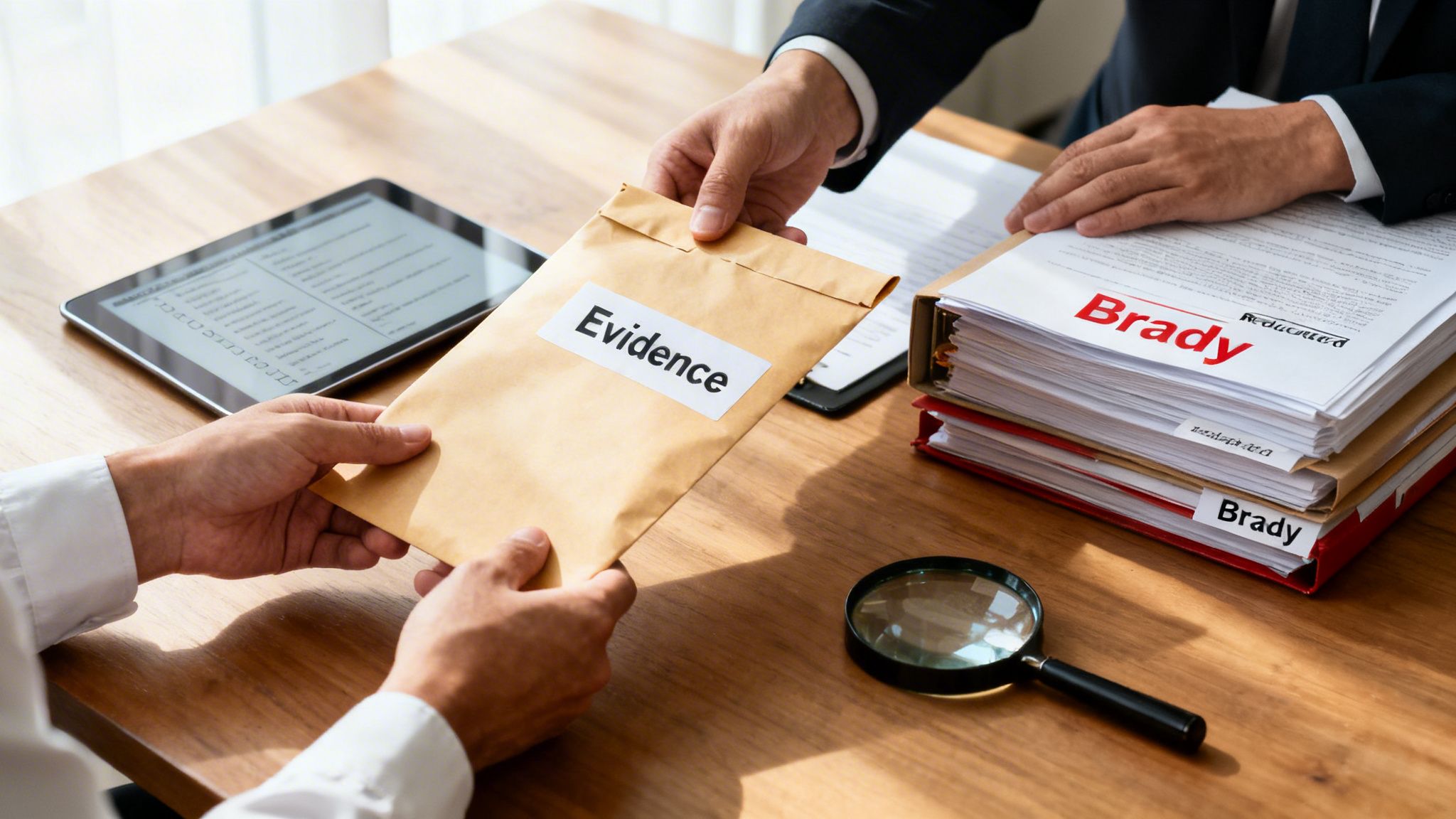
Under Texas law and landmark U.S. Supreme Court rulings, prosecutors must turn over all evidence, including exculpatory evidence (known as Brady material) that could help prove your innocence. This stage is non-negotiable for building a robust defense strategy, as it often reveals weaknesses in the prosecution's case, from procedural errors to contradictory witness statements. The information gathered here is vital and similar in importance to what is gathered when you prepare for a deposition.
What This Looks Like for Kingwood Residents
- DWI Case: Discovery might reveal that the breathalyzer used during your stop on Northpark Drive had a history of inaccurate readings or was not properly calibrated, severely weakening the state's primary evidence.
- Assault Case: Your attorney could receive the alleged victim's initial statement to Humble Police, which may contradict their later testimony, providing a powerful tool for cross-examination at trial.
- Theft Case: The prosecution might turn over security footage from a Kingwood business that is grainy or shows someone else entirely, directly challenging the accusation against you.
Practical, Step-by-Step Guidance
A thorough and aggressive approach to discovery is essential. This is where your defense attorney meticulously combs through the state's case file to find opportunities.
- File Comprehensive Discovery Motions: Your attorney should file motions demanding all evidence, including police reports, body and dashcam footage, and 911 call recordings.
- Request Exculpatory Evidence: Specifically demand any evidence that could point to your innocence or question the credibility of state witnesses.
- Analyze All Documents: Scrutinize every piece of paper, from lab results to officer notes, for inconsistencies or errors.
- Preserve Evidence for Independent Testing: If physical evidence exists, your attorney can request to have it independently tested by a defense expert.
At The Law Office of Bryan Fagan, our Kingwood attorneys understand that a case is often won or lost during discovery. We aggressively pursue every piece of evidence to ensure your rights are protected and your defense is as strong as possible.
6. Suppression Hearing (Motion to Suppress Evidence)
One of the most powerful pre-trial tools in a criminal defense attorney's arsenal is the Motion to Suppress Evidence. This critical step in the criminal trial process involves a formal hearing where your lawyer challenges the legality of how the prosecution obtained its evidence. If the judge agrees that law enforcement violated your constitutional rights, the tainted evidence can be excluded, or "suppressed," from being used against you at trial.
This hearing is founded on the principle that evidence gathered through an illegal search (a Fourth Amendment violation) or an improperly obtained confession (a Fifth Amendment violation) should not be admissible. A successful motion can dismantle the prosecution’s case before a jury is ever seated, often leading to a dismissal of charges or a much more favorable plea bargain.
What This Looks Like for Kingwood Residents
- DWI Case: Your attorney might file a motion to suppress the results of a breathalyzer test if the officer who pulled you over on Northpark Drive lacked reasonable suspicion for the initial traffic stop.
- Drug Possession: If police searched your home in a Kingwood neighborhood without a valid warrant or probable cause, any evidence found could be suppressed, gutting the prosecution's case.
- Assault Charge: A confession might be challenged if you were interrogated by Humble police officers without being read your Miranda rights, making your statements inadmissible.
Practical, Step-by-Step Guidance
The success of a suppression hearing depends on meticulous preparation and a detailed account of your interaction with law enforcement. Your memory and cooperation are invaluable.
- Document Everything: Write down every detail you can remember about your arrest, including what officers said, how they searched you or your property, and when they read your rights.
- Be Honest with Your Attorney: Provide your lawyer with a complete and truthful account of events. Even small details can be the basis for a successful motion to suppress.
- Identify Witnesses: If anyone else saw the arrest or search, their testimony could be crucial.
- Follow Legal Advice: Your attorney will identify the specific constitutional violations and build the legal argument. Trust their expertise in navigating this complex process.
At The Law Office of Bryan Fagan, our Kingwood defense team excels at scrutinizing police conduct to protect your rights. We will thoroughly investigate your case to identify any grounds for suppressing evidence and fight aggressively to have it excluded.
7. Plea Negotiations and Plea Agreements
Most criminal cases do not end with a jury verdict. Instead, they are resolved through plea negotiations, a critical phase in the steps in a criminal trial process where your attorney and the prosecutor discuss a potential resolution. In Texas, an estimated 97% of criminal cases conclude this way, making it a pivotal opportunity to control the outcome and avoid the risks of a trial. A plea agreement typically involves pleading guilty or "no contest" in exchange for a reduced charge or a more favorable sentence.
This process is a strategic negotiation. The goal is to secure a better outcome than what might happen if you were found guilty at trial. For many defendants in Kingwood and Northeast Houston, a well-negotiated plea bargain can mean the difference between a felony and a misdemeanor, or probation instead of jail time. It provides certainty in an otherwise unpredictable process.
What This Looks like for Kingwood Residents
- DWI Case: An attorney might negotiate a first-time DWI charge down to an obstruction of a highway, avoiding a permanent DWI on your record.
- Assault Charge: In a Harris County court, a felony assault charge could be reduced to a Class A misdemeanor with anger management classes as a condition of probation.
- Drug Possession: A plea agreement might result in deferred adjudication, which allows for the case to be dismissed entirely after a successful probation period. You can learn more about what deferred adjudication is in Texas and how it can protect your future.
Practical, Step-by-Step Guidance
Navigating plea bargains requires experienced legal guidance to ensure your rights are protected and the offer is truly in your best interest.
- Never Negotiate Alone: Always have your attorney handle all discussions with the prosecutor.
- Assess the Evidence: Work with your lawyer to evaluate the strength of the prosecutor's case against you versus your chances at trial.
- Consider All Consequences: Discuss how a plea will impact your job, housing, and professional licenses.
- Get It in Writing: Ensure every term of the agreement is documented clearly before you enter a plea in court.
The team at The Law Office of Bryan Fagan understands the high stakes of plea negotiations. We meticulously analyze every aspect of your case to advise you on the best path forward, ensuring any agreement serves your long-term interests right here in the Kingwood area.
8. Pre-Trial Motion Practice: Shaping the Battlefield
Before a single juror is selected, one of the most strategic steps in a criminal trial process takes place: pre-trial motion practice. This is the formal stage where your defense attorney and the prosecutor file motions, which are written requests asking the court to make specific rulings on legal issues. These motions can define the rules of the trial, limit the evidence the jury will hear, and sometimes even lead to a case dismissal.
The outcome of these motions can dramatically alter the course of your case. For instance, a successful motion to suppress evidence can cripple the prosecution's ability to prove its case. This procedural battleground is where an experienced criminal defense lawyer establishes the legal framework for the trial ahead, protecting your rights and strengthening your defense strategy.
What This Looks Like for Kingwood Residents
- DWI Case: Your attorney might file a Motion to Suppress the breathalyzer results if the machine was not properly calibrated or if the traffic stop lacked probable cause on a road like Kingwood Drive.
- Assault Charge: In a high-profile case that has received significant local media attention, your lawyer could file a Motion for a Change of Venue to move the trial from Harris County to ensure a more impartial jury pool.
- Drug Possession: If you were charged with multiple offenses, your attorney might file a Motion to Sever, arguing that trying the charges together would unfairly prejudice the jury against you.
Practical, Step-by-Step Guidance
While your attorney handles the legal drafting and arguing of motions, your role is to provide them with all the necessary information to build the strongest arguments possible.
- Provide a Detailed Account: Be completely honest with your attorney about every detail of your arrest and the events leading up to it. This information is critical for identifying potential rights violations.
- Identify Witnesses: Inform your lawyer of anyone who witnessed the incident or your arrest. Their testimony could support a motion.
- Preserve All Evidence: Keep any documents, photos, or digital communications related to your case and share them with your legal team.
- Discuss Strategy: Ask your attorney to explain the pre-trial motions they plan to file. Understanding this part of the steps in a criminal trial process empowers you and helps you prepare for what's next.
At The Law Office of Bryan Fagan, our Kingwood attorneys excel at meticulous pre-trial motion practice. We scrutinize every piece of evidence and police procedure to identify opportunities to protect your rights and position your case for the best possible outcome.
9. Trial Preparation, Proceedings, and Verdict
This is the culmination of all prior steps in the criminal trial process: the trial itself. It begins with intensive preparation, where both the defense and prosecution finalize strategies, prepare witnesses, and organize evidence. The trial proceeds with jury selection, opening statements, the presentation of evidence, and closing arguments, concluding with the jury's deliberation and verdict.
In Texas, the prosecution must prove guilt beyond a reasonable doubt, the highest legal standard. Your constitutional right to confront witnesses against you is paramount during this phase. This stage is where a meticulously prepared defense can expose weaknesses in the prosecution's case and assert your innocence before a jury of your peers.
What This Looks Like for Kingwood Residents
- DWI Trial: Your attorney might present expert testimony from a toxicologist challenging the reliability of a breathalyzer test administered in Humble, leading to a not guilty verdict.
- Assault Trial: In a Harris County courtroom, your defense could focus on witness credibility, demonstrating inconsistencies in testimony that create reasonable doubt.
- Theft Trial: If accused of theft in Kingwood, your defense might introduce alibi witnesses and surveillance footage proving mistaken identity, directly refuting the prosecution's claims.
Practical, Step-by-Step Guidance
Your active participation and preparation with your attorney are critical for a successful outcome. This is where your defense narrative comes to life.
- Prepare Thoroughly: Work with your lawyer to practice your testimony and understand the questions you will face from both your attorney and the prosecutor.
- Assist in Jury Selection: Provide your attorney with insights on potential jurors to help select an impartial panel.
- Maintain Composure: Your demeanor in the courtroom is observed by the judge and jury. Remain professional, respectful, and composed throughout the proceedings.
- Develop a Compelling Narrative: A strong trial defense tells a clear, believable story that emphasizes the presumption of innocence.
At The Law Office of Bryan Fagan, we prepare every case as if it will go to trial. Our Kingwood-based litigators craft powerful defense strategies and advocate fiercely for our clients in the courtroom, providing trusted representation when it matters most.
10. Sentencing Hearing: Determining the Consequences
If a trial results in a guilty verdict or you accept a plea agreement, the next of the critical steps in a criminal trial process is the sentencing hearing. This is the formal court proceeding where the judge determines the appropriate punishment. It is not an automatic process; both the prosecution and your defense have the opportunity to present arguments and evidence to influence the judge's final decision.
In a Kingwood or Harris County courtroom, the judge will consider a wide range of factors. The punishment can include imprisonment, fines, restitution to victims, community service, or probation with specific conditions. The goal of this stage is to present a complete picture of who you are to argue for a fair and just outcome.
What This Looks Like for Kingwood Residents
- DWI Felony with Prior Conviction: After a guilty verdict, the defense might present evidence of the defendant's steady employment in Humble and recent enrollment in an alcohol treatment program to argue for probation rather than a lengthy prison term.
- Assault Conviction: The prosecution could present evidence of aggravating factors, like the severity of the victim's injuries, to argue for a significant prison sentence.
- Theft Charge: A defendant might be ordered to pay back the value of the stolen items (restitution) to a Kingwood business and serve several years on probation as part of their sentence.
Practical, Step-by-Step Guidance
Your defense attorney's work is paramount during this phase. A well-prepared sentencing presentation can dramatically alter the outcome, shifting the focus from punishment to rehabilitation.
- Prepare a Mitigation Presentation: Gather detailed documentation of your employment, family responsibilities, education, and community involvement.
- Secure Character Witnesses: Arrange for credible family members, employers, or community leaders from the Kingwood area to testify on your behalf.
- Present Relevant Documentation: Provide any mental health, addiction treatment, or other medical records that may help explain the circumstances of the offense.
- Request Alternatives: Ask your attorney to argue for alternatives to incarceration, such as intensive probation, specialized treatment programs, or community service.
At The Law Office of Bryan Fagan, our Kingwood criminal defense team understands that the sentencing hearing is a crucial opportunity to advocate for your future. We work diligently to present a comprehensive and compelling case to achieve the most favorable outcome possible.
10-Step Criminal Trial Process Comparison
| Stage | 🔄 Complexity / ⚡ Efficiency | Resources Required | 📊 Expected Outcomes | 💡 Ideal Use Cases | ⭐ Key Advantages |
|---|---|---|---|---|---|
| Arrest and Booking | Low–Medium complexity; immediate process ⚡ | Law enforcement, booking staff, ID/forensic tools, detention space | Official arrest record; possible detention or release | Initial custody, preserve constitutional rights, begin defense contact | Establishes formal record; documents rights and evidence |
| First Appearance / Arraignment | Low complexity; time-sensitive (usually ≤72 hrs) ⚡ | Judge, prosecutor, clerk, defender, court space | Charges read, bail set, counsel assigned, possible initial plea | Early release/bail decisions; challenge probable cause quickly | Fast resolution on detention; early access to counsel |
| Preliminary Examination (Felonies) | Medium–High complexity; moderate pace 🔄 | Prosecutor, witnesses, transcripts, defense counsel | Probable cause determination; possible dismissal or bind-over | Test sufficiency of felony evidence before indictment | Opportunity to expose weak evidence and obtain dismissal/reduction |
| Grand Jury Indictment (Felonies) | Medium complexity; schedule-dependent 🔄 | Prosecutor, grand jurors, exhibits; secrecy protocols | Indictment (true bill) or no-bill; formal felony charging | Prosecutorial screening for felonies where defendant not present | Neutral citizen review; formalizes felony charges (but defense limited) |
| Discovery and Disclosure | High complexity; ongoing process 🔄 | Attorneys, investigators, labs, document management, time | Full/partial evidence exchange; reveals prosecution theory | Case evaluation, motion practice, plea negotiation, trial prep | Reveals exculpatory/impeachment material; enables informed strategy |
| Suppression Hearing (Motion to Suppress) | High complexity; requires constitutional analysis 🔄 | Legal research, witness testimony, evidentiary records, counsel | Evidence excluded or admitted; can significantly alter case | Challenging illegal search/seizure, Miranda, ID procedures | Can be case-dispositive by removing key evidence |
| Plea Negotiations and Plea Agreements | Variable complexity; often fast ⚡ | Defense counsel, prosecutor, case files, negotiation leverage | Guilty plea with negotiated terms or case dismissal possibilities | When risk of trial conviction exists or to reduce exposure | Certainty of outcome, reduced penalties, faster resolution |
| Pre‑Trial Motion Practice | High complexity; can delay proceedings 🔄 | Extensive briefing, hearings, legal research, counsel time | Court rulings shaping admissibility, venue, scheduling; possible dismissal | Resolve legal issues pre-trial, preserve appellate record | Establishes favorable legal boundaries and preserves issues for appeal |
| Trial Preparation, Proceedings, and Verdict | Very high complexity; slow and resource‑intensive 🔄⚡ (lengthy) | Full trial team, experts, witnesses, exhibits, time and budget | Jury verdict (guilty/not guilty); public resolution of facts | Cases requiring full adjudication of disputed facts | Full exercise of trial rights; potential acquittal and public vindication |
| Sentencing Hearing | Medium complexity; post-conviction focus 🔄 | PSI, character witnesses, mitigation docs, counsel | Judge-imposed punishment: prison, probation, fines, restitution | Mitigate sentence after conviction or plea acceptance | Opportunity to present mitigation and seek reduced penalties |
Your Next Step: Secure a Trusted Kingwood Defense Attorney
Navigating the criminal justice system in Texas can feel like trying to find your way through a dense forest without a map. Each of the steps in the criminal trial process, from the initial arrest to a potential sentencing hearing, represents a critical juncture with its own set of rules and strategic challenges. This journey is an adversarial process where your rights, freedom, and future are on the line.
Understanding these stages is the first step, but knowledge alone is not enough. The prosecution has the full weight of the state's resources behind them. To level the playing field, you need a dedicated advocate who not only understands Texas law but also knows the local Kingwood courts, prosecutors, and procedures.
Key Takeaways for Northeast Houston Residents
- A Proactive Defense is Essential: The most effective defense begins the moment you are arrested. Waiting means missing vital opportunities to gather evidence and challenge the state's case from the outset.
- Every Stage is an Opportunity: A skilled defense attorney doesn't just wait for trial. They actively work at every step—arguing for lower bail, challenging illegal searches, or negotiating a dismissal. Each phase is a chance to weaken the prosecution's position.
- Your Rights are Your Shield: The right to remain silent and the right to an attorney are not just legal theories. They are practical tools that form the foundation of a successful defense. Asserting them is not an admission of guilt; it is a demonstration of an informed and protected citizen.
The Power of Local, Experienced Representation
An attorney who regularly practices in the Harris and Montgomery County courts serving the Kingwood, Humble, and Porter communities understands the specific tendencies of local judges and prosecutors. This local insight is invaluable when crafting a defense strategy, negotiating plea agreements, and presenting your case to a jury of your peers.
A Critical Insight: The outcome of your case often depends on actions taken long before a trial begins. The evidence gathered (or excluded), the motions filed, and the negotiations conducted during the pre-trial phases can effectively determine the final result. An experienced local attorney ensures these crucial early steps are handled with precision and foresight.
Mastering the complexities of the steps in the criminal trial process is not something you should have to do alone. The stakes are simply too high. A conviction can lead to jail time, steep fines, and a permanent criminal record. The value of having a trusted legal partner cannot be overstated. They serve as your guide, your advocate, and your staunchest defender, ensuring your story is heard and your rights are fiercely protected. The path forward may seem uncertain, but with the right legal team by your side, you can face the process with confidence.
Facing criminal charges in the Kingwood, Humble, or Northeast Houston area is a serious matter that requires immediate and experienced legal guidance. The Law Office of Bryan Fagan – Kingwood TX Lawyers provides the dedicated, local, and client-focused representation you need to navigate every step of the criminal trial process. Schedule your free, confidential consultation with us at our Kingwood office today to build the strong defense you deserve.