
If you're searching for a divorce lawyer near Kingwood Town Center, you're probably not doing it on a calm Saturday with plenty of time to think. You're doing it between work calls, school pickup, and another hard conversation at home. You may already have a spouse talking about moving money, changing passwords, or "just keeping this simple" while nothing feels simple at all.
That’s why most online lawyer lists around Kingwood are frustrating. They tell you who handles divorce, child custody, mediation, and property division. They rarely tell you what divorce is likely to cost, what hidden expenses show up, or how to budget before the first hearing. One review profile may mention an hourly rate, another may mention a free consultation, and that’s about it. The broader gap is real. A roundup of Kingwood divorce attorney listings notes that local profiles typically skip meaningful pricing details, even though people consistently want answers about retainers, filing fees, and extra costs such as forensic accounting. That same review points out that court filing fees average $300 in Harris County, and one listed attorney, Steven Byers, discloses $275 per hour, while many others do not (Justia overview of Kingwood divorce lawyer listings).
For families in Kingwood, Humble, Porter, and Northeast Houston, that lack of clarity creates bad decisions. People wait too long to hire counsel. They assume an amicable case will stay amicable. They burn through savings because nobody explained the procedural steps that drive cost.
You need more than a list of names. You need a practical plan for timing, court realities, document prep, fee structure, and the choices that can either control conflict or multiply it. You also need a law office that answers the phone when stress is high. For firms evaluating modern intake tools, this overview of AI phone answering services designed for family lawyers is worth reading because fast response matters when a potential client is deciding whether to act today or put the problem off again.
Introduction to Hiring a Divorce Lawyer Near Kingwood Town Center
Kingwood residents often start with the same question. "Do I really need a lawyer nearby, or can any Houston divorce attorney handle this?" My view is simple. Nearby matters. Not because Texas law changes block by block, but because your daily life does.
A divorce filed by someone living near Kingwood Town Center still pulls you into a county system that can feel far away and impersonal. You still have kids to get to school in Humble, work obligations in Northeast Houston, and a household budget that can’t absorb avoidable legal mistakes.
Why local convenience changes the case
A local attorney is easier to meet with when documents are missing, when temporary orders are urgent, or when negotiations suddenly become serious. That sounds basic, but in family law, basic logistics affect outcomes.
Practical rule: Hire close enough that you can realistically meet, sign, review, and respond without turning every task into a half-day event.
If your lawyer is difficult to reach or too far removed from your routine, you’re more likely to delay decisions. Delay is expensive in divorce. It leads to rushed filings, incomplete disclosures, and reactive strategy.
The budgeting gap nobody should ignore
The biggest problem with many "divorce lawyer near kingwood town center" pages is that they treat cost like an afterthought. That’s backward. Cost planning should happen at the start, not after the retainer is paid.
Before you call any office, decide what kind of case you think you have:
- Likely uncontested: You and your spouse broadly agree on property, parenting, and support.
- Contested but workable: There are disputes, but both sides may still negotiate.
- High-conflict: One spouse is hiding information, threatening a custody fight, or disputing major assets.
That simple classification helps you ask better questions in the first consultation and avoid hiring based on marketing alone.
Understanding Texas Law and Local Court Landscape
A Kingwood spouse files for divorce expecting a quick reset. Then pressure starts. The paperwork has to be filed correctly, temporary orders may need immediate attention, and the case usually runs through Harris County procedures that are less convenient and less forgiving than many local families expect.
Texas law sets the floor, not the finish line
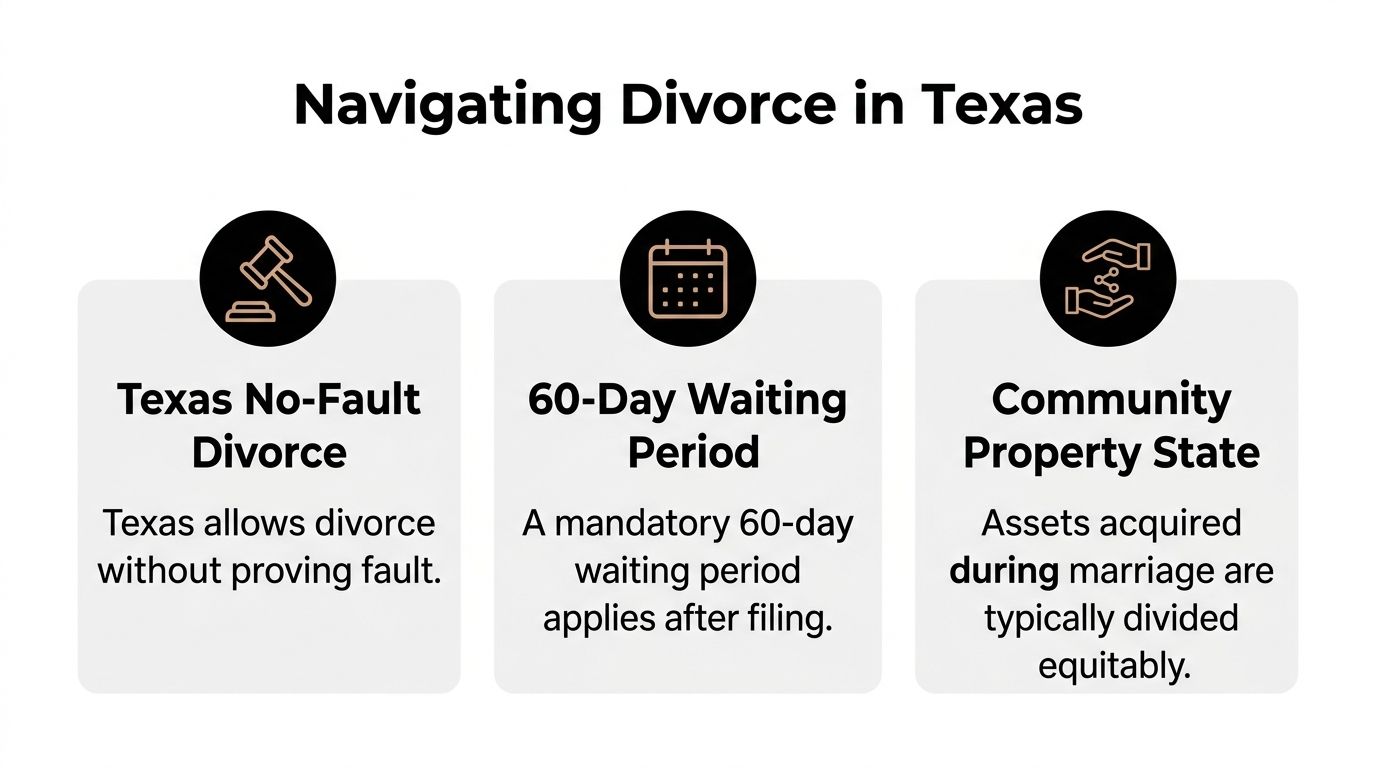
Texas allows no-fault divorce. One spouse can ask for a divorce without proving adultery, cruelty, or some other marital misconduct. That makes filing easier. It does not make the case simple.
Fault can still affect settlement pressure, property arguments, and how aggressively each side litigates. If your spouse wasted money, hid assets, or created instability around the children, those facts still matter. Treat no-fault as the starting rule, not a promise of an easy case.
The 60-day waiting period misleads people
Texas has a minimum 60-day waiting period before a divorce can be finalized. Kingwood clients hear that number and assume two months is realistic. It usually is not.
The delay comes after filing. Temporary orders, financial disclosures, inventory disputes, parenting schedules, mediation, and court settings take time. If one side shows up unprepared, the calendar slips and the bill grows.
That is one of the biggest cost transparency gaps in divorce. Some firms quote an attractive entry number and say little about the procedural steps that drive fees.
Community property is about documentation
Texas follows community property rules, but judges do not cut everything down the middle. The legal standard is a "just and right" division. In practice, that means the spouse with better records often starts from a stronger position.
If you own a house in Kingwood, retirement accounts, stock awards, a family business, or significant debt, get the paper trail together early. Deeds, mortgage statements, account histories, loan records, and proof of separate property claims matter more than assumptions. Waiting to organize those records after the case turns hostile is a bad strategy.
Kingwood families deal with Harris County court procedures, not neighborhood convenience
This is the local hurdle many articles skip. Kingwood may feel separate from central Houston, but divorce cases commonly run through the Harris County court system. That affects hearing logistics, travel time, scheduling, and how quickly you can get in front of a judge.
It also affects expectations. Busy family courts do not reward sloppy filings, missing financial information, or last-minute preparation. If temporary custody, support, or exclusive use of the home is on the table, your lawyer needs to prepare as if every deadline matters, because it does.
Procedure drives outcome
The petition is only the beginning. Substantive work usually includes service, an answer, possible standing orders or temporary restraints, requests for documents, sworn inventories, mediation scheduling, and temporary hearings if the household cannot function without court intervention.
That sequence is where cases get expensive.
A lawyer who knows the local court procedures can tell you which step is coming next, what documents to gather before the court asks, and where delay will cost you money. That is the difference between reacting to the case and controlling it.
What to expect in practical terms
If your divorce is contested, expect months of process, not a quick signature. If children are involved, the case becomes a custody and scheduling matter at the same time. If property is disputed, it becomes an evidence problem too.
Go into this with clear eyes. Hire counsel who explains the Harris County process in plain English, gives you a realistic timeline, and tells you upfront which procedural fights are worth paying for. For local court context affecting Kingwood families, see Kingwood divorce market and court context.
Finding and Evaluating Divorce Attorneys in Kingwood
Kingwood has options. That’s good news, but it also means you need standards. Don’t hire the first lawyer with a polished website or the first office that offers a consultation.
According to Avvo listings, Kingwood hosts at least 12 specialized divorce lawyers, with over 671 client reviews across those profiles (Avvo Kingwood divorce lawyer listings). A crowded market helps you compare, but only if you compare the right things.
Build a shortlist the smart way
Start offline, then verify online.
Ask trusted people in Kingwood, Humble, Porter, or Northeast Houston whether they’ve worked with a family lawyer who was responsive and prepared. Personal referrals are useful because they tell you what the representation felt like, not just what the website says.
Then verify the basics:
- Practice focus: Look for lawyers who regularly handle divorce, custody, support, and property division.
- Client feedback: Read the actual reviews, not just the star average.
- Professional distinctions: Board certification in family law carries weight in Texas.
- Consultation style: Notice whether the office answers direct questions clearly or speaks in vague promises.
For a more detailed checklist, review how to choose a divorce attorney.
What to value more than a polished profile
Many Kingwood-serving attorneys have strong profiles, and some are board-certified with high ratings. That’s useful. It’s not enough.
Ask these questions in the first call or consultation:
- How much of your practice is family law?
- How do you approach temporary orders?
- Who handles communication after I hire you?
- What documents do you want from me first?
- Do you regularly handle cases involving retirement accounts, real property, or business interests?
If the answers are fuzzy, move on.
A good divorce lawyer should make the process clearer in the first conversation, not more confusing.
Red flags that should end the conversation
Some signs are easy to miss because people are emotionally drained when they call.
- Vague billing language: If the office won’t explain how fees are earned or replenished, expect confusion later.
- Guaranteed outcomes: No honest lawyer can guarantee custody, property results, or an easy finish.
- No discussion of procedure: If nobody mentions disclosures, hearings, mediation, or temporary issues, they may be selling reassurance instead of strategy.
- One-size-fits-all advice: A divorce involving kids and retirement accounts is not the same as a short marriage with no children.
If you're comparing online visibility and wondering why some firms dominate local search, this breakdown on how to improve local SEO gives useful context. It also explains why online prominence alone shouldn't decide who handles your divorce.
One local option people often compare is the Law Office of Bryan Fagan, which handles divorce, custody modifications, and enforcement matters from its Kingwood office. That type of local practice can be worth considering if you want family-law-focused support close to home.
Getting Ready for Attorney Consultations and Budgeting
You sit down for a consultation near Kingwood Town Center, the lawyer asks for pay stubs, bank statements, retirement balances, mortgage information, and any prior court orders, and you realize half of it is still in a kitchen drawer or on your spouse’s laptop. That is how people waste money before the case even starts.
Preparation changes the value of the first meeting. A well-prepared consultation gives you real advice about strategy, likely pressure points in the case, and what will drive fees in Montgomery or Harris County family court. Around Kingwood, that local court piece matters more than many online guides admit. Filing county, standing orders, hearing availability, and how fast you can get in front of a judge all affect cost.
Start with documents. Bring copies if you can.

What to bring to the first meeting
Bring enough information for the attorney to spot immediate problems, not just hear your side of the story.
- Marriage and court records: Marriage certificate, prenuptial or postnuptial agreements, and any existing family court orders
- Income records: Recent pay stubs, tax returns, bonus history, self-employment records, and benefit information
- Financial account statements: Checking, savings, brokerage, retirement, pension, and cryptocurrency records if applicable
- Debt records: Mortgage statements, car loans, credit cards, personal loans, and business debts
- Child-related records: School schedules, daycare invoices, health insurance information, therapy records if relevant, and your current parenting schedule
- Property documents: Deeds, vehicle titles, appraisals, and records for rental property, land, or a family business
Bring a short written timeline too. One page is enough. List the wedding date, separation date, children’s names and ages, major assets, major debts, and any urgent issue such as a spouse draining accounts, blocking access to the children, or threatening to move.
Say early if you suspect hidden assets, cash payments, irregular overtime, or missing statements. That affects the plan from day one.
Budget for procedure, not just the final decree
Many people ask, “What does a divorce cost?” That is too broad to help you. Ask what steps your case is likely to require.
A contested divorce can generate fees long before trial. You may need filing fees, service of process, temporary orders, sworn inventories, discovery responses, mediation, business valuation work, retirement division documents, and follow-up hearings if the other side stalls. A prior cost guide on Texas divorce cost breakdown notes that attorney retainers, contested discovery, expert work, and trial preparation often drive the total more than the petition itself.
That is the part many firms gloss over. The main budget problem usually is not the hourly rate alone. It is the number of procedural steps your case is going to trigger.
If you want a grounded overview of the moving parts, read this guide on the cost of divorce in Texas. It is useful for separating basic filing expenses from the bigger charges tied to conflict, property disputes, and custody fights.
Questions that expose cost risks early
Use the consultation to pin down where money gets spent in your case.
Ask these questions directly:
- What county will likely handle my case, and how does that court usually handle temporary orders, mediation, and scheduling?
- What has to happen before we can get temporary relief, and what will that process cost me?
- Which documents do you need from me in the first seven days to avoid extra billable follow-up?
- Do you expect formal discovery, or can we get records voluntarily first?
- Will retirement accounts, stock compensation, real estate, or a family business require outside experts?
- What work can your office do on a limited scope or flat-fee basis?
- How often do you replenish retainers, and what events usually trigger that request?
- If my spouse refuses to turn over records, what is the next procedural step?
Those questions do two things. They show whether the lawyer understands local practice, and they force a clearer conversation about budgeting.
A practical consultation plan for Kingwood clients
Keep it simple and organized.
- Gather the records listed above.
- Build a one-page case summary with dates, names, assets, debts, and urgent concerns.
- Write down your top three goals. Choose practical goals such as staying in the house short term, setting a workable possession schedule, or protecting a retirement account.
- Make a list of missing information your spouse controls.
- Bring written fee questions, including billing increments, retainer replenishment, expert costs, and mediation expectations.
Good preparation cuts avoidable fees. Your lawyer spends less time chasing basic facts and more time identifying the procedural moves that matter in your case.
Here’s a short video that helps frame what to discuss during early divorce planning:
Comparing Legal Fees and Divorce Alternatives
A spouse in Kingwood agrees to “keep this cheap,” then stops producing bank records, changes the school pickup routine, and hires counsel after the petition is filed. That is how a low-cost divorce turns into an expensive one.
The smart question is not which option sounds cheapest on day one. The smart question is which process matches your facts, your spouse’s behavior, and the way Harris County family courts handle delay, disclosure problems, and temporary orders.
Comparison of Legal Fee Structures and Divorce Alternatives
| Option | Typical Cost Range | Timeframe | Ideal For |
|---|---|---|---|
| Hourly-fee attorney representation | Costs vary based on work performed and conflict level | Depends on negotiation, hearings, and court setting | Cases with disputed custody, property, or urgent temporary orders |
| Flat-fee limited work | Usually best for simple tasks or narrow services | Often faster for defined work | Uncontested or low-conflict matters needing document help |
| Mediation | Often lower than full litigation when both sides participate | Can shorten the path to settlement | Couples willing to negotiate in good faith |
| Collaborative divorce | Often useful when privacy and structured negotiation matter | Depends on both spouses' cooperation | Families wanting to avoid litigation and preserve co-parenting |
| Pro se filing | Lowest out-of-pocket legal spend, but highest personal risk | Can stall if paperwork or agreements are flawed | Very simple cases with little disagreement |
| Online divorce platforms | Can help with straightforward paperwork | Works best when issues are truly simple | Tech-comfortable couples with limited disputes |
What actually drives the bill in a Kingwood divorce
Fees rise for predictable reasons. Hidden assets. Incomplete records. Emergency hearings. Parenting disputes that should have been addressed early. Experts for retirement accounts, business valuation, or real estate. Retainer agreements often describe hourly rates, but they do not always make the primary cost drivers obvious enough for families under stress.
That is the transparency gap clients need to press on.
Ask for plain answers about what triggers more work. If your spouse ignores document requests, will counsel send informal requests first or move quickly into formal discovery? If temporary orders are likely, how many preparation hours should you expect before the hearing? If mediation fails, what gets reused and what gets billed again? Those are the procedural steps that change your total spend.
Traditional litigation versus negotiated paths
Litigation is the right call when a spouse is hiding money, blocking access to children, refusing to follow temporary agreements, or using delay as a tactic. In those cases, paying for stronger early action often saves money later because it narrows the issues and creates enforceable deadlines.
Negotiated options work well when both spouses are exchanging information on time and can discuss schedules and property without turning every detail into a fight. The problem is that many couples choose mediation too early, before they know the full asset picture or before anyone has pinned down a workable temporary parenting plan.
That is a costly mistake.
Mediation should follow preparation, not replace it. If you are considering that route, read this guide on divorce mediation in Texas before treating it like a simple settlement meeting.
Options that sound cheaper often carry hidden risk
Pro se filings and online divorce platforms have a place in very simple cases. They can help with paperwork where there are no real disputes, no unusual assets, no support disagreements, and no custody complications.
Kingwood families should be careful here. A case may look simple until someone raises reimbursement claims, separate property issues, retirement division, or a possession schedule that does not fit the child’s school and activity routine. Then the savings disappear. Fixing a bad decree, correcting missing language, or returning to court for enforcement usually costs more than doing it right the first time.
Collaborative divorce can be a strong middle option for spouses who want privacy and structure. It only works if both sides commit to full disclosure and steady participation. If one spouse is evasive, collaborative practice can become an expensive detour before litigation.
My recommendation on choosing the right path
Choose litigation if you need court authority, fast boundaries, or formal discovery.
Choose mediation if the facts are already on the table and both sides are capable of reasonable compromise.
Choose limited-scope or flat-fee help only when the issues are narrow and uncontested.
Choose online tools only for the rare case that is simple in fact, not just simple in theory.
Families around Kingwood Town Center do best when they pick a process based on procedure, not hope. Cost matters. So does local court reality. A cheaper starting point means nothing if the case stalls, the paperwork fails, or the final orders do not solve the underlying problem.
Next Steps and Free Consultation at Law Office of Bryan Fagan
A common Kingwood mistake happens right before filing. One spouse empties a joint account, changes passwords, or sends a long angry text laying out demands about the house or the kids. That single move can create avoidable hearings, discovery fights, and credibility problems from day one.
Handle the last 72 hours before filing carefully. Save statements. Screenshot account balances. Download tax returns, pay stubs, retirement information, and loan records. If children are involved, write down the actual school, childcare, pickup, medical, and activity schedule you have been following. Courts care about specifics, and vague memory usually loses to clean records.
Your first meeting with a lawyer should produce three things: the filing sequence, the documents still missing, and a clear fee explanation. If a lawyer cannot tell you what triggers extra cost, such as service issues, temporary orders, appraisals, retirement division work, or disputes over separate property, you are not getting real cost guidance.
What to do this week
- Preserve records: Bank statements, credit card statements, paycheck records, tax returns, and retirement account information.
- Protect communication: Keep texts, emails, and calendar entries that show parenting routines, spending, and major conversations.
- Stop making unforced errors: Do not transfer property, hide money, change the children’s routine, or post about the case online.
- Book a consultation: Ask for the first procedural steps, likely pressure points in your case, and how fees change if the case turns contested.
The Law Office of Bryan Fagan serves Kingwood from 900 Rockmead Dr #225, which gives local clients a nearby place to sit down, review facts, and make decisions before the next deadline hits (Texas divorce appeal discussion identifying Kingwood office location).
If you live in Kingwood, Humble, Porter, or Northeast Houston, demand direct answers. Ask how filing works, what can slow the case down in local practice, and what your decree must include to avoid enforcement problems later.
If you're ready to talk through your divorce, child custody concerns, property division issues, or next legal steps, schedule a free consultation with Law Office of Bryan Fagan – Kingwood TX Lawyers. Our Kingwood office helps clients assess risk early, prepare for local court procedure, and make decisions with a realistic plan for cost and timing.