Skip to content
When a loved one dies, the legal tasks don’t wait for grief to settle. A son in Kingwood may be trying to find his mother’s will while also fielding calls from the bank. A surviving spouse in Humble may know there’s a house, a car, and a few accounts to deal with, but not know what the court expects first. Many families in Northeast Houston start in the same place. They know something needs to be filed, signed, or transferred, but they don’t know what comes next.
That’s usually where the search for a probate attorney near kingwood begins. Not because someone wants a lawsuit or a long court fight, but because they want a clear path. They want to protect the estate, avoid mistakes, and keep family tension from getting worse.
Probate can feel intimidating when you first hear the word. In practice, it’s often a structured process with familiar tasks: locating the will, opening the estate, notifying the right people, handling debts, and transferring property the right way. The hard part is that each step matters, and local court procedure matters too.
For families in Kingwood, Humble, Porter, and nearby Northeast Houston communities, probate isn’t just a Texas law issue. It’s a local court issue. The right filing, in the right county, with the right supporting documents, can make the process much smoother.
Navigating Probate in Kingwood After a Loss
A common story goes like this. Someone passes away, and within a few days the family starts hearing practical questions. Who can access the account? Can the house be sold? What if the will is in a safe deposit box? Does probate have to happen in Harris County or Montgomery County?
Those questions usually arrive before anyone feels ready.
In Kingwood and Humble, many estates include a family home, retirement accounts, vehicles, and personal belongings with emotional value. Even when relatives get along, paperwork can stall everything. If no one knows where the original will is, the first urgent task may be locating it. If that’s your situation, this guide on how to find a deceased person’s will can help you start with the basics.
Why families feel stuck early
The first days after a loss are full of uncertainty because different institutions ask for different things. A bank may ask for legal authority. A title company may ask whether probate has been opened. Family members may assume the executor can act immediately, even though court authority often comes first.
That doesn’t mean you’ve done anything wrong. It means probate has rules.
Practical rule: If you’re the person expected to handle the estate, don’t start transferring or distributing property informally just because relatives agree. What seems simple at home can create problems later with the court, creditors, or title issues.
What support should feel like
A good local probate guide should make the process smaller, not more confusing. You should understand what documents matter, what deadlines matter, and which questions depend on whether the estate belongs in Harris County or Montgomery County.
If you’re searching for a probate attorney near kingwood, you’re probably looking for two things at once. Legal help, and peace of mind. Both matter.
Understanding Probate in Texas A Clear Explanation
A lot of families around Kingwood and Humble hear the word probate and picture a drawn-out court fight. In many estates, that is not what is happening. Probate is the legal process the court uses to confirm authority, sort out the estate, and make sure property passes the right way under Texas law.
In plain terms, probate works like the instruction and approval process for wrapping up someone’s legal and financial affairs after death. If the person lived in this area, that process often runs through a Harris County or Montgomery County court, depending on where the case belongs. That local detail matters because the rules come from Texas law, but the paperwork, filing practices, and court setting are handled close to home.
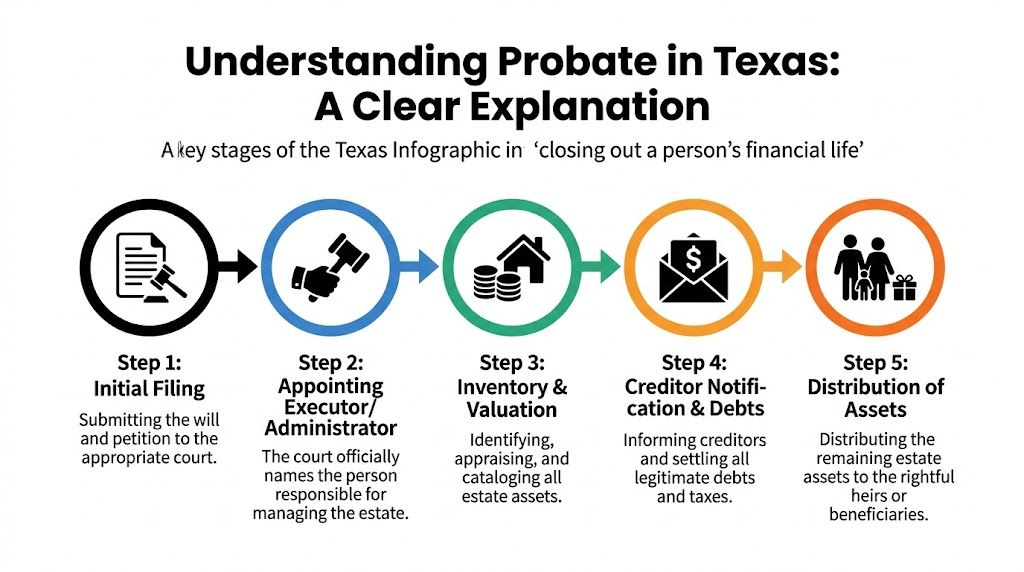
The core functions of probate
Probate usually does four jobs.
- It places the will before the court, if there is a will.
- It identifies who has legal authority to act for the estate.
- It creates an orderly process for assets, debts, and required notices.
- It clears the way for property to reach the correct beneficiaries or heirs.
That is why a death certificate alone is often not enough for a bank, title company, or other institution. Those groups may need proof from the court showing who can sign, who can collect information, and who can transfer property. If you want a step-by-step overview, this guide on how to probate a will in Texas explains the process in more detail.
Testate and intestate in plain language
These two words confuse people because they sound more technical than they are.
- Testate means the person died with a valid will.
- Intestate means the person died without a valid will.
If someone in Kingwood dies testate, the court reviews the will and may appoint the executor named in it, if that person is qualified. If someone dies intestate, the court does not guess at what the person would have wanted. Texas law supplies the inheritance rules.
That is where many families get surprised. A spouse does not always receive everything automatically. The answer can depend on whether there are children, whether those children are from the current marriage or a prior relationship, and whether the property is community or separate property. One small family detail can change the result in a big way.
Why the Texas Estates Code matters
The Texas Estates Code sets the rules probate courts follow. For local families, that matters because it gives structure to a process that can feel uncertain at the start. It also allows for different types of estate administration, including independent administration, which often involves less court supervision when the will and the facts support that approach.
A helpful way to understand this is to compare two roads to the same destination. One road involves more court oversight at different points. The other gives the personal representative more room to handle tasks without returning to the court for permission each time. Which road fits depends on the estate, the will, and whether any disputes or special issues are present.
What people often misunderstand
Several probate misunderstandings come up again and again in Northeast Houston.
- A will does not skip probate on its own. In many cases, the will is the document the court uses during probate.
- Being named executor is not the same as having present authority. Court appointment usually comes first.
- Some assets pass outside probate. Life insurance with a named beneficiary and certain payable-on-death accounts are common examples.
- Probate is different from estate planning. Estate planning is done during life. Probate deals with what happens after death.
These points sound simple, but they affect real decisions. A family member may try to sell a vehicle, access an account, or transfer a home before the legal authority is in place. That can create delays that were avoidable from the start.
A local example
Say a Humble father leaves a valid will naming his daughter as executor and leaves his house to his two children. Probate gives her a recognized legal role, lets her gather information about the estate, address debts and required notices, and complete the transfer the right way.
Now change one fact. There is no will.
The court may need to determine who the heirs are under Texas law before that same house can be transferred. That added step is one reason probate without a will often feels heavier for families. The goal is still the same. The court is making sure the right people are handling the estate and the right people receive the property.
The Key Stages of the Probate Process in Texas
A family in Kingwood loses a parent on Friday. By Monday, someone is asking about the house, another relative wants access to a bank account, and the named executor is wondering what happens first. That moment is where probate often feels confusing. The process becomes easier to handle when you can see it as a series of ordered steps through the local court system, usually in Harris County or Montgomery County for families in this area.
Filing the probate application
Probate usually begins with an application filed in the correct court. For families in Kingwood, Humble, and Northeast Houston, the right venue often depends on where the person lived at death and other case-specific facts. In practice, that often points to Harris County or Montgomery County.
If there is a will, the original will is usually filed with the application. The court uses that filing to determine what type of estate administration is appropriate and who should be considered for appointment.
The hearing and appointment
After the application is filed, the court sets a hearing. At that hearing, the judge may decide whether to admit the will to probate and whether the person named as executor is qualified to serve.
That court approval matters because it is the point where authority becomes official. Until then, family members may have good intentions but still lack legal authority to act for the estate.
Letters Testamentary explained simply
In a will-based probate, one of the key documents is Letters Testamentary. This is the court-issued paper that shows a bank, title company, or other institution that the executor has authority to act for the estate.
A will works like a set of instructions. Letters Testamentary work like the court's confirmation that the executor can carry those instructions out. Around Kingwood, that distinction comes up often when dealing with local banks, real estate transfers, and account access.
Inventory, assets, and estate information
Once appointed, the executor starts gathering a clear picture of the estate. That means identifying what the estate owns, what passes outside probate, and what paperwork supports each asset.
This stage often feels like assembling a neighborhood map. You are locating each property line before anything can be transferred. Deeds, vehicle titles, account statements, tax records, and insurance information all help show what belongs in the estate and what does not.
Common tasks during this phase
- Locate property records for homes, land, or mineral interests
- Identify financial accounts and confirm how each one is titled
- Separate probate assets from non-probate assets so transfers are handled correctly
- Preserve records carefully in case beneficiaries later ask for details
Creditor notice and debt handling
The executor also has to address debts and required notices. Probate is partly a transfer process, but it is also a process for making sure the estate handles valid claims in the proper order.
Texas law includes deadlines that can apply after an executor is appointed, including deadlines tied to creditor notice. The exact notice requirements can vary depending on the estate and the type of creditor involved, which is one reason executors in Harris County and Montgomery County often want clear guidance early rather than trying to correct a missed step later.
Distribution to heirs or beneficiaries
After the estate information is collected, debts and required matters are addressed, and the court process is in order, property can be distributed to the heirs or beneficiaries entitled to receive it.
For a Kingwood-area family, that might mean signing a deed to transfer a home, closing an estate account and dividing funds, or delivering personal property under the will. Families often focus on this part first because it feels like the finish line. The court places it later in the process so the transfer is done correctly and with less risk of future disputes.
How long probate may take
The timeline depends on the facts of the estate, the county court involved, and whether there are complications such as title problems, missing documents, or family disagreements. Some estates move along without much friction. Others take longer because one missed filing, an unclear asset list, or a disagreement over property creates extra work for the executor and the court.
If you want a more detailed step-by-step explanation, this guide on how to probate a will in Texas gives a closer look at the filing process.
Reasons a probate may slow down
- The original will cannot be found
- Heirs disagree about property
- Real estate title issues come up
- The executor misses a filing or notice requirement
- The estate includes assets that are hard to value
For families in Kingwood, Humble, and nearby Northeast Houston communities, probate usually feels less overwhelming once each stage is handled in the right order. A local case often moves more smoothly when the executor understands what the Harris County or Montgomery County court expects at each step.
Deciding If You Need a Kingwood Probate Attorney
A common Kingwood scenario goes like this. A parent passes away, the family is grieving, and one adult child is named executor. Then the questions start piling up. Does this estate belong in Harris County or Montgomery County? Can you talk to the bank yet? Do you need court approval before dealing with the house?
That is the point where many families decide whether to handle probate on their own or get legal help from a nearby attorney.

Kingwood is served by many experienced probate attorneys, and that reflects a practical reality. Local families often decide that probate is easier to handle with professional guidance, especially when the estate touches property, heirs, or court procedures in the Kingwood, Humble, and Northeast Houston area.
The choice usually comes down to three things. How complicated the estate is, whether the family is likely to stay on the same page, and how comfortable you are dealing with court rules and deadlines.
Probate works a lot like being handed responsibility for a project you did not choose, while you are still mourning the person who used to handle everything. Even organized people can feel stuck.
Situations where legal help is usually necessary
Some estates become legal matters, not paperwork matters.
- The will may be contested. If someone raises concerns about validity, signatures, capacity, or undue influence, early legal advice can help prevent avoidable mistakes.
- Family members already disagree. Distrust tends to spread into every decision, from who gets notified to how property is valued and distributed.
- The estate includes a business or difficult property issues. A family business, multiple parcels of real estate, mineral interests, or title problems can add layers that are hard to handle without guidance.
- There is no will. Texas intestacy rules can create heirship questions that surprise families, especially in blended families or situations involving children from prior relationships.
Situations where an attorney is strongly recommended
Some estates are not headed for a courtroom fight, but they still carry enough risk that legal help makes sense.
That often includes cases where the executor has never handled probate before, lives outside Texas, or needs to deal with a home in Kingwood, Humble, or nearby Northeast Houston. It also includes estates where one missed step could slow down access to accounts or delay the transfer of real property.
A lawyer's role in those cases is often simple and practical. File the right documents, explain what authority the executor has, keep deadlines straight, and help the family avoid preventable errors in the Harris County or Montgomery County probate process.
Decision point: If your main concern is making a mistake that delays the estate or creates conflict, a probate consultation is usually time well spent.
When some families try to handle it alone
Some executors start out on their own because the estate looks simple. The will seems clear. The beneficiaries get along. There is one house, one bank account, and no obvious dispute.
Sometimes that works.
But probate problems are often easier to prevent than to repair. A filing issue, a notice problem, or confusion about which assets belong in the estate can turn a manageable case into a frustrating one. That is especially true when the estate crosses county lines or involves property records in this part of the Houston area.
Here’s a short video that helps frame what many families consider before moving forward with probate help in Kingwood.
A simple self-check
Ask yourself these questions:
- Do I know whether this estate should be filed in Harris County or Montgomery County?
- Do I know what legal authority I need before speaking with banks, buyers, or title companies?
- Do I understand which assets pass through probate and which do not?
- Am I prepared to keep beneficiaries informed if confusion or conflict starts?
If several of those answers are no, speaking with a local probate attorney is often the safer path.
The Advantages of a Local Kingwood Probate Lawyer
A family in Kingwood loses a parent, and within days the practical questions start piling up. Which courthouse handles the case. What paperwork has to be filed first. How do you transfer a home, reach a bank, or answer a relative who wants updates right away.
That is where local probate counsel often helps the most. A lawyer who regularly handles estates connected to Kingwood, Humble, and Northeast Houston is not learning the local court system while your family waits. That lawyer already understands the county-level details that shape real cases in this area.
Local knowledge matters because probate is handled county by county
For many Kingwood families, probate is tied to either Harris County or Montgomery County. That sounds simple until you are the executor trying to decide where a case belongs, what forms the court expects, and how to avoid a preventable delay.
Texas probate law is statewide. The day-to-day process is still local. Filing practices, scheduling, and court expectations can differ enough that nearby experience saves frustration. If you want a clearer picture of how county procedure affects local estates, this guide to Harris County probate matters affecting Kingwood families helps explain the local context.
A good comparison is roadwork in Houston. The map may show one destination, but the route changes depending on the neighborhood, the detours, and which entrance is open. Probate works the same way. The legal goal may be straightforward, but the path is easier when your lawyer already knows the local route.
Why a nearby lawyer helps in everyday probate work
The value of local counsel is not limited to appearing in court.
A nearby probate lawyer can help an executor gather the right documents, prepare filings before they go to the clerk, explain what authority the executor has, and respond when a bank or title company asks for paperwork in unfamiliar terms. That kind of support often keeps small problems from turning into larger ones.
It also helps with simple logistics. Kingwood and Humble families often prefer being able to meet close to home, sign documents without a long drive into central Houston, and get answers quickly when something changes.
Practical advantages families often notice
- County-specific guidance for estates connected to Harris County or Montgomery County
- Cleaner filings because documents are reviewed before submission
- Executor support when financial institutions or buyers ask for probate papers
- Steadier communication when beneficiaries have questions or emotions start affecting decisions
Local representation can reduce family strain
Probate is paperwork, deadlines, and legal authority. It is also grief.
In many estates, the hardest part is not the form itself. It is the tension around the form. One sibling thinks things are taking too long. Another does not understand why certain assets are not being distributed yet. A surviving spouse may be worried about bills while the estate is still being opened.
A local attorney can serve as a steady point of contact. That matters. Instead of one family member trying to explain every step, the lawyer can clarify what happens next, what the court requires, and what the executor can realistically do at each stage.
When grief and paperwork show up at the same time, clear guidance can lower stress for everyone involved.
Choosing among local options
Kingwood residents have several attorneys to consider. The better questions are practical and local.
| What to Ask | Why It Matters |
|---|---|
| Do you regularly handle probate matters affecting Kingwood, Humble, and Northeast Houston? | Local experience often means fewer filing mistakes and fewer surprises. |
| Have you worked with estates in both Harris County and Montgomery County? | Kingwood-area families often have ties to one county while property or relatives are tied to the other. |
| Will you help with executor responsibilities outside the initial filing? | Executors often need guidance long after the case is opened. |
| How do you communicate with clients and family members during the case? | Clear updates can lower confusion and reduce conflict. |
One local option is Law Office of Bryan Fagan – Kingwood TX Lawyers, which provides probate and estate administration services in Kingwood along with related estate planning support.
What Does Probate Cost in the Kingwood Area?
A family in Kingwood may walk out of a funeral home and then face a second shock a few days later. Someone has to ask, “What is this going to cost to settle the estate?” That question is practical, not cold. Bills keep coming, and probate in Harris County or Montgomery County can involve several separate expenses that do not all show up at once.
Probate cost works a lot like home repair after a storm. You may know the roof needs attention, but the final price depends on what is found once the work begins. A simple estate with a clear will, cooperative heirs, and easy-to-locate assets usually costs less than an estate with title problems, creditor issues, or family conflict.
Where probate costs usually come from
In the Kingwood area, families often see probate expenses from more than one source:
- Court filing fees for opening the probate case
- Issuance and service costs for notices, citations, or required paperwork
- Attorney fees based on the kind of probate and the amount of work involved
- Bond premiums if the court requires a bond for an executor or administrator
- Document and record costs such as certified copies, death certificates, and property records
- Administration expenses tied to valuing, protecting, or transferring estate assets
Those categories matter because people often hear one number and assume it covers everything. It usually does not. Attorney fees are only one piece of the total cost.
Potential Probate Costs in Harris & Montgomery County
| Expense Item | Typical Range / Amount | Notes |
|---|---|---|
| Court filing fees | Varies by case | The amount depends on the court and filing type. |
| Attorney fees | Varies by matter | Flat fees may be used for simpler estates. Hourly billing may apply in more complex matters. |
| Bond cost | Case-specific | Not every executor or administrator must post bond. |
| Certified copies and records | Varies by need | Banks, title companies, and other institutions may request certified documents. |
| Additional hearing or dispute-related costs | Varies significantly | Contested matters usually cost more than uncontested ones. |
The county matters too. Kingwood families sometimes assume all local probate cases work the same way, but procedure, filing practices, and scheduling can feel different depending on whether the estate is handled in Harris County or Montgomery County. If you want a local starting point, this overview of Harris County probate for Kingwood families explains the court side in more detail.
How lawyers may charge
Fee structure often depends on how predictable the case is.
A straightforward probate with a valid will, known heirs, and no expected disputes may be quoted as a flat fee. That helps families budget early. An hourly arrangement is more common where the lawyer cannot reasonably predict the amount of work, such as cases involving missing documents, out-of-state heirs, creditor problems, or disagreements over property.
Neither option is automatically better. Flat fees can bring clarity. Hourly billing can be fair when the estate has moving parts and no one knows at the start how much court involvement will be needed.
Cost questions that are worth asking early
If money is tight, say so at the first meeting. Probate lawyers hear that concern all the time, especially from widows, adult children, and first-time executors who are trying to keep a household running while sorting out legal paperwork.
Helpful questions include:
- Do you offer a flat fee for simple probate cases?
- What services are included in that fee?
- What expenses are paid to the court or third parties separately?
- Is there a lower-cost option for a small estate or limited asset transfer?
- If full representation is not realistic, do you offer consultation-only guidance?
A lower fee at the start does not always mean lower total cost. If an executor files the wrong probate application, misses a required step, or transfers property incorrectly, the correction can cost more later in time, filing fees, and legal work.
For many families in Kingwood, Humble, and Northeast Houston, the most useful first step is getting a case-specific estimate after a lawyer reviews the will, asset mix, county, and family situation. That gives you a clearer picture of what the estate is likely to require, instead of guessing from someone else’s experience.
Your Kingwood Probate Questions Answered
Families usually reach this point with a few very specific questions. These are the kinds of questions people in Kingwood, Humble, and Northeast Houston often ask once they realize probate is not a single form, but a sequence of legal steps.
How long do I have to probate a will in Texas
Texas law has deadlines that can affect probate rights. If you’re worried that too much time has passed since the death, don’t guess. Talk with a probate lawyer promptly so the facts can be reviewed and the correct path identified.
The safest approach is early action. Delay tends to narrow options, not improve them.
What happens if there’s no will
If there’s no valid will, the estate may pass under Texas intestacy law. That means the law decides who inherits based on the family structure.
Many families often find themselves surprised. The result may not match what relatives assumed the deceased person wanted. Intestate estates also tend to create more questions about heirs, authority, and distribution.
Can probate be avoided
Sometimes yes, but that question usually belongs to estate planning before death, not probate after death. Certain assets may pass outside probate depending on how they’re titled or whether a beneficiary was named.
If your broader concern is protecting your own family later, ask about wills, trusts, beneficiary designations, and transfer methods while you’re planning, not after a crisis begins.
What if I live outside Texas but need to handle a Kingwood estate
That’s common. Adult children often live in another state while a parent remained in Kingwood, Humble, or Northeast Houston.
An out-of-state executor can face practical problems fast. Signing documents, obtaining records, dealing with the court, and coordinating real estate issues all become harder from a distance. Local probate counsel can often help keep that process organized and reduce unnecessary trips.
Do all estates need full probate
No. Some estates qualify for simpler options depending on the facts, the assets, and whether there’s a valid will. The right procedure depends on the estate’s details, not just the family’s preference.
This is one reason people get conflicting advice from friends. Two estates can look similar on the surface but require different legal tools.
What should I gather before speaking with a probate attorney
Bring what you have. That often includes:
- The original will, if you have it
- Death certificate information
- A list of known assets
- Any information about debts
- Names and contact information for heirs or beneficiaries
- Questions about family concerns or possible disputes
You don’t need a perfectly organized file before making the call. A probate lawyer can help you identify what’s missing.
What if family members are already arguing
Treat that as a warning sign, even if the disagreement seems small. Conflict rarely gets easier once money, property, or sentimental items are on the table.
Early legal guidance can help set boundaries, clarify roles, and keep one person from making a move that makes the situation worse.
When should I contact a probate attorney near kingwood
As soon as you know you may need probate. Early advice is often the difference between an orderly administration and a frustrating one.
If you’re not sure whether the estate belongs in probate, that’s still a good time to ask. A short conversation can help you understand whether you need full probate, a simpler option, or related estate administration support.
If you're dealing with the loss of a loved one and need clear local guidance, Law Office of Bryan Fagan – Kingwood TX Lawyers can help you understand your options in Kingwood, Humble, and Northeast Houston. A free consultation can help you sort out whether probate is needed, what county procedures may apply, and what practical next steps make sense for your family.