
Your child may be asleep down the hall while you're sitting at the kitchen table in Kingwood, scrolling through attorney profiles and trying to figure out what happens next. Maybe you're worried about where your child will spend school nights, whether summer breaks will change, or how a judge will view the texts, missed pickups, and arguments that led you here.
That feeling is common in Kingwood, Humble, Porter, and across Northeast Houston. Custody cases bring legal questions, but they also bring fear, guilt, and a steady concern about keeping life stable for your child.
A good custody case starts by slowing things down. The law asks what arrangement serves the child’s best interest. Your job is to understand what the court will care about, what evidence matters, and how to choose counsel who knows the local courts and the practical realities families face in this area.
Navigating Child Custody in Kingwood Your First Steps
A parent in Kingwood usually doesn’t start by searching legal terms. They start with a real-life problem. One parent moved out. School pickup became tense. A holiday schedule turned into an argument. Someone mentioned filing first, and now everything feels urgent.
The first step is to get clear on the actual issue. Some families need an initial custody order. Others already have orders and need to change them because of relocation, safety concerns, or a child’s changing routine. In some homes, paternity needs to be established before custody and support can be fully addressed. If that applies to your situation, this guide on how to establish paternity in Texas is a useful starting point.
Kingwood has a substantial family law network. Kingwood is served by 9 dedicated child custody attorneys with over 732 client reviews, and Harris County District Courts processed over 15,000 family law filings in 2022 alone, according to Avvo’s Kingwood child custody listings. That tells you two things. First, parents here have options. Second, the court system is busy enough that preparation matters.
Start with the problem you need solved
Parents often say, “I want custody.” Texas courts usually break that into more specific questions:
- Who makes major decisions: Education, medical care, and other important choices.
- Where the child lives: The primary residence issue.
- When each parent has time: Weekends, holidays, summer, and transportation details.
- What needs protection: Temporary rules if conflict is high or safety is an issue.
Practical rule: Don’t walk into a consultation with only a conclusion. Bring the facts that explain why your proposed arrangement helps your child function day to day.
What helps early and what usually hurts
The parents who put themselves in a stronger position tend to do a few things right away.
- Get organized early: Save messages, calendars, report cards, and medical information in one place.
- Keep the child’s routine steady: School attendance, activities, and exchanges matter more than dramatic accusations.
- Avoid performative conflict: Angry texts and social media posts rarely help a custody case.
- Write down a timeline: Judges and lawyers need dates, not general feelings.
The search for a custody lawyer near kingwood texas should be less about finding the loudest promise and more about finding someone who can turn your family’s facts into a workable legal strategy.
The Rules of Child Custody in Texas What Kingwood Parents Must Know
Texas parents often hear the word “custody,” but Texas law usually talks in terms of conservatorship, possession and access, and the best interest of the child. Those terms matter because they shape how a judge in Harris or Montgomery County analyzes your case.
Conservatorship is decision-making authority. Possession and access is the schedule. A parent can share decision-making but still have a different schedule than the other parent. That’s why two cases can both involve “joint custody” in everyday conversation while looking very different in court orders.

What the best interest standard means in real life
Texas Family Code §153.002 centers the child’s best interest. In practice, that means courts look for stability, parental judgment, involvement in the child’s life, and a plan that supports the child’s emotional and practical needs.
For a Kingwood family, that often turns into concrete questions:
- School continuity: Can the child stay on track with attendance and homework?
- Medical consistency: Who has handled appointments, medications, and follow-up care?
- Daily parenting: Who gets the child ready for school, manages activities, and responds when plans change?
- Co-parenting ability: Can each parent communicate and follow an order without dragging the child into conflict?
A judge isn’t grading who feels more wronged. A judge is weighing which structure is most likely to keep the child stable.
The 2025 and 2026 changes parents can’t ignore
Older articles about custody in Kingwood often miss the biggest current issue. Recent law changes have shifted how courts review safety concerns.
HB 1685, signed in June 2025, requires courts to consider a parent’s history of domestic violence more stringently. In Harris County pilot districts, denials of joint managing conservatorship increased by 22%, according to H. Steven Byers’ custody and visitation page. For parents filing now, that changes case preparation in a practical way.
If domestic violence is part of your history, your case needs more than broad allegations or blanket denials. Courts will expect documentation that helps them evaluate risk and credibility. Depending on the facts, that may include protective orders, counseling records, police-related paperwork, communication logs, or other records that show what happened and how it affected the child.
Safety concerns now receive sharper scrutiny. In custody litigation, unsupported claims can stall a case, but well-documented concerns can reshape the result.
The verified data also notes that the best-interest analysis was updated in Senate Bill 1234, effective January 2026, with judges in the Kingwood area weighing this type of documentation heavily in post-2025 filings. That means a parent who relies only on a personal narrative may be underprepared.
Terms Kingwood parents should know
Use plain English when you meet with counsel, but understand these legal labels when you see them in pleadings or orders:
| Term | Plain meaning |
|---|---|
| Conservatorship | Who has legal rights and duties for the child |
| Joint managing conservatorship | Parents may share major rights and decisions |
| Sole managing conservatorship | One parent holds broader decision-making authority |
| Possession and access | The parenting time schedule |
| Temporary orders | Short-term rules while the case is pending |
| Modification | A request to change an existing order |
What local parents should do now
If you’re looking for a custody lawyer near kingwood texas, make sure the attorney discusses current law, not just generic custody concepts. A modern case evaluation should cover:
- Any family violence history: Even old incidents may matter if they affect current conservatorship requests.
- What documents exist already: Protective paperwork, counseling records, school concerns, and communication logs.
- Whether temporary orders are needed: Especially if exchanges, school decisions, or safety issues are unstable.
- How local facts fit the law: A Kingwood schedule involving Humble-area schools, activities, and commuting realities needs a realistic plan.
If you want a service page focused specifically on this practice area, review the firm’s Kingwood child custody attorney resource.
How to Find and Evaluate the Right Custody Lawyer in Kingwood
Some parents choose a lawyer the same way they’d choose a restaurant. They scan ratings, look for a convenient office, and call the first name that seems familiar. That approach can leave out the details that matter most in a custody case.
A better method is to evaluate fit. You’re not only hiring legal knowledge. You’re hiring judgment, communication style, and the ability to build a case around facts that a judge will care about.
What to look for beyond a directory listing
A strong consultation should leave you with more clarity, not more confusion. The lawyer should explain the difference between what feels important and what will likely be persuasive in court.
Look for signs that the attorney understands local family life in Kingwood, Humble, Porter, and Northeast Houston. Schedules involving school zones, commute patterns, extracurriculars, and exchange logistics often shape a custody plan more than people expect.
The attorney should also be candid about trade-offs. For example, a parent may want a rigid order because trust is low, but a more detailed order can also create more points for future enforcement disputes. In other cases, flexibility sounds appealing but only works when both parents reliably cooperate.
A useful consultation doesn’t just promise results. It helps you see the weak points in your own case before the other side does.
Questions worth asking in the first meeting
Bring written questions. Stress makes people forget half of what they meant to ask.
| Category | Question to Ask |
|---|---|
| Court experience | How often do you handle custody matters in Harris County or nearby courts affecting Kingwood families? |
| Strategy | Based on these facts, do you see this as a negotiation case, a hearing case, or a case that may need trial preparation from the start? |
| Communication | Who will return my calls and emails, and how quickly should I expect updates? |
| Evidence | What documents should I gather first, and what usually matters less than clients think? |
| Temporary orders | Do I need temporary orders soon for possession, school issues, or decision-making? |
| Settlement | When does it make sense to mediate, and when does mediation usually fail? |
| Risks | What facts in my case could hurt me if the other side raises them? |
| Parenting plan | What kind of schedule is realistic for my child’s age, school routine, and activities? |
| Modifications | If I already have orders, what would make a modification request stronger or weaker? |
| Billing | How do you charge for hearings, negotiation, document review, and trial preparation? |
How to read reviews without overreading them
Reviews can help, but they rarely tell you how a lawyer will handle your specific facts. Read them for patterns instead of drama.
- Look for communication patterns: Do clients mention responsiveness and clarity?
- Notice case similarity: A glowing divorce review may tell you less than a balanced custody review.
- Watch for practical detail: Comments about preparation and follow-through are usually more useful than praise that says very little.
- Stay skeptical of extremes: One very angry or very emotional review may not reflect the whole picture.
If you want a sense of how firms present themselves online, resources on winning strategies for family law marketing can help you read attorney websites more critically. They show how legal practices frame authority, trust, and local relevance, which makes it easier to separate polished messaging from substance.
One practical local option
One available option in this market is Law Office of Bryan Fagan – Kingwood TX Lawyers, which handles family law matters including child custody and custody modifications in Kingwood.
The right choice still depends on your facts. If your consultation feels rushed, overly vague, or focused only on telling you what you want to hear, keep looking.
From Consultation to Courtroom Your Custody Case Timeline
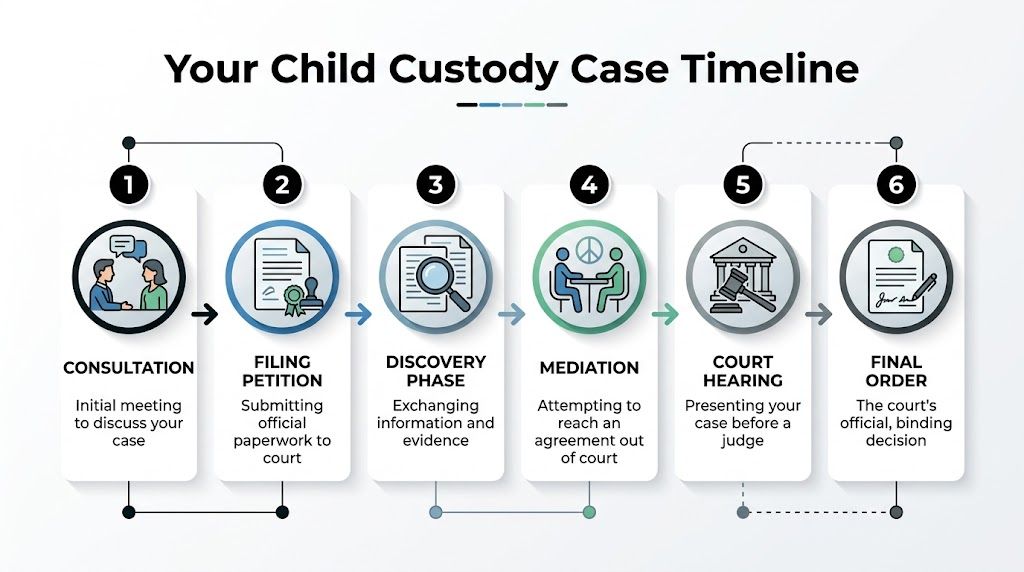
Most custody cases feel chaotic only because parents can’t see the sequence yet. Once the process is broken into stages, the case becomes easier to manage. There are deadlines, decisions, and waiting periods, but there’s also a structure.
What usually happens after you hire counsel
The case often starts with a detailed intake meeting. Your lawyer gathers the family history, identifies urgent issues, and decides whether immediate relief is needed.
Then the paperwork is filed. If there’s no existing order, the filing asks the court to establish rights, duties, and a parenting schedule. If there is already an order, the filing may ask for a modification.
After filing, the court process begins to shape the dispute:
Initial consultation and case assessment
The lawyer reviews family dynamics, prior parental involvement, and the child’s needs.Petition and response
The case is formally opened, and the other side gets a chance to answer.Temporary orders stage
If there’s conflict about where the child stays, who makes decisions, or how exchanges happen, the court may issue short-term rules.Discovery and evidence exchange
Each side gathers and shares information that supports its position.Mediation
Many courts want parents to attempt settlement before trial.Final hearing or trial
If settlement fails, the judge decides the unresolved issues.
Why mediation matters more than many parents expect
A lot of parents assume court is the main event. In reality, the middle of the case often matters most. That’s where the facts get tested, weak arguments fall away, and settlement becomes possible.
According to Bryan Fagan’s discussion of Texas child custody lawyer outcomes, certified mediators in Kingwood achieve settlement rates of 75-85%, and 68% of favorable outcomes are linked to detailed documentation. Those points fit what experienced family lawyers see in practice. A parent with organized records often negotiates from a stronger position than a parent who only repeats broad complaints.
Case reality: Mediation works best when both sides understand what the evidence will probably show if the case reaches a judge.
That doesn’t mean every case should settle. Cases involving serious safety concerns, repeated noncompliance, or unrealistic demands may need a courtroom decision. But many parents in Humble and Northeast Houston do better when they prepare for trial carefully and negotiate seriously along the way.
The timeline is legal and personal at the same time
Each stage affects family life. Temporary orders may set exchange routines for months. Discovery may require gathering school, medical, and communication records. Mediation can force hard conversations about holidays, summer, transportation, and decision-making authority.
That’s why preparation for a hearing should start long before the hearing date. Parents who wait until the week before often miss details that matter. This guide on how to prepare for custody hearing is a useful companion if you’re trying to get ready for the courtroom side of the process.
What works and what tends to backfire
Some approaches help at nearly every stage:
- Consistent documentation: Facts recorded close in time carry more weight than reconstructed memories.
- Reasonable proposals: Courts notice when one parent offers a child-focused plan and the other offers punishment disguised as a schedule.
- Clean communication: Brief, respectful messages can become useful exhibits.
- Focused testimony: The strongest testimony usually ties conduct back to the child’s well-being.
What tends to fail is overexplaining every grievance, treating the child like a witness in the conflict, or assuming the judge will infer facts that were never clearly documented.
Building a Strong Case Key Documents and Evidence to Gather
The strongest custody cases usually don’t feel dramatic on paper. They feel organized. Judges often respond better to a clean set of records than to a long story filled with conclusions.
Start with the records that show how your child lives. Think in terms of school, health, communication, routine, and decision-making.

The records parents should gather first
This isn’t about collecting everything. It’s about collecting the right things.
- School records: Report cards, attendance notes, behavior reports, teacher emails, and activity schedules.
- Medical information: Appointment summaries, prescription details, therapy records when appropriate, and insurance communications.
- Parent communication: Texts, emails, parenting app messages, and exchange-related communication.
- Calendar history: A running log of overnights, missed visits, late pickups, and schedule changes.
- Child activity records: Sports, tutoring, church, counseling, and other recurring commitments.
- Existing legal paperwork: Prior orders, petitions, notices, and any protective paperwork if relevant.
What makes evidence useful
Useful evidence answers a court’s practical questions. Who is involved in school decisions? Who follows through on appointments? Who communicates about the child instead of fighting about the past?
A few habits make evidence stronger:
- Keep original format when possible: Don’t retype text exchanges if screenshots or exports are available.
- Preserve dates: A timeline matters more when each entry ties to a specific date.
- Avoid editing for effect: Cropped or altered records invite credibility problems.
- Group by topic: School records together. Medical records together. Communication together.
Bring evidence that shows patterns, not just isolated bad moments.
What to write down in a parenting log
Many Kingwood parents benefit from a simple parenting journal. It doesn’t need legal language. It needs consistency.
Include details such as:
| Topic | Example of what to note |
|---|---|
| Exchange problems | Late pickup, no-show, location change, or refusal |
| School issues | Missed homework, parent-teacher meeting attendance, behavior concerns |
| Health matters | Appointment attendance, medication issues, urgent care visits |
| Child statements | Only when relevant, recorded carefully and without coaching |
| Co-parent communication | Requests made, responses received, and whether a problem was resolved |
Later in the process, this kind of log can help your lawyer see patterns that aren’t obvious from memory alone.
A short video like the one below can also help parents think more concretely about what preparation looks like in a custody matter.
Evidence mistakes that hurt otherwise valid cases
Parents often weaken good cases by making avoidable mistakes.
- Saving only the worst messages: Courts usually need context, not selected outrage.
- Talking through the child: Asking a child to report on the other parent can create bigger problems.
- Mixing issues together: A child support disagreement and a custody concern aren’t always the same legal issue.
- Waiting too long: By the time a hearing approaches, records can be lost, phones changed, and details forgotten.
If you’re searching for a custody lawyer near kingwood texas, ask how that lawyer wants records delivered. Some prefer date-sorted PDFs. Others want a spreadsheet timeline plus exhibits. The format matters because clear evidence is easier to use in negotiation and court.
Answering Your Pressing Custody Questions
Parents usually carry a handful of urgent questions that don’t fit neatly into a single timeline. These are the questions that tend to come up late at night, after an exchange goes badly or after a relative asks whether they can step in.
Can grandparents get custody in Kingwood
Sometimes, but it’s difficult.
Under Texas Family Code §153.433, grandparents seeking custody or significant court-ordered rights must overcome the parent’s strong legal position. In Kingwood-area cases, that means they need evidence of meaningful involvement and a clear legal basis for court intervention. According to McNamara’s family law information, this standard succeeded in only 11% of Harris County cases in 2025.
That doesn’t mean grandparents should give up. It means they should approach the case carefully. Courts want specific proof of significant past contact and a concrete explanation of why the requested order serves the child’s best interest. General claims like “I’ve always helped” usually aren’t enough without records, timelines, and corroborating detail.
Grandparent cases are usually won or lost on evidence of involvement, not emotion alone.
How much does a custody case cost
The honest answer is that cost depends on conflict level, urgency, and how many issues are being fought over. A negotiated parenting plan costs less work than a case with emergency hearings, extensive discovery, and trial preparation.
Ask direct questions during the consultation. Find out how the lawyer handles retainers, hourly billing, staff billing, mediation preparation, and hearing days. Also ask what you can do yourself to keep fees down. Organized records, concise communication, and realistic goals often reduce avoidable legal work.
The cheapest path isn’t always the smartest path. A vague agreement that creates future conflict can cost more later in modifications or enforcement proceedings.
Can an existing custody order be changed
Yes, but not just because one parent is unhappy.
A modification request usually needs a meaningful reason tied to the child or the family’s changed circumstances. In practical terms, parents often seek changes after relocation, repeated schedule failures, school problems, safety concerns, or a shift in the child’s needs.
The strongest modification requests do three things well:
- They identify the change clearly: What is different now from when the current order was signed?
- They show why the current order no longer fits: Where is the breakdown?
- They offer a workable replacement: Judges prefer concrete solutions over broad complaints.
What if the other parent keeps making accusations
Stay calm and document carefully.
Don’t answer every accusation with a longer accusation. Preserve the message, respond briefly if needed, and talk with counsel about whether the claim affects conservatorship or possession. In some cases, false or exaggerated claims lose force when one parent remains consistent, organized, and child-focused over time.
Do I need a lawyer if I think we can settle
Many parents do settle, and that’s often a good outcome. But settlement still needs structure. Parenting plans must be clear enough to work on school mornings, holidays, summer breaks, transportation changes, and extracurricular conflicts.
A lawyer helps spot the gaps that lead to future court returns. Even when both parents want peace, unclear language can undo that quickly.
Take the Next Step for Your Family’s Future in Kingwood
A custody case feels personal because it is. It touches your child’s home life, school routine, and sense of security. The legal side matters, but so does having a steady plan.
Parents in Kingwood, Humble, Porter, and Northeast Houston usually do better when they act early, document carefully, and make decisions based on what a court will weigh. That matters even more now that current Texas custody law places sharper focus on documentation and safety-related evidence.
You don’t need to solve everything tonight. You do need a clear next step. A consultation can help you sort out whether you need an initial order, a modification, temporary orders, or just a realistic view of how your facts fit Texas law.
If you need guidance from a local team that serves Kingwood families, schedule a free consultation with Law Office of Bryan Fagan – Kingwood TX Lawyers. You can talk through your situation, get practical direction, and start building a plan that protects your child’s future.