
When you're facing a divorce, the financial uncertainty can be overwhelming. For many of our neighbors in Kingwood, Humble, and across Northeast Houston, the first question that comes to mind is, "How do I protect my assets?"
The good news is that the path to securing your financial future doesn't start with a complicated legal chess move. It starts with a simple, powerful action: getting a crystal-clear picture of your entire marital estate. We understand how stressful this is, and our goal is to give you practical, step-by-step guidance.
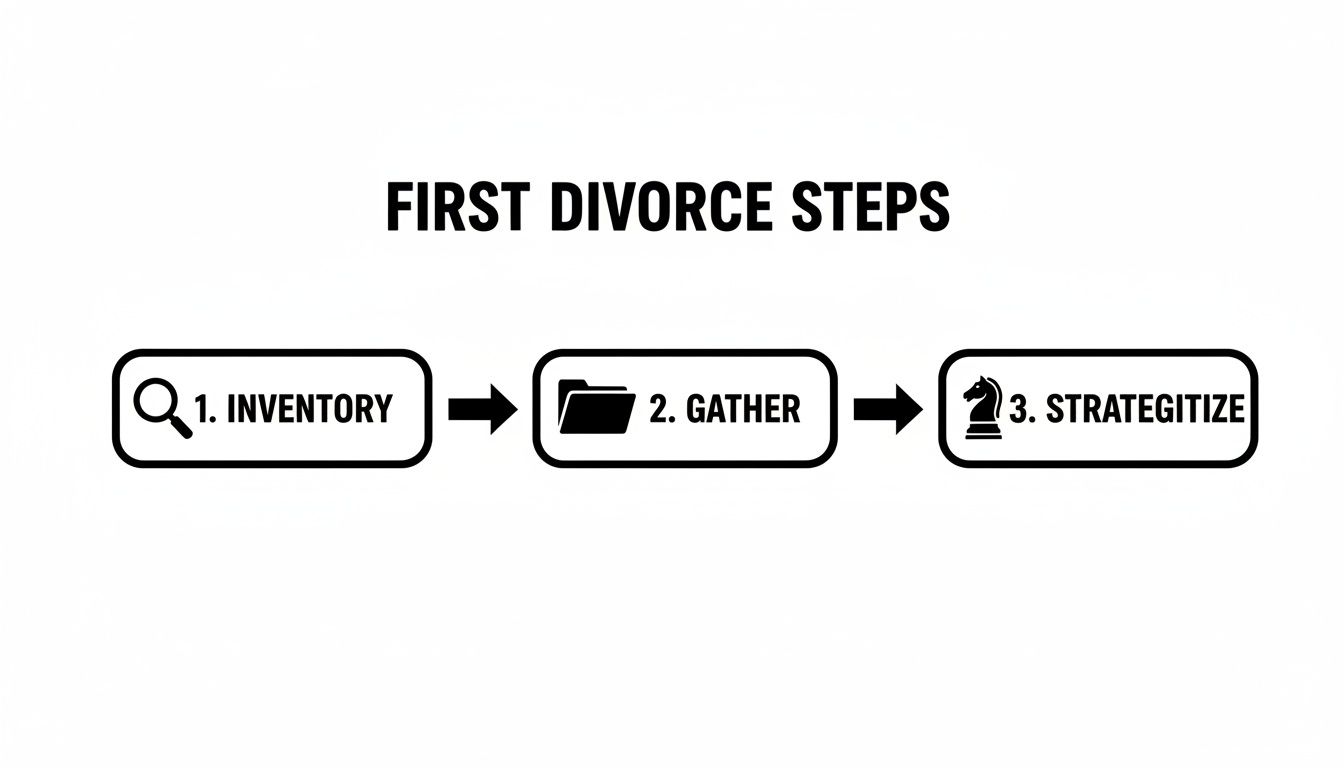
Before you can protect anything, you have to know exactly what you have. Texas is a community property state, a concept that can be confusing. Put simply, it means nearly everything acquired during the marriage is considered jointly owned and will be divided in a "just and right" manner by the court. Your job, with our help, is to make sure the court sees the complete, accurate picture.
Becoming a Financial Detective for Your Own Life
Think of this first phase as a fact-finding mission. You need to gather every single piece of financial paperwork you can get your hands on. It’s easy to remember the joint checking account, but the marital estate is often much broader and includes assets that are easy to forget.
As your local Kingwood attorneys, we always advise clients to start compiling documents for everything, including:
- Real Estate: Deeds, mortgage statements, and property tax records for your family home in Kingwood or any other properties.
- Bank Accounts: Statements for all checking, savings, and money market accounts—whether they're in your name, your spouse's, or held jointly.
- Investments: Pull records for any stocks, bonds, mutual funds, and brokerage accounts.
- Retirement Funds: Statements for 401(k)s, IRAs, pensions, and any other retirement plans are crucial.
- Business Interests: If a business in Northeast Houston is involved, find the formation documents, tax returns, and recent profit-and-loss statements.
- Vehicles & Valuables: Gather titles for cars, boats, or RVs, along with any appraisals for jewelry, art, or valuable collections.
This groundwork is non-negotiable. It sets the stage for every single negotiation and decision that comes next, and it’s a process we can guide you through, step by step.
Why Acting Fast Is Your Best Defense
Gathering these documents right away isn't just about being organized; it's a critical defensive move. It creates a financial baseline before assets can be intentionally hidden, sold off, or transferred to a friend or family member.
Let's face it: financial disputes are a huge part of divorce. In the United States alone, there were roughly 673,989 divorces in 2022. That's hundreds of thousands of families who had to split homes, savings, and retirement accounts in a single year. This reality highlights why having a complete, documented inventory from day one is the single most important protective step you can take.
By creating a detailed financial snapshot at the very beginning, you and your Kingwood attorney can operate from a position of strength and knowledge, ensuring transparency throughout the process.
This proactive approach helps shut down future arguments over what assets exist and what they might be worth. It gives our legal team the hard evidence needed to fight for a fair division for you.
To help you get started, we've put together a checklist of the immediate actions you should take.
Initial Asset Protection Checklist for Kingwood Residents
This checklist outlines the first essential steps to secure your financial information and assets right at the beginning of a divorce. Following these actions can provide peace of mind and create a solid foundation for the legal process ahead.
| Action Item | Why It's Critical in a Texas Divorce | Documents to Gather |
|---|---|---|
| Gather 3-5 Years of Financial Records | Establishes a clear financial history and makes it harder for assets to be hidden or "disappear." | Bank and credit card statements, tax returns, loan applications, pay stubs, brokerage statements. |
| Open a New, Separate Bank Account | Creates a secure place for your personal funds and income post-separation, separate from joint accounts. | Your driver's license, Social Security number. Once open, reroute your direct deposit here. |
| Change Online Account Passwords | Secures your private financial, email, and social media accounts from being accessed without permission. | Make a list of all online accounts—banking, retirement, email, social media—and update each with a unique, strong password. |
| Run Your Credit Report | Identifies all joint and individual debts, helping you spot any secret accounts or loans opened in your name. | You can get free reports annually from Equifax, Experian, and TransUnion. |
| Document Valuable Personal Property | Creates a record of valuable items (art, jewelry, antiques) before they can be removed from the home or sold. | Take photos or videos of the items, and gather any receipts or appraisals you have. |
Completing this checklist will empower you to face the divorce process with confidence, knowing you've laid a solid foundation for protecting your financial future. If you're in Kingwood or the surrounding area and need guidance, our team is here to help. Schedule a free consultation to discuss your situation and learn how we can protect what matters most to you.
Making Sense of Community vs. Separate Property in Texas

When you're facing a divorce in Texas, you'll hear two terms over and over: community property and separate property. This isn't just legal jargon; it's the entire playbook for how your assets will be divided. Getting this right is the absolute foundation of protecting what’s yours.
The starting point in Texas is simple: the law presumes everything you or your spouse acquired during the marriage belongs to the "community." Your salary, the family home in Kingwood, the cars, the investments—it's all considered jointly owned and up for a "just and right" division. The burden is on you to prove something is separate.
What Counts as Separate Property?
Separate property is a specific legal carve-out for assets that are yours and yours alone. They aren’t part of the marital pot that gets divided.
For our clients in Humble and Porter, this usually involves a few key things:
- Inheritances: If your grandmother left you her stock portfolio, those stocks are your separate property, no matter when you received them.
- Property Owned Before Marriage: That condo you bought in Northeast Houston before you ever walked down the aisle is yours.
- Gifts: A valuable watch given directly to you by your parents for a big birthday is considered a gift to you, making it separate property.
But here’s the catch: keeping it separate is your responsibility. One wrong move, and that clear line can get blurry fast.
The Danger of "Commingling" Assets
This is where so many people unintentionally sabotage their own separate property claims. Commingling is what happens when you mix your separate assets with community assets until you can no longer tell them apart.
Let’s say you inherit $50,000. That’s your separate property. But then you deposit it into the joint checking account you share with your spouse. From there, you use it to pay the mortgage, buy groceries, and go on vacation. Suddenly, that "separate" money is completely tangled up with marital funds.
In Texas, you need "clear and convincing evidence" to prove an asset is separate. If you can't meticulously trace your separate funds because they've been mixed with community money, the court is likely to just call the whole thing community property.
It’s why we always tell our Kingwood clients: if you receive an inheritance or a significant gift, open a new bank account in your name only and put the money there. Don't touch it for joint expenses.
Real-World Scenarios We See All the Time
Divorce is messy, and so is untangling finances. Here are a couple of common, complex situations we handle for families right out of our Kingwood office.
Example 1: The House You Owned Before the Wedding
You bought your home in Kingwood years before you got married. It's clearly your separate property. But for the last decade, you and your spouse have used your paychecks (community funds) to make the mortgage payments.
- The Reality: The equity you had on the day you got married is still your separate property. But your spouse now has a valid claim for reimbursement or a share of the equity that was paid down using marital funds. They helped build that value, and they’re entitled to a piece of it.
Example 2: The Business Started During the Marriage
Your spouse launched a small business in Porter while you were married. Maybe your name isn't on any of the official paperwork, but that doesn't matter. Because it was started and grown using marital time, talent, and money, the business itself is community property. Its entire value is on the table for division.
Protecting your assets begins with correctly identifying what is yours, what is theirs, and what is ours. A simple mistake can cost you dearly. This is, without a doubt, one of the most critical stages where you need guidance from a family law attorney who knows the local Kingwood courts.
At The Law Office of Bryan Fagan, we've spent years helping families right here in Kingwood navigate these complex property laws. We know how to trace assets, find the right documents, and build the case to protect your separate property. Schedule a free consultation with our Kingwood team to get a clear picture of where you stand.
Using Legal Tools Like Trusts and Marital Agreements
From our experience, the strongest asset protection strategies are almost always the ones put in place long before a divorce is even a consideration. For many couples in Kingwood and Northeast Houston, this kind of proactive legal planning is what provides a clear path to financial security down the road.
When you use tools like marital agreements and trusts, you get to define your financial landscape on your own terms. The alternative is leaving it all up to a judge who doesn't know you or your family's history. These legal instruments allow you to decide ahead of time how assets should be handled, which can bring peace of mind and dramatically reduce conflict if the marriage ends.
And they aren't just for the ultra-wealthy. These are practical, powerful tools for anyone in our community who wants to protect a family business, safeguard a future inheritance, or simply keep the assets they brought into the marriage separate.
Prenuptial and Postnuptial Agreements
Marital agreements are essentially contracts between spouses that outline financial rights and responsibilities. The only real difference between them is the timing.
-
Prenuptial Agreements ("Prenups"): You sign these before you get married. They're perfect for anyone entering a marriage with significant separate property, kids from a prior relationship, or an ownership stake in a business. A well-drafted prenup clearly defines what belongs to whom, keeping it from being divided in a divorce.
-
Postnuptial Agreements ("Postnups"): These are created after the wedding. We often see couples in the Porter and Humble area use a postnup when a major financial event happens during the marriage. For example, if one spouse starts a new business or receives a large inheritance, a postnup can formally designate that asset as separate property, preventing it from getting mixed up with community assets.
Taking the time to create one of these agreements provides real clarity. It can save an incredible amount of time, money, and emotional stress later on by allowing you and your spouse to make calm, rational decisions about your finances.
The Role of Trusts in Asset Protection
Trusts are another powerful tool, but their effectiveness in a divorce really hinges on one critical factor: timing. A trust is a legal arrangement where you (the grantor) give a third party (the trustee) the right to hold and manage assets for a beneficiary.
When divorce is a concern, the most protective kind is usually an irrevocable trust. Once you place assets into this type of trust, you legally give up ownership and control. Because the assets are no longer technically yours, they are often shielded from the property division process. You can dig deeper into the differences in our guide on revocable vs. irrevocable trusts.
But be warned: Texas courts are savvy. They look very closely at the intent behind the creation of a trust. A trust you established years ago as part of a legitimate estate plan for your kids is viewed completely differently than one you created a month before filing for divorce.
A judge will likely see right through a last-minute maneuver. For instance, if a business owner in Kingwood transfers major company assets into a brand new trust just before serving their spouse with divorce papers, the court will probably see it as an attempt to defraud the other spouse. These tools are valid planning devices, not get-out-of-jail-free cards.
Why Proactive Planning Is Your Best Strategy
The key takeaway here is that these legal tools work best when they're part of a long-term financial strategy—not a last-minute reaction to a failing marriage. Trying to move or shield assets right before or during a divorce can be flagged as fraudulent by the court, and that comes with serious penalties.
Protecting your assets isn't about hiding them; it's about defining them clearly and legally from the outset. Whether it's a prenuptial agreement before you say "I do," a postnuptial agreement to protect a new venture, or a carefully planned trust, taking these steps proactively is always your strongest move.
Dividing Complex Assets Like Businesses and Retirement Accounts

Splitting a joint savings account is usually straightforward. You look at the balance, divide it, and move on. But what happens when your most valuable assets can’t be so easily sliced in half?
For many families in Kingwood and Northeast Houston, this is where a divorce gets truly complicated. We’re talking about family businesses, substantial retirement accounts, and real estate holdings. These high-value assets demand a completely different playbook. Their worth isn't just a number on a statement; it's a moving target. Going in without a solid strategy is one of the fastest ways to see your net worth shrink.
Valuing and Protecting Your Kingwood Business
If you're a local business owner, the thought of putting your company on the chopping block is probably keeping you up at night. The hard truth is, if the business was started or grew significantly during your marriage, Texas law considers it community property. That means its value is on the table.
The first, non-negotiable step is getting a professional business valuation. This is not the time to rely on old tax returns or your own best guess. You need a forensic accountant or a certified business appraiser to dig deep. They’ll analyze everything—cash flow, hard assets, debts, goodwill, and your position in the market—to pin down a fair market value.
This professional valuation is your shield. It prevents your spouse from either inflating the number to get a bigger payout or lowballing it if they want to be bought out.
Once you have a solid number, you have options that don’t involve putting a "For Sale" sign out front.
- Trade Other Assets: Often, the business-owning spouse can "buy out" the other's share by trading other community assets of equal value. This could be their half of the family home in Kingwood, a larger portion of an investment portfolio, or other property.
- Structure a Payout: If a lump-sum buyout would gut the company's cash flow, you can negotiate a structured payment plan over several years. This allows the business to keep running smoothly.
- Remain Co-Owners (The Rare Exception): In some unusually amicable divorces, spouses might agree to stay on as business partners. This is a risky path that requires an ironclad partnership agreement. Before even considering it, you need to understand the critical differences between business structures, like those we cover in our guide on joint ventures versus partnerships.
The goal is to satisfy your spouse's legitimate community property claim without destroying the business you worked so hard to build. Protecting your business in a divorce starts with an accurate, defensible valuation.
Properly Dividing Retirement Accounts
For many people in the Humble and Porter areas, their 401(k) or IRA is their single largest asset besides their home. But you can't just write your spouse a check for half of it. Doing so would trigger a massive tax bill and crippling early withdrawal penalties.
The only correct legal tool for this job is a Qualified Domestic Relations Order (QDRO), which we pronounce "kwah-dro." A QDRO is a specific type of court order that tells the retirement plan administrator how to divide the account and create a separate one for your ex-spouse.
A correctly drafted QDRO allows the funds to be transferred without any immediate tax consequences or penalties. Your spouse can then roll their share into their own retirement account. This process is highly technical, and a single mistake in the paperwork can be incredibly costly. It's critical to have a local Kingwood attorney who is deeply familiar with both Texas law and the complex federal regulations governing retirement plans.
Tackling Real Estate and Stock Options
Other assets bring their own unique hurdles.
- Real Estate: Dividing a family home or investment property usually means one spouse buys out the other, or you sell the property and split the cash. You’ll need a formal appraisal to determine its current market value and calculate the equity—the value minus any mortgage debt—that needs to be divided.
- Stock Options and Grants: These are a common part of executive compensation packages but can be tricky to value. Some options may be vested (owned outright), while others are unvested (dependent on future employment). An experienced attorney can help calculate the community property portion and ensure they are divided fairly.
Navigating these complex assets is where having seasoned local legal counsel truly makes a difference. At The Law Office of Bryan Fagan, our Kingwood attorneys regularly handle divorces involving businesses, executive compensation, and significant retirement funds. We connect you with the right financial experts and ensure every detail is handled correctly. Schedule a free consultation to discuss how to protect your most valuable and complex assets.
Uncovering Hidden Assets with Legal Discovery
What happens when your gut tells you something’s off? Maybe you’re seeing strange withdrawals from a joint account, or you hear whispers of a new investment your spouse “forgot” to mention. For so many of our clients here in Kingwood, this is the most gut-wrenching part of a divorce—the gnawing fear that your spouse is hiding assets.
The good news is, Texas law doesn't force you to simply trust your spouse's version of the story. The legal system gives us powerful tools to demand complete financial transparency. You don't have to navigate this in the dark.
Putting an Immediate Stop to Financial Games
If you have a real fear that your spouse is about to sell the boat, empty a savings account, or max out joint credit cards, we can act immediately. Our first line of defense is typically a Temporary Restraining Order (TRO).
A TRO is a court order we can get quickly to essentially freeze the marital estate. It legally stops both of you from making any unusual financial moves, such as:
- Selling real estate, vehicles, or other valuable property.
- Making large, unexplained withdrawals from bank or investment accounts.
- Changing beneficiaries on life insurance policies or retirement plans.
- Transferring assets to friends or family members.
By getting a TRO in place, we create a stable financial playing field right here in Harris County. It ensures the assets that make up your community estate are actually there to be divided fairly when the time comes.
The Power of Formal Discovery
With the immediate fires put out, we can then deploy our most powerful tool for getting to the truth: formal discovery. This is the official, court-sanctioned process for demanding information and documents from your spouse. This isn't a polite request—it's a legal requirement they must comply with.
The discovery process levels the playing field. It transforms the divorce from a battle of accusations into a fact-based negotiation, ensuring all assets are brought into the light for a just and right division.
This process is your single best weapon against financial dishonesty. It forces your spouse to provide a full accounting of their finances, all under penalty of perjury.
The Tools We Use in Discovery
In a Northeast Houston divorce, the discovery process involves several key legal instruments. Keeping track of every document is critical, which is why meticulous organization, often aided by cloud-based legal case management software, is so important. Our firm uses a combination of these tools to paint a complete financial picture:
- Requests for Production: We send a formal demand for specific documents. Think bank statements, credit card bills, tax returns for the last five years, loan applications, and business ledgers.
- Interrogatories: These are written questions your spouse must answer in writing and under oath. We can ask them to list every single asset they own or explain a series of large cash withdrawals.
- Requests for Admission: We send statements of fact that your spouse must either admit or deny. For example, "Admit that you opened a new bank account at XYZ Bank on March 15th." This helps us lock them into a specific story.
- Depositions: This is a formal, in-person interview where we question your spouse under oath in front of a court reporter. It’s an incredibly effective way to get direct answers and follow up on suspicious activity in real-time.
If you suspect your spouse is being less than forthcoming, we have a number of legal strategies to help. We provide a more detailed overview of how to find hidden assets in divorce on our blog.
If your spouse refuses to cooperate or lies during discovery, they can face serious consequences from the court. A judge can order them to pay your attorney’s fees or, in some cases, even award you a larger share of the community estate for their misconduct.
You deserve to know the full truth about your marital finances. If you’re in the Kingwood area and have concerns about hidden assets, schedule a free, confidential consultation with our team. We can walk you through your options and start the process of protecting your financial future.
What About Assets Outside of Texas?
For many families in Kingwood and the greater Northeast Houston area, life doesn't stop at the state line. You might own a vacation home, hold out-of-state investments, or have business interests overseas. When a marriage ends, these assets can throw a major wrench into the works.
A Texas court has the authority to divide your entire marital estate, no matter where an asset is physically located. That sounds straightforward, but the reality is far more complex. Getting a Kingwood judge to sign an order is one thing; making it stick in another state or country is another battle entirely.
The Hurdle: Jurisdiction vs. Enforcement
Let's get practical. A judge in Harris County can absolutely rule on how to split a condo you own in Florida. The problem? A Florida court isn't automatically bound to enforce that Texas order. You could end up with a perfectly valid Texas divorce decree but find yourself in a drawn-out legal fight just to claim your share of that property in Florida.
This problem gets even more complicated when you're dealing with international assets. Trying to enforce a U.S. court order in another country can be an incredibly expensive and frustrating process. You might even have to re-litigate the entire issue in a foreign court system, playing by a completely different set of rules.
The Risks: Valuation and Hidden Assets
Valuing property outside of Texas brings its own set of headaches. How do you get an accurate appraisal on a piece of real estate in another state or country? What about the impact of currency fluctuations? These aren't simple math problems.
On top of that, the more global your finances are, the higher the risk that your spouse might try to hide something. It’s far easier to squirrel away funds in an offshore account than it is at the local bank in Kingwood. As legal experts will tell you, divorces involving foreign assets are often “more complicated than average,” partly because one spouse may try to conceal property. Don't forget, Texas and most other jurisdictions require full disclosure of all assets. Getting caught hiding something can lead to serious legal penalties. You can read more about how global wealth complicates divorce on sinatralegal.com.
When your property spans multiple jurisdictions, you're not just going through a divorce—you're navigating several legal and financial systems at the same time. This is where you need an attorney who has been down this road before and knows what to expect.
Protecting these assets isn’t about luck; it’s about having the right strategy from the start. This means working closely with your Kingwood attorney to get a few key things done:
- Create a full inventory: Identify and list every single asset, no matter where it's located.
- Bring in local experts: This often involves hiring qualified appraisers or forensic accountants in the other state or country.
- Know the local laws: You must understand the specific property and divorce laws of the foreign jurisdiction.
- Build an enforcement plan: Develop a clear legal strategy for making sure your Texas decree is honored abroad.
This is not a situation you want to handle on your own. The financial stakes are simply too high. At The Law Office of Bryan Fagan, our Kingwood attorneys have the experience to manage these complex, multi-jurisdictional cases. We'll help you build a solid strategy to protect what's yours, wherever it might be.
Common Questions About Protecting Assets in a Texas Divorce
When you’re staring down the barrel of a divorce, the questions about your money, your home, and your financial future can feel completely overwhelming. At our Kingwood office, we’ve heard just about every concern imaginable, and a few common worries pop up time and time again.
Let's walk through some of the most pressing questions we get from your neighbors about protecting what’s yours in a Texas divorce.
Can My Spouse Just Empty Our Bank Account?
This is a huge fear for many people, and for good reason. While someone can physically withdraw all the money, it's a spectacularly bad idea in a Texas divorce. A judge will take a very dim view of this, often seeing it as a blatant attempt to defraud the community estate.
Courts have the power to "claw back" that money. They can order it returned or, more commonly, award the other spouse a much larger share of the remaining assets to even the score. If you genuinely believe your spouse might do this, we need to act fast. We can file for temporary court orders to freeze joint accounts, essentially putting a legal lock on the marital estate until it can be divided fairly.
I Owned My Kingwood House Before We Got Married. Is It Safe?
On the surface, yes. The house you owned before the marriage is almost certainly your separate property. But this is where Texas community property law gets complicated.
If you used "community funds"—that's money either of you earned during the marriage—to pay the mortgage, property taxes, or for a big renovation, the community estate now has a financial interest in your separate property house. This is called a reimbursement claim.
Put simply, your spouse could be entitled to get back a share of the home's equity that was built up using marital money. To protect this asset, you have to meticulously trace where every dollar came from for every payment made on the house during the marriage. It's a heavy lift, but it's crucial for proving its separate character.
The Bottom Line: Separate property doesn't always stay separate. The longer the marriage, the more likely it is to get tangled up with community funds. The burden of proof is always on the person claiming an asset is separate, and that requires rock-solid financial records.
What if I Think My Spouse Is Hiding Assets?
A suspicion that your spouse is hiding money or property is one of the most serious issues in a divorce. This isn't just a hunch you have to live with; it’s something we can actively investigate. This is exactly what the formal discovery process was made for.
As your attorney, we can legally require your spouse to provide a full and honest financial disclosure. We use powerful legal tools to uncover the truth:
- Subpoenas to get bank records directly from financial institutions in Northeast Houston and beyond.
- Depositions to question your spouse, their business partners, or even family members under oath.
- Interrogatories and Requests for Production to demand documents and sworn written answers.
If we find hidden assets, the consequences for your spouse can be severe. A judge can penalize them by awarding you a disproportionate share—sometimes all—of the hidden asset, plus a larger chunk of the rest of the marital estate.
How Do I Protect My Inheritance?
Good news: Under Texas law, an inheritance is your separate property. The bad news? You can lose that protection if you aren't careful. The single biggest mistake people make is commingling—mixing your inherited money with community funds.
To keep your inheritance truly separate, you have to treat it as separate.
- Quarantine It: The moment you receive the funds, deposit them into a brand-new bank account that is in your name only.
- Don't Cross the Streams: Do not use this account for joint expenses like paying the mortgage, household bills, or family vacations.
- Title It Right: If you use your inheritance to buy something, like a car or an investment property, make sure the title is in your name alone and explicitly states it is your "sole and separate property."
Every divorce has its own unique set of facts, and these answers are meant as a general guide. For advice that’s tailored to your specific situation in Kingwood, Humble, or the surrounding communities, your best first step is to sit down with an experienced family law attorney.
The team at The Law Office of Bryan Fagan – Kingwood TX Lawyers is here to give you the clarity and protection you deserve. We are a local, experienced, and client-focused firm providing trusted representation right here in Kingwood. Schedule your free consultation online or call us to get the answers you need and start building a strategy to secure your financial future.