Think of the muniment of title process as the express lane for settling a loved one's estate here in Texas. It's a unique legal shortcut that lets a family transfer property using a valid will, but without the lengthy and often expensive process of a full probate administration.
For many of our neighbors in Kingwood, Humble, and Northeast Houston, this is a practical and reassuring option. If the estate is straightforward—meaning it doesn't have any unsecured debts like credit card bills or medical expenses—this process can be a game-changer. It allows you to officially transfer assets, like the family home right here in Kingwood, to the rightful heirs with far less stress and paperwork. At The Law Office of Bryan Fagan, we are here to guide local families through this process with clarity and compassion.
A Simpler Path to Securing Your Family's Property
Losing someone you love is hard enough. The last thing you need is a confusing and drawn-out court process. For many families in Kingwood, Humble, and across Northeast Houston, the word "probate" alone can sound intimidating and overwhelming. We understand that feeling, and we're here to help you find a simpler way.
Thankfully, Texas law offers a practical alternative called probating a will as a muniment of title, but only when certain conditions are met.
Instead of appointing an executor to formally manage the estate—gathering assets, paying off creditors, and distributing what's left—a muniment of title acts more like a legal seal of approval on the will. The court essentially validates the will and makes it part of the public record, serving as direct proof of the ownership change. This makes it a client-focused solution that aligns with our firm's goal of providing trusted representation right here in Kingwood.
How Is This Different from Regular Probate?
Let's break it down with a simple, practical analogy. Think of a valid will as a clear roadmap showing who gets what property after a loved one passes.
- A full probate is like hiring a formal tour guide (the executor) who has to report back to the court at every turn, manage all the funds, and officially hand over the property at the end of a long journey.
- A muniment of title is like having a judge look at the roadmap, confirm it's correct, and then simply hand the keys to the destination directly to the people named in the will. No tour guide, no lengthy reporting.
This streamlined approach offers some major benefits for local Kingwood families:
- It Costs Less: With fewer steps and less court oversight, the attorney's fees and court costs are almost always lower than a full administration.
- It's Much Faster: The entire process can often be wrapped up in just a few weeks or a couple of months, not the year or more that full probate can sometimes take.
- It's Simpler: Because no executor is appointed, there are far fewer administrative duties and court filings to worry about.
Who Can Use Muniment of Title in Texas?
This isn't an obscure legal loophole; it's a well-established and frequently used option for Texas estates. The legal authority comes directly from the Texas Estates Code, which spells out the requirements. The most important one? The estate can't have any unpaid debts, except for liens on real estate, like a home mortgage.
This makes it an ideal fit for many situations we see every day with our Kingwood clients, especially for estates where the primary asset is a paid-off house or a home with a mortgage. If you want to dive deeper, you can learn more about how to avoid probate in Texas.
Of course, navigating the legal requirements to ensure an estate actually qualifies requires a careful eye. Our team at The Law Office of Bryan Fagan has guided countless local families through this process, and we can quickly help you figure out if it's the right path for your family. We're here to offer the local insight and compassionate legal support you need. Contact our Kingwood office today for a free consultation to discuss your options.
How a Muniment of Title Secures Your Property's Ownership
The word "muniment" might sound a little old-fashioned, but for homeowners here in Kingwood, it’s a powerful and practical way to secure property ownership after a loved one passes. At its core, a muniment is simply a document that serves as proof of title. In this case, a court's order acts as the crucial link in your property's chain of title, working much like a deed does in a typical sale.
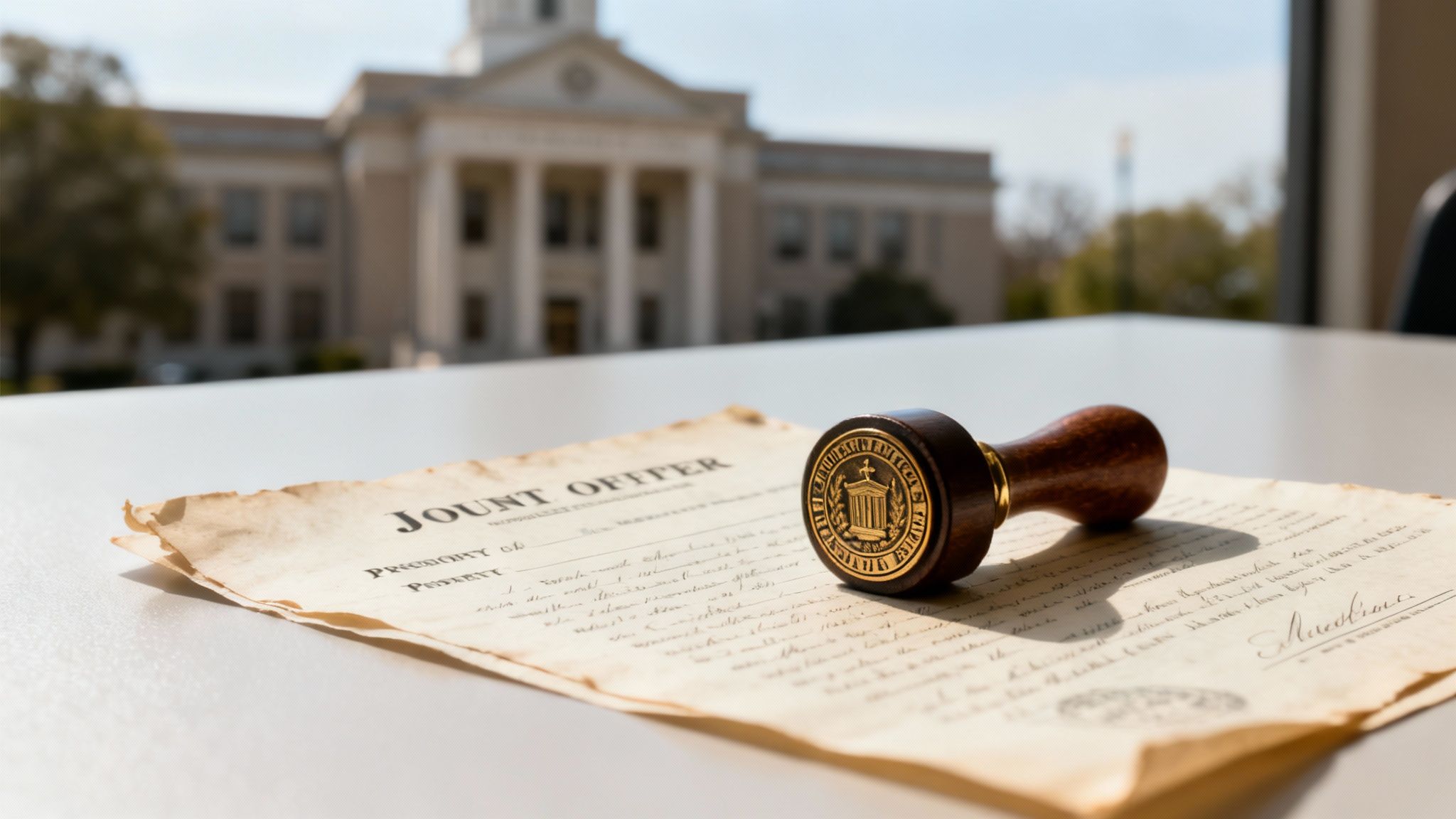
When a judge in Harris or Montgomery County probates a will as a muniment of title, they are effectively validating the will as the official document that transfers ownership. That court order, along with the will itself, is then filed directly into the county's public property records. This simple but critical step creates a clear, legal, and public record showing the property has officially changed hands from your loved one to you.
Turning a Will into a Deed
Think of it like this. A traditional deed is a standalone document that clearly states, "Person A sold this house to Person B." A muniment of title order gets you to the same place, just through a different legal path. It basically says, "The court confirms Person A's will legally gives this house to Person B." The end result is identical: a solid, legally recognized transfer of ownership.
This isn't some new legal trick; it's a process deeply rooted in Texas property law. Title professionals have always categorized muniments of title into different types—patents, deeds, and yes, wills. When a probate court admits a will as a muniment of title, that order just becomes the next link in the chain, preserving a continuous trail that proves who owns the property, free and clear.
Real-World Benefits for Kingwood Families
Securing the title to a home in Northeast Houston is about more than just filing paperwork. It's about unlocking the full value and potential of the inheritance you've received. Once that muniment of title order is properly recorded, you have the undisputed authority to treat the property as your own.
Here’s what that looks like in practical terms:
- You Can Sell the Property: With a clear title, you can list the home without legal clouds hanging over the deal. Title companies will recognize the court order as valid proof of your ownership.
- You Can Refinance or Get a Loan: Need to borrow against the property for renovations or other expenses? Lenders will see a clean chain of title, which makes the loan approval process much smoother.
- You Can Claim a Homestead Exemption: As the new legal owner, you can apply for a homestead exemption right here in Harris or Montgomery County, which can significantly reduce your annual property tax bill.
To really grasp how a muniment of title functions, it helps to understand the fundamental categories of assets. For a good starting point, you can explore the difference between real and personal property.
Ultimately, this process takes an inherited property from being a legal question mark and transforms it into a secure, valuable asset. It solidifies your rights and ensures your family’s legacy is protected. At The Law Office of Bryan Fagan, our Kingwood attorneys specialize in making this process seamless and making sure your inheritance is legally sound.
Qualifying for a Muniment of Title in Kingwood
Not every estate gets to take the shortcut. Muniment of title is a fantastic tool, but Texas law is very particular about who can use it. Think of it less like an open highway and more like a restricted carpool lane—you have to meet specific criteria to get access.
For families here in Kingwood and the surrounding communities of Humble and Porter, figuring out if you qualify is the critical first step. It's about ensuring the estate is simple enough to avoid the complexities of a full probate administration.
At The Law Office of Bryan Fagan, we help people make that determination every day. Let's walk through the exact requirements so you can see where your loved one's estate stands.
The Four Key Requirements in Texas
To probate a will as a muniment of title in Texas, the estate must check four specific boxes. If even one of these isn't met, the court will require a different, more involved process.
-
There Must Be a Valid Written Will: This is non-negotiable. The entire process is built on the foundation of a legally sound will. If your loved one died without a will (intestate), or if the will presented has legal flaws—like it wasn't signed correctly or was created under duress—a muniment of title is off the table. The will is the roadmap the court needs to transfer property.
-
The Application Must Be Filed Within Four Years: Texas has a strict four-year statute of limitations for probating a will. This clock starts ticking on the day the person passes away. While a few very rare exceptions exist, for the vast majority of families in Northeast Houston, this four-year deadline is a hard stop.
-
There Is No Need for a Formal Administration: This one sounds a bit vague, but it’s really about simplicity. Does the estate have ongoing business affairs that need managing? Are the beneficiaries in a heated dispute? If so, the estate needs a formal administrator to step in and handle things. A muniment of title is only for situations where the sole task is transferring ownership—nothing more.
-
The Estate Has No Unsecured Debts: This is the big one, the requirement that trips up most estates. To qualify, the estate cannot have any unpaid debts, with one major exception: debts secured by real estate, like a home mortgage.
Understanding Secured vs. Unsecured Debts
This distinction is absolutely crucial for our Kingwood clients, so let's make it crystal clear.
-
Secured Debts: This is a loan attached to a specific piece of property (collateral). The classic example is a mortgage on a home. If the loan isn't paid, the lender can foreclose on that property. A mortgage on a house in Kingwood is a secured debt and is perfectly acceptable for a muniment of title.
-
Unsecured Debts: These are debts with no collateral backing them up. The lender can't just seize an asset if you fail to pay. This includes things like credit card balances, medical bills, personal loans, and unpaid utility bills.
A Practical Kingwood Example: Let's say your father passed away in his Porter home. His only significant debt was the mortgage on his house. He didn't have any credit cards or outstanding medical bills. His estate would almost certainly meet the "no unsecured debt" rule, making it a prime candidate for a muniment of title.
But change one small fact: what if he also had a $2,000 hospital bill or a $500 credit card balance? That single unsecured debt would disqualify the estate from this process. It's a black-and-white rule; any unsecured debt means the estate must go through a different probate path.
It's also important to know which assets are even part of the estate to begin with. Our guide on probate and nonprobate assets can help you sort out what the court will be looking at.
Eligibility Checklist for Muniment of Title in Texas
Use this practical checklist to see if your loved one's estate might qualify for the muniment of title process. Answering 'Yes' to all questions is a strong indicator.
| Requirement | Yes / No |
|---|---|
| Is there a valid, original, written Will? | |
| Has it been less than four years since the person passed away? | |
| Are there no outstanding unsecured debts (credit cards, medical bills, etc.)? | |
| Is the only major debt a mortgage on real estate? | |
| Is there no need for a formal estate administration (no disputes, no complex assets)? |
If you checked 'Yes' to all these questions, you may be in a good position to use this simpler process.
Sorting through these legal qualifications can feel like a maze when you're already grieving. You don't have to figure it out alone. The attorneys at The Law Office of Bryan Fagan are right here in Kingwood to give you clear, straightforward advice. Schedule a free consultation with us, and we'll help you find the right path forward for your family.
The Muniment of Title Process Step by Step
Going through the muniment of title process can feel overwhelming, but it doesn't have to be. For families here in Kingwood and Humble, understanding the roadmap ahead can bring a lot of peace of mind during an already difficult time. We've laid out the entire journey in five clear, practical steps, from the initial paperwork to officially transferring your loved one's property into your name.
Think of this as the express lane for probate—it’s a faster path designed for estates that meet a few key Texas requirements.
The flowchart below gives you a quick snapshot of the main qualifications.

As you can see, the big three are having a valid will, no unsecured debts (like credit cards), and filing within four years of the person's passing. These are the non-negotiable hurdles you have to clear.
Step 1: Filing the Application and Will
The journey begins by officially asking the court to recognize the will. This is done by filing a document called an Application to Probate Will as a Muniment of Title. For most Kingwood residents, this will be filed with the Harris County or Montgomery County probate courts.
You'll need to submit the original, signed will along with the application. This is what kicks off the legal case. Having an experienced local attorney handle this step is crucial, as they'll make sure everything is prepared correctly and filed in the right jurisdiction, sidestepping common mistakes that can cause frustrating delays right out of the gate.
Step 2: The Public Notice Period
Texas law requires a public heads-up about the probate filing. The county clerk does this by "posting citation"—basically, they put up a formal notice at the courthouse. This notice stays up for about 10 days, letting the public know that a will has been submitted.
It’s mostly a formality. The goal is to give anyone with a potential interest in the estate, like a creditor or a forgotten heir, a chance to come forward. Once this waiting period passes without any challenges, your case is clear to proceed to the hearing.
Step 3: The Court Hearing
With the notice period complete, a court hearing gets scheduled. Don't worry, this isn't a dramatic courtroom trial; it's usually a short, straightforward meeting with a probate judge. During the hearing, you (or your lawyer) will present evidence to confirm the will is valid and that the estate checks all the boxes for a muniment of title.
This typically involves simple, sworn testimony to confirm a few key facts:
- That the person has passed away.
- That the court has jurisdiction (for instance, they were a Northeast Houston resident).
- That the will being presented is their authentic, final will.
- That the estate has no outstanding unsecured debts.
Our experienced Kingwood attorneys handle this hearing for our clients, presenting all the necessary proof to the judge. We make it our job to give the court everything it needs to approve the application smoothly and without question.
Step 4: Receiving the Judge's Order
If the judge agrees that everything is in order, they will sign an Order Admitting Will to Probate as a Muniment of Title. This signed order is the single most important document you’ll receive.
Think of this court order as the new deed. It's the legal document that officially validates the will and gives it the power to transfer property. It legally declares that the beneficiaries named in the will are now the new owners.
Once the order is signed, the court's job is done. Unlike traditional probate, there's no executor to appoint and no ongoing reports to file. That's precisely what makes the muniment process so much quicker and less expensive.
Step 5: Recording the Order in the County Records
The final—and absolutely critical—step is to get a certified copy of the judge's order and the will and file them in the official public property records. For a house in Kingwood, this means filing it with the Harris or Montgomery County Clerk, depending on where the property is located.
This action creates a clear, permanent public record showing that ownership has changed hands. It establishes a solid "chain of title," proving to anyone who looks—a future homebuyer, a title company, or a bank—that you are the rightful legal owner. Skipping this final step can cause massive headaches down the road, so it's essential not to overlook it.
Navigating these steps requires careful attention to detail and a solid grasp of local court rules. At The Law Office of Bryan Fagan, our Kingwood probate attorneys manage this entire process for you, ensuring every form is filed correctly and every deadline is met. Call us today for a free consultation to see how we can help your family.
Common Roadblocks and How to Navigate Them
While a muniment of title is a simpler path for handling an estate, the journey isn't always perfectly smooth. For families here in Kingwood, unexpected issues can pop up, causing real worry and confusion. We've seen it before, and we want you to be prepared.
What happens if a surprise bill surfaces? What if a relative disputes the will? Knowing these potential roadblocks ahead of time can make all the difference.
Our team at The Law Office of Bryan Fagan has seen nearly every "what if" scenario imaginable. We believe in preparing our clients for these possibilities so that if a complication arises, we have a clear and effective strategy ready to go.
What if an Unknown Debt Appears
This is easily the most common hurdle we see with our clients in Northeast Houston. You believe the estate is completely debt-free, you file for a muniment of title, and then a forgotten credit card statement or an old medical bill shows up. Because the absolute core requirement of this process is having no unsecured debt, this discovery can stop everything in its tracks.
So, what are your options? Here is some practical guidance:
- Pay the Debt: If the bill is small and the beneficiaries all agree, the simplest solution is often for one or more heirs to just pay the debt personally. Once it's paid, the estate is officially debt-free again, and the muniment of title can move forward.
- Negotiate with the Creditor: It’s sometimes possible to negotiate a settlement with the creditor for less than what's owed. This can be a very practical way to clear the debt without a huge financial burden on the family.
- Transition to a Different Probate Process: If the debt is substantial, paying it out of pocket probably isn't realistic. In this case, the best path forward is to convert the case into a more traditional probate administration. This allows an executor to be appointed who can legally use the estate's own assets to pay its debts. Our team handles this pivot seamlessly, ensuring no time is wasted.
What if Someone Challenges the Will
Will contests, while not exactly common in muniment of title cases, can definitely happen. A disgruntled family member might emerge claiming the will is invalid because of fraud, lack of capacity, or undue influence. A will contest immediately throws a wrench in the works, making the estate far too complex to qualify for the streamlined muniment process.
If someone files a will contest, the court will require the case to be moved into a formal administration. That legal framework is specifically designed to handle disputes, letting both sides present evidence before a judge decides on the will's validity. If you find yourself in this situation, having an experienced probate litigation attorney is absolutely critical to defend the will and protect your loved one's final wishes. For more background on this, our guide on how to probate a will in Texas provides some valuable context.
What if the Four-Year Deadline Has Passed
Texas law is pretty strict: a will generally must be probated within four years of the person's death. Families in Humble or Porter sometimes find a will tucked away in a drawer years after this deadline has passed. While it creates a major hurdle, it's not always an impossible one.
Texas law carves out a narrow exception: a will can be probated after four years if the applicant can prove they were not "in default" for failing to file it sooner. This essentially means you have to show a really good reason for the delay, like you had no idea the will even existed despite a diligent search.
Proving you weren't in default takes a strong legal argument and clear evidence. This is a complex situation where you absolutely need skilled legal guidance to have any chance of success.
While a muniment of title is meant to simplify things, ensuring a clear title also means understanding property liens and other potential issues that could cloud ownership down the road.
No matter what roadblock you hit, you don't have to face it alone. Our Kingwood office is here to give you the local, experienced guidance you need. Schedule a free consultation with The Law Office of Bryan Fagan today, and let us help you find the best solution for your family.
Get Trusted Legal Guidance from Our Kingwood Probate Attorneys
Losing a loved one is hard enough. The last thing you need is to get bogged down in a confusing and stressful legal process. For many families right here in Kingwood, Humble, and Northeast Houston, the muniment of title process is a simpler, more direct way to handle an inheritance, letting you avoid the headaches of a full-blown probate administration.
The goal is to save you time, reduce legal costs, and let you focus on what really matters—your family. We believe in providing trusted, client-focused representation right in your community.
But you don’t have to navigate this on your own. Here at The Law Office of Bryan Fagan, we know that no two families are alike. Our local Kingwood attorneys are part of this community, and we're here to offer the kind of compassionate, experienced legal support you deserve. We'll sit down with you, listen to your story, and take a look at your loved one's will. From there, we can give you a straight, honest answer about whether a muniment of title is the right move for you.
Let us help you find the clearest path forward. We invite you to schedule a free consultation at our Kingwood office to talk through your family’s situation, with no pressure or obligation. Give us a call today and let our team provide the peace of mind that comes with having a trusted advocate on your side.
Answers to Your Top Questions About Muniment of Title
When you're sorting out a loved one's final affairs, questions are bound to come up. For families here in Kingwood, the muniment of title process often brings a mix of relief and uncertainty. It's a faster alternative to traditional probate, but it has its own unique quirks.
Let's clear up some of the most common questions we hear from our local clients, so you can move forward with confidence.
How Long Does This Process Usually Take?
One of the biggest benefits of a muniment of title is speed, especially when compared to full-blown probate. For our clients in the Kingwood and Humble areas, this process can often wrap up in just a few weeks to a couple of months. A full probate, on the other hand, can easily stretch out for a year or more.
The timeline really hinges on the local court's docket. How busy the Harris County or Montgomery County probate courts are will affect how soon you can get a hearing. But because this process skips the appointment of an executor and the lengthy court oversight that follows, it's always the much faster path.
Can It Be Used for Assets Besides a House?
Yes, absolutely. While it's most famous for transferring the title to a home, a muniment of title is surprisingly flexible and can be used to transfer a variety of other assets.
Think of it this way: the court order acts as a golden ticket, proving you are the rightful new owner. You can present it to transfer:
- Vehicles: Take the court order straight to the Texas DMV to get a car or truck title transferred into your name.
- Bank Accounts: Most Texas banks are very familiar with these orders and will use them to release funds to the beneficiaries listed in the will.
- Investment Accounts: Brokerage firms will accept the order to move stocks, bonds, and other investments to the rightful heirs.
The only real question is whether an institution will accept the order. Texas-based banks and agencies know the drill. Out-of-state institutions might occasionally need a little nudge or a letter from an attorney explaining what the order is, but it's rarely a major hurdle.
What Happens if a Will Is Denied as a Muniment of Title?
If a judge denies the application, please don't panic. It’s not the end of the line, and it doesn't mean the will is suddenly invalid. It simply means the estate didn't quite fit the very specific criteria for this shortcut. Maybe an unexpected credit card bill or a final medical expense—an unsecured debt—popped up after you filed.
A denial isn't a dead end; it's just a detour. The court is simply saying that the estate needs to take a different legal path to get to the same destination.
When this happens, we just pivot our strategy. The case is typically converted into a more traditional form of probate, like an independent administration. This allows for an executor to be appointed who can then officially pay off that surprise debt and manage the rest of the estate. Our firm handles this transition seamlessly, keeping the process on track without adding any extra stress to your family’s plate.
At The Law Office of Bryan Fagan – Kingwood TX Lawyers, we know that dealing with probate feels overwhelming. Our job is to lift that weight by providing clear, practical, and compassionate legal guidance. To discuss your family's situation and find the right path forward, schedule a free, no-obligation consultation at our Kingwood office today. You can learn more about our services at https://kingwoodattorneys.com.