
A parent in Kingwood usually starts searching for emergency custody at the worst possible moment. Your child comes back from a visit with injuries you can't explain. You get texts that suggest heavy drug use around the child. You hear the other parent may leave with the child before anyone can stop it. In that moment, you're not thinking about legal vocabulary. You're thinking, “How do I protect my child right now?”
That fear is real, and Texas law does have a tool for genuine emergencies. But it helps to know that emergency custody is reserved for urgent safety situations, not ordinary parenting conflict. Courts in Harris County take these requests seriously because they can temporarily change possession of a child before both parents are fully heard.
For parents in Kingwood, Humble, Porter, and Northeast Houston, the first challenge is often figuring out whether the situation is legally urgent or truly upsetting. Those are not always the same thing. A judge will focus on immediate danger, sworn facts, and whether waiting for a regular hearing could put the child at risk.
If you're trying to understand your options under emergency custody in Kingwood, the key is to slow the panic just enough to gather facts. What happened, when did it happen, who saw it, and what records exist? Those details matter.
Introduction When Your Child's Safety Is Your Top Priority
A Kingwood parent might notice the warning signs gradually. A child starts acting frightened before exchanges. A school calls about troubling statements. A neighbor mentions seeing the other parent passed out while the child was outside alone. Sometimes it builds. Sometimes it happens all at once.
When parents ask about what qualifies as emergency custody in Texas Kingwood, they're usually standing in the middle of that fear. They want to know whether a judge can step in today, not weeks from now. They also want to know whether they'll be believed.
Practical rule: If the problem involves a child's immediate physical safety, possible abuse, severe neglect, substance abuse affecting the child, abandonment, or a real threat the child will be taken out of the court's reach, it may be the kind of crisis that calls for emergency action.
That doesn't mean every dangerous situation looks dramatic from the outside. Some emergencies involve visible injuries. Others involve threats, impaired caregiving, or sudden plans to disappear with the child. The law looks for facts that show waiting could cause serious harm.
In the Kingwood area, families often feel pressure to act fast but also worry about acting the wrong way. That's understandable. Filing too little can leave a child exposed. Filing the wrong kind of request can slow things down.
What parents usually need most in the first hours
- Clarity: Is this an emergency under Texas family law, or a serious issue that still needs the regular court process?
- Proof: What documents, messages, reports, and witnesses can support what you're saying?
- A plan: Which court filing comes first, what happens without notice to the other parent, and what hearing comes next?
If your child may be in danger in Kingwood, Humble, or Northeast Houston, the goal is protection first and strong preparation second. Courts can move quickly in the right case, but they still require careful evidence and the right procedure.
What Legally Qualifies as an Emergency in Texas Family Law
Texas law treats emergency custody like a fire alarm, not a suggestion box. You pull it when there's a real, immediate threat to the child's physical health or safety. You don't pull it because the co-parent is difficult, unreliable, or making choices you strongly dislike.
Texas guidance explains that emergency relief is tied to an immediate danger standard. A court may grant emergency action when sworn facts show that waiting for a normal hearing could cause irreparable harm to the child, including situations such as physical abuse, severe neglect, or a credible threat of abduction, as described by TexasLawHelp's guidance on temporary restraining orders in family cases.
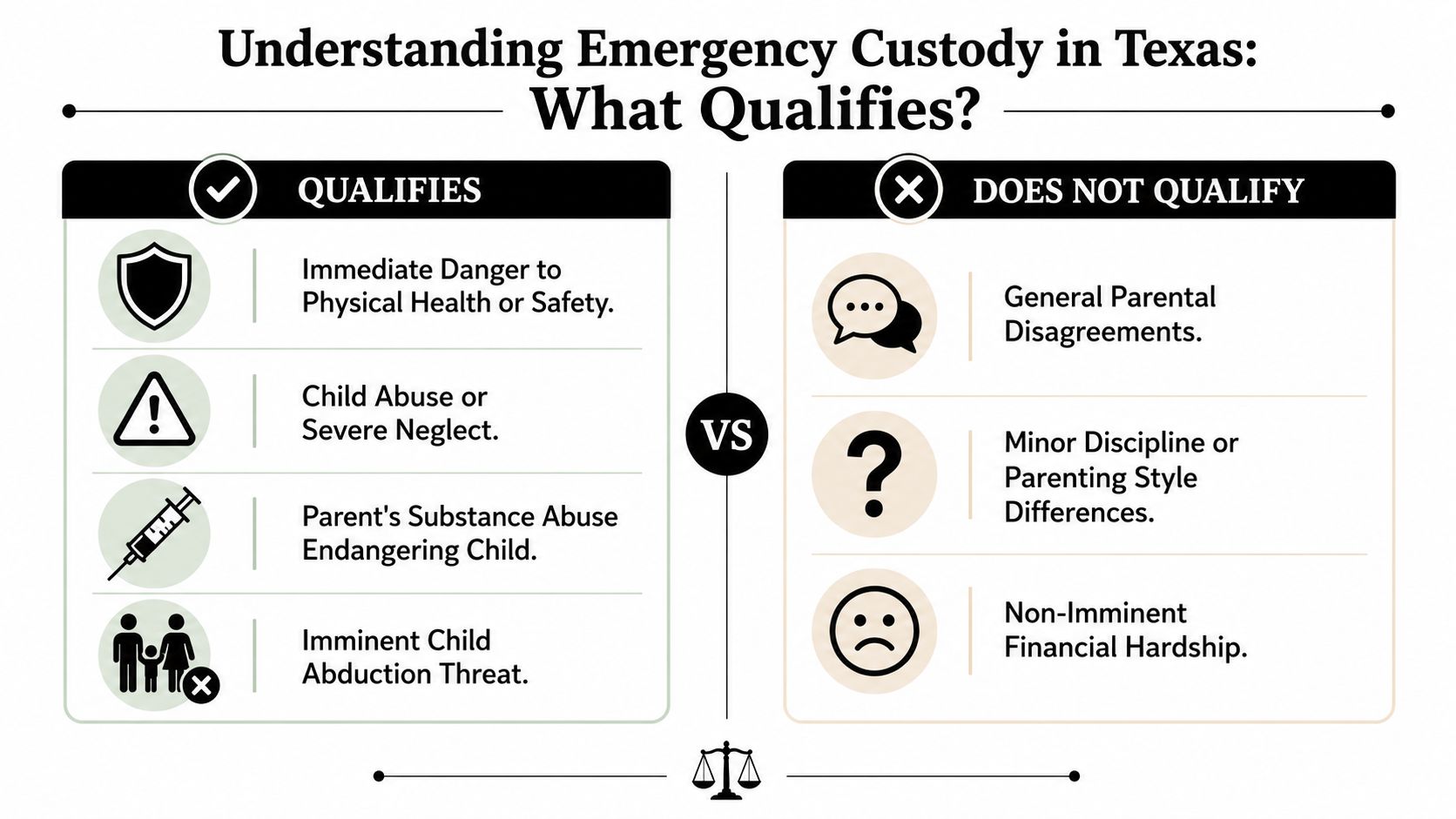
Situations that may qualify
The common thread is urgency plus danger. A judge wants to see that the child faces a specific risk now, not just a concern about what could happen someday.
Here are examples that often fit the emergency framework:
- Physical abuse: The child has injuries, makes a clear disclosure, or there's a police report describing violence.
- Sexual abuse concerns: The child reports contact, a medical provider documents concerns, or an investigation is underway.
- Severe neglect: A young child is left alone, basic care is missing, or the child is exposed to conditions that threaten safety.
- Substance abuse creating risk: A parent is caring for the child while impaired, driving intoxicated with the child, or exposing the child to dangerous drug activity.
- Abandonment or lack of supervision: The child is left without an appropriate caregiver.
- Credible threat of abduction: The other parent has said they will leave with the child or has taken concrete steps suggesting the child may be removed before a hearing.
Situations that usually do not qualify
A problem can be serious and still fall short of emergency custody. That distinction frustrates many parents in Kingwood and Humble, but it matters.
| Usually not enough by itself | Why courts often reject it as an emergency |
|---|---|
| Disagreement over bedtime, diet, or routines | It's a parenting conflict, not immediate danger |
| Anger about a new boyfriend or girlfriend | Courts need proof of actual risk to the child |
| Missed calls or poor co-parent communication | Frustrating, but not usually an urgent safety crisis |
| General claims that the other parent is irresponsible | Vague allegations rarely justify emergency relief |
Emergency custody is for immediate safety problems. It isn't a shortcut for winning a broader custody dispute.
Why the standard is so high
Courts in the Harris County system serving Kingwood have to balance two concerns at once. They must protect children fast when needed, but they also must prevent misuse of emergency motions in ordinary custody fights. That's why judges look for specific facts, close in time to the filing, supported by documents or witnesses.
If you're unsure whether your facts meet the standard, ask yourself a blunt question: if the judge does nothing until the regular hearing, what exactly could happen to the child before then? The clearer and more immediate the answer, the stronger the emergency claim usually is.
Evidence You Need to Support an Emergency Custody Request
Judges don't grant emergency custody because a parent sounds upset. They grant it when the file shows credible, organized proof. In Texas emergency cases, documentary evidence often carries the most weight.
Texas courts commonly rely on records such as police reports, medical records, CPS findings, photographs, texts, and sworn witness statements, as noted in this discussion of emergency custody evidence in Texas.

What to gather right away
Start with the items closest to the event. A same-day record usually helps more than a later summary from memory.
- Messages and call records: Save texts, emails, voicemails, and screenshots that show threats, admissions, intoxication, or plans to leave with the child.
- Photos and videos: Keep originals if possible. Make sure dates and context are preserved.
- Medical records: Emergency room notes, pediatric records, discharge papers, and recommendations from providers can matter.
- Police or incident reports: If law enforcement responded, get the report information as soon as you can.
- CPS materials: If a report was made or an investigator contacted you, preserve every document and communication.
- Witness statements: Teachers, relatives, neighbors, counselors, or other adults may have seen or heard something important.
How to make the evidence usable
A pile of screenshots isn't the same as a persuasive presentation. Courts need to understand what happened quickly.
Use this simple structure:
- Build a timeline. List events in date order.
- Match each event to proof. Attach the text, photo, report, or witness name to that event.
- Focus on safety. Leave out side arguments that don't relate to immediate danger.
- Preserve originals. Don't crop, edit, or rewrite messages.
- Write down context while it's fresh. Names, dates, times, and locations fade fast under stress.
If you're collecting records to file in court, it also helps to understand how documents are treated legally. A practical outside resource is this guide to what makes a document legally binding from SendItFax, especially if you're sorting affidavits, signed statements, and formal records under pressure.
Important: Accusations start a conversation. Documents move a judge.
Parents in Northeast Houston often make one avoidable mistake. They hand the court every grievance from the relationship instead of the narrow set of proof tied to the emergency. The stronger approach is cleaner. If the issue is intoxicated driving with the child, lead with that. If the issue is bruising after a visit, lead with the photos, medical review, and who observed it.
For a more detailed breakdown of organizing records, witness statements, and timelines, you can review how to prepare evidence for a custody hearing in Texas from our Kingwood guidance page.
The Step-by-Step Process for Emergency Orders in Harris County
For Kingwood families, emergency custody usually begins with a filing in the Harris County family court system. The process is fast compared with ordinary custody litigation, but it still follows rules. Understanding the sequence can lower some of the panic.
Texas guidance explains that a parent generally needs a Suit Affecting the Parent-Child Relationship, often called a SAPCR, on file before the court can issue temporary orders. In an immediate danger situation, a judge may review an ex parte request without advance notice to the other parent, but that order is short-term and a fuller hearing must follow, according to the Texas State Law Library's guide on temporary orders in child custody cases.
Here is the process in a visual format many parents find easier to follow.
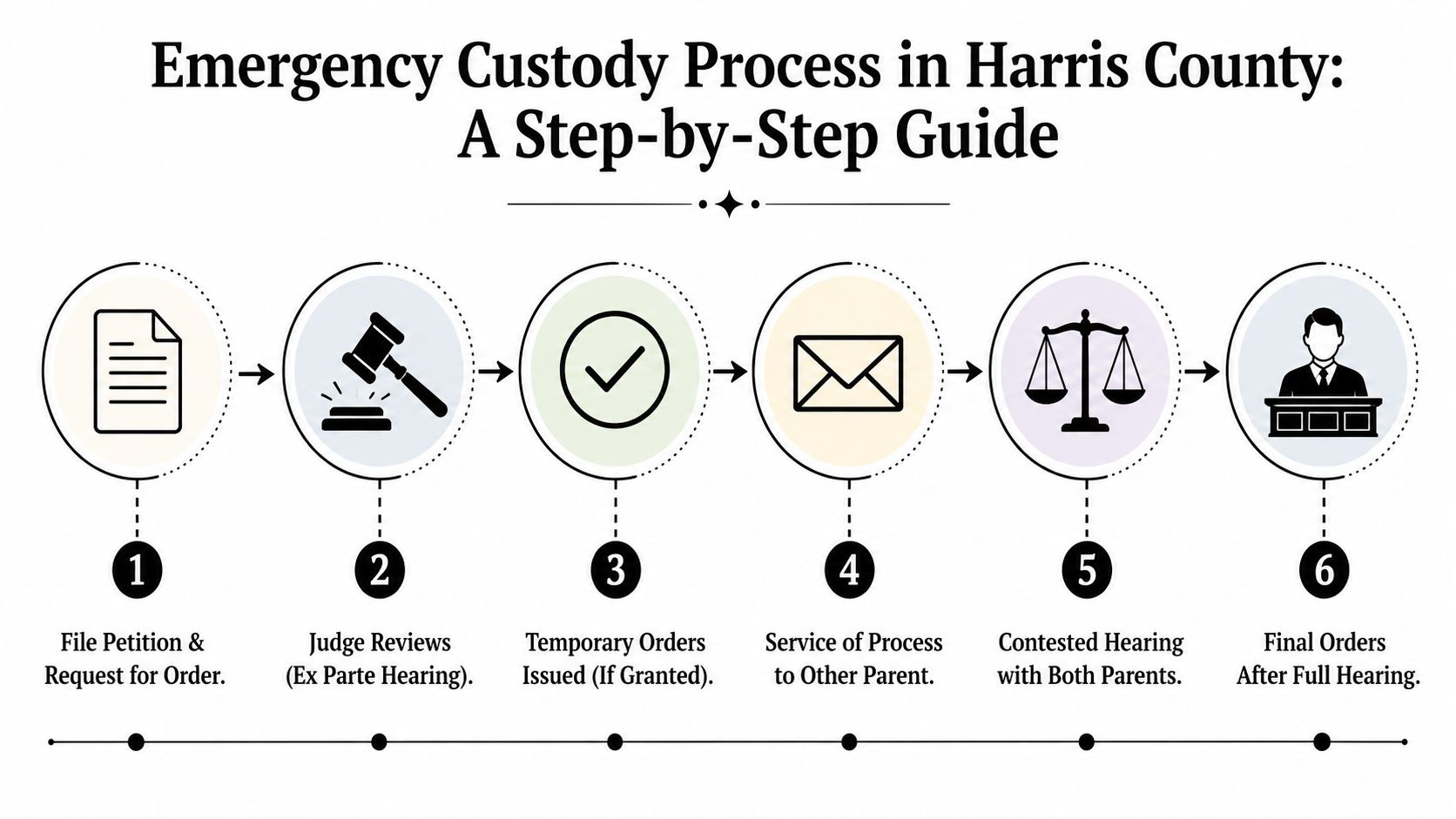
Step one filing the case and emergency request
The first move is usually filing the custody case itself, along with emergency paperwork asking for immediate relief. That filing must include sworn facts. In plain English, that means someone signs under oath explaining what happened and why the child can't safely wait for a regular hearing.
The success or failure of many emergency requests depends on the details provided. If the filing says only “I'm worried,” that usually won't carry much weight. If it says, “The child returned with visible injuries, was examined, and I have photos, records, and texts sent that night,” the court has something concrete to review.
Step two the ex parte review
“Ex parte” means the judge may look at the emergency request before the other parent receives notice. That sounds dramatic, but the reason is practical. If there's an urgent safety issue, the court may need to act before a warning gives someone time to disappear, hide evidence, or take the child.
The first emergency order is often a stopgap. It creates immediate protection while the court schedules a fuller hearing with both parents.
That ex parte review may happen quickly if the paperwork is clear, the evidence is strong, and the court is available. It may also move slower than a frightened parent hopes if the filings are incomplete or the allegations are too vague.
Step three service and the follow-up hearing
If the judge grants emergency relief, the other parent still gets the chance to respond. They must be formally served, and the court then holds a hearing where both sides can present evidence.
A short explainer can help if legal terms still feel abstract.
At that next hearing, the judge considers carefully what restrictions should stay in place while the larger custody case moves forward. That may involve temporary conservatorship, possession limits, exchange conditions, or other protective terms.
What parents in Kingwood should do during this process
- Stay focused on current risk: Don't let the hearing drift into every old dispute in the relationship.
- Bring organized proof: Judges can absorb a clean timeline faster than a chaotic stack of papers.
- Follow temporary orders exactly: Even when emotions are high, your own compliance matters.
- Prepare for testimony: You need calm, factual answers, not guesses or exaggeration.
For local procedural context, many parents find it helpful to review our overview of navigating Harris County family court from Kingwood.
Kingwood Local Courts and Timelines What to Expect
Families in Kingwood often ask one urgent question before any other. How fast can this happen?
The honest answer is that speed depends heavily on Harris County court availability. The filing itself is more efficient now because e-filing has made the submission process more straightforward, but getting a judge to review and sign an ex parte emergency order still depends on court access, the quality of the evidence, and whether the request clearly fits the emergency standard, as discussed in this overview of emergency custody timing in Texas.

Why local knowledge matters in practice
Texas law applies statewide, but the day-to-day handling of emergency family matters has a local rhythm. Judges may differ in how they prefer affidavits organized, how they review emergency submissions, and how tightly they focus on immediate proof versus broader context. Court staff procedures also matter more than commonly realized.
That's especially important for parents in Kingwood, Humble, Porter, and Northeast Houston, because these cases often turn on hours, not abstract legal theory. A filing that reaches the right place in the right format can move more smoothly than one that technically exists but doesn't answer the court's immediate concerns.
What usually affects timing
A few practical factors tend to shape how quickly emergency relief can move:
- Court availability: A judge must be available to review the request.
- Quality of the affidavit: The sworn statement needs specific facts, not conclusions.
- Supporting records: Documents that back up the emergency claim help the court act with confidence.
- Service issues: After the first order, the next stage depends on proper notice to the other parent.
Parents sometimes assume “emergency” means instant. In reality, courts move urgently, but they still need enough reliable information to justify extraordinary relief. If the danger is active and immediate, you shouldn't wait to gather perfect materials before seeking help. But you do need enough facts to make the risk understandable.
This is also where one practical legal option may matter. The Law Office of Bryan Fagan – Kingwood TX Lawyers handles family law matters involving custody and emergency requests, which can include preparing affidavits, organizing evidence, and guiding parents through local Harris County procedures.
After the Hearing What Happens Next in Your Custody Case
An emergency order doesn't end the custody case. It stabilizes a dangerous situation long enough for the court to make more informed decisions. That difference matters because many parents feel a wave of relief after the first hearing, then confusion when they learn there's still more ahead.
If emergency relief is granted, the case usually shifts into a phase where the judge considers broader temporary arrangements. Those may address who has possession of the child, whether visits need supervision, how exchanges should happen, and what restrictions remain necessary while the case continues.
The case becomes less urgent but more detailed
The emergency phase is narrow. The court asks, “Is the child in immediate danger right now?” The next phase asks larger questions about stability, parenting roles, and what arrangement protects the child while the final case is pending.
That means the evidence may broaden. School records, counseling concerns, caregiving history, communication patterns, and home stability can become more important. The court is no longer deciding only whether to stop a crisis. It is shaping a workable temporary structure.
A strong emergency filing protects the child today. A strong temporary-orders strategy helps protect the child for the months that follow.
If the request is denied
A denial doesn't always mean the judge thinks nothing is wrong. Sometimes it means the court believes the situation should be addressed through regular temporary orders instead of emergency relief. Sometimes the proof is incomplete. Sometimes the allegations are concerning but not immediate enough under the legal standard.
If that happens, don't assume your case is over. It may mean the path forward is a prompt noticed hearing, stronger documentation, or another protective strategy tied to the facts.
For many Kingwood parents, the hardest part is realizing that emergency custody is one chapter, not the whole story. The goal isn't just to win a fast order. The goal is to build lasting safety and stability for your child.
Frequently Asked Questions About Kingwood Emergency Custody
Does drug or alcohol use qualify if it didn't happen directly in front of my child
Maybe. The key issue is whether the substance use creates an immediate safety risk to the child. If a parent is impaired while supervising, driving, or making decisions about the child's care, that can matter more than where the use physically occurred.
What if I think the other parent is about to leave with my child
A credible abduction threat can be one of the strongest reasons to seek emergency relief. Save texts, travel messages, sudden withdrawal from school plans, or statements from witnesses. The court will want concrete facts showing the threat is real and immediate.
Can I get emergency custody just because the other parent keeps violating our agreement
Usually not by itself. Repeated violations may support enforcement or a request to modify custody, but emergency relief is generally reserved for urgent safety problems rather than routine noncompliance.
What if the judge denies the emergency request
You may still be able to pursue temporary orders through the regular process. A denial can mean the court wants a fuller hearing with both sides present, or it may mean your evidence needs to be better organized and more specific.
Should I wait until I have every piece of evidence
No. If the danger is immediate, act quickly. But bring as much reliable proof as you can. Courts in the Kingwood and Harris County area respond best to urgent facts that are supported by clear records, not guesses or generalized fear.
If your child may be in danger in Kingwood, Humble, Porter, or Northeast Houston, don't try to sort through this alone. Schedule a free consultation with Law Office of Bryan Fagan – Kingwood TX Lawyers to discuss your situation, your evidence, and the fastest lawful steps available to protect your child.