Skip to content
In Texas, a judge can issue an emergency child-custody Temporary Restraining Order without notice to the other parent, often on the same day the request is filed. That first order is short-term, and if it's granted, the court should set the next hearing within 14 days so both sides can be heard.
If you're in Kingwood, Humble, Porter, or Northeast Houston and you're searching for answers in the middle of a crisis, you probably don't care about legal jargon right now. You want to know whether the court can act fast enough to protect your child. In the right case, yes, it can.
But speed depends on one thing more than anything else. You must be able to show the court that this is a real emergency, not just a painful disagreement with the other parent. Judges in Harris County see urgent requests often. They move quickly when a child faces immediate danger. They slow down when the filing is built on suspicion, frustration, or old custody disputes dressed up as emergencies.
That's why the most helpful question usually isn't just, “How fast can you get emergency custody in Texas Kingwood?” It's also, “What facts will make a judge act today?”
A Kingwood Parent's Guide to Emergency Child Custody
A lot of parents call in the same state of panic. The other parent didn't return the child. There's suspected drug use. A child says something happened during visitation that doesn't sit right. A parent in Kingwood drops everything and starts searching for immediate legal help because waiting until next week feels impossible.
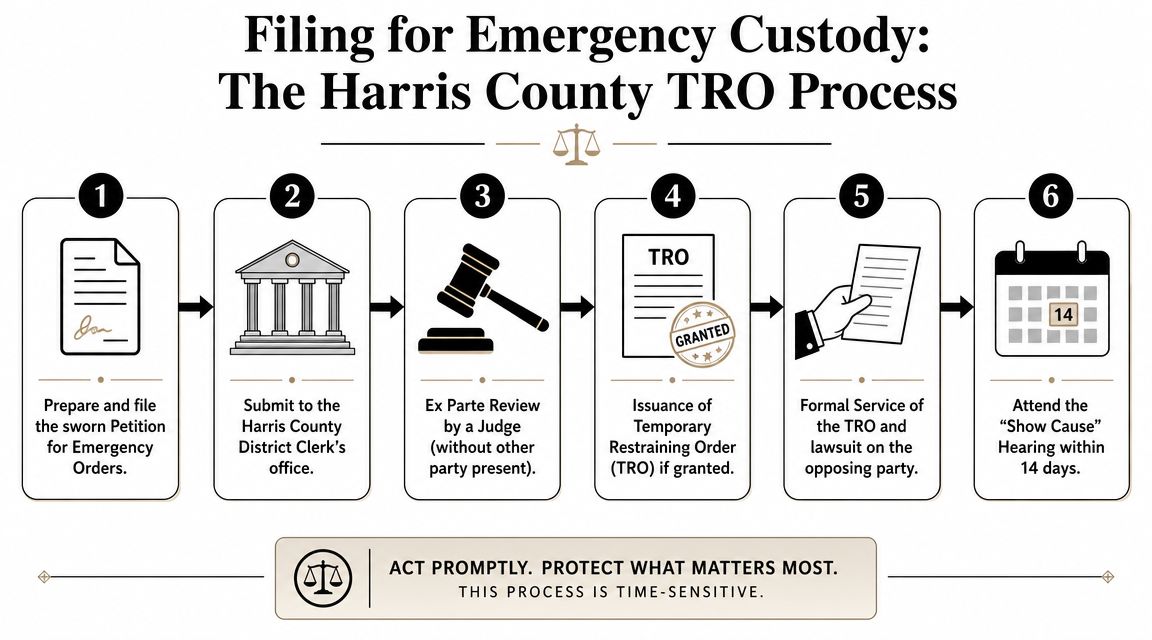
Texas does allow fast action in true emergencies. According to TexasLawHelp's explanation of TROs in child-custody emergencies, a court may hear the request ex parte, which means without advance notice to the other parent, and the order can be granted often on the same day. The same guidance explains that the TRO is only good for 14 days, and the court should set the next hearing within that period.
That combination matters. It means the court can step in quickly, but it also means the first order is only a temporary safety measure. It is not a final custody ruling.
Practical rule: Emergency custody is about immediate protection, not winning the whole case in one afternoon.
For parents in Kingwood and nearby Humble, that usually means acting on two tracks at once. First, protect the child right now. Second, prepare for a fast follow-up hearing where the judge will expect evidence, not just fear.
A strong emergency filing usually has a clear timeline, supporting records, and a focused explanation of why waiting would put the child at risk. A weak one usually overreaches. It tries to turn every parenting conflict into an emergency. Harris County judges can tell the difference quickly.
If you're dealing with a genuine danger, the law gives you a path to ask for immediate relief. The hard part is using that path the right way.
What a Texas Court Considers a True Custody Emergency
Parents often know when something feels wrong. Courts need more than that. A Harris County judge will look for facts showing that the child faces immediate risk if the court does not act right away.
That's a high bar, and it should be. Emergency custody is powerful. It can change possession and access before the other parent has a chance to respond. Courts reserve that tool for serious situations.
Situations that may support an emergency request
A true emergency usually involves specific conduct that threatens the child's safety or welfare right now. Examples can include:
- Violence or threats of violence that place the child in danger.
- Serious substance abuse concerns tied to the child's care, supervision, or transport.
- Abandonment or severe neglect where the child's basic needs are not being met.
- Exposure to dangerous people or conditions that create immediate risk.
- Credible threats to remove or hide the child in a way that would prevent prompt court intervention.
The key is immediacy. The court wants to know why ordinary scheduling won't protect the child.
Situations that usually do not qualify
Some problems are real, painful, and worth addressing, but they usually are not emergency-custody cases. Common examples include:
- Routine co-parenting conflict
- Missed pickups or communication failures
- Disagreements about school, discipline, or extracurriculars
- A parent being rude, manipulative, or difficult
- Old incidents with no current threat
Those issues may support a modification case, enforcement action, or request for standard temporary orders. They usually won't justify an ex parte emergency order by themselves.
Courts move fastest when the danger is current, concrete, and supported by evidence.
The difference between a toxic family dynamic and a legal emergency
This distinction matters in Kingwood family cases. Some parents are dealing with emotionally draining relatives, boundary violations, or chaotic co-parenting patterns that affect everyone in the home. Those problems can seriously harm family stability even when they don't rise to the level of an emergency filing. If that sounds familiar, this guide on strategies for setting family boundaries can help you think through the non-court side of protecting your household.
Legal emergencies and family dysfunction overlap sometimes, but they are not the same. A judge is looking for immediate harm or immediate risk of harm to the child.
What works and what backfires
What works in Harris County is a narrow, fact-driven request. Parents do better when they present dates, events, records, and direct observations. They do worse when the filing turns into a character attack.
A few examples of what helps:
- Specific facts: “He drove with the child after drinking” is stronger than “He's irresponsible.”
- Fresh events: Recent incidents carry more urgency than old stories.
- Corroboration: Photos, texts, police reports, medical records, and witness statements matter.
What usually backfires:
- Padding the filing with every grievance from the relationship
- Making claims you can't support
- Using emergency custody as an advantage in an ongoing dispute
- Waiting too long after the alleged emergency and then calling it immediate
Judges notice delay. If a parent says the child is in danger but waits without explanation, the court may question whether the risk is urgent.
Immediate Steps to Protect Your Child in Northeast Houston
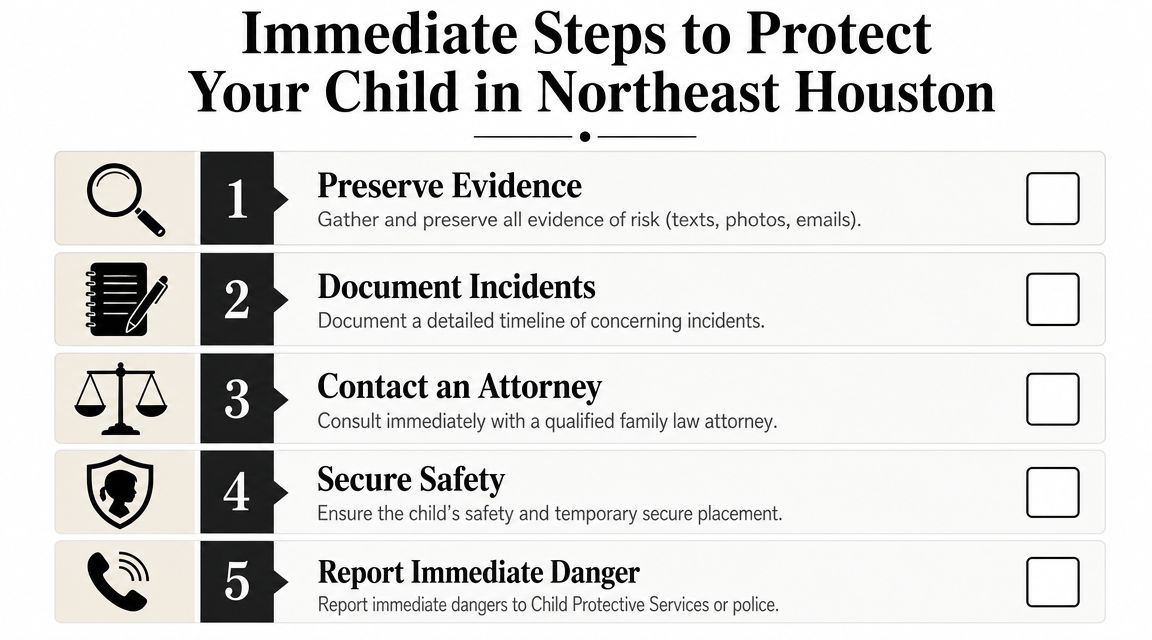
When a child may be in danger, your first job is safety. Your second job is documentation. Those two steps shape almost every emergency custody case filed in Kingwood, Humble, and Northeast Houston.
Start with safety, not paperwork
If the danger is immediate, call law enforcement or emergency services first. If the concern involves abuse or neglect, a report to the proper authorities may also be necessary. Don't delay urgent protection because you're trying to build a perfect file.
If the child is with you and there is a genuine safety issue, keep the child in a secure place while you get legal advice. That may mean staying with a trusted family member in Kingwood or Humble, changing pickup plans, or avoiding direct confrontation with the other parent until you know the next legal step.
If you think waiting could expose your child to harm, act to protect first and explain the timeline clearly later.
Build the evidence the court will actually use
Texas emergency filings are usually tied to a pending custody case or modification case and supported by a sworn affidavit. The Texas State Law Library guide on temporary orders explains that the fastest path is usually to file the petition or motion with a sworn affidavit showing immediate risk, request an ex parte hearing the same day, and ask the court for a short-term order without notice if waiting would endanger the child.
That means your evidence needs to be organized for an affidavit, not just collected in your phone.
Use a practical checklist:
- Preserve messages: Save texts, emails, voicemails, and social media messages exactly as they appear.
- Create a timeline: Write down dates, times, locations, witnesses, and what happened.
- Keep photos and videos: Store them in a way that preserves the original date if possible.
- Request records: Medical paperwork, school communications, police records, and incident reports can matter.
- Identify witnesses: Teachers, neighbors, relatives, or other adults who personally observed events may help.
What to write down today
Parents in Northeast Houston often remember the big event but forget the details the court will ask about later. Write these down while they're still fresh:
- What happened
- When it happened
- Who saw or heard it
- Why the child is at risk if nothing changes
- What action you took immediately after
Small details matter. If the child came home with visible injuries, note where, when, and what the child said. If the other parent made threats by text, save the full thread, not just screenshots of selected lines.
Be careful with your own conduct
In emergencies, worried parents sometimes create new legal problems while trying to solve the old one. Avoid these common mistakes:
- Do not coach the child on what to say.
- Do not alter evidence or crop communications in a misleading way.
- Do not send threatening messages to the other parent.
- Do not violate an existing order casually unless you are responding to a true immediate safety concern and are prepared to explain why.
If the issue involves an existing order that the other parent has already broken, this article on what to do if the other parent violates a custody order in Kingwood, Texas can help you separate an enforcement issue from a true emergency.
Choose the right kind of help
Different problems call for different responses:
- Immediate danger: Contact emergency responders or law enforcement.
- Abuse or neglect concerns: Make the appropriate report to child protection authorities.
- Fast court action: Contact a family law attorney who handles emergency filings in Harris County.
- Non-emergency co-parenting conflict: Document it and discuss standard court remedies.
The fastest legal filing in the world won't make up for weak facts. But strong facts, collected early and presented clearly, can make urgent court action possible.
Filing for Emergency Custody The Harris County TRO Process
Parents often assume emergency custody starts with a dramatic courtroom moment. In reality, it starts at a desk, with careful paperwork. The judge's speed depends on how well the filing explains the danger.
Step one is the case posture
In Texas, emergency custody is usually requested inside an existing SAPCR or modification case. SAPCR means Suit Affecting the Parent-Child Relationship. If no case is pending, the legal team may need to file the underlying case along with the emergency request.
That matters because the court needs a procedural vehicle to issue custody-related orders. A strong emergency claim can still get slowed down if the filing posture is wrong.
The affidavit does the heavy lifting
Most parents think the motion is the main event. It usually isn't. The sworn affidavit carries the urgency. This is the document where the parent lays out the facts under oath.
A useful affidavit is direct. It states what happened, when it happened, how the parent knows it happened, and why waiting for ordinary notice would put the child at risk.
A weak affidavit usually sounds like this:
- long on accusations
- short on dates
- vague about danger
- emotional without being factual
A better affidavit sounds more like a timeline than an argument.
The court does not need every bad fact from the relationship. The court needs the facts that explain why a child needs protection today.
What ex parte actually means
Parents hear ex parte and assume it means secret. It doesn't. It means the judge may review the emergency request without giving the other parent advance notice before that first short-term order is considered.
That's allowed because waiting for notice can defeat the purpose of emergency relief in a true danger situation. But it is also why judges are careful with these requests. They know only one side is in the room at that moment.
How fast the first ruling can happen
When the facts support it and the filing is properly prepared, a judge may review the request quickly. The fastest result is a same-day TRO, but that depends on the court's availability, the quality of the paperwork, and whether the emergency is clear on its face.
The controlling timeline after that first order is the 14-day TRO limit. As explained in this discussion of emergency custody orders in Texas, after an ex parte TRO is issued, the court must hold a follow-up hearing within 14 days, where both sides can appear and the judge can dismiss, modify, or extend the order. For Kingwood families, the fastest path is often a temporary safety order reviewed in under two weeks.
What happens after the TRO is signed
The order is only the beginning. Once the judge signs the TRO, several things happen quickly:
Service on the other parent
The other side must be formally served with the lawsuit and the emergency order.Setting the full hearing
The court schedules the follow-up hearing within the TRO window.Preparation for live testimony
The case shifts from paper to proof. Witnesses, exhibits, and direct testimony become more important.Practical enforcement questions
You may need to coordinate exchanges, school pickup authority, or restrictions in a way that matches the signed order.
What usually slows the process down
Even in Harris County, emergency filings can lose momentum for practical reasons. The most common ones are:
- Unclear facts
- Missing affidavit details
- Poor document organization
- Filing the wrong request in the wrong case posture
- Asking for too much relief unrelated to the emergency
That last problem is common. A parent may need immediate safety restrictions but tries to turn the TRO into a full rewrite of custody, support, and possession. Judges often respond better to a focused request tied tightly to the immediate risk.
A local point that matters in Kingwood cases
Parents in Kingwood, Humble, and Northeast Houston often want to know whether they should rush to the courthouse alone. Sometimes that works. Often it doesn't. Emergency requests are technical, and the margin for error is small. Family law counsel can help assemble the affidavit, frame the legal basis correctly, and present the request in a way the court can act on.
One option parents in the area consider is Law Office of Bryan Fagan – Kingwood TX Lawyers, which handles family law matters including custody disputes in the Kingwood area.
The larger point is this. In a true emergency, speed comes from preparation. The court can move fast, but only if the filing gives the judge a legally sound reason to do so.
What to Expect at Your Emergency Custody Hearing
The first surprise for many parents is that the emergency process has two very different moments. The first is the urgent request on paper, sometimes with a brief ex parte appearance. The second is the hearing where both sides show up and the judge takes a closer look.

The full hearing feels different from the emergency filing
At the follow-up hearing, the other parent has a chance to respond. That changes the tone. The judge is no longer deciding whether to issue a short-term safety stopgap based on one side's sworn facts. The judge is weighing competing testimony and deciding whether the temporary protections should stay, change, or end.
That's why preparation matters so much. By the time you walk into court, you should know:
- What order you are asking for
- Which facts support that request
- Which documents you may offer
- Which witnesses can confirm your account
How to present yourself in court
Parents often worry about saying the perfect thing. That isn't the goal. Credibility is the goal.
Helpful courtroom habits include:
- Answer the question asked
- Stick to facts and dates
- Stay calm even if the other parent says something false
- Bring organized copies of your records
- Dress neatly and act respectfully
What hurts credibility is exaggeration. If you don't know something, say that. If you're estimating a time or date, make that clear.
A judge is listening for reliability as much as urgency.
What the judge may focus on
Emergency custody hearings in Harris County often revolve around a few recurring questions:
- Why was immediate action necessary?
- What evidence supports the claimed risk?
- What order protects the child while the case continues?
- Is the requested relief narrowly suited to the problem?
That last point matters. If a child needs protection from dangerous transport, the answer might be supervised exchanges or driving restrictions. If a child needs protection from a violent home environment, the answer may be much stronger. Judges often look for the least disruptive order that still keeps the child safe.
If you want a broader overview of courtroom preparation, this guide on how to prepare for a custody hearing is a helpful companion.
A short video can also help you get mentally ready for the courtroom setting and process:
Possible outcomes at the hearing
The judge has several options. The court may:
- Keep protections in place through temporary orders
- Modify the emergency order to fit the evidence more precisely
- Deny continued emergency relief if the proof falls short
- Set additional steps for the broader custody case
A denial is not always the end of the custody issue. Sometimes it means the judge doesn't see a basis for emergency relief, but the underlying dispute still belongs in a normal modification or temporary-orders process.
What parents often misunderstand
Many parents think the hearing is about proving the other parent is generally bad. It usually isn't. The hearing is about present risk and immediate child-focused solutions.
That difference can calm the process down. You don't have to prove every flaw in the other parent's life. You need to prove the facts that justify the order you're requesting.
Alternatives to a TRO Protective Orders and Standard Orders
Not every urgent family problem in Kingwood calls for an emergency custody TRO. Sometimes another legal tool fits better and gives the judge a clearer path to act.
Why the right tool matters
A TRO is designed for immediate, short-term relief. A protective order serves a different purpose. Standard temporary orders serve another. Choosing the wrong one can waste time, especially when a child needs stability quickly.
If your situation involves ongoing custody conflict but not a same-day danger issue, you may be better served by seeking temporary custody orders in Texas through the regular family-court process.
Comparing Emergency Legal Orders in Texas
| Order Type | Primary Purpose | Typical Duration | Who It Protects | Legal Standard |
|---|---|---|---|---|
| Emergency TRO | Immediate short-term protection in a custody emergency | Short-term. In a Texas custody emergency, a TRO is only good for 14 days before follow-up review as discussed earlier in this article | Usually the child, and sometimes the parent-child situation more broadly | Immediate risk that justifies action without waiting for normal notice |
| Protective Order | Protection from family violence or threats of violence | Varies by court order | A person at risk, which may include a child | Facts showing family violence or a qualifying threat requiring protection |
| Standard Temporary Orders | Stability while a divorce, SAPCR, or modification case is pending | Temporary during the case | Parents and children in the case | Need for interim rules on custody, possession, support, or use of property |
A practical way to think about the options
Use this framework:
- Use a TRO when the child needs immediate short-term protection and waiting for ordinary notice could create danger.
- Use a protective order when violence or threats are central to the problem.
- Use standard temporary orders when the issue is serious but not so immediate that ex parte relief is necessary.
What works better in real cases
The best filings are usually narrow and honest about the legal tool being requested. Courts appreciate precision. If a parent has a violence issue, asking for a custody TRO when a protective order is the cleaner fit can muddy the case. If a parent has an urgent scheduling problem but no immediate danger, forcing it into an emergency frame can damage credibility.
For many Northeast Houston families, the strongest strategy isn't the most dramatic one. It's the one that fits the facts.
Frequently Asked Questions About Emergency Custody in Kingwood
Can I get emergency custody in Kingwood in one day
Sometimes, yes. In a true emergency, the court may consider an ex parte request and grant a TRO the same day. But “same day” depends on strong facts, a proper filing, and a judge who sees immediate risk from the papers presented.
Is the same-day order final
No. The first order is temporary. If emergency relief is granted, the court then moves to a fuller hearing where both sides can appear. That second stage is where many parents learn whether the emergency protections will remain in place, change, or end.
What if the judge denies my emergency request
It doesn't always mean your concerns are unimportant. It may mean the judge doesn't believe the legal standard for emergency action was met on the facts presented. You may still have options through modification, enforcement, protective-order proceedings, or standard temporary orders.
A denied emergency request is not the same as a final loss on custody.
Can I file without a lawyer
You can, but emergency filings are difficult to get right under pressure. The law expects a procedurally correct filing supported by a sworn affidavit that clearly explains immediate danger. Small mistakes can cost time, and time matters in these cases.
What should I bring to the attorney or to court
Bring what proves your facts, not just what tells your story. That usually includes messages, photos, timeline notes, prior orders, school or medical records, police information if available, and names of witnesses with firsthand knowledge.
Will the court punish me if I ask for emergency custody and lose
Not automatically. But if a parent misuses emergency filings for tactical reasons, it can hurt credibility. That's one reason honest case assessment matters so much at the start.
What if the other parent lives outside Kingwood
That can affect logistics, service, and hearing preparation, but it does not prevent a Texas court from acting if the case is properly before the court and the facts support emergency relief. Local families in Kingwood, Humble, Porter, and Northeast Houston still need to move quickly when the child is here or the order needs local enforcement.
How much does emergency custody cost
Costs vary too much from case to case to state a reliable amount here. The better question is what kind of legal process your facts support. A narrowly targeted emergency filing may require different work than a broader custody modification with ongoing hearings.
What should I do right now if I think my child is in danger
Protect the child first. Preserve evidence. Get legal advice quickly. Don't wait for the facts to get easier to prove. They usually get harder with time.
If you're in Kingwood, Humble, or Northeast Houston and you need immediate guidance on a custody emergency, careful local advice can make the difference between a rushed filing and an effective one.
If you're worried about your child's safety and need clear answers now, Law Office of Bryan Fagan – Kingwood TX Lawyers offers free consultations for families in Kingwood, Humble, Porter, and Northeast Houston. We can help you understand whether your situation fits an emergency custody request, what evidence matters most, and what steps to take next through the Kingwood office.