Skip to content
You’re standing in a parking lot in Kingwood. It’s exchange time. You showed up where the order says to show up. Your child’s backpack is ready, your phone is in your hand, and the other parent doesn’t come.
That moment hits hard. You’re angry, embarrassed, worried about your child, and probably already hearing excuses before they even arrive. If you’re searching for what to do if other parent violates custody order kingwood texas, start with this: don’t panic, don’t retaliate, and don’t let this become a sloppy record.
In Kingwood, Humble, Porter, and across Northeast Houston, I’ve seen the same mistake over and over. A parent knows the other side is wrong, but they react emotionally, skip documentation, send a string of hostile texts, or stop following their own order. That hurts the case.
Texas courts can help. They will not fix a custody problem based on frustration alone. They act on proof, precise pleadings, and a clear pattern of noncompliance. If you handle the first few hours correctly, you put yourself in a much stronger position for enforcement and, if needed, modification later.
A Frustrating Reality for Kingwood Parents
A missed exchange in Kingwood rarely feels like “just” a missed exchange. It usually comes with a child asking questions, a last-minute text that doesn’t match the order, or no message at all. Parents in Kingwood, Humble, and Northeast Houston deal with this at grocery store parking lots, school pickup lines, and neutral exchange spots every week.
What makes it worse is the uncertainty. You don’t know if the other parent is running late, playing games, or about to keep doing this. You also don’t know whether calling the police will help, whether the judge will care, or whether you should just let it go this one time.
You shouldn’t ignore it.
What this usually looks like on the ground
Sometimes the violation is obvious. The other parent refuses to bring the child to the exchange. Sometimes it’s more slippery. They show up late enough to ruin the visit, cancel repeatedly, block phone contact, or return the child outside the ordered time.
Those details matter because courts enforce the written order, not what feels fair in the moment.
The fastest way to weaken a strong custody complaint is to handle it like a personal argument instead of a legal record.
That’s the practical reality in Harris County. Judges want to know what the order says, what happened, when it happened, and what proof you have.
You are not powerless
A custody order is a court order. If the other parent keeps violating it, Texas law gives you tools to respond. Those tools can include enforcement, make-up visitation, attorney’s fees, and, in more serious cases, stronger court intervention.
You also don’t have to sort this out alone. Families in Kingwood and nearby communities often need a calm local plan, not internet noise. The right response starts with what you do in the first day, because that first day becomes the foundation of everything that follows.
Your First 24 Hours After a Custody Violation
When a violation happens, your job is simple. Protect the child, preserve the facts, and stay controlled.

Start with safety, not anger
If you don’t have the child and you believe there is an immediate safety issue, call law enforcement right away. If there’s no emergency but the other parent is refusing the exchange, you can still contact local police or the constable to make a report. Be realistic, though. Officers often won’t force a handoff based on a civil custody dispute unless there’s a clear safety concern or a specific order issue they can act on immediately.
What they can do is create a record. That matters later.
If the child is with you and the other parent is threatening to escalate at the exchange site, leave with the child if the order allows you to maintain possession at that moment and the situation feels unsafe. Don’t stand there arguing in a parking lot in front of your child.
Do these things before you drive away
Use your phone and create evidence while the facts are fresh.
- Take a timestamped photo: Get yourself at the exchange location if possible, along with anything that shows where you are.
- Screenshot messages: Save texts, missed calls, voicemails, app messages, and emails.
- Write a short note immediately: Record the date, exact time, location, who was present, and how long you waited.
- Keep receipts if relevant: If you bought gas, parked, or made another time-stamped stop tied to the exchange, keep that too.
- Stay physically present long enough to show compliance: Don’t leave too quickly and then claim a no-show.
If there’s an actual emergency involving danger to the child, legal help may need to move faster than a standard enforcement case. In that kind of situation, review options for an emergency custody order in Kingwood.
Send one clean message
Most parents blow this part. They send ten texts. They accuse. They threaten. They use language that later makes both sides look unreasonable.
Send one message that does three things: confirms the violation, asks for the child or makeup time, and stays neutral.
A good example:
“I arrived at the exchange location listed in our order at the scheduled time and waited. You did not appear with our child. Please confirm your location and when you will comply with the order.”
That message creates a record. It doesn’t inflame the situation. It helps you look like the parent who is trying to follow the order.
What not to do in the first day
Don’t withhold your next visit as payback. Don’t stop paying child support. Don’t tell the child the other parent “doesn’t care.” Don’t post about it on Facebook. Don’t improvise your own fix.
Those choices feel satisfying for about ten minutes and then become evidence against you.
A short video can help you think clearly about what enforcement usually looks like in practice.
Get organized that same night
Before bed, create a folder on your phone or computer. Label it with the child’s name and the year. Put everything from the incident into that folder.
Then start a running log. If this turns into a pattern, you won’t remember every detail a month from now. Your notes from tonight will be far more credible than a reconstructed story later.
Building Your Case How to Document Every Violation
A strong custody case in Harris County is built on detail. Not emotion. Not general complaints. Detail.

Texas courts take enforcement seriously, but they also expect proof. In Texas, including Kingwood in Harris County, custodial parents who violate visitation orders face structured civil enforcement under Texas Family Code Chapter 157. Courts can impose sanctions in up to 70% of documented enforcement cases, but they often reject claims without clear evidence of attempted compliance, such as proof of the non-custodial parent arriving at the exact location, date, and time specified in the order. Delays in filing weaken cases, with over 25% of motions failing due to insufficient records, according to this discussion of Texas custody enforcement.
Keep one master log
Use one system and stick with it. A notebook works. A spreadsheet works better. A dedicated digital note works too. The point is consistency.
For each violation, record:
- Exact date and time: Not “last weekend.” Use the specific date and scheduled exchange time.
- Exchange location: Quote the place exactly as stated in the order if possible.
- What the order required: Copy the relevant language from your decree or order.
- What occurred: Late, no-show, refusal, blocked communication, early return, or denied pickup.
- Your attempted compliance: Include when you arrived, how long you waited, and what you brought or prepared.
- Witnesses: Name anyone who saw the event, including family members or neutral third parties.
- Related communications: List the text, email, app message, or voicemail tied to that event.
This needs to be boring. Boring records win cases.
If it isn’t written down, it didn’t happen in court.
Preserve the original evidence
Don’t just summarize your texts. Save them. Don’t rewrite emails. Export them if you can. Don’t crop screenshots so tightly that the date and sender disappear.
If you want a plain-English primer on what courts usually treat as records and exhibits, this guide to documentary evidence is a useful overview.
Parents in Kingwood often do well using co-parenting tools that preserve messages in one place. Apps such as OurFamilyWizard or similar platforms can help reduce “I never got that message” disputes because they create a cleaner communication trail than random text chains.
Document your own compliance too
This part gets missed constantly. You are not just proving what the other parent did wrong. You are proving that you followed the order.
That means keeping proof that you:
- showed up at the right place
- showed up on time
- had the child ready if it was your exchange duty
- did not cancel or move the exchange without agreement
- communicated in a reasonable way
That last point matters. Judges notice tone.
Build records the court can actually use
When parents prepare for a Harris County hearing, I want documents organized by incident, not dumped in a pile. Create folders by month or by violation. Give each event a simple label, like “March 3 denied pickup” or “April 14 late return.”
Then line up your order, your log, your screenshots, and any witness information so they all match. If your hearing is coming up, this practical page on how to prepare for a custody hearing can help you get your evidence into usable shape.
A simple structure that works
Here’s a reliable format for each incident:
| Item | What to include |
|---|---|
| Order term | The exact possession or access provision |
| Scheduled exchange | Date, time, location |
| Violation | What the other parent did or failed to do |
| Your compliance | Arrival, wait time, communication |
| Evidence | Screenshots, photos, call logs, witnesses |
Keep doing this every time. A single violation may justify action. A documented pattern gives the court something much harder to ignore.
Taking Legal Action Filing a Motion to Enforce in Harris County
If the other parent keeps violating the order, stop hoping they’ll suddenly become cooperative. Move the issue into court.
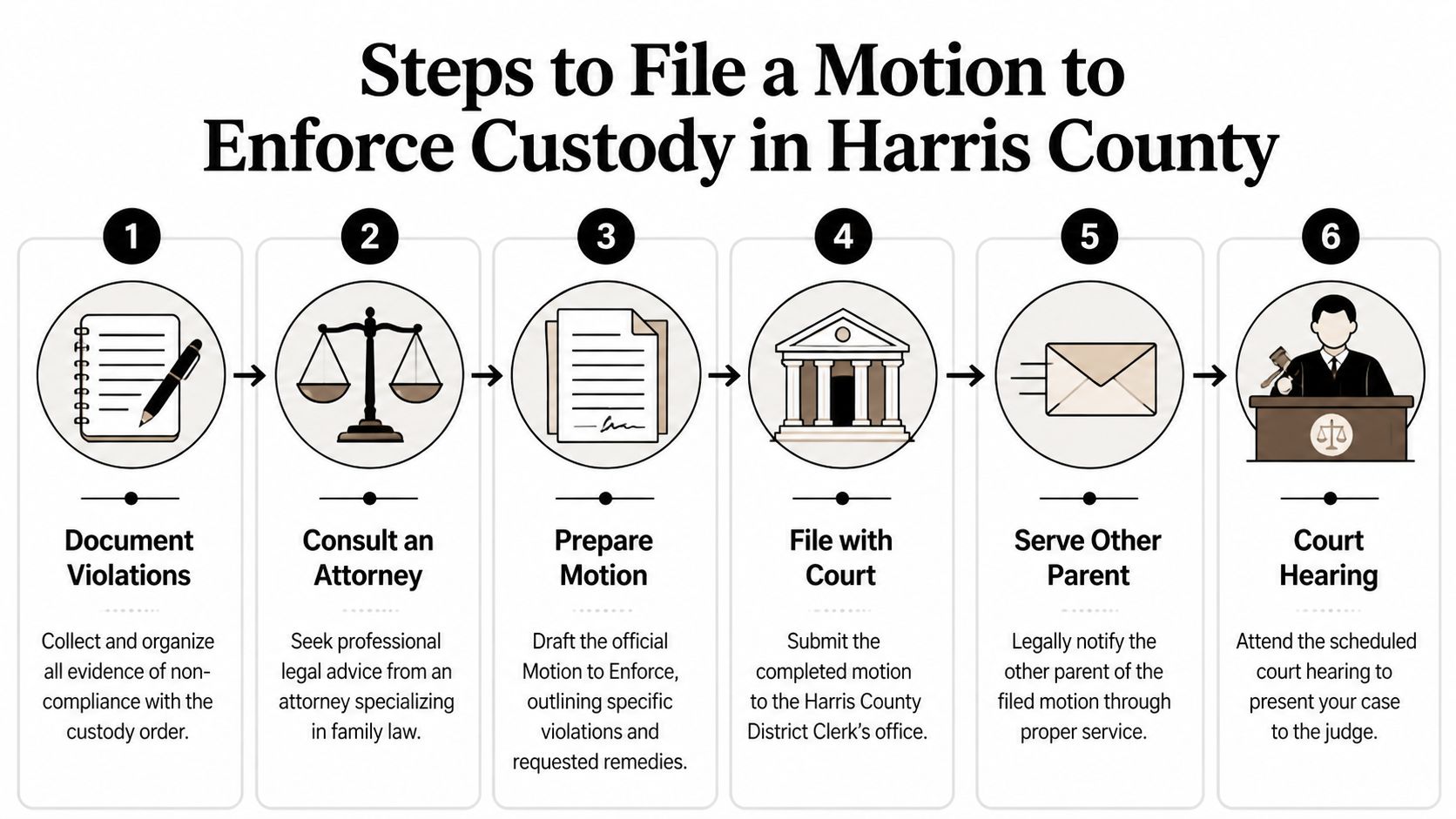
A Motion to Enforce asks the judge to hold the other parent accountable for specific violations of a custody or visitation order. In practical terms, you are telling the court: here is the exact order, here are the exact violations, and here is the relief I want.
The court expects precision
In Harris County, these filings are technical. You don’t get points for being upset. You get results by being exact.
Your motion must identify the specific order provisions violated, the date and nature of each violation, and what remedy you want the judge to grant. If your pleading is vague, the court can reject it or limit what relief is available.
That’s one reason represented parents usually do better. Technical enforcement motions demand specificity under Texas law, including identifying the exact order provisions violated. Success rates for enforcement motions can climb to 90% with attorney representation versus 55% for those who file themselves, largely because 30% of self-filed motions are rejected for procedural errors like vague pleadings. Post-hearing, the violating parent is ordered to pay the other party's attorney's fees and costs in approximately 80% of cases where a violation is found, according to this overview of custody-order enforcement standards.
What filing usually involves
In the Kingwood area, families often end up in Harris County family courts that handle these matters, including courts such as the 246th or 507th District Courts depending on where the original case sits. The first practical question is simple. Which court signed your current order? That usually determines where enforcement belongs.
The sequence usually looks like this:
- Review the current order carefully and pull the exact provisions that were violated.
- Draft the motion with each violation listed separately.
- Request specific remedies such as makeup time, attorney’s fees, contempt findings, or other relief allowed by the order and law.
- File with the district clerk in the proper court.
- Serve the other parent correctly through formal service.
- Prepare for the hearing with exhibits, testimony, and a clean timeline.
A custody enforcement case often turns on paperwork quality before anyone even testifies.
Motion to enforce versus contempt
Parents use these terms interchangeably, but they aren’t identical in practice. A motion to enforce is the filing. Contempt is one possible remedy the judge may impose if the violations were willful and the order is enforceable as written.
That distinction matters because contempt carries stricter procedural requirements. If the motion is drafted carelessly, you can lose your advantage before you ever reach the hearing.
Why local help matters
This isn’t just about knowing Texas law. It’s about knowing how local courts expect these cases to be presented. A parent filing alone may miss service problems, attach messy exhibits, or ask for relief the court can’t grant on the pleadings submitted.
If you’re dealing with repeated denied visitation in Kingwood or Humble, working with a custody enforcement lawyer in Kingwood can help you turn your records into a filing the court can act on. One local option for that work is the Law Office of Bryan Fagan – Kingwood TX Lawyers, which handles enforcement matters under Texas Family Code Chapter 157.
What to bring to the hearing
Don’t walk in with a phone full of screenshots and no organization. Bring:
- A copy of the signed order
- A violation timeline
- Printed communication records
- Photos or location proof
- Witness names and contact information
- A proposed list of remedies you want
Judges in Harris County move quickly. If your evidence is scattered, your case feels weaker than it is. If your evidence is tight, the judge can follow the pattern fast.
Understanding Potential Outcomes and Court Remedies
A successful enforcement case is not just about proving the other parent was wrong. It’s about asking for remedies that solve the problem.
Texas courts have several ways to respond when a parent violates a custody order. Some remedies are corrective. Some are punitive. The smart approach is to ask for what protects your time with your child and improves compliance going forward.
Texas Custody Enforcement Remedies at a Glance
| Remedy | What It Is | When It's Used |
|---|---|---|
| Make-up visitation | Extra possession time to replace time you wrongly lost | Common when the court finds denied visitation or interference with scheduled access |
| Fines | Monetary penalties for violations of the order | Used when the court wants to punish willful noncompliance; fines can reach up to $500 per violation under the verified Texas enforcement data |
| Attorney’s fees | Reimbursement of legal fees and costs | Often requested when you had to go to court because the other parent would not follow the order |
| Counseling or related corrective relief | Orders aimed at reducing future conflict and supporting compliance | Considered when the conflict is affecting the child or communication is breaking down |
| Jail time for contempt | Confinement for serious or repeated willful violations | Reserved for more severe cases; verified Texas data allows up to 180 days for repeated contempt |
| Supervised visitation or tighter exchange terms | More controlled possession arrangements | Used when the facts show serious conflict or safety concerns |
What judges often care about most
Judges don’t like repeat violations. They also don’t like vague accusations. The strongest requests tie the remedy to the problem.
If the parent denied one weekend, make-up time may be the central fix. If the parent repeatedly violates orders and ignores warnings, fees, fines, or contempt become more realistic. If the conflict is spilling over onto the child, counseling or stricter exchange procedures may make sense.
As noted earlier in the article, courts respond best when your records show exact incidents and your own compliance.
Don’t mistake punishment for the main goal
Parents sometimes come in wanting the court to “teach the other parent a lesson.” That’s understandable, but it’s not the most effective way to frame the case.
The better question is this: What order will reduce the chance this happens again?
For some families in Kingwood and Northeast Houston, that means make-up time and fees. For others, it means clearer pickup terms, a neutral exchange location, or a more serious contempt warning. If the problem keeps repeating, enforcement can also lay the groundwork for a larger custody change.
The best remedy is the one that protects your child’s routine and your parent-child relationship next month, not just the one that feels satisfying today.
If your broader concern is conservatorship, possession, or parenting-time structure, reviewing your Kingwood child custody options can help you decide whether enforcement alone is enough.
When Violations Escalate Long-Term Solutions and Custody Modification
Some cases are bigger than enforcement. If the other parent keeps violating the order, keeps interfering with your relationship with the child, or turns every exchange into chaos, you may need to ask the court to change the order itself.

When enforcement is no longer enough
A judge can enforce an order and still leave the same basic custody structure in place. That works if the violation is isolated or the parent changes course quickly.
It doesn’t work well when the case has become a pattern. Repeated denials, ongoing interference, relocation problems, or behavior that destabilizes the child can justify a modification instead of another warning.
In Harris County, which serves Kingwood, roughly 45% of child custody modification petitions linked to repeated order violations are approved when a pattern of interference is proven. This requires demonstrating a material and substantial change under Texas Family Code §156.101. A 2025 Texas HHS study highlighted that 72% of children in these high-conflict cases show increased anxiety, and a recent Kingwood ISD data analysis linked violated orders to a 20% drop in grades, strengthening the “best interest of the child” argument for modification, according to this discussion of co-parent order violations and their impact.
What a court needs to see
Modification is a bigger ask than enforcement. You are not just saying the other parent broke the rules. You are saying the current arrangement no longer works for the child.
That usually means proving two things:
- There has been a material and substantial change: repeated violations can become that change when they show the current order is unworkable.
- The requested change is in the child’s best interest: this is where school records, counseling concerns, missed routines, and anxiety symptoms can matter.
Don’t ignore the child’s emotional reality
Parents often focus on the legal insult and miss the deeper issue. Kids feel this instability. They notice cancelled weekends, tense handoffs, and the fear that plans can disappear without warning.
That emotional impact can become part of a serious custody strategy. If your child is struggling, get support from appropriate professionals, keep records, and discuss with counsel whether counseling provisions or a broader modification request should be part of the case.
A judge is more persuaded by evidence that a child’s routine, school performance, or emotional stability is suffering than by a parent saying, “I’m fed up.”
Practical long-term options
The right move depends on the facts. Long-term solutions can include:
- A petition to modify conservatorship or possession: This may seek primary custody, a different possession schedule, or stricter terms.
- Supervised visitation: This can be appropriate when conflict or safety issues are serious.
- A more controlled exchange process: Neutral sites and tighter exchange language reduce future disputes.
- Temporary emergency relief: In urgent situations, a temporary restraining order or related temporary orders may be part of the strategy.
Kingwood parents often wait too long to consider modification because they keep hoping the next missed weekend will be the last one. Usually it isn’t. If the pattern is established, address the pattern.
Frequently Asked Questions for Kingwood Parents
Can I withhold child support if the other parent is denying visitation
No. Don’t do it.
Child support and visitation are treated as separate duties. If you stop paying support because the other parent blocked access, you may create a second legal problem and weaken your credibility. Enforce your visitation rights through the court. Don’t create a support violation of your own.
Can I refuse to send the child next time to even things out
No. That’s self-help, and it often backfires.
Courts expect you to keep following the order unless a judge changes it or there is a true emergency involving safety. If you retaliate, the other parent may use your conduct to muddy the case or file against you.
What if the other parent takes the child out of state without permission
Treat that seriously. Review the exact language of your order immediately. Geographic restrictions, notice requirements, and possession terms matter. If there is a real risk the child will not be returned or the move violates the order, contact a lawyer quickly and consider emergency relief.
How long does an enforcement case take in Harris County
It depends on the court, the service process, and whether the matter is contested. Under the verified Texas data, since the 2011 Texas Family Code amendments, enforcement hearings must occur within 30 days of filing, reducing resolution time by 40% according to the enforcement summary already noted earlier in the article. That does not mean every case is simple or fast, but it does mean waiting around is usually a mistake.
Do I need a police report to win enforcement
No. A police report can help, especially if it documents a denied exchange or safety concern, but it is not the only evidence that matters. Courts often rely heavily on your order, logs, messages, photos, and proof that you showed up and attempted compliance.
What if my child doesn’t want to go
That depends on the child’s age, the facts, and what your order says. But parents should be careful here. A child’s reluctance does not automatically excuse a parent from following a court order. If there are real safety or emotional concerns, handle them through the court and through appropriate professional support, not by making unilateral changes.
Should I file right after one violation
Sometimes yes, sometimes no.
If the violation is severe, file quickly. If it’s one incident and the other parent corrects it immediately, you may choose to document it and watch closely. The key is not to normalize misconduct. If your gut says this is becoming a pattern, trust that instinct and get legal advice before the record gets stale.
What should I bring to a consultation
Bring the signed custody order, your violation log, screenshots, emails, app messages, school information if relevant, and any photos or witness names. The more organized you are, the faster a lawyer can tell you whether this is an enforcement case, a modification case, or an emergency case.
If you’re dealing with denied visitation, missed exchanges, or a pattern of custody violations in Kingwood, Humble, Porter, or Northeast Houston, talk with Law Office of Bryan Fagan – Kingwood TX Lawyers. A free consultation can help you sort out what happened, what evidence matters, and what legal step makes the most sense for your family right now.