Skip to content
The text comes in right as you’re grabbing your keys in Kingwood. “Something came up. You can’t see them today.” Your stomach drops. You’re angry, then panicked, then tempted to fire back something you’ll regret five minutes later.
If you searched my ex won’t let me see my child kingwood tx, you’re probably in that exact moment. You’re not overreacting. When a parent blocks access to a child, it hits every nerve at once. It feels unfair because it is unfair. It also creates a legal problem that needs a smart response, not an emotional explosion.
I want to be very clear. You are not powerless, and you do not fix this by yelling, withholding money, or showing up ready for a fight. In Texas, the parent who stays calm, documents everything, and follows the order usually walks into court in a much stronger position. That’s true in Kingwood, Humble, Porter, and across Northeast Houston.
What you do in the next 72 hours matters. A lot. Those first messages, screenshots, notes, and decisions can become the backbone of an enforcement case later. They can also protect you from making a bad situation worse.
That Gut-Wrenching Moment When Your Ex Denies Visitation
It’s Friday in Kingwood. You’re in the driveway, bag packed, booster seat buckled in, and your phone lights up with a text that says you’re not getting your child today. Maybe it’s “they don’t want to go.” Maybe it’s “something came up.” Maybe there’s no response at all.
That kind of message can knock the air out of you. It also tempts people into the worst possible choices. They drive over angry. They start firing off threats. They drag the child into the middle. Stop. None of that gets your parenting time back, and it can hand the other parent fresh ammunition.
What matters right now is simple. Get control of the facts.
If there is a court order, a denied visit may be a direct violation of that order. If there is no order, you still need a clean record of what happened, what you requested, and how the other parent responded. Texas judges do not reward the parent who was loudest that night. They pay attention to the parent who stayed steady, followed the rules, and can prove it.
Your next 72 hours matter more than this argument.
Start treating this incident like evidence from the first minute. Save the text. Screenshot the call log. Write down the scheduled exchange time, the pickup location, and whether you showed up. If there were witnesses, note their names. If your ex gave a reason, record the exact words and nothing extra. That paper trail will support any later custody order violation case in Kingwood, Texas.
Your child feels this too. Children notice missed pickups, tense handoffs, and pressure from both sides. Judges notice it as well. A parent who keeps the child out of the fight usually looks far more credible than a parent who turns one denied visit into a scene.
What this really means
A blocked visit is serious because it usually signals one of two problems. The other parent thinks they can control the schedule, or they believe there will be no consequence for breaking it. Both problems get worse when you respond emotionally instead of methodically.
You need a record that shows three things. You had parenting time scheduled. You were ready to exercise it. The other parent interfered.
That is the backbone of almost every strong enforcement claim.
What not to tell yourself
Bad assumptions wreck good cases fast.
- “I’ll stop paying support until I get my time.” Don’t do it. Child support and visitation are separate issues in Texas.
- “I need to explain to my child what their other parent is doing.” Keep your child out of the conflict.
- “If I just show up and refuse to leave, they’ll have to give me my child.” That can turn into a police call or a claim that you acted aggressively.
- “One ugly text will make them take me seriously.” One ugly text can become Exhibit A against you.
You do not need to win the confrontation tonight. You need to build a clear, usable record that puts you in the stronger legal position if this happens again.
Your First 24 Hours What to Do and What to Avoid
The first 24 hours decide whether this becomes a messy argument or a clean enforcement case.
Your job is simple. Build a record that proves you were supposed to have your child, you showed up or were available, and the other parent blocked the visit. If you do that well in the first 72 hours, you give your lawyer something useful to work with later. If you send angry texts, argue at the curb, or start making threats, you hand the other side ammunition.
Start your documentation the same day. Do not trust your memory tomorrow.
Do these things immediately
Use one place to track everything. A notes app, Google Doc, or paper notebook is fine. What matters is that you record events in real time and keep them organized.
Write down the scheduled exchange
List the date, time, location, and what the order or usual schedule says.Save every message exactly as it came in
Keep texts, emails, voicemails, missed calls, and app messages. Do not paraphrase.Record your response
Stick to facts. State that you are present or available for your possession time and ask for the exchange to happen.Take screenshots with timestamps
Make sure the contact name, date, and time are visible.Document what happened in person
If you went to the pickup spot, note when you arrived, how long you waited, whether anyone came out, and who was with you.Preserve supporting proof
Save call logs, map history, calendar entries, gas receipts, or anything else that places you where you were supposed to be.
What your notes should include
| Information to Record | Example | Why It Matters |
|---|---|---|
| Scheduled possession time | “Friday at 6:00 p.m. pickup under the order” | Shows the visit was supposed to happen |
| Denial message | “You can’t see them today” at 5:12 p.m. | Captures the refusal in the other parent’s words |
| Your response | “I am here for my scheduled pickup and ready to exercise my time” | Shows you acted reasonably |
| Arrival details | “Arrived at 5:58 p.m., waited until 6:20 p.m.” | Proves you attempted the exchange |
| Witnesses | “My sister was in the car with me” | Backs up your timeline |
| Follow-up request | “Asked for makeup time that evening by text” | Shows you tried to fix the problem calmly |
A short, disciplined log beats a long emotional rant every time.
What to avoid in the first day
The fastest way to weaken your case is to act like this is a street fight instead of a custody problem.
Do not withhold child support
Texas treats support and possession as separate issues. Refusing to pay support does not help you get your time back.Do not send threats or insults
Judges read screenshots. One nasty message can overshadow the denial itself.Do not involve your child
Do not ask your child what the other parent said, ask for screenshots, or put them in the middle.Do not create your own makeup plan
Keeping the child extra time later or taking the child outside the order can put you in violation too.Do not call the police expecting them to force a handoff
Police often will not enforce a civil possession dispute on the spot unless there is a clear safety issue or other immediate legal concern.
A text you can send
Send one clear message. Then stop.
“I am at the pickup location for my scheduled possession of [child’s name]. I am ready to pick them up. Please confirm the exchange. If you are refusing today’s visit, I am requesting makeup time.”
That message does the job. It shows you followed the schedule, stayed calm, and gave the other parent a fair chance to comply.
If you already have a court order and need a practical breakdown of the next steps, read what to do if the other parent violates a custody order in Kingwood, Texas.
Your 72-hour plan
For the next three days, act like you may need to hand this file to a judge.
Create one folder for screenshots. One folder for voicemails. One running timeline with dates and times. Keep your messages short. Keep your emotions off the page. That is how you regain control.
Attempting Resolution Before Court The Kingwood Approach
You do not need ten more texts. You need one clean record.
In Harris County, the parent who stays organized usually stands in a stronger position than the parent who sends angry message after angry message. Before you ask a judge for help, build a paper trail that shows you acted reasonably, stayed focused on your child, and gave the other parent a fair chance to correct the problem.

Why a written attempt matters
A calm written message does two jobs at once. It may solve the immediate problem, and if it does not, it becomes part of the timeline you may later hand to your lawyer or a judge.
That matters in Kingwood cases. Judges do not want a pile of emotional screenshots with no dates, no clear request, and no proof that you tried to fix the issue like an adult.
What to send
Send one message that covers four points. State the missed visit. Refer to the order. Confirm you were available. Offer a specific fix.
Use language like this:
“Under our current order, I was scheduled to have possession on [date and time]. I was available for the exchange, but it did not happen. I want to keep this focused on [child’s name]. Please confirm a makeup period on [specific date and time], or confirm that future exchanges will occur as ordered.”
That message works because it is usable later. A judge can read it in ten seconds and understand exactly what happened.
What to save in your 72-hour file
Do not just send the message and hope for the best. Build the file now.
- The exact date and time of the denied visit
- The pickup location
- Screenshots of your text thread
- Call logs and voicemails
- A photo showing you were at the exchange point, if you have one
- The section of your order that covers possession
- A short timeline entry describing what happened
Keep each entry factual. “Arrived at 6:00 p.m. at designated pickup location. No child produced. Sent text at 6:07 p.m.” That is the level of detail that helps.
What actually helps resolve it
Parents often make this worse by trying to win the argument. Drop that goal. Focus on getting compliance or setting up the next legal step.
A useful communication has three qualities:
- Short enough to read quickly
- Specific enough to act on
- Calm enough to use in court later
If the other parent gives a reason that sounds temporary, such as a transportation problem or a misunderstanding about time, offer one reasonable makeup option and stop there. If the excuses keep changing, your documentation is already doing its job.
When mediation helps, and when it does not
Mediation can help if the problem is poor communication, scheduling confusion, or a dispute over logistics. It can also show the court that you made a serious effort to solve the issue without filing first.
Mediation is a bad fit when the other parent is flatly refusing possession, hiding the child, or making threats. If the situation starts sounding urgent instead of inconvenient, read about when to seek an emergency custody order in Kingwood.
For some families, this is also the point where a local lawyer can review the timeline, the wording of the order, and the messages you plan to preserve. Law Office of Bryan Fagan – Kingwood TX Lawyers handles family law matters in the Kingwood area, including custody enforcement and modification.
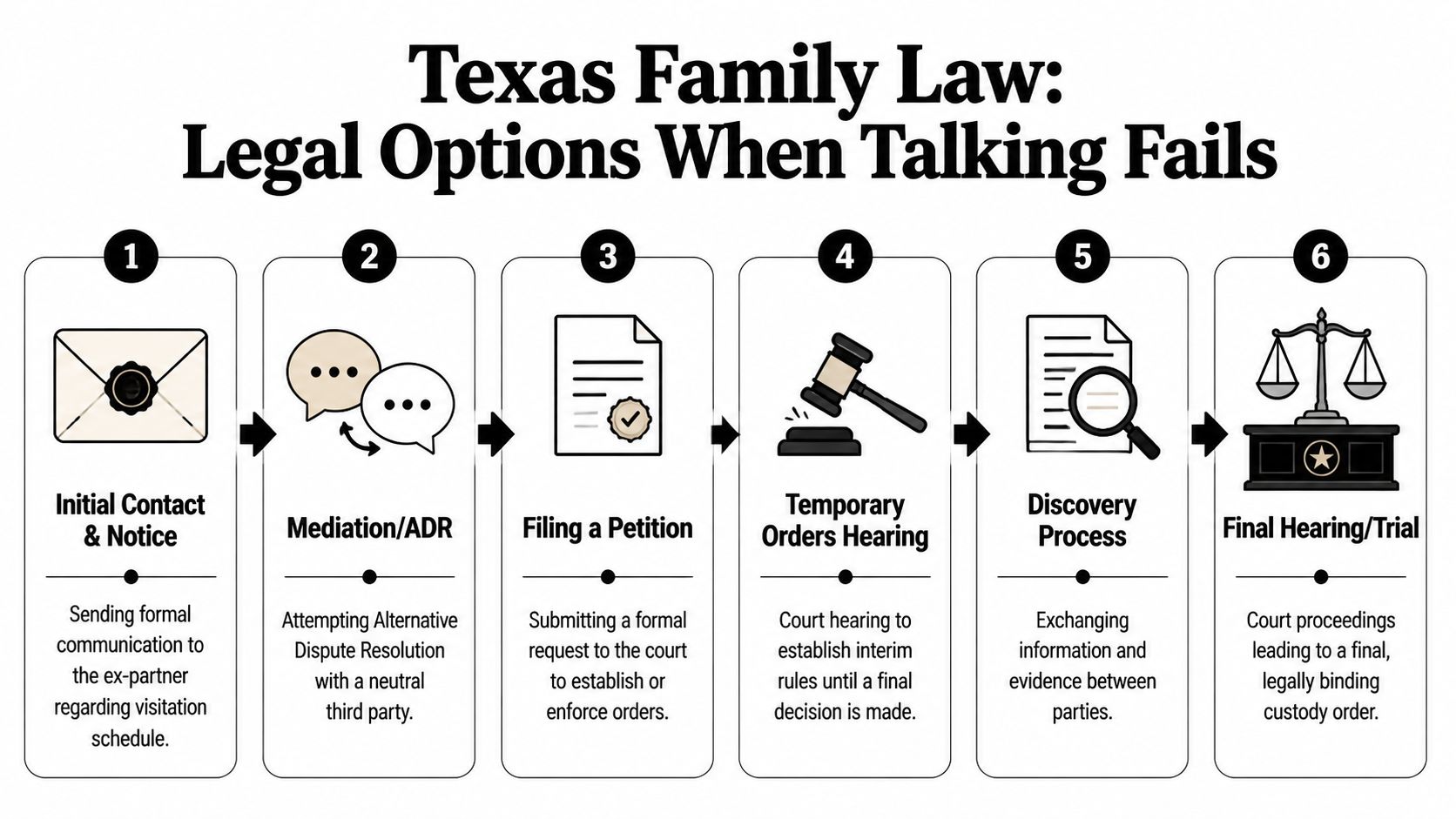
When Talking Fails Your Legal Options Under Texas Law
By the time you reach this point, stop trying to persuade your ex. Start building a case.
Texas courts do not respond well to vague complaints. They respond to dates, times, screenshots, missed exchange locations, and a court order that was clearly violated. The notes and messages you gathered in the first 72 hours matter here. They are often the difference between sounding upset and proving a violation.
The main tool is a Motion to Enforce Visitation. If you already have a signed order and the other parent is not following it, enforcement puts the issue in front of the judge and asks the court to act. Under Texas law, possession and child support are separate issues. Do not withhold support because you were denied time with your child. That move usually hurts you, not the other parent.
Motion to Enforce means the order must be specific
Judges enforce clear orders. They do not enforce loose understandings or fuzzy schedules.
That means your paperwork has to match the order line by line. If your possession order says pickup is Friday at 6:00 p.m. at a certain location, your proof should show that you appeared, were ready, and were denied. If your evidence is organized, the court can work with it. If it is a pile of angry texts and general complaints, the court has less to work with.
A useful enforcement file usually includes:
- The exact wording of the possession provision
- Each denied date and time
- Screenshots of texts, emails, and call logs
- Your incident log from the first 72 hours and after
- Photos, location history, or witness names if available
Contempt is possible, but precision matters
Contempt is the penalty side of enforcement. If the other parent willfully disobeyed a court order, the judge can impose consequences. Those can include fines, makeup time, and in some cases attorney's fees. In more serious situations, jail time can also be on the table.
That does not happen because you are frustrated. It happens because your evidence is clean, specific, and tied to the exact language of the order.
Modification may fit better than repeated enforcement
Some cases are not about one missed weekend. They are about a pattern. The other parent keeps blocking access, changing the rules, or creating conflict around every exchange. At some point, chasing one denial at a time stops making sense.
A modification asks the court to change the current order because the present setup is not working. Judges look at the child's best interest. A repeated pattern of denied visitation, interference, or refusal to cooperate can support a request to change possession terms, exchange terms, or other parts of the order.
Here is the practical rule. If the problem is a violation of a workable order, enforce it. If the problem is a continuing pattern that shows the order no longer functions in real life, ask whether modification is the smarter filing.
Emergency relief is a different category
Parents in Kingwood often use the word "emergency" when what they really mean is "I am furious and scared." Those feelings are real. They still do not create an emergency case by themselves.
Emergency relief is for situations involving immediate risk to the child, such as serious safety concerns, threats, abuse, neglect, or a real risk the child will be hidden or removed. If that is what is happening, read about when an emergency custody order may be appropriate in Kingwood. That process is different from ordinary visitation enforcement.
The right filing depends on your facts
Use this framework:
- One denial under a clear order: preserve proof and prepare for enforcement if the behavior continues.
- Several denials under a clear order: talk with a lawyer about filing a Motion to Enforce.
- A long pattern of interference: ask whether a modification would solve the bigger problem.
- Immediate danger to the child: treat it as a safety issue and move fast.
Do not pick the filing that sounds toughest. Pick the one your evidence supports. That is how parents regain control in court.
What if We Don't Have a Formal Custody Order
This is one of the hardest spots a parent can be in. You were never married, or you separated without going to court, and the schedule has always been informal. Then one day the other parent decides you’re not seeing the child.
At that point, parents often call the police and get an answer they hate. Without a court order, law enforcement generally can’t enforce a verbal agreement.

What the law actually requires
For parents without a formal custody order, police cannot enforce verbal agreements. The key step is establishing legal parentage and asking the court to issue orders through a Suit Affecting the Parent-Child Relationship, commonly called a SAPCR. Digital evidence like text messages and email timestamps showing a pattern of denied access can help show a judge why formal orders are needed for the child’s best interest, as explained in the Texas State Law Library guidance on visitation and custody denial.
What a SAPCR does
A SAPCR gives structure to a situation that currently has none. It can address:
- Legal parentage
- Conservatorship rights
- Possession and access schedule
- Child support
- Decision-making authority
If you’re an unmarried parent in Kingwood or Northeast Houston, this is usually the path out of limbo. Until a court signs orders, you are trying to solve a legal problem with an emotional agreement. That rarely holds when conflict rises.
Your evidence still matters
Parents often think, “If there’s no order, my screenshots don’t matter.” They do matter.
Your documentation can help show:
- You’ve been involved in the child’s life
- There was an established pattern of contact
- The other parent recently started cutting off access
- You acted reasonably and consistently
That evidence can shape temporary orders and final orders. It can also undercut a false story that you were absent or uninterested.
If there is no court order, stop arguing about what’s “fair” and start building what’s enforceable.
Starting from scratch does not mean starting empty
You may already have useful proof sitting in your phone:
- school pickup messages
- pediatric appointment texts
- photos tied to dates
- emails about daycare
- shared calendars
- missed-exchange messages
- payment records for child-related expenses
If your situation fits this category, read more about Texas custody laws for unmarried parents. That page can help you understand how Texas treats unmarried mothers and fathers when no formal order exists.
For many families in Humble and Porter, the first real breakthrough happens when they stop chasing compliance with a verbal deal and start seeking signed orders a judge can enforce.
The Court Process and Potential Outcomes
You filed. Your ex still has the child. The judge is not hearing your case tomorrow.
That gap is where a lot of parents make expensive mistakes. They stop documenting, send angry messages, skip a scheduled exchange because they assume it is pointless, or show up to court with a phone full of screenshots and no timeline. Do not do that. The first 72 hours of documentation you started earlier now become the backbone of your case. Keep building it in the same format, date by date, denial by denial, with calm messages and clean records.

What a hearing usually looks like
Texas family court is usually less dramatic than people expect. It is organized, fast-moving, and focused on proof.
The judge will want specifics. What date was possession supposed to start? Where was the exchange? What did you send? What did the other parent say or do? Did you appear at the pickup spot? Did you follow the order exactly? Your visitation log, screenshots, call records, emails, and testimony matter because they answer those questions in a clear sequence.
Organization wins points. A simple binder or folder with a one-page timeline, copies of messages, and each denied visit listed by date is far more persuasive than a long emotional story.
Common outcomes
Judges usually start by restoring order and making future violations harder.
Possible outcomes include:
- Makeup possession time for missed visits
- More specific exchange terms such as exact times, locations, or pickup procedures
- Attorney’s fees and court costs assessed against the parent who violated the order
- A clear warning from the court that continued interference can bring stronger penalties
- A modification case if the denial pattern is serious enough to show the current arrangement is not working
If the violations continue, the consequences can get heavier. Repeated interference can support stronger enforcement remedies and, in some cases, a request to change conservatorship or possession terms. Judges take patterns seriously, especially when one parent is clearly undermining the child’s relationship with the other.
A short video can also help you understand how these disputes play out in real life:
What judges want to see from you
A judge is watching your conduct as much as your complaint.
The parent who does well in court is usually the one who stayed steady before court. That means showing up for exchanges, following the written order, keeping support paid if support was ordered, and refusing to use the child as a messenger or bargaining chip. It also means your evidence is clean and your testimony is tight.
Bring facts, not speeches.
Judges want to see that you acted like a parent who wanted time with your child, not like someone trying to win an argument with an ex. If you give the court a clear timeline backed by records, you make it much easier for the judge to fix the problem.
Conclusion Take Back Your Rights with a Kingwood Advocate
If your ex won’t let you see your child in Kingwood, the answer is not panic and it’s not revenge. It’s documentation, discipline, and the right legal move at the right time.
Start with the first 72 hours. Save everything. Keep your messages calm. Don’t stop child support. Don’t drag your child into the conflict. If the denials continue, use the court process Texas provides. If there’s no order in place, stop relying on verbal promises and get enforceable orders.
Parents in Kingwood, Humble, Porter, and Northeast Houston deal with this every day. The parents who regain control are usually the ones who stop reacting and start building a case. That’s the shift you need to make now.
You don’t have to figure it out alone. A local family law attorney can review your timeline, your evidence, and your current order, then tell you the fastest realistic path forward.
If your ex is blocking access to your child, schedule a free consultation with Law Office of Bryan Fagan – Kingwood TX Lawyers. Our Kingwood office serves local families in Kingwood, Humble, Porter, and Northeast Houston, and we can help you understand your options under Texas law, organize your evidence, and take the next step toward protecting your relationship with your child.