Skip to content
A spouse can try to hide assets in a Texas divorce, but it isn't legally permissible and it often backfires. Texas requires sworn financial disclosure during divorce, and if concealment is uncovered, courts can reallocate property, impose sanctions, award attorney's fees, and a post-divorce case to recover hidden assets must be filed within two years of the final decree.
If you're in Kingwood, Humble, Porter, or Northeast Houston and your gut tells you something is off, pay attention to that instinct. Many people first notice hidden-asset problems at home, not in court. A spouse suddenly becomes secretive about money, mail starts disappearing, income no longer matches spending, or there's a new explanation for why accounts “just look different now.”
My advice is simple. Don't ignore the signs, don't confront the issue recklessly, and don't assume the truth will surface on its own. In a Texas divorce, the spouse who gets organized early usually has the stronger position.
Recognizing the Red Flags of Hidden Assets
Suspicion around money is one of the hardest parts of divorce. It can make you question your memory, your judgment, and even your right to ask basic questions about your own household finances. If you're searching for can my spouse hide assets in divorce Texas Kingwood, the answer is that people may try, but there are usually warning signs before the legal process exposes the problem.

Financial behavior that should put you on alert
Some red flags are obvious. Others look small until you see the pattern.
- Sudden cash activity: Large withdrawals, frequent ATM use, or odd transfers that don't fit your family's usual habits.
- Missing money from regular income: Deposits that used to hit a joint account stop appearing, or pay seems to be routed somewhere new.
- Strange debt stories: Your spouse suddenly claims there are loans, business losses, or obligations you never heard about before.
- Unusual repayments or gifts: Money goes to friends or relatives with no clear reason, especially during separation.
- New financial products: Accounts, apps, or investment tools show up out of nowhere.
A Texas family-law source notes that modern concealment isn't limited to secret bank accounts. Crypto, online payment apps, tokenized assets, and electronically routed income can also be used to hide value, while lawyers now use more advanced discovery tools to trace them through records and digital trails (digital asset concerns in Texas divorce).
Behavioral changes matter too
A spouse who's hiding assets often changes behavior before they change paperwork.
Practical rule: When secrecy increases at the same time divorce tension rises, treat it as a legal issue, not just a relationship problem.
Watch for things like these:
| Red flag | Why it matters |
|---|---|
| Refusing to discuss bills | People avoiding the truth often avoid details |
| Redirected mail | Statements, notices, or tax documents may be going elsewhere |
| New passwords or locked devices | Digital financial access may be narrowing on purpose |
| Business talk that stops making sense | Income may be delayed, reduced on paper, or moved |
| Travel or purchases that don't match reported money | Lifestyle can reveal undisclosed funds |
In Kingwood and Humble cases, I often tell people to focus less on proving fraud immediately and more on documenting inconsistencies. If your spouse says money is tight but keeps spending freely, that discrepancy matters. If income supposedly dropped but loan applications show a different story, that matters too.
Turn suspicion into a written list
Don't rely on memory. Start a running timeline.
Include:
- Dates of unusual transfers
- Names of people receiving money
- Changes in payroll or business deposits
- Photos or screenshots of visible account names
- Notes about major purchases, trips, or luxury spending
That list won't prove everything by itself, but it gives your attorney a starting map. And in a Kingwood divorce, a clear map is far more useful than a vague fear.
How to Preserve and Gather Financial Evidence Yourself
You don't need to be a forensic accountant to start protecting yourself. You do need to act carefully, stay legal, and gather what you can access now. The strongest early move is building a clean financial file before records disappear, accounts change, or stories get polished.

A Texas evidence-preservation framework starts with a complete financial data map, including 24 months of bank and card statements, the last 3–5 years of tax returns, brokerage and retirement statements, loan applications, pay stubs, business ledgers, and public-record searches for deeds, vehicle titles, and entity filings (Texas divorce evidence workflow).
Build your evidence kit at home
Start with documents you already lawfully have access to. Common places to look include filing cabinets, shared email folders, tax-prep folders, cloud drives, desk drawers, household safes, and joint online accounts.
Gather these first:
- Bank and credit card statements from all joint and known individual accounts.
- Tax returns with all schedules and attachments.
- Retirement and brokerage statements if available.
- Loan applications because people often overstate income on those.
- Pay stubs and compensation records including bonuses or commissions.
- Business documents if your spouse owns or controls a company.
- Property records such as deeds, titles, and entity filings.
If your spouse runs a company in Kingwood, Porter, or Northeast Houston, hidden assets may be mixed into business activity. For readers trying to understand how money can be disguised through books, reimbursements, or side transfers, this overview of fraud prevention for small businesses gives useful context on how financial irregularities are often identified.
Organize records so your lawyer can use them
Don't dump everything into one folder and hope for the best. Sort records in a way that makes patterns visible.
Try this basic structure:
- Income
- Pay stubs
- tax returns
- bonus records
- Banking
- checking
- savings
- transfers
- Debt
- credit cards
- personal loans
- business loans
- Property
- home
- vehicles
- investment accounts
- Business
- ledgers
- invoices
- entity documents
Save copies in a secure place your spouse can't alter, such as a private cloud account you control or a physical folder outside the home.
If you want a more focused breakdown of what lawyers look for, review this guide on finding hidden assets in a divorce.
What not to do
This part matters just as much as gathering documents.
- Don't hack accounts: Illegal access can damage your case.
- Don't guess at numbers: Mark something as suspicious, not proven.
- Don't alter records: Keep documents in original form whenever possible.
- Don't announce your strategy: Quiet preparation is usually smarter than confrontation.
- Don't rely only on initial disclosures: Those may be incomplete.
A careful, lawful financial snapshot gives your lawyer an advantage. It also gives you something just as important during a stressful divorce in Kingwood. Clarity.
Using Texas Law to Formally Uncover Hidden Property
Once you've preserved records, the next step is using formal legal tools. Through these tools, suspicion turns into proof. Texas divorce law gives your attorney real mechanisms to force disclosure, compare sworn statements against records, and trace money that was moved, undervalued, or omitted.
Early in that process, many people benefit from seeing how formal discovery works in plain English. This overview of discovery in divorce helps explain the structure behind these requests.
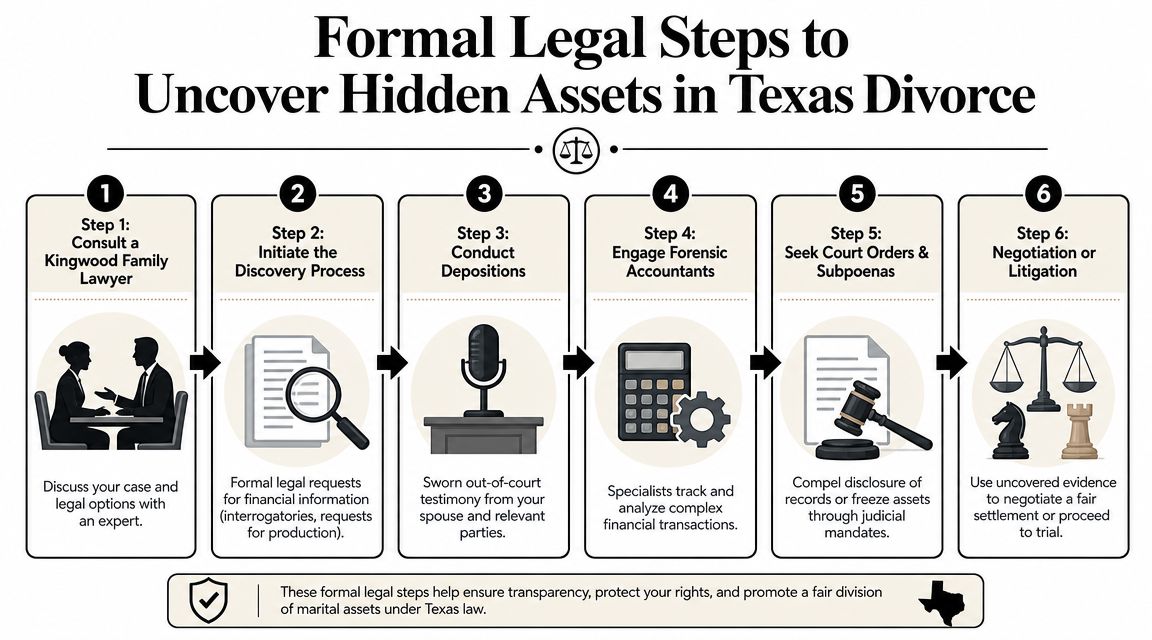
Texas requires full financial disclosure in divorce. Texas Family Code Section 6.711 requires each spouse to file an inventory and appraisement of assets and debts, under oath, and if a spouse deliberately hides assets, courts can award a disproportionate share to the innocent spouse to achieve a just and right division (Texas sworn disclosure requirement).
The discovery tools that do the real work
A lot of clients hear the word “discovery” and assume it's just paperwork. It isn't. It's how your lawyer boxes in a dishonest spouse.
Here's what those tools look like in practice:
| Legal tool | What it does |
|---|---|
| Interrogatories | Written questions your spouse must answer |
| Requests for Production | Demands for records such as statements, ledgers, and tax documents |
| Depositions | Sworn testimony taken outside the courtroom |
| Subpoenas | Orders requiring third parties like banks or employers to produce records |
| Motions to Compel | Requests asking the court to force compliance when someone stalls |
Each tool has a different purpose. Interrogatories test the spouse's story. Production requests test the paper trail. Depositions test credibility. Subpoenas test whether the third-party records match what your spouse claimed.
A local example of how this plays out
Take a common Porter-area scenario. One spouse says business income fell and there's less money available for division. But household spending didn't fall. Mortgage payments continue, travel continues, and there are unexplained transfers through payment apps.
A lawyer can respond by:
- requesting business ledgers and account statements,
- comparing tax returns to deposits,
- subpoenaing records from financial institutions,
- questioning the spouse under oath about missing funds,
- and using a forensic accountant if the books don't make sense.
That's how hidden-property cases are built. Not through drama. Through contradictions.
The strongest hidden-asset cases usually come from inconsistency. Reported income says one thing. Spending, transfers, and records say another.
For many families in Kingwood and Humble, the issue isn't a secret vault of cash. It's money being rerouted, delayed, disguised as debt, or buried in business records.
Why timing matters
The worst mistake is waiting until the eve of trial to ask for the hard records. By then, records may be harder to collect, and your legal team has less time to compare documents and push the court for enforcement.
That's one reason people often work with a local firm that regularly handles property disputes, including the Kingwood property division team. In a hidden-assets case, the value isn't just filing papers. It's knowing which records to demand first, which discrepancies matter most, and when to push for court intervention.
A useful overview can help too, especially if you want to hear this explained from another angle.
If you live in Northeast Houston and you're worried your spouse is manipulating finances, don't assume you need a smoking gun before you talk to a lawyer. You don't. You need enough facts to start formal discovery, then let the legal process do its job.
The Serious Consequences for a Spouse Who Hides Assets
A spouse who hides assets in a Texas divorce is making a bad gamble. Judges don't like deception, and they have wide discretion to fix the damage.
Texas courts have long treated dishonest asset concealment as a serious breach. A judge may award the concealed asset, or a larger share of the estate, to the innocent spouse, and because financial statements are signed under oath, false statements can also expose a spouse to perjury allegations in addition to family-law sanctions (Texas consequences for concealment).
What courts can do
When concealment affects a community-property division, the court isn't stuck giving an even split and moving on. Texas courts can reshape the result.
A judge can use the property division itself to correct financial deception.
Possible consequences include:
- Reallocation of property: The innocent spouse may receive a larger share of the marital estate.
- Award of the hidden asset: In some cases, the concealed property itself becomes part of the remedy.
- Attorney's fees: The court may require the dishonest spouse to pay fees caused by the concealment.
- Sanctions and enforcement: A spouse who ignores orders can face additional court consequences.
The legal concept many people hear in these cases is fraud on the community. In plain English, it means one spouse cheated the marital estate. Harris County and Montgomery County courts take that seriously because concealment distorts what the court is supposed to divide fairly.
Why dishonesty usually hurts the liar more than the other side
People hide assets because they think secrecy gives them an advantage. In reality, hidden money often becomes a credibility problem that infects the whole case. Once a judge believes one spouse lied about finances, every other claim gets harder to sell.
If you suspect your spouse dissipated or diverted marital property, this page on dissipation of assets can help you understand how waste and concealment fit into a larger property-division fight.
The practical lesson for Kingwood families is straightforward. Don't let threats or bluffs intimidate you. If your spouse is hiding assets, the law gives the court tools to make that strategy expensive.
When and How to Partner with a Kingwood Divorce Attorney
You can start the paper trail yourself. You usually can't finish the case yourself. Hidden-asset disputes are won through procedure, timing, and pressure.
If your spouse is evasive, self-employed, paid by commission, paid digitally, or moving money through relatives or a business, get legal help early. The sooner your attorney sends preservation demands and starts formal discovery, the harder it is for the other side to keep rewriting the story.
A local lawyer also matters for practical reasons. Kingwood, Humble, Porter, and Northeast Houston families need counsel who understands the courts, filing expectations, and how property issues get litigated in this area. The Law Office of Bryan Fagan – Kingwood TX Lawyers handles family-law matters including divorce and property division, which is directly relevant when a spouse may be concealing assets.
Here's when you should stop researching and schedule a consultation:
- You've seen unexplained transfers or cash withdrawals
- Your spouse controls the business records
- Income claims don't match spending
- You found signs of hidden digital assets or payment apps
- You're worried records may disappear
Don't wait for certainty. In these cases, delay helps the spouse controlling the money.
If you're ready to talk through your options, contact the Kingwood office or review the firm's Kingwood divorce attorney services to take the next step. A confidential consultation can help you figure out what's suspicious, what's provable, and what to do next.
Frequently Asked Questions About Hidden Assets in Texas
Hidden-asset cases create a lot of urgent questions, especially when you're trying to make decisions fast. These are the ones I hear most often from people in Kingwood, Humble, and nearby Northeast Houston communities.

What if I find hidden assets after the divorce is final
You may still have a remedy, but you need to move quickly. A Texas source states that a case to recover hidden assets after divorce must be filed within two years of the final divorce decree, which creates a strict deadline many people miss (Texas post-divorce hidden asset deadline).
That deadline is a big deal. If you discover the problem after the decree, don't spend months debating whether it's worth pursuing. Get legal advice right away.
Can my spouse hide money in a business or cryptocurrency
They can try. Business records, delayed compensation, electronic payment platforms, and digital assets can all be used to make money harder to spot. That doesn't mean the money is beyond reach.
The key is tracing patterns, not chasing rumors. If business deposits don't match reported income, if spending stays high while income supposedly falls, or if digital transactions are appearing outside normal household accounts, those issues can be investigated through discovery and forensic review.
What is a forensic accountant and do I need one
A forensic accountant is a financial specialist who reviews records for hidden income, diverted money, suspicious transfers, and inconsistencies between reported earnings and actual spending. In a simple divorce, you may not need one. In a case involving a business, commission income, cash-heavy work, or complicated digital transactions, they can be extremely useful.
They don't replace your attorney. They support your attorney by making the financial picture clearer.
Can I recover attorney's fees if my spouse hid assets
Texas courts can order financial remedies when a spouse conceals property, and attorney's fees may be part of that relief depending on the facts and the court's orders. If your legal fees increased because your spouse played games with disclosure, raise that issue early with your lawyer and document exactly how the concealment expanded the fight.
What should I do today if I'm worried about hidden assets
Start with a calm checklist:
- Collect lawfully available records
- Write down suspicious dates and transactions
- Preserve digital and paper documents
- Avoid illegal access to private accounts
- Schedule a consultation before records disappear
You don't need more internet articles. You need a plan. If your spouse may be hiding assets in a divorce, a timely legal review can protect your share of the estate and stop a bad situation from getting worse.
If you're dealing with divorce and financial secrecy in Kingwood, Humble, Porter, or Northeast Houston, schedule a free consultation with Law Office of Bryan Fagan – Kingwood TX Lawyers. You'll get clear guidance on your rights, the records to preserve, and the legal steps available to uncover hidden property before it's too late.